• Home
  • Latest
  • Fortune 500
  • Finance
  • Tech
  • Leadership
  • Lifestyle
  • Rankings
  • Multimedia
Inflation
Europe

Friends don’t slap tariffs on friends. Here are the strategies that will ensure the U.S. wins the race for chips and tech supremacy, according to the Consumer Technology Association

By
Gary Shapiro
Gary Shapiro
Down Arrow Button Icon
By
Gary Shapiro
Gary Shapiro
Down Arrow Button Icon
December 16, 2022, 8:59 AM ET
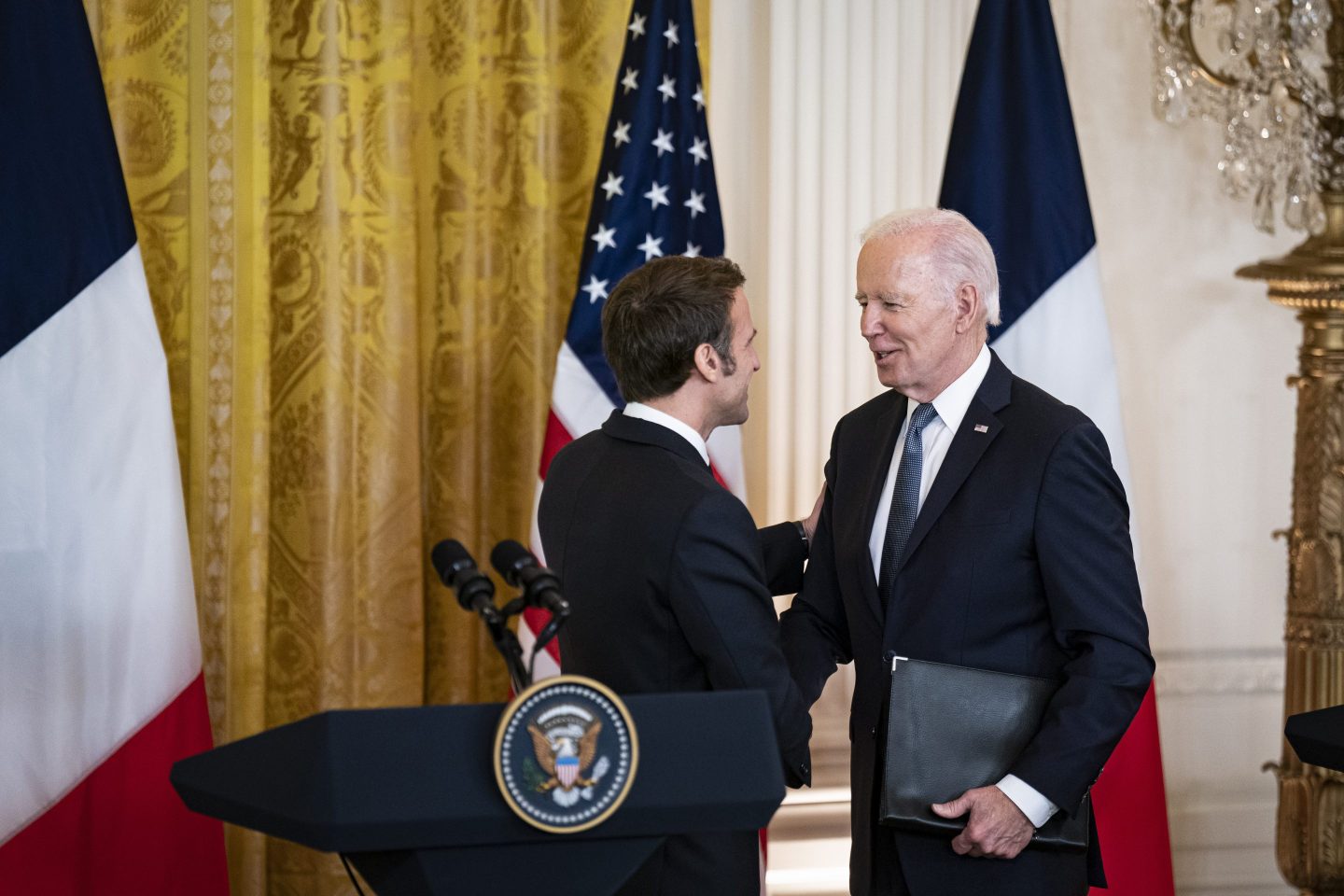
President Joe Biden shakes hands with French President Emmanuel Macron during a state visit  on Dec. 1, setting aside recent tensions with Paris over defense and trade issues to celebrate the oldest U.S. alliance.
President Joe Biden shakes hands with French President Emmanuel Macron during a state visit on Dec. 1, setting aside recent tensions with Paris over defense and trade issues to celebrate the oldest U.S. alliance. Al Drago—Bloomberg/Getty Images

Over a decade ago, I described the competition we’re seeing today from China and urged an American counterstrategy focused on our unique strength in creativity and innovation in my best-selling book, The Comeback.

My premise was correct. China has emerged as an economic behemoth, investing strategically in new technologies and cornering the market on many vital materials, components, and finished products, while expanding its global influence.

China’s COVID policies, coupled with a recent crackdown on some of China’s most successful tech companies, give the U.S. a window to recalibrate our national strategy. By rising to meet the challenge now, we can ensure American democracy thrives. In short, if we do it right, our children and grandchildren will enjoy the same freedoms we enjoy today.

While Congress and the Biden Administration have chosen to invest in certain key technologies to compete with China, this cannot be our only strategy. Our trade and tech policy must recognize that our allies, including friendly democracies like Japan, Canada, Australia, New Zealand, and South Korea, also value these freedoms.

We must strengthen our relationship with our allies by reducing barriers to trade and investment.

Five years ago, the U.S. initiated multiple trade wars, fueling inflation and shifting production to new locations, many of which do not have free trade agreements with the U.S.

American leaders from both parties treat trade as a zero-sum battle and trade policy as a vehicle for scoring political points at home and abroad. Our isolationist approach to trade is moving in a more dangerous direction–making what should be a team effort with our friends a go-it-alone “Hunger Games” strategy.

Isolationist policies aren’t just a drag on American businesses and consumers. They are creating friction with some of our most important allies. The EU, Japan, and South Korea have expressed concern about “discriminatory elements” in President Biden’s signature Inflation Reduction Act (IRA), signed into law in August. The IRA offers tax breaks for electric vehicles and sustainable energy equipment produced in North America but makes no similar allowances for other U.S. trading partners. Those provisions could even violate World Trade Organization rules. They make no sense: We can’t exclude key trading partners from a growing U.S. market like electric vehicles and in the same breath talk about the values and principles that inform our trade relationships!

Our approach to tariffs can be compared to the Smoot-Hawley tariffs that got us into the Great Depression almost a century ago. You don’t need an economics degree to recognize that tariffs aren’t paid by foreign countries, whether they’re friends or foes. They’re taxes paid by American businesses–and ultimately consumers.

Since 2018, tariffs have cost U.S. tech companies over $32 billion and stalled growth in production and jobs. “Make in America” and “Buy America” requirements may sound good in theory–but the reality is that higher tariffs and less competition result in higher inflation. This means more expensive and even lower quality goods and services for American families, businesses, and our federal and state governments. Even eliminating the China tariffs would help us more than it would China by dramatically lowering U.S. inflation and cutting our Consumer Price Index by 1.3 percentage points in the medium and long term.

As a nation, our economy was built on strong and mutually beneficial trade relationships that encourage innovation and lower costs for businesses and consumers. We host regular summits with our trade partners to align on trade policy and–at least in theory–avoid unfair or unilateral trade practices. But too often, we haven’t lived up to our principles and imposed tariffs on U.S. allies. Instead, our politicians should understand that our common belief with our allies in liberty for our citizens and market economies for our businesses drives our shared desire for free trade and investment.

We can and should be using trade policy tools to advance our shared global objectives. To help Ukraine in the face of Russia’s unprovoked invasion, the EU suspended all tariffs on imports from Ukraine for one year. The U.S. took a small step in the same direction, suspending tariffs on Ukrainian steel–but our administration can offer additional support through open trade with Ukraine. By reducing trade barriers between the U.S. and its allies, we can help advance new technologies to make the world a better place–from combating climate change to making our societies healthier. 

And when countries undermine free and fair trade through intellectual property theft or forced technology transfers, we can work with allies to impose consequences. For example, the U.S. has been working with the EU and Japan for several years on new rules to address China’s anti-competitive trade practices. The U.S. and its allies are also working to align their controls on exports of critical technologies to our adversaries.

Partnerships between the U.S. and our allies are built on trust. When our political leaders impose tariffs on allies or play favorites with domestic companies, we send the wrong signal: that our relationships and trade agreements are no more than talk and tattered paper.

The Biden Administration must instead send the right signal to the world by working with our allies to strengthen the rules-based international trading system, remove trade barriers, and negotiate more trade agreements.

 Gary Shapiro is president and CEO of the Consumer Technology Association (CTA), the U.S. trade association representing more than 1,500 consumer technology companies, and a New York Times bestselling author. He is the author of the book Ninja Future: Secrets to Success in the New World of Innovation. His views are his own. 

The opinions expressed in Fortune.com commentary pieces are solely the views of their authors and do not necessarily reflect the opinions and beliefs of Fortune.

More must-read commentary published by Fortune:

  • Will the U.S. and Europe slide into recession in 2023? Here’s how to look out when economic outlooks don’t
  • Biden crowned world energy czar as diplomacy triumphs over Putin’s tantrums
  • Are you wagering money on the World Cup? Sports betting is taking America by storm–and a third of young men are hooked
  • Could Kanye West be placed under Kim Kardashian’s conservatorship?

Our new weekly Impact Report newsletter examines how ESG news and trends are shaping the roles and responsibilities of today's executives. Subscribe here.

About the Author
By Gary Shapiro
See full bioRight Arrow Button Icon

Latest in

Finance
Lorem ipsum dolor sit amet, consectetur adipiscing elit, sed do eiusmod tempor incididunt ut labore et dolore magna aliqua. Ut enim ad minim veniam
By Fortune Editors
October 20, 2025
Finance
Lorem ipsum dolor sit amet, consectetur adipiscing elit, sed do eiusmod tempor incididunt ut labore et dolore magna aliqua. Ut enim ad minim veniam
By Fortune Editors
October 20, 2025
Finance
Lorem ipsum dolor sit amet, consectetur adipiscing elit, sed do eiusmod tempor incididunt ut labore et dolore magna aliqua. Ut enim ad minim veniam
By Fortune Editors
October 20, 2025
Finance
Lorem ipsum dolor sit amet, consectetur adipiscing elit, sed do eiusmod tempor incididunt ut labore et dolore magna aliqua. Ut enim ad minim veniam
By Fortune Editors
October 20, 2025
Finance
Lorem ipsum dolor sit amet, consectetur adipiscing elit, sed do eiusmod tempor incididunt ut labore et dolore magna aliqua. Ut enim ad minim veniam
By Fortune Editors
October 20, 2025
Finance
Lorem ipsum dolor sit amet, consectetur adipiscing elit, sed do eiusmod tempor incididunt ut labore et dolore magna aliqua. Ut enim ad minim veniam
By Fortune Editors
October 20, 2025

Most Popular

Finance
Lorem ipsum dolor sit amet, consectetur adipiscing elit, sed do eiusmod tempor incididunt ut labore et dolore magna aliqua. Ut enim ad minim veniam
By Fortune Editors
October 20, 2025
Finance
Lorem ipsum dolor sit amet, consectetur adipiscing elit, sed do eiusmod tempor incididunt ut labore et dolore magna aliqua. Ut enim ad minim veniam
By Fortune Editors
October 20, 2025
Finance
Lorem ipsum dolor sit amet, consectetur adipiscing elit, sed do eiusmod tempor incididunt ut labore et dolore magna aliqua. Ut enim ad minim veniam
By Fortune Editors
October 20, 2025
Finance
Lorem ipsum dolor sit amet, consectetur adipiscing elit, sed do eiusmod tempor incididunt ut labore et dolore magna aliqua. Ut enim ad minim veniam
By Fortune Editors
October 20, 2025
Finance
Lorem ipsum dolor sit amet, consectetur adipiscing elit, sed do eiusmod tempor incididunt ut labore et dolore magna aliqua. Ut enim ad minim veniam
By Fortune Editors
October 20, 2025
Finance
Lorem ipsum dolor sit amet, consectetur adipiscing elit, sed do eiusmod tempor incididunt ut labore et dolore magna aliqua. Ut enim ad minim veniam
By Fortune Editors
October 20, 2025
Fortune Secondary Logo
Rankings
  • 100 Best Companies
  • Fortune 500
  • Global 500
  • Fortune 500 Europe
  • Most Powerful Women
  • Future 50
  • World’s Most Admired Companies
  • See All Rankings
Sections
  • Finance
  • Fortune Crypto
  • Features
  • Leadership
  • Health
  • Commentary
  • Success
  • Retail
  • Mpw
  • Tech
  • Lifestyle
  • CEO Initiative
  • Asia
  • Politics
  • Conferences
  • Europe
  • Newsletters
  • Personal Finance
  • Environment
  • Magazine
  • Education
Customer Support
  • Frequently Asked Questions
  • Customer Service Portal
  • Privacy Policy
  • Terms Of Use
  • Single Issues For Purchase
  • International Print
Commercial Services
  • Advertising
  • Fortune Brand Studio
  • Fortune Analytics
  • Fortune Conferences
  • Business Development
  • Group Subscriptions
About Us
  • About Us
  • Editorial Calendar
  • Press Center
  • Work At Fortune
  • Diversity And Inclusion
  • Terms And Conditions
  • Site Map
Fortune Secondary Logo
  • About Us
  • Editorial Calendar
  • Press Center
  • Work At Fortune
  • Diversity And Inclusion
  • Terms And Conditions
  • Site Map
  • Facebook icon
  • Twitter icon
  • LinkedIn icon
  • Instagram icon
  • Pinterest icon

Latest in

EnergyOil
The Strait of Hormuz is a critical choke point for global energy markets, but there are ways to get around it
By Jason MaMarch 2, 2026
3 hours ago
trump
Economynational debt
Interest on the $38.8 trillion national debt has tripled since 2020, and it already costs taxpayers more than defense and Medicaid
By Nick LichtenbergMarch 2, 2026
4 hours ago
trump
Middle EastMiddle East
Trump’s strikes on Iran could cost American economy as much as $210 billion, top budget expert says
By Nick LichtenbergMarch 2, 2026
4 hours ago
OpenAI logo is seen in this photo illustration with the South Korean flag in the background
AIOpenAI
‘Could it kill someone?’ A Seoul woman allegedly used ChatGPT to carry out two murders in South Korean motels
By Catherina GioinoMarch 2, 2026
4 hours ago
Commercial vessels in the Persian Gulf
EnergyIran
Energy markets offer ‘relatively small reaction’ to Iran war, but prices could spike if oil and gas aren’t flowing by the end of the week
By Jordan BlumMarch 2, 2026
4 hours ago
A woman stands with her hand on her hip as she pumps gas into her car.
EnergyOil
Oil markets are bracing for $100 barrels and a redux of a 1970s-era crisis but ‘three times the scale,’ analyst warns
By Sasha RogelbergMarch 2, 2026
4 hours ago

Most Popular

placeholder alt text
Middle East
U.S. military gives Iran a taste of its own medicine with cheap copycat Shahed drones, while concern shifts to munitions supply in extended conflict
By Jason MaMarch 1, 2026
1 day ago
placeholder alt text
Success
MacKenzie Scott's close relationship with Toni Morrison long before Amazon put Scott on the path to give more than $1 billion to HBCUs
By Sasha RogelbergMarch 1, 2026
1 day ago
placeholder alt text
Economy
Your grandparents are the reason the U.S. isn't in a recession right now. That won't last forever
By Eleanor PringleMarch 1, 2026
2 days ago
placeholder alt text
AI
American schools weren’t broken until Silicon Valley used a lie to convince them they were—now reading and math scores are plummeting
By Sasha RogelbergMarch 1, 2026
1 day ago
placeholder alt text
Health
Gen Z men are eating ‘boy kibble,’ the human equivalent to dog food, to load up on protein cheaply
By Jake AngeloMarch 1, 2026
2 days ago
placeholder alt text
Success
Slack cofounder says workers and CEOs can get stuck doing 'fake' work like pre-meetings and slideshows
By Emma BurleighMarch 1, 2026
1 day ago

© 2026 Fortune Media IP Limited. All Rights Reserved. Use of this site constitutes acceptance of our Terms of Use and Privacy Policy | CA Notice at Collection and Privacy Notice | Do Not Sell/Share My Personal Information
FORTUNE is a trademark of Fortune Media IP Limited, registered in the U.S. and other countries. FORTUNE may receive compensation for some links to products and services on this website. Offers may be subject to change without notice.