To the surprise of nobody (except maybe the delusional mophead himself), Sam Bankman-Fried is in custody on numerous criminal charges and facing a lawsuit from the Securities and Exchange Commission. The fine folks at Fortune Crypto are on the case, and you can follow the latest developments here.
In the meantime, let’s take one last look at generative A.I.—and in particular, Big Tech’s absence from the craze—before the year comes to a close. (An early reminder: Our last Data Sheet of 2022 will be published on Friday, and we’ll return on Jan. 4.)
When the tech history books are written on 2022, generative A.I. will occupy an early chapter in the tome.
First came the emergence of text-to-image generators DALL-E 2 and Stable Diffusion, opening our eyes to the possibilities of consumer-facing A.I. Then came the arrival of ChatGPT, a stunningly intelligent and creative chatbot. Finally, the A.I.-powered photo and video editor Lensa burst onto the scene, with TechCrunch reporting Monday that it’s currently the world’s most-downloaded app.
The technology alone is remarkable enough. But one of the underappreciated parts of generative A.I.’s coming-out party has been its hosts.
Despite billions of dollars at their disposal, the tech industry’s biggest behemoths have essentially ceded the early buzz over generative A.I. to companies barely known outside of Silicon Valley.
DALL-E and ChatGPT are the products of OpenAI, a six-year-old research lab-slash-startup (admittedly, one bankrolled with more than $2 billion by Microsoft and a roster of tech luminaries). Stability AI, which provided computing power for and led the public rollout of Stable Diffusion, just raised its first $100 million funding round. And Lensa creator Prisma Labs has only announced a single funding round, totaling $6 million in 2019, per Crunchbase.
The relative anonymity of these companies raises the question: Did Big Tech, weighed down by its bloat and complacency, miss the generative A.I. bash?
Well, not exactly. Compared to the scrappy startups nipping at their heels, tech industry giants face a more complex calculus when rolling out novel technology.
Take, for example, Alphabet. The Google parent has shoveled countless dollars into developing LaMDA, a large language model akin to ChatGPT, yet company officials haven’t released their chatbot to the public yet.
In many ways, this approach is understandable. Alphabet, already a known commodity, doesn’t benefit from buzz in the same way as OpenAI. Rather, its priorities are financial, which means integrating A.I. technology into its existing products—a process that could take years to complete—and doing so in a way that maintains consumer trust in the company.
“How Google missed this moment is not a simple matter of a blind spot,” Alex Kantrowitz, author of the Big Technology newsletter, wrote last week after speaking with an early LaMDA product manager. “It’s a case of an incumbent being so careful about its business, reputation, and customer relationships that it refused to release similar, more powerful tech.”
In a similar vein, major tech companies arrive at the generative A.I. scene carrying much more baggage than upstarts, putting added pressure on them to deliver safe and effective products. While users have marveled at the magic of image generators and chatbots, they’ve also spotted major problems with the technology. The issues range from proliferation of false information, to the creation of deepfake videos, to potential violations of artist copyrights.
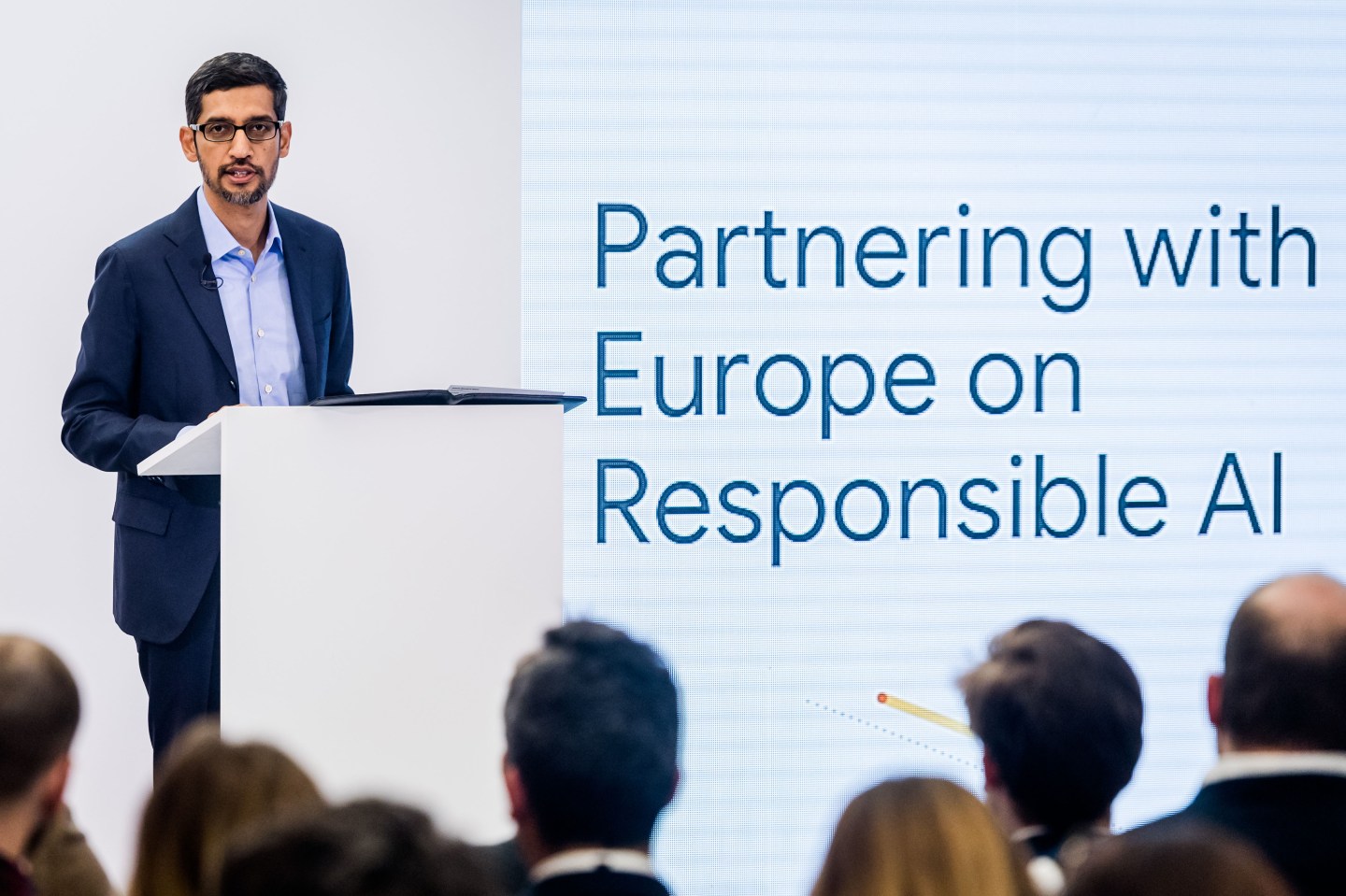
Google senior vice president James Manyika spoke of these considerations in a discussion with Fortune CEO Alan Murray last week at the Brainstorm A.I. conference in San Francisco: “Google has been extraordinarily thoughtful about not rushing to throw these things out into the world without actually doing proper research and fully understanding what these technologies are capable of.”
It’s a lesson that Meta, hardly a paragon of public trust, learned the hard way earlier this year.
The Facebook parent made a terrible first impression this summer when it debuted Blenderbot, the company’s new A.I. chatbot. The product looks rather rinky-dink compared to ChatGPT, and users immediately prodded it into spewing racist comments and conspiracy theories. While Meta could eventually take the lead in generative A.I., company executives did the firm no favors by releasing something as underwhelming as Blenderbot.
Fair questions can be asked about whether some larger tech outfits would have benefited from getting farther ahead of the generative A.I. curve. Lensa’s ascendance, for example, sure feels like a missed opportunity for Snap, which has seen its stock price plummet 80% this year.
But as we head into 2023 and beyond, most members of Big Tech will benefit more from arriving at the generative A.I. party fashionably late, rather than getting there first.
Want to send thoughts or suggestions to Data Sheet? Drop me a line here.
Jacob Carpenter
NEWSWORTHY
Chapped about chips. Chinese government leaders confirmed Tuesday that they have filed a trade dispute complaint with the World Trade Organization over punishing new U.S. export controls on semiconductors, the Register reported. Chinese officials argued the restrictions, which include a ban on global exports of advanced chips made with U.S. manufacturing technology, violate international trade rules. In the meantime, China’s government is putting together a chip subsidies package for its domestic manufacturers that could approach $150 billion over five years, Reuters reported Tuesday.
Services no longer wanted. Twitter has disbanded its Trust and Safety Council, determining that the body of independent advisors is “not the best structure” for receiving outside advice on matters related to the platform, the Associated Press reported Monday. The decision adds to mounting questions about new owner Elon Musk’s approach to content moderation on Twitter since his takeover of the company in October. About 100 people served on the advisory board, which provided recommendations about limiting hate speech, child sexual abuse material, and other inappropriate content.
A last-ditch operation. Microsoft’s efforts to earn regulators’ support for its Activision Blizzard acquisition included offering to make the Call of Duty franchise available on rival Sony’s subscription gaming service, Bloomberg reported Monday, citing a source familiar with the matter. The disclosure provides more context to Microsoft’s bid to appease regulators like the Federal Trade Commission, which sued in administrative court last week to stop the $68.7 billion purchase of the video game developer. PlayStation parent Sony has rejected the Xbox parent’s offers related to Call of Duty, arguing the acquisition will harm competition in the gaming industry.
Posting a quality quarter. Oracle topped analysts’ revenue and earnings estimates for the fiscal second quarter, buoyed by the strength of its cloud business, CNBC reported Monday. The software company totaled $12.3 billion in quarterly revenue, up 18% year-over-year and beating forecasts of $12.1 billion, with earnings of $1.21 per share, 3 cents better than projected. Oracle shares slipped 1% in mid-day trading Tuesday, largely due to a weaker-than-expected outlook for the current quarter.
FOOD FOR THOUGHT
Money can buy privacy. If you haven’t heard much about Sergey Brin and Larry Page in the past few years, that’s just the way they like it. A new Insider report shows the Google co-founders, who left the company together in 2019, have taken great pains to protect their privacy in recent years, shielding much of their business dealings and family affairs from the public. Page has been particularly reclusive, spending much of the pandemic on his private Fijian island and emerging only sporadically to oversee his post-Google businesses in person. Brin hasn’t shunned the spotlight quite as much, though he’s also worked to keep his business interests quiet while tackling charitable and entrepreneurial endeavors.
From the article:
A look inside their worlds reveals two strikingly different empires, each stamped by the interests and inclinations of the man who oversees it. Brin is an inquisitive philanthropist pursuing intellectual curiosities and humanitarian-minded projects; Page has leveraged his vast wealth to retreat from the public eye, ceding day-to-day oversight of his ventures to a small circle of trusted lieutenants.
But at their core, the former partners — who still retain control of Alphabet, the $1.2 trillion parent company of Google — share a single overriding similarity: Both rely on a tangled web of corporate entities and family offices that serve to minimize their tax obligations, protect them from liability, and shield their wealth from public view.
IN CASE YOU MISSED IT
Big tech is laying off workers. The growing ‘green collar’ job industry hopes to recruit them, by Abigail Bassett
US scientists just announced a major nuclear fusion breakthrough that could be ‘one of the most impressive scientific feats of the 21st century’, by Tristan Bove
The miserable end of SBF and what comes next, by Jeff John Roberts
How partners at Google parent Alphabet’s growth fund CapitalG are tackling the downturn, by Anne Sraders and Jessica Mathews
Twitter resumes selling blue check marks to users after the previous try devolved into chaos, by Kurt Wagner and Bloomberg
MrBeast is taking over a corner of Fortnite for a $1 million pop-up game challenge giveaway, by Alice Hearing
The secret ingredient for Artemis I’s success: How small businesses are taking us to the moon, by Frank Slazer
BEFORE YOU GO
A master plan. The modern-day version of back catalogs is proving surprisingly lucrative for popular YouTube personalities. The Wall Street Journal reported Tuesday that two companies, Spotter and Jellysmack parent Keli Network, are throwing hundreds of millions of dollars at YouTubers to secure the rights to old videos. The dueling firms, which Fortune's Alexandra Sternlicht wrote about in October, aim to profit off ad revenues from the YouTube catalogs, particularly as certain digital celebrities gain larger online followings and spur interest in older videos. For some YouTubers, the immediate cash infusion helps them grow their business and provides financial security amid the fast-changing creator economy. Spotter and Jellysmack, both of which received investments from SoftBank’s Vision Fund, said they expect to spend at least $1.5 billion on content library agreements.
Editor's note: This article has been updated to correct Stability AI's role in the production of Stable Diffusion.
This is the web version of Data Sheet, a daily newsletter on the business of tech. Sign up to get it delivered free to your inbox.