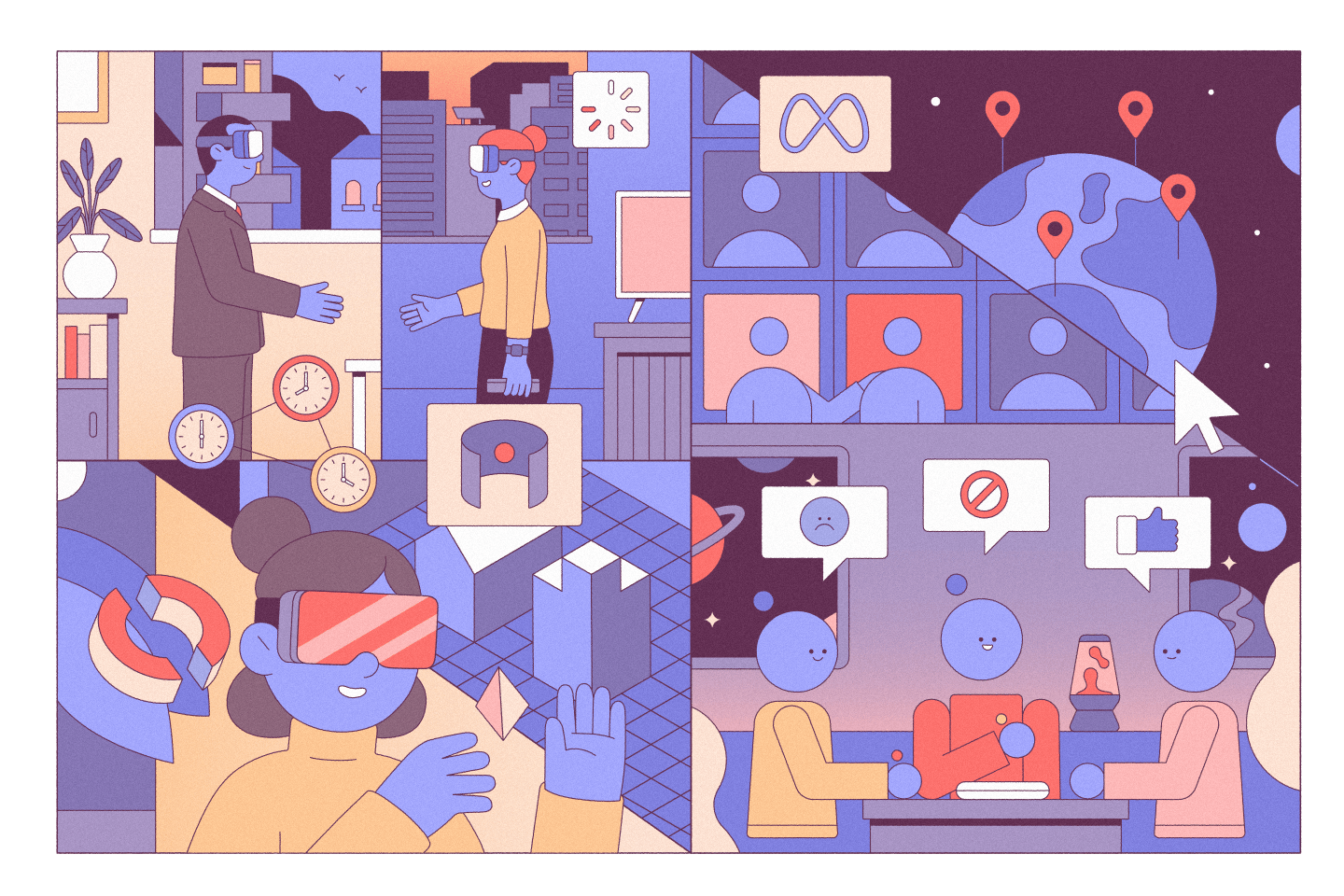
If you’re like me—and millions of others who live within commuting distance of their desk jobs—one of your first waking thoughts on weekdays is a deceptively simple question: “Should I go in?”
The eternal query leads to more questions about the weather, your dog walker’s availability, deadlines, free meals, and, most important, who else will schlep into the office. Might you see work friends? Are there meetings you should attend in person? Will those meetings be moved to a tedious half-online, half-in-person format, anyway?
Now, proponents of the metaverse—a web of shared, immersive virtual spaces—argue that VR can almost eliminate this daily decision tree ritual, making it unnecessary for people to choose between in-person and online communication. The technology has already proved to be an effective training tool for companies like Hilton, Walmart, and BMW, with studies showing that people learn and retain more when they engage with virtual reality. But Mark Zuckerberg, CEO of Meta, and others envision far more day-to-day office work moving into the metaverse. Augmented reality, they say, offers the ideal blend of real-world presence and remote-work autonomy.
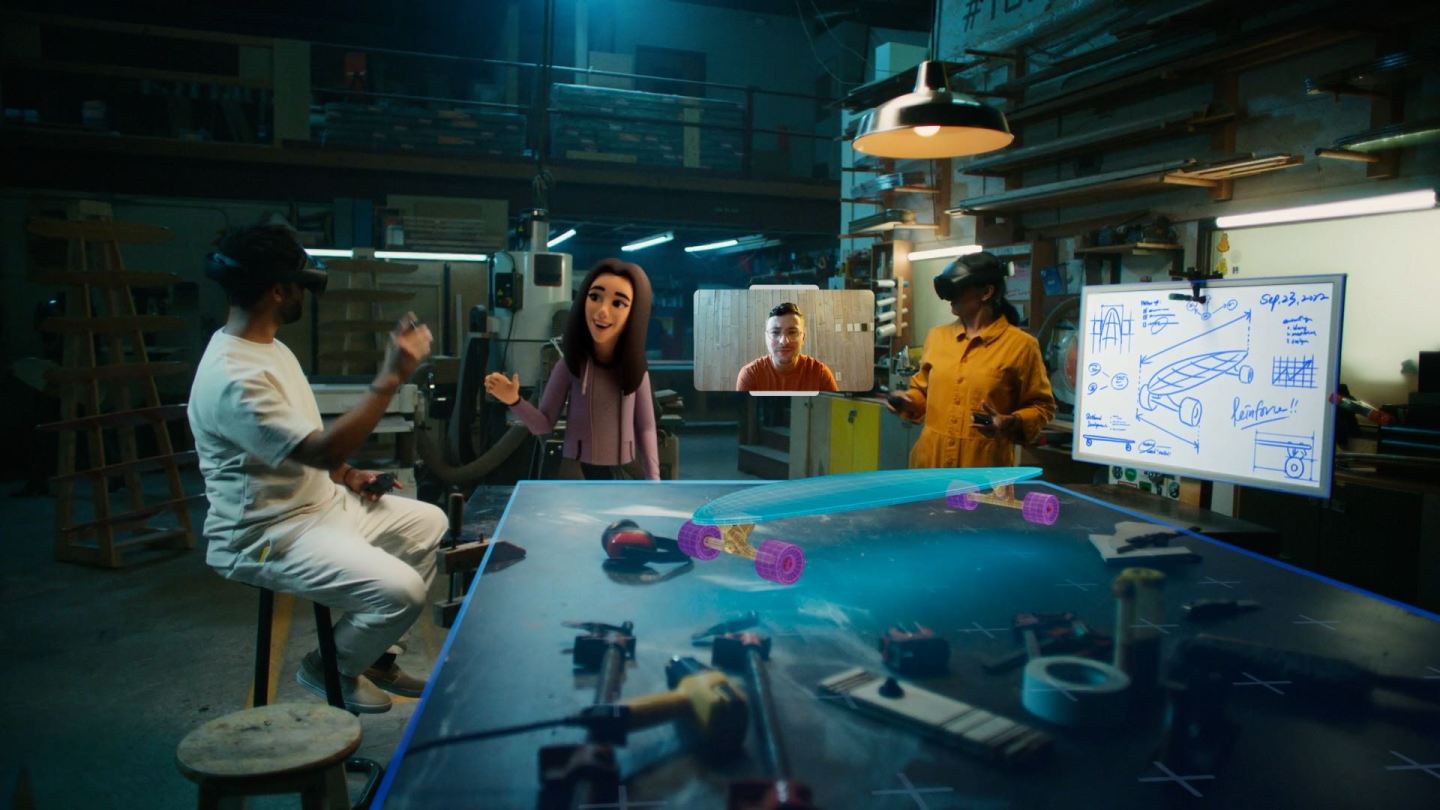
Zuckerberg controversially insists that software like his Horizon Workrooms, in which people appear to one another as avatars without legs, can make geographic location irrelevant. In a new partnership with Microsoft, Meta is now pushing into mixed-reality work, promising a future where in-the-flesh employees will meet with holograms and avatars and handle real and virtual objects. That Meta has laid off 11,000 people and seen its stock price plunge because its metaverse gamble has so far failed has not deterred the CEO’s mission to dominate a still-nascent industry. Many suspect that his focus on the enterprise is part of a longer-term plan to get more people used to the technology. Convincing companies that the metaverse will change work is one way to ensure that millions of non-gamers have no choice but to engage with VR and AR.
Still, Meta and Microsoft aren’t the only companies that see the metaverse reshaping work. Experts who spoke to Fortune are also enthusiastic about the VR workplace. At a time when leaders fear that a lack of shared office time will eventually cause workers to disengage, lose productivity, and, worse, become less inventive, the metaverse could play a role in shoring up connectedness, they say.
But these advocates also list several caveats.
Keep expectations low; the tech is evolving
As much as Zuckerberg may want to give people the impression that today’s metaverse office is set up for hours of virtual work, most other technologists say we’re years away from that.
Sandy Carter, a longtime tech executive, is in this camp. She heads up partnerships for Unstoppable Domains, a startup that allows people to buy their Web3 domain name to maintain a single identity as their avatars float through online universes. She’s literally banking on the metaverse gaining far more traction and points to successes like Paris Hilton’s virtual New Year’s Eve party, which reportedly drew more attendees than New York’s Times Square event last year, as a sign that it will.
But Carter, an adjunct professor at Carnegie Mellon University and chair of the nonprofit Girls in Tech, is a realist. She doesn’t pretend virtual professional spaces are ready to replace physical conference rooms or Zoom calls. In fact, she says the only people spending much time toiling or brainstorming in the metaverse are those developing products for it, like game or workplace app developers and consulting companies. And even for the VR-savvy, it doesn’t sound fun. Meta’s employees have reportedly resisted using the product their CEO has spent billions developing, despite his claims that Meta’s teams regularly meet in Workrooms. The problem is that virtual work is still too awkward to navigate, says Carter.
Case in point: When she hosted a discussion in the Decentraland metaverse last year, one panelist, a professor from Carnegie Mellon, found himself unable to get his avatar off the ceiling, so he hovered there the entire lecture. At another event, several avatars were stuck outside the digital building because they couldn’t figure out how to open the doors. Those doors were eventually deleted. “It has to be easier for us all to operate, or interoperate, in that world,” Carter says.
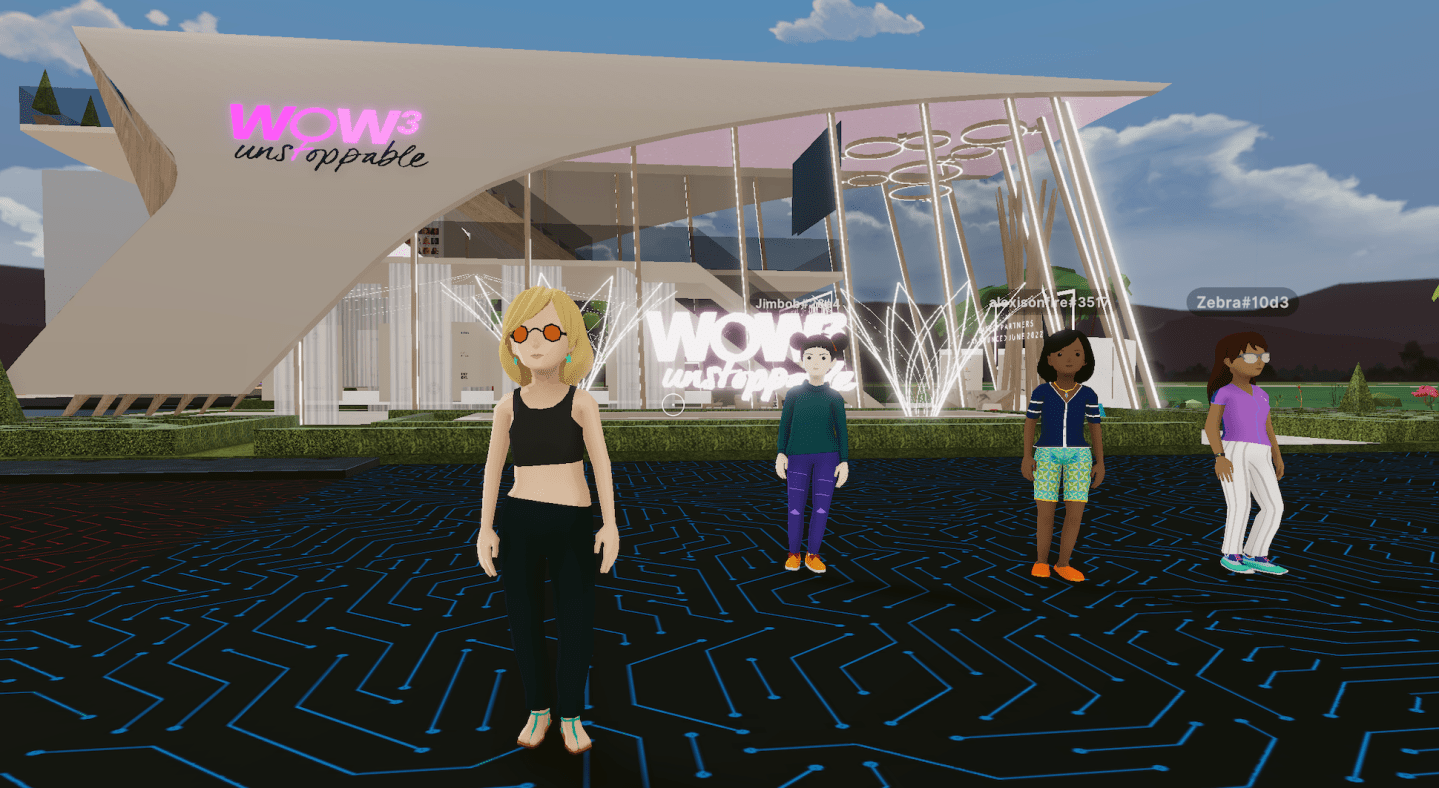
Stories like these—not to mention the metaverse’s cartoon aesthetic and the undeniable dorkiness of VR headsets—make it easy to mock the promise of virtual work. However, Carter and others believe that the hardware will get lighter, sleeker, and less conspicuous, and slipping in and out of VR will eventually become seamless.
Set limits and choose noncore business tasks
VR and augmented reality technologies are advancing quickly, and Apple’s imminent arrival in the space is expected to supercharge interest. Meanwhile, tech critics already see Meta’s latest Quest Pro headset, which costs $1,500, as a vast improvement over its less expensive Quest 2 devices. Meta’s new tie-up with Microsoft, the tech company most associated with enterprise products, is also making the latter firm’s widely used office software available within Meta’s Workrooms.
Yet using the metaverse in small doses may be the secret to making the most out of it, according to Janet Balis, head of Americas marketing at EY. She suggests that companies consider holding time-limited metaverse meetings, mostly for training or in-house collaboration.
Employees should slowly familiarize themselves with the possibilities of VR, especially if a company plans to launch a consumer-facing VR business, like a digital boutique selling real or digital goods, or a virtual showroom, she says. But she cautions against holding meetings central to your core business in a virtual environment because employees may not immediately feel physically or psychologically comfortable in VR.
Allison Horn, executive director of global talent at Accenture, likewise advises that people take tiny steps in the metaverse. Working in VR beats two-dimensional meetings, like video calls, because you can walk around a virtual room, walk up to a whiteboard, or mingle among colleagues. The sense that you are with other people is real, she says, but employees may not believe it until they try it for themselves.
You can “cocreate and hear each other’s voices, instead of presenting as one-to-many or one-to-one,” she adds. But even if there were no hiccups in the software, she says VR is a new way of perceiving the world, and some people will need to build their VR capabilities. She suggests starting with a five- to 10-minute seated metaverse experience, working up to half an hour, and only then trying standing.
She warns against ever choosing VR for meetings that touch on private topics, noting that companies are still using consumer-grade equipment. Even though there are layers of security built into existing software, “we never hold confidential client meetings in the metaverse,” she says.
Don’t expect VR to make the workplace more equitable
Accenture is one of a few companies that has ventured into the metaverse workplace in a big way. It purchased 60,000 Oculus headsets for employees during the pandemic and announced it would start onboarding recruits in the company’s metaverse, the Nth Floor.
To be sure, Accenture has more reason than most companies to invest time and money in this space. Like other consulting firms, it has begun advising its corporate clients on metaverse strategies and uses the metaverse for client meetings.
The Nth Floor has also enabled members of Accenture’s employee resource groups to connect across time zones, build safe spaces for meetings, and host events open to the entire company. One group honored veterans in November, and another created a metaverse museum during Black History Month that attracted 400 visitors in one day.
Some argue that, in theory, a shift to the metaverse could further support workplace diversity and equity. VR and AR applications could enable employees who live in rural areas, people with disabilities, and caregivers to be as “present” in the office as those who work in the physical building, chipping away at proximity bias.
Allowing employees to build avatars and alter them also gives workers the freedom to choose how they present themselves and are, in turn, perceived, whether as human figures, animals, or inanimate objects. Unstoppable’s Carter sees this kind of pseudo-anonymity as liberating, noting that some companies also use avatars to help obscure job applicants’ identities. “You won’t know if I’m an 85-year-old man or a young Black woman,” she says. “I believe it’s going to be a great equalizer.”
But bias and abuse still have a way of seeping into seemingly anonymous interactions, says Phoebe Gavin, a career coach and executive director of talent development at Vox who happens to be an avid gamer. Even with a fantastical avatar, she says, “Do you think people aren’t going to find out that the lizard at the office is actually a Black woman?” Working with avatars whose real identities are at least initially hidden would also create more cognitive work for people from marginalized backgrounds, she adds. That’s because those employees are constantly managing how others see them, code-switching when necessary to avoid the hazards of racism and other forms of bias; figuring out when to adjust the way they communicate or behave would take more effort in a metaverse of nonrepresentative avatars.
Balis, at EY, feels that companies should wait and see what cultural norms develop about online identities, noting that the Gen Z employees entering the workforce are the most diverse generation yet. “They value their ability to express themselves,” she points out. Self-expression may mean hyperrealism to some, while others find more satisfaction in being unrecognizable. “We’re going to continue to see a full spectrum of expression, and it’s really important not to mandate what those avatars or forms need to be,” Balis says.
Put safety precautions in place
Companies must be mindful of employee risks when working way off-site in a virtual world. Many organizations discovered during the pandemic that remote work did not eliminate sexual harassment and other abuse. The same will be true for VR. Its advantage over other mediums—the sense it gives users of being physically present with others—also makes virtual harassment particularly disturbing, prompting Meta to create a safety bubble feature for users who’d like to keep surrounding avatars at a safe distance.
Employers that open virtual offices or adopt VR apps will need to apply the same rigor in enforcing proper employee conduct in the metaverse as they do anywhere—whether in the actual office, online, or at a boozy company event. Companies will want to remind workers that they’re representing their employer in the metaverse, too, and be aware that some might use see avatars as alter egos through which they can channel negative behaviors.
Accenture, for one, has fielded a few reports of harassment from employees and says it treats virtual incidents the same as real-world ones. “We’re learning that bad behavior will surface itself in whatever environment you put multiple humans in,” says Horn. “While one could argue, ‘Well, the behavior is not as bad in the metaverse because you can’t physically do anything to anybody,’ but the emotional concern is still there.”
Plan for wellness in the metaverse workplace
As the metaverse gains enterprise users, companies must also consider the health risks, says Horn. Are employees in VR too often? Are they at risk of burnout? “Are we contributing to a digital overload?” she asks.
Another area of concern: Employees could identify with their avatars more than their physical selves, to the point the physical world underwhelms them. There are many unanswered questions about the psychological effects of taking on an avatar form or appearing as a hologram at work.
At the request of employees, Accenture recently invested in metaverse wellness programs, including subscriptions to the fitness app Supernatural and immersive meditation applications, so employees can use their Quest headsets to take a 10-minute virtual forest walk between Zoom calls. (Though VR isn’t going to save people from being overworked, it could encourage relaxation; small studies have found that nurses who used the same kind of meditative VR interventions at the height of the COVID crisis reported reduced stress.)
But Horn and Balis both believe that leaders must keep educating themselves and employees about how to find the right balance between working in person, teleworking, and virtual reality. As they see it, the metaverse will never fully replace in-person work, nor will it eliminate the need for email, phone calls, messaging apps, and Zoom calls. Employees will be able to stay healthiest by finding variety and learning how to pick the right device depending on what they need to accomplish. Of course, that may mean avoiding gadgets entirely. Difficult conversations may still need to happen face-to-face, no matter how sensitive avatars become to human micro-expressions.
Balis recommends creating “a full palette of workplace interactions” so that people have access to whatever they need to work quietly and independently or have bursts of collaboration, whether online, in a virtual room, or in person. “We’re learning from the new hybrid workplace that we need to create different interactions for different moments,” she says. And some of those encounters simply can’t be virtual—even if it is immersive.
This article is part of Fortune @ Work: The Return-to-Office Playbook.