
Every day, people throughout your organization make decisions—possibly hundreds of them—that either increase or decrease its sustainability. Which supplier should we choose? Do we procure green glass or clear glass for our product? Should we host the conference in London or New York?
Just as artificial intelligence has improved the decisions organizations make to optimize financial performance, improve processes, meet customer needs, and more, it will be critical in helping them reach their climate goals. In fact, because it can gather, complete, and interpret large, complex datasets on emissions and climate impact, A.I. is fundamentally important in helping to manage the full range of climate-related issues.
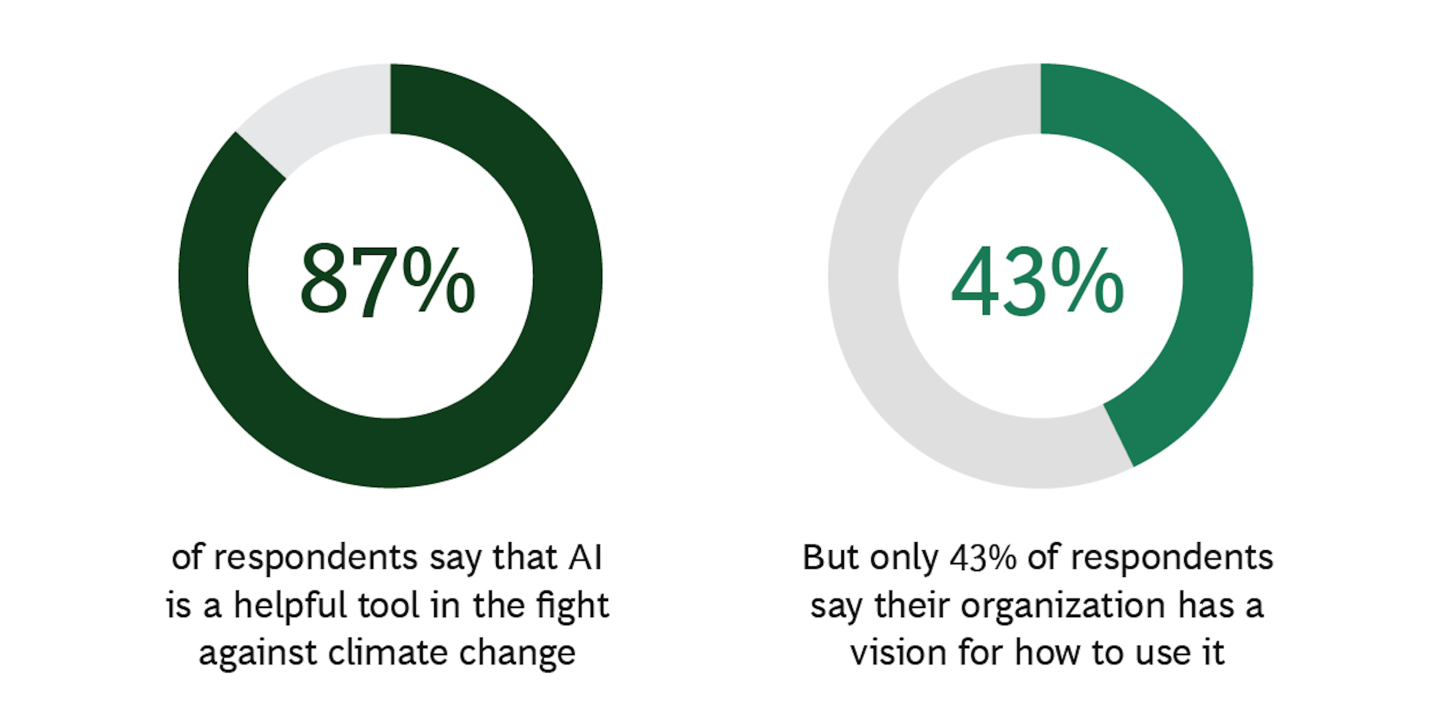
BCG recently conducted a global survey of 1,000 leaders in A.I. and climate that tells us more about that potential—as well as the barriers getting in the way. We found that 87% of respondents feel that advanced analytics and A.I., or simply “A.I.,” is a helpful tool in the fight against climate change today, but only 43% say that they have a vision for using A.I. in their own climate change efforts.
They see the greatest business value for AI in the reduction and measurement of emissions. In fact, there are many diverse ways in which global leaders can use A.I. to achieve their goals:
Mitigation. A.I. can help measure emissions at the macro and micro levels, reduce the effects of emissions, and remove existing emissions from the atmosphere. In our work, we’ve found that A.I. can help reduce GHG emissions equal to 5% to 10% of an organization’s carbon footprint, or 2.6 to 5.3 gigatons of CO2e if scaled globally.
There are some exciting examples of technology already doing this work. Climate TRACE (Tracking Real-Time Atmospheric Carbon Emissions), a coalition backed by Al Gore, uses satellite imagery and A.I. to measure emissions. Blue Sky Analytics, a member of Climate TRACE, can estimates emissions specifically from fires. And Pachama uses satellite imagery and A.I. to measure and monitor the carbon stored in forests over time, identifying high-quality carbon credits.
BCG’s CO2 A.I. platform helps organizations measure, simulate, track, and optimize their emissions at scale. This ready-to-deploy software can be used across all industries, including oil and gas, biopharmaceuticals, automotive, and consumer products. It not only accurately measures emissions directly produced by the company’s own activities (Scopes 1 and 2) but also quantifies the more difficult-to-measure, indirect emissions produced along the company’s entire value chain (Scope 3).
Adaptation and resilience. A.I. is also well suited to help anticipate climate-related hazards, whether by improving long-term projections of localized events, such as sea-level rise, or by upgrading early warning systems for extreme phenomena, such as hurricanes or droughts. One such example of how A.I. and advanced analytics can help communities adapt to changing climates is a program in Southeast Asia. By combining satellite data with advanced flood modeling, the team there was able to identify critical infrastructure such as hospitals, as well as the wetlands most at risk of flooding, and understand where strategically placed artificial barriers could do the most good.
AI can also help with vulnerability and exposure management, monitoring current crises, strengthening infrastructure (through smart irrigation, for example), protecting populations by predicting large-scale migration patterns, and preserving biodiversity, such as by identifying and counting species.
Research, finance, and education. A.I. can also be an instrumental tool in supporting climate research and modeling, to understand the scale of change and inform policy decisions. It can play a critical role in climate finance, by forecasting carbon prices. And A.I. can help educate the public and influence behavior, through personalized tools that can estimate carbon footprints, for example, or make recommendations for climate-friendly purchases. Investing in these A.I.-powered fundamentals will be key to the success of both mitigation and adaptation and resilience efforts.
Overcoming A.I.’s roadblocks
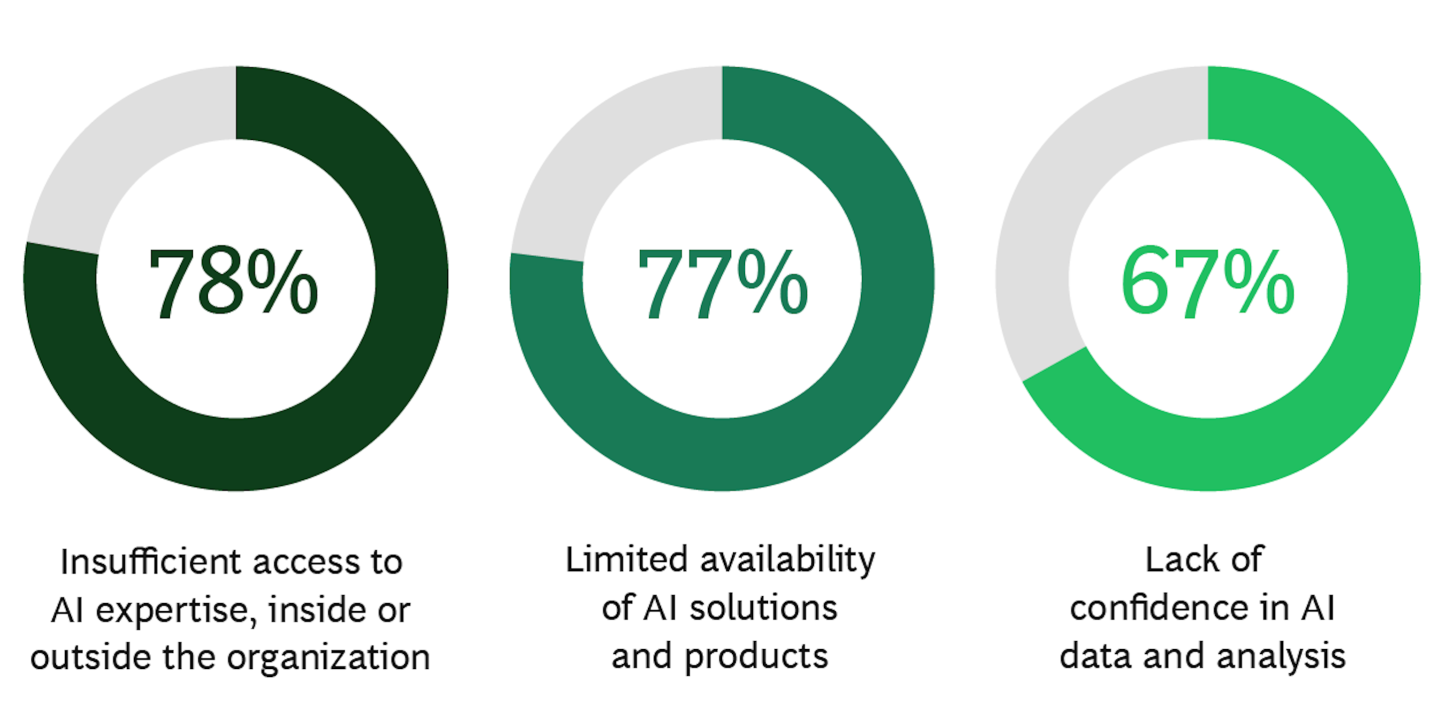
With so many powerful opportunities for A.I. to make a difference in this struggle, what’s holding organizations back from putting it to greater use? While there are already areas in which A.I. solutions are well established and ready for broad application, most existing solutions are scattered, can be inaccessible, and lack the resources to scale. Among survey respondents, 78% say the roadblocks are due to insufficient AI expertise, 77% cite limited availability, and 67% point to a lack of confidence in A.I.-related data and analysis.
A.I. is not a cure-all. It’s one of many tools we should be using to address this global challenge. But it can help us go down a more informed, increasingly data-driven, and faster path—and we have no time to lose.
Christoph Schweizer is the Global CEO of Boston Consulting Group. Boston Consulting Group is a partner of Fortune’s Path to Zero.
Sign up for the Fortune Features email list so you don’t miss our biggest features, exclusive interviews, and investigations.











