• Home
  • Latest
  • Fortune 500
  • Finance
  • Tech
  • Leadership
  • Lifestyle
  • Rankings
  • Multimedia
China

China gave tens of billions in secretive ‘emergency loans’ to vulnerable nations, emerging as world’s major creditor and IMF competitor

By
Yvonne Lau
Yvonne Lau
Down Arrow Button Icon
By
Yvonne Lau
Yvonne Lau
Down Arrow Button Icon
September 12, 2022, 3:16 PM ET
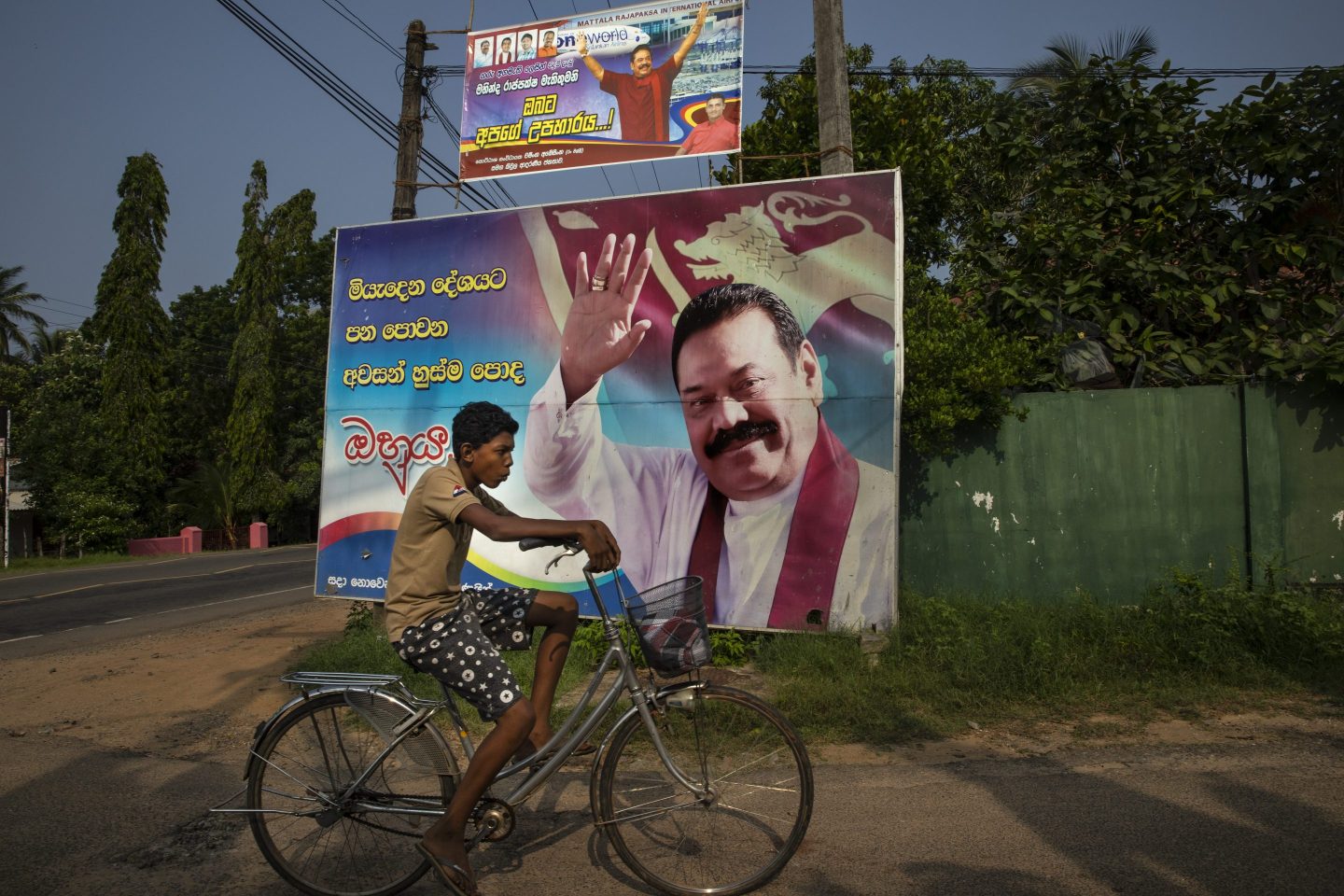
A child bikes past a poster of former prime minister Mahinda Rajapaksa in Tangalle, Sri Lanka, on November 16, 2018.
A child bikes past a giant poster of former President Mahinda Rajapaksa in Tangalle, Sri Lanka, November 2018.Paula Bronstein—Getty Images

In recent years, China has shelled out tens of billions in opaque “emergency loans” for at-risk nations, indicating a shift to providing short-term emergency lending rather than longer-term infrastructure loans.

It’s a (largely) unforeseen development from Beijing’s $900 billion Belt and Road Initiative (BRI), launched in 2013. 

Since 2017, Beijing has given a collective $32.8 billion in emergency loans to Sri Lanka, Pakistan, and Argentina, according to AidData, a research lab at William & Mary University that focuses on China’s global financing activities. 

China has also offered emergency loans to Eastern European nations Ukraine and Belarus; South American countries Venezuela and Ecuador; African nations Kenya and Angola; alongside Laos, Egypt, and Mongolia. Chinese overseas lending and credit relationships remain “exceptionally opaque,” according to World Bank researchers. “Chinese lenders require strict confidentiality from their debtors and do not release a granular breakdown of their lending,” they wrote.

But researchers have found that the bulk of China’s overseas lending—around 60%—is now to low-income countries that are currently mired in debt distress, or at high risk of it. Beijing’s pivot to short-term rescue lending highlights its growing role as an emergency lender of last resort, rendering it an alternative to the Western-backed International Monetary Fund (IMF). 

Experts are concerned about what comes next, as many of the nations that took loans from China are facing an extraordinary debt crunch amid an era of inflation and climate change. For instance, a Pakistani official said just last week that the epic flooding that covered most of the South Asian country will cost upwards of $10 billion.

Secret loans 

Beijing’s emergency lending for at-risk nations has been aimed at averting defaults on infrastructure loans it gave through the BRI, according to a Financial Times report.

“Beijing has tried to keep these countries afloat by providing emergency loan after emergency loan without asking its borrowers to restore economic policy discipline or pursue debt relief through a coordinated restructuring process with all major creditors,” Bradley Parks, AidData executive director, told the FT.

Emerging economies across Asia, Africa, and the Middle East have struggled with repaying their BRI loans. The COVID-19 pandemic and Russia’s war on Ukraine exacerbated these nations’ food and fuel shortages and their balance of payments crises. Nearly 70% of the world’s poorest countries will dole out $52.8 billion this year to repay debts, with more than a quarter of that amount flowing to China.  

This means that China has become the most important official player in global sovereign debt renegotiations, World Bank researchers say. But as Chinese lenders require strict confidentiality from their debtors and do not release a granular breakdown of their lending, there’s a yawning knowledge gap on what happens to Chinese claims in the event of debt distress and default, they wrote.

IMF alternative

Gabriel Sterne, a former IMF economist and current head of global emerging markets and strategy research at Oxford Economics, told the FT that China’s emergency lending merely “postpones the day of reckoning” for debt-distressed nations that may be seeking out Chinese loans and avoiding the IMF, the latter of which “demands painful reform.” 

In the past couple of weeks, both China and the IMF have inked, or moved closer to, bailout agreements for Sri Lanka, Pakistan, and other nations. Beijing, meanwhile, has pledged to forgive 23 interest-free loans to 17 African nations, and will redirect $10 billion of its IMF reserves to the continent. 

There are now signs that the IMF is pushing for full transparency from vulnerable nations in order to receive funding. AidData’s Parks told the South China Morning Post last month that the IMF is pressuring borrowers to disclose their BRI loan contract details. 

The IMF has “zeroed in on cash collateral clauses in BRI loan contracts that give China a first priority claim on foreign exchange in borrower countries,” Parks said. 

Some countries are already abiding by the tougher loan conditions. Pakistan, for instance, has “shared details with the IMF…in consultation with the Chinese side,” Muhammad Faisal, a research fellow at the Institute of Strategic Studies Islamabad, told the SCMP.

Still, World Bank researchers predict that China’s appetite for overseas financing, lending, and debt relief is set to decline as Chinese lenders face pressure at home and abroad. Emerging economies are at risk of a “sudden stop” in Chinese lending, which could have “substantial” ripple effects worldwide.

[This report was updated to include a final paragraph on World Bank researchers’ predictions.]

Sign up for the Fortune Features email list so you don’t miss our biggest features, exclusive interviews, and investigations.

About the Author
By Yvonne Lau
LinkedIn iconTwitter icon
See full bioRight Arrow Button Icon

Latest in

AIchief executive officer (CEO)
Microsoft AI boss Suleyman opens up about his peers and calls Elon Musk a ‘bulldozer’ with ‘superhuman capabilities to bend reality to his will’
By Jason MaDecember 13, 2025
14 minutes ago
Danish military forces participate in an exercise with hundreds of troops from several European NATO members in the Arctic Ocean in Nuuk, Greenland, Monday, Sept. 15, 2025.
PoliticsDonald Trump
Danish intelligence report warns of U.S. economic leverage and military threat under Trump
By The Associated PressDecember 13, 2025
1 hour ago
Ukrainian President Volodymyr Zelensky gives a joint press conference in Kyiv, Ukraine in 2023 as European leaders visit the country 18 months after the start of Russia's invasion.
EuropeUkraine invasion
EU indefinitely freezes Russian assets to prevent Hungary and Slovakia from vetoing billions of euros being sent to support Ukraine
By Lorne Cook and The Associated PressDecember 13, 2025
1 hour ago
Spanish Prime Minister Pedro Sánchez often praises the financial and social benefits that immigrants bring to the country.
EuropeSpain
In a continent cracking down on immigration and berated by Trump’s warnings of ‘civilizational erasure,’ Spain embraces migrants
By Suman Naishadham and The Associated PressDecember 13, 2025
1 hour ago
EconomyAgriculture
More financially distressed farmers are expected to lose their property soon as loan repayments and incomes continue to falter
By Jason MaDecember 13, 2025
2 hours ago
Middle EastMilitary
Trump pledges retaliation after 3 Americans are killed in Syria attack that the U.S. blames on the Islamic State group
By Samar Kassabali, Bassem Mroue, Seung Min Kim and The Associated PressDecember 13, 2025
4 hours ago

Most Popular

placeholder alt text
Economy
Tariffs are taxes and they were used to finance the federal government until the 1913 income tax. A top economist breaks it down
By Kent JonesDecember 12, 2025
2 days ago
placeholder alt text
Success
Apple cofounder Ronald Wayne sold his 10% stake for $800 in 1976—today it’d be worth up to $400 billion
By Preston ForeDecember 12, 2025
1 day ago
placeholder alt text
Success
40% of Stanford undergrads receive disability accommodations—but it’s become a college-wide phenomenon as Gen Z try to succeed in the current climate
By Preston ForeDecember 12, 2025
1 day ago
placeholder alt text
Economy
The Fed just ‘Trump-proofed’ itself with a unanimous move to preempt a potential leadership shake-up
By Jason MaDecember 12, 2025
1 day ago
placeholder alt text
Economy
For the first time since Trump’s tariff rollout, import tax revenue has fallen, threatening his lofty plans to slash the $38 trillion national debt
By Sasha RogelbergDecember 12, 2025
1 day ago
placeholder alt text
Success
Apple CEO Tim Cook out-earns the average American’s salary in just 7 hours—to put that into context, he could buy a new $439,000 home in just 2 days
By Emma BurleighDecember 12, 2025
1 day ago
Rankings
  • 100 Best Companies
  • Fortune 500
  • Global 500
  • Fortune 500 Europe
  • Most Powerful Women
  • Future 50
  • World’s Most Admired Companies
  • See All Rankings
Sections
  • Finance
  • Leadership
  • Success
  • Tech
  • Asia
  • Europe
  • Environment
  • Fortune Crypto
  • Health
  • Retail
  • Lifestyle
  • Politics
  • Newsletters
  • Magazine
  • Features
  • Commentary
  • Mpw
  • CEO Initiative
  • Conferences
  • Personal Finance
  • Education
Customer Support
  • Frequently Asked Questions
  • Customer Service Portal
  • Privacy Policy
  • Terms Of Use
  • Single Issues For Purchase
  • International Print
Commercial Services
  • Advertising
  • Fortune Brand Studio
  • Fortune Analytics
  • Fortune Conferences
  • Business Development
About Us
  • About Us
  • Editorial Calendar
  • Press Center
  • Work At Fortune
  • Diversity And Inclusion
  • Terms And Conditions
  • Site Map

© 2025 Fortune Media IP Limited. All Rights Reserved. Use of this site constitutes acceptance of our Terms of Use and Privacy Policy | CA Notice at Collection and Privacy Notice | Do Not Sell/Share My Personal Information
FORTUNE is a trademark of Fortune Media IP Limited, registered in the U.S. and other countries. FORTUNE may receive compensation for some links to products and services on this website. Offers may be subject to change without notice.