• Home
  • News
  • Fortune 500
  • Tech
  • Finance
  • Leadership
  • Lifestyle
  • Rankings
  • Multimedia
Healthembryos

Scientists created synthetic mouse embryos from stem cells to study the early stages of development: ‘It is reminiscent of such spectacular scientific advances as the birth of Dolly the sheep’

By
Laura Ungar
Laura Ungar
and
The Associated Press
Down Arrow Button Icon
By
Laura Ungar
Laura Ungar
and
The Associated Press
Down Arrow Button Icon
August 25, 2022, 1:09 PM ET
Mouse embryo study
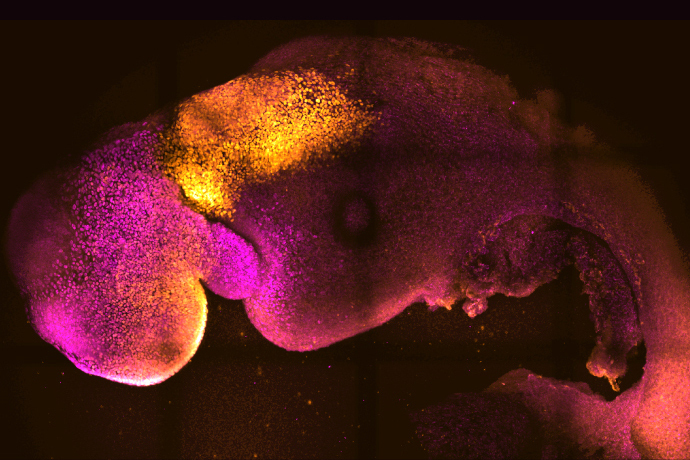
This microscope image provided by researchers Gianluca Amadei and Charlotte Handford in August 2022 shows a synthetic mouse embryo with colors added to show brain and heart formation.Gianluca Amadei—Charlotte Handford via AP

Scientists have created “synthetic” mouse embryos from stem cells without a dad’s sperm or a mom’s egg or womb.

The lab-created embryos mirror a natural mouse embryo up to 8 ½ days after fertilization, containing the same structures, including one like a beating heart.

In the near term, researchers hope to use these so-called embryoids to better understand early stages of development and study mechanisms behind disease without the need for as many lab animals. The feat could also lay the foundation for creating synthetic human embryos for research in the future.

“We are undoubtedly facing a new technological revolution, still very inefficient … but with enormous potential,” said Lluís Montoliu, a research professor at the National Biotechnology Centre in Spain who is not part of the research. “It is reminiscent of such spectacular scientific advances as the birth of Dolly the sheep” and others.

A study published Thursday in the journal Nature, by Magdalena Zernicka-Goetz at the California Institute of Technology and her colleagues, was the latest to describe the synthetic mouse embryos. A similar study, by Jacob Hanna at the Weizmann Institute of Science in Israel and his colleagues, was published earlier this month in the journal Cell. Hanna was also a coauthor on the Nature paper.

Zernicka-Goetz, an expert in stem cell biology, said one reason to study the early stages of development is to get more insight into why the majority of human pregnancies are lost at an early stage and embryos created for in vitro fertilization fail to implant and develop in up to 70% of cases. Studying natural development is difficult for many reasons, she said, including the fact that very few human embryos are donated for research and scientists face ethical constraints.

Building embryo models is an alternative way to study these issues.

To create the synthetic embryos, or “embryoids,” described in the Nature paper, scientists combined embryonic stem cells and two other types of stem cells—all from mice. They did this in the lab, using a particular type of dish that allowed the three types of cells to come together. While the embryoids they created weren’t all perfect, Zernicka-Goetz said, the best ones were “indistinguishable” from natural mouse embryos. Besides the heart-like structure, they also develop head-like structures.

”This is really the first model that allows you to study brain development in the context of the whole developing mouse embryo,” she said.

The roots of this work go back decades, and both Zernicka-Goetz and Hanna said their groups were working on this line of research for many years. Zernicka-Goetz said her group submitted its study to Nature in November.
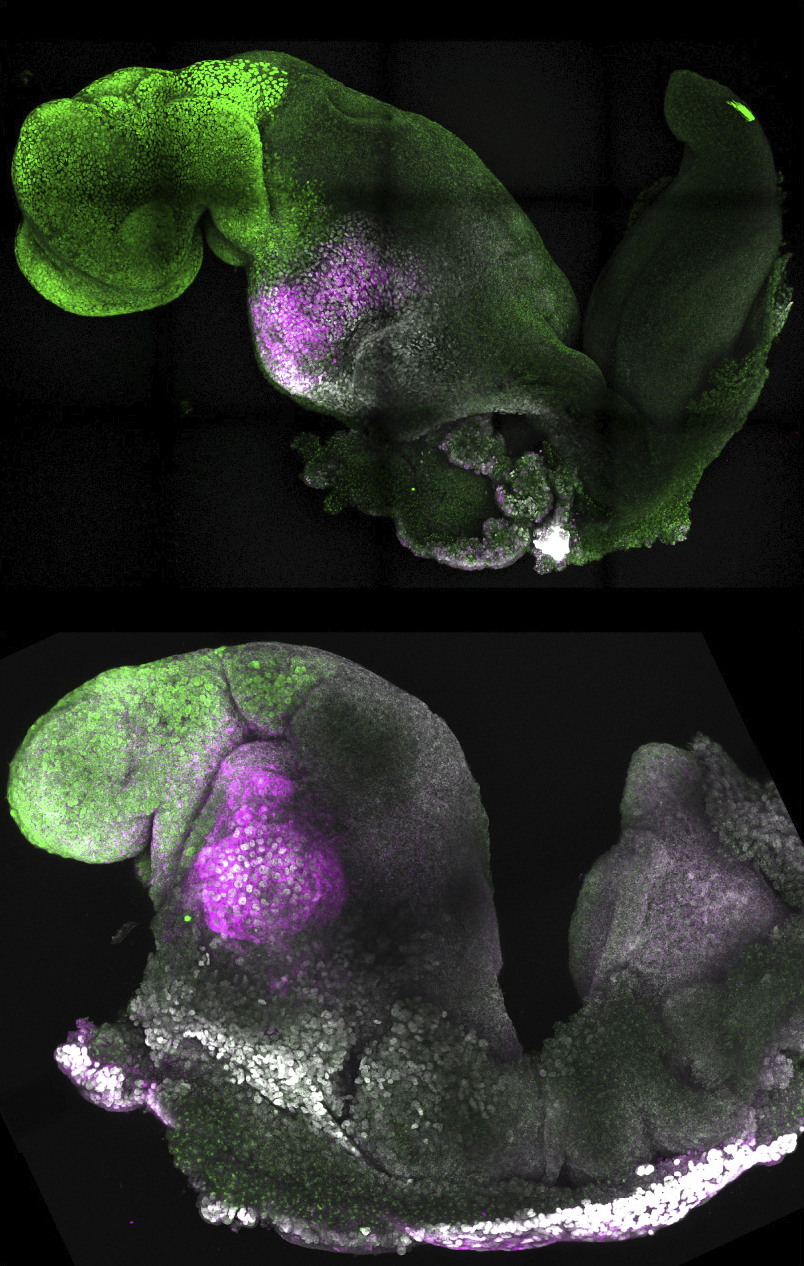
Mouse Embryo Study
This combination of microscope images provided by researchers Gianluca Amadei and Charlotte Handford in August 2022 shows natural, top, and synthetic mouse embryos with colors added to show comparable brain and heart formation.
Gianluca Amadei, Charlotte Handford via AP

Scientists said next steps include trying to coax the synthetic mouse embryos to develop past 8 ½ days —with the eventual goal of getting them to term, which is 20 days for a mouse.

At this point, they “struggle to go past” the 8 1/2-day mark, said Gianluca Amadei, a coauthor on the Nature paper based at the University of Cambridge. “We think that we will be able to get them over the hump, so to speak, so they can continue developing.”

The scientists expect that after about 11 days of development the embryo will fail without a placenta, but they hope researchers can someday also find a way to create a synthetic placenta. At this point, they don’t know if they will be able to get the synthetic embryos all the way to term without a mouse womb.

Researchers said they don’t see creating human versions of these synthetic embryos soon but do see it happening in time. Hanna called it “the next obvious thing.”

Other scientists have already used human stem cells to create a “blastoid,” a structure mimicking a pre-embryo, that can serve as a research alternative to a real one.

Such work is subject to ethical concerns. For decades, a “14-day rule” on growing embryos in the lab growing human embryos in the lab has guided researchers. Last year, the International Society for Stem Cell Research recommended relaxing the rule under limited circumstances.

Scientists stress that growing a baby from a synthetic human embryo is neither possible nor under consideration.

“Perspective on this report is important since, without it, the headline that a mammalian embryo has been built in vitro can lead to the thought that the same can be done with humans soon,” said developmental biologist Alfonso Martinez Arias of the Universitat Pompeu Fabra in Spain, whose group has developed alternative stem cell based models of animal development.

“In the future, similar experiments will be done with human cells and that, at some point, will yield similar results,” he said. “This should encourage considerations of the ethics and societal impact of these experiments before they happen.”

Sign up for the Fortune Features email list so you don’t miss our biggest features, exclusive interviews, and investigations.
About the Authors
By Laura Ungar
See full bioRight Arrow Button Icon
By The Associated Press
See full bioRight Arrow Button Icon

Latest in Health

Boston Celtics head coach Joe Mazzulla stands on the court with his arms folded
Workplace CultureLeadership
You don’t need to have fun at work—take it from NBA head coach Joe Mazzulla: ‘Fun is a cop-out sometimes when things aren’t going well’
By Dave SmithDecember 4, 2025
2 hours ago
Bill Gates
HealthGates Foundation
Bill Gates decries ‘significant reversal in child deaths’ as nearly 5 million kids will die before they turn 5 this year
By Nick LichtenbergDecember 4, 2025
8 hours ago
Coca-Cola
LawFood and drink
‘They took food and made it unrecognizable’: San Francisco sues Coca-Cola, Nestle, other major food companies over public health crisis
By Jaimie Ding and The Associated PressDecember 3, 2025
19 hours ago
Workplace CultureSports
Exclusive: Billionaire Michele Kang launches $25 million U.S. Soccer institute that promises to transform the future of women’s sports
By Emma HinchliffeDecember 2, 2025
2 days ago
North Americaphilanthropy
Anonymous $50 million donation helps cover the next 50 years of tuition for medical lab science students at University of Washington
By The Associated PressDecember 2, 2025
2 days ago
Trump
PoliticsWhite House
Trump had MRI on heart and abdomen and it was ‘perfectly normal,’ doctor says
By The Associated PressDecember 2, 2025
2 days ago

Most Popular

placeholder alt text
North America
Jeff Bezos and Lauren Sánchez Bezos commit $102.5 million to organizations combating homelessness across the U.S.: ‘This is just the beginning’
By Sydney LakeDecember 2, 2025
2 days ago
placeholder alt text
Economy
Ford workers told their CEO 'none of the young people want to work here.' So Jim Farley took a page out of the founder's playbook
By Sasha RogelbergNovember 28, 2025
6 days ago
placeholder alt text
North America
Anonymous $50 million donation helps cover the next 50 years of tuition for medical lab science students at University of Washington
By The Associated PressDecember 2, 2025
2 days ago
placeholder alt text
C-Suite
MacKenzie Scott's $19 billion donations have turned philanthropy on its head—why her style of giving actually works
By Sydney LakeDecember 2, 2025
2 days ago
placeholder alt text
Innovation
Google CEO Sundar Pichai says we’re just a decade away from a new normal of extraterrestrial data centers
By Sasha RogelbergDecember 1, 2025
3 days ago
placeholder alt text
Economy
Scott Bessent calls the Giving Pledge well-intentioned but ‘very amorphous,’ growing from ‘a panic among the billionaire class’
By Nick LichtenbergDecember 3, 2025
19 hours ago
Rankings
  • 100 Best Companies
  • Fortune 500
  • Global 500
  • Fortune 500 Europe
  • Most Powerful Women
  • Future 50
  • World’s Most Admired Companies
  • See All Rankings
Sections
  • Finance
  • Leadership
  • Success
  • Tech
  • Asia
  • Europe
  • Environment
  • Fortune Crypto
  • Health
  • Retail
  • Lifestyle
  • Politics
  • Newsletters
  • Magazine
  • Features
  • Commentary
  • Mpw
  • CEO Initiative
  • Conferences
  • Personal Finance
  • Education
Customer Support
  • Frequently Asked Questions
  • Customer Service Portal
  • Privacy Policy
  • Terms Of Use
  • Single Issues For Purchase
  • International Print
Commercial Services
  • Advertising
  • Fortune Brand Studio
  • Fortune Analytics
  • Fortune Conferences
  • Business Development
About Us
  • About Us
  • Editorial Calendar
  • Press Center
  • Work At Fortune
  • Diversity And Inclusion
  • Terms And Conditions
  • Site Map

© 2025 Fortune Media IP Limited. All Rights Reserved. Use of this site constitutes acceptance of our Terms of Use and Privacy Policy | CA Notice at Collection and Privacy Notice | Do Not Sell/Share My Personal Information
FORTUNE is a trademark of Fortune Media IP Limited, registered in the U.S. and other countries. FORTUNE may receive compensation for some links to products and services on this website. Offers may be subject to change without notice.