
Alexa, what’s the future of digital assistants? I don’t how Alexa would answer that question. But looking at the number of top A.I. minds who have recently left big tech companies to create well-funded startups dedicated to building a new-breed of digital assistants aimed at being useful for business, a golden era of digital work companions is likely to be around the corner.
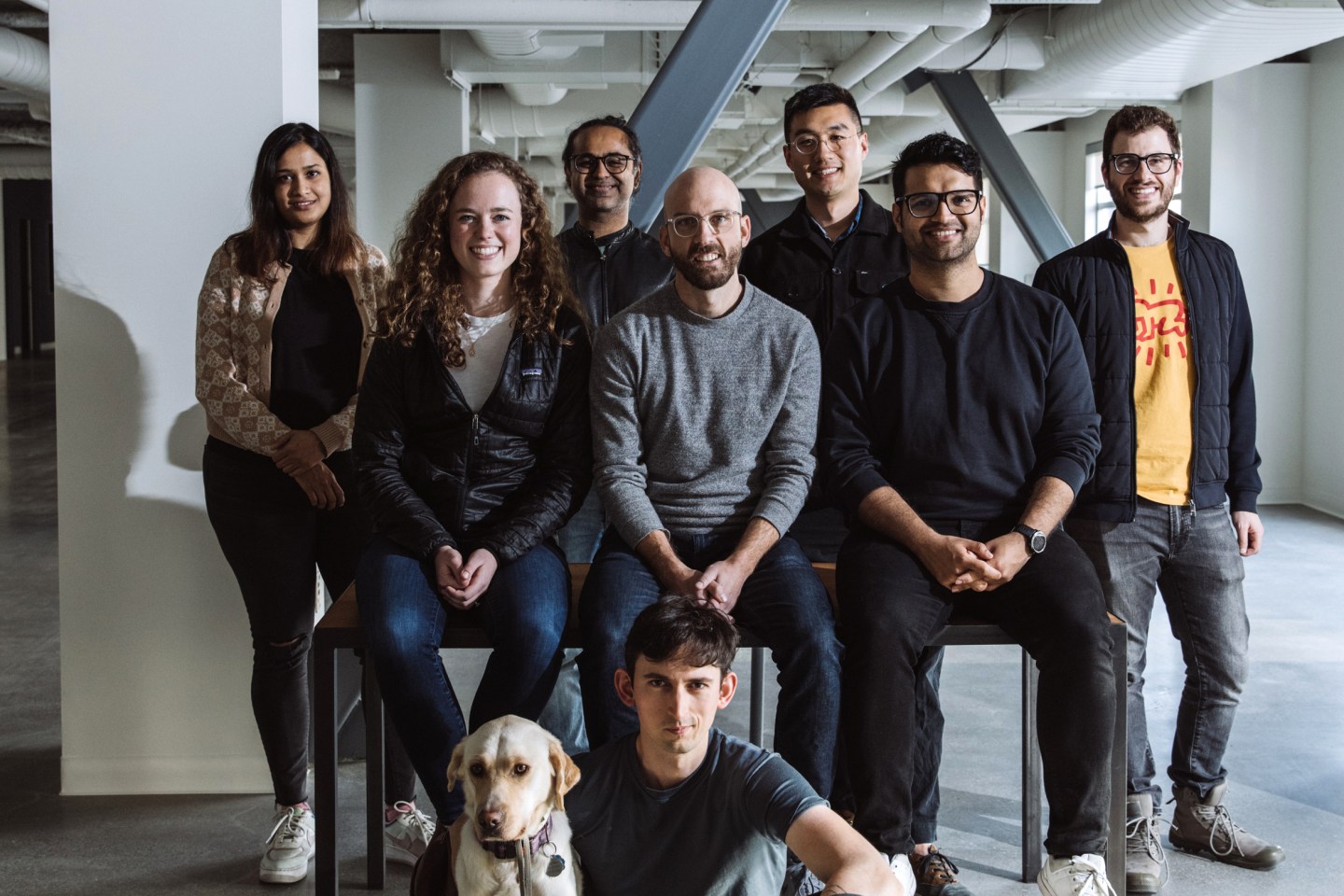
Among this new crop of digital startups is Adept AI Labs. The company, which emerged from “stealth mode” earlier this year with $65 million in initial venture capital funding, stands out for its founding team. They include a group of researchers from Google Brain who in 2017 invented the A.I. architecture known as “The Transformer.” This algorithmic design has underpinned a huge number of A.I. advances, especially in natural language processing, over the past five years. Now, the team that created the Transformer thinks the same basic idea can be used to create more capable, general assistants that will be able to work alongside people to help perform a wide range of business tasks.
“The problem we’ve carved out is how to get machine to collaborate with humans and actually build things for them,” says Ashish Vaswani, Adept’s co-founder and chief scientist. Vaswani was the lead author on the paper that introduced the Transformer. He says what Adept is building is not simply a better chat bot. “We want to figure out how to get machines to perform actions for people, not just have conversations with them.”
Vaswani says the software Adept is building will learn through human feedback, not just by ingesting a lot of pre-existing data from text, which is how most large language A.I. systems are trained today. David Luan, Adept’s co-founder and CEO, says that language understanding is a key capability that Adept’s software will have to possess, since language is a major way humans provide feedback. But the system won’t just stop with language. “You can think of it as a universal teammate,” Luan says. “If you had another person on your team, what would you shamelessly ask them to do? That’s what we want this software to do.”
Adept’s first step has been creating software that can follow natural language instructions to perform tasks using other software. In a demonstration of this that Adept has posted online, its software uses a basic SQL database to perform a variety of tasks. A user types “can you grab the name and population for every country?” and the software goes ahead and pulls that data from the database and assembles it in a simple table. Then a user asks the software to “make a bar plot of that,” and the software does so. But the plot is hard to read because it contains too many countries. So the user asks it to just “to show the countries with the 6 highest populations,” and the software comes right back with a much easier to read chart. This time though the labels for the six countries are overlapping, which still isn’t great. So the user types, “Good. But the x axis is still a bit hard to read, can you fix that?” And remarkably, the software does so—by writing the labels on an angle—even though the feedback from the user was not that specific. Later in the demo, the software grabs publicly-available U.S. unemployment figures from the Internet and charts those.
This is what Luan calls teaching the software to “climb the ladder of abstraction.” Eventually, Vaswani says, he wants the software to be able to take an instruction as abstract and complex as, “tell me how my customers are churning?” and have the software analyze the data and produce a report, all without having to receive additional instructions.
Why didn’t Vaswani and his group just stay at Google and build this general assistant for the tech giant? Well, Niki Parmar, another member of the Google team who left to co-found Adept as its chief technology officer, says that at Google, A.I. research is set up to enhance existing products, not create entirely new product categories. “This is what excites us about Adept,” she says. “Here we can have both research and product together.” She says Adept plans to have a minimally viable product out with customers within months. “We are a small team that is very aligned to the mission, and we can move fast,” she says.
In addition to Adept, there are also startups such as Cohere AI, also founded by veterans of Google Brain, including researchers who worked alongside Vaswani on the Transformer, as well as alumni from Meta’s AI Research division and DeepMind. And there’s Inflection, which was co-founded by former DeepMind co-founder Mustafa Suleyman and LinkedIn co-founder Reid Hoffman. All of these companies are looking to create A.I. to assist humans at a wide variety of tasks.
It will be interesting to watch and see how capable these new digital assistants will really be, which will gain traction and for what uses, and how the major tech companies, such as Google and Microsoft, will respond to what could turn out to be a formidable threat to parts of their business.
With that, here’s the rest of this week’s news in A.I.
Jeremy Kahn
@jeremyakahn
jeremy.kahn@fortune.com
Correction, July 7: An earlier version of this story misspelled the last name of Adept co-founder and CEO David Luan and the first name of Adept co-founder and CTO Niki Parmar.
A.I. IN THE NEWS
Researchers claim A.I. model can accurately predict crime. That is what a group from the University of Chicago said it has been able to do by creating a "digital twin" of certain cities and then training an A.I. to forecast where certain types of crime will occur. After training the model on data from Chicago from 2014 to 2016, the A.I. system was 90% accurate in forecasting where crime would occur in the weeks following the training period. The researchers said the system achieved similar results for seven other cities. Scientists not involved in the project said they were concerned that such systems could perpetuate racial bias in policing, especially as the data the system was trained on included crimes that citizens report as well as crimes that the police already proactively go out searching for. The UChicago team said that while they shared some of these concerns, their A.I. system could also be used to identify racial bias in policing. There's more here from The New Scientist.
Japan using A.I. to identify rip currents. Officials in Kanagawa prefecture, south of Tokyo, are using A.I. to identify rip currents–which cause 60% of drowning deaths—and send a warning to bathers and lifeguards, The Guardian reports. The system uses a pole mounted camera to take video of the waves at a popular surf beach and then uses A.I. to identify rip currents and anyone swimming nearby, sending alerts via a smartphone app to life guards.
Age prediction A.I. software may not be accurate, CNN finds. Reporters from the U.S. news network tested the A.I. age prediction software from London-based startup Yoti that Meta's Instagram social media platform plans to use to verify users ages and found the results varied. For "a couple of reporters," CNN said the estimated age range that Yoti's software provides was accurate, but for others it was "off by many years." In one case, it estimated that an editor who is more than 30 years old was between the ages of 17 and 21. Experts the network talked to also varied in their opinions on whether the technology was good, ethical use of A.I. or one that was problematic because it helped normalize the use of facial recognition and might not work as accurately as the companies deploying it assume.
Activist in push to convince EU to ban A.I. lie detectors. The call comes following controversial pilot tests conducted in 2019 along the borders of Greece, Hungary, and Macedonia that used A.I. from a British company called Silent Talker that claimed to be able to identify deception. Those tests though showed the technology did not work as expected and the company that made the software has since dissolved. But, according to Wired, lawyers, activists and some European Union lawmakers are calling for such lie-detection software to be explicitly banned as part of the EU's proposed Artificial Intelligence Act.
EYE ON A.I. RESEARCH
The trade-offs between privacy, security and performance in machine learning remain unresolved. That was the takeaway from a recent research paper from a team at the Delft University of Technology in the Netherlands that looked at various approaches to privacy-preserving machine learning, where some information is shared to train an A.I. system, but the actual underlying data remains private. It turns out that most federated learning, in which only the weights used in a neural network model are shared, still have the potential to leak some data. That means someone could potentially reverse engineer the underlying data, the researchers found. But they also found that methods to further secure the data using a cryptography technique known as homomorphic encryption resulted in massive slow-downs in the time it took to train the A.I. "Our results support the fact that as our encryption system gets stronger, the performance loss is higher, making the decision of balancing security and performance a difficult but nevertheless vital issue for the developers," the researchers wrote.
FORTUNE ON A.I.
How Formula 1’s McLaren team is using A.I. to fuel performance—by Stephanie Cain
Tesla lays off about 200 Autopilot workers and closes a California office as Musk staff cuts spread—by Edward Ludlow, Dana Hull and Bloomberg
What does a dog’s nose know? A.I. may soon tell us—by Jeremy Kahn
Commentary: Quantum hacking is the next big cybersecurity threat. Here’s how companies should prepare for ‘Y2Q’—by Francois Candelon, Maxime Courtaux, Vinit Patel, and Jean-Francois Bobier
BRAIN FOOD
An A.I. learned to redistribute wealth in a way most people found more fair than a system designed by humans. That is the result from research carried out by DeepMind and published this week in the scientific journal Nature Human Behavior. The point of the research was to see if an A.I. system could learn from collective human preferences. But the mechanism chosen for the experiment was an economic game in which the A.I. system had to figure out a way to distribute contributions that each player had made to a collective investment pool in such a way that the majority of human players would vote for that distribution scheme. It turned out that the method the A.I. system was able to come up with was more popular than any that human players tried.
The researchers found that, among other failings, human players did not sufficiently reward poorer players for making relatively large contributions to the collective pot. The DeepMind team wrote that, "one remaining open question is whether people will trust AI systems to design mechanisms in place of humans. Had they known the identities of referees, players might have preferred human over agent referees simply for this reason. However, it is also true that people often trust AI systems when tasks are perceived to be too complex for human actors."
The researchers also cautioned that people sometimes state their preferences differently when they are being asked to vote on a policy that is merely being described, rather than one they have experienced firsthand. "However, AI-designed mechanisms may not always be verbalizable, and it seems probable that behaviours observed in such case may depend on exactly the choice of description adopted by the researcher," the researchers wrote.
Finally, the researchers said their results were not an argument for "A.I. government" where autonomous agents would make policy decisions without human intervention. Instead they said they simply saw the democratic voting as an interesting way of gathering collective human feedback for an A.I. system. In fact, the team pointed out that voting itself can be problematic, with the majority potentially overriding the rights or interests of minority groups.