• Home
  • News
  • Fortune 500
  • Tech
  • Finance
  • Leadership
  • Lifestyle
  • Rankings
  • Multimedia
CommentaryUkraine invasion

When war reaches the workplace: Russia’s invasion of Ukraine is unsettling stressed-out American workers

By
Cheryl Naumann
Cheryl Naumann
Down Arrow Button Icon
By
Cheryl Naumann
Cheryl Naumann
Down Arrow Button Icon
April 6, 2022, 6:30 AM ET
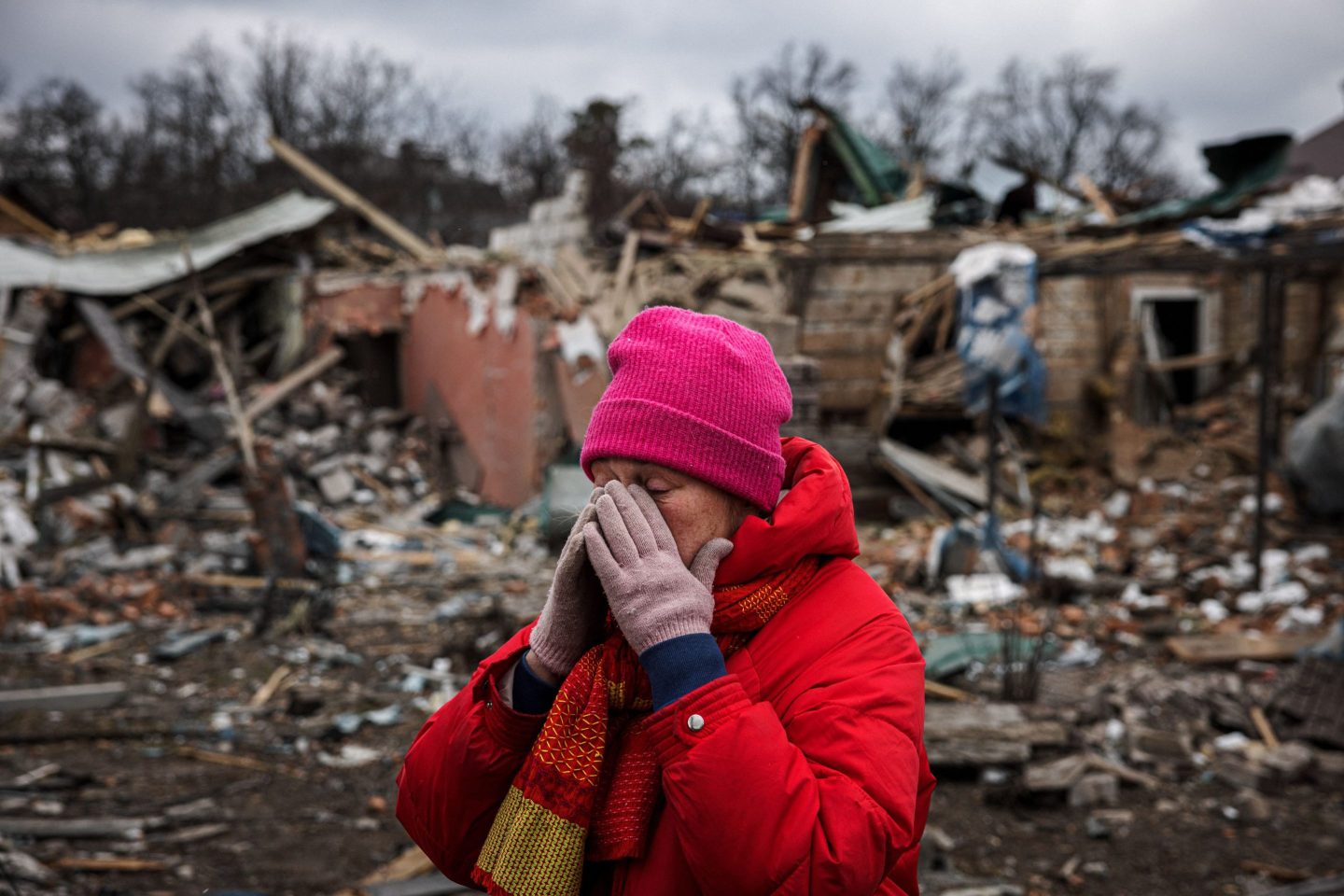
The aftermath of Russian aerial attacks on the city of Irpin, northwest of the Ukrainian capital Kiev, on March 13. Employees need to know that their managers are seeing the same images–and hoping for peace.
The aftermath of Russian aerial attacks on the city of Irpin, northwest of the Ukrainian capital Kiev, on March 13. Employees need to know that their managers are seeing the same images–and hoping for peace.DIMITAR DILKOFF - AFP - Getty Images

The war in Ukraine may be thousands of miles away, but it feels unnervingly close to home for many American workers.

Relentless news coverage of bombed hospitals, burning homes, and dazed refugees can leave company employees, who are still readjusting after the two-year rollercoaster ride of the pandemic, further unsettled.

Now is the time for company leaders to embrace the human in human resources. A workplace isn’t all business–it’s a team of people with real hopes, fears, and stresses.

Wise managers should be checking in with employees about how they are dealing with the war in Ukraine. 

According to a recent American Psychological Association/Harris Poll survey, nine out of 10 Americans feel the war in Ukraine compounds the emotional stresses of the past two years of pandemic lockdown. Seven out of 10 Americans fear the crisis in Ukraine will lead to nuclear war.

The American Psychological Association’s 2022 Stress in America report showed similar results. The association’s Vaile Wright told NPR the level of concern about Ukraine–80% overall–represented the highest proportion of people reporting feeling stressed about a single issue in the survey’s 15 years.

This is modern business management. In our lifetimes, companies have gone global–so have employee concerns and vulnerabilities. 

Societal leadership, says the Edelman Trust Barometer, is now “a core function of business.” 

How the company reacts to major societal events matters greatly to current and prospective employees, as well as customers and investors. In the Edelman report, based on 36,000 respondents from 28 countries, six of every 10 workers said they choose a workplace based on their beliefs and values. Eighty percent said they make investments based on their beliefs and values. 

Old-school executives who try to maintain a high wall between the workplace and the outside world are unwise. Modern businesses should not pretend to be removed from their communities. Executives who turn their backs on the major events in the world around them will be seen as arrogant, naive, insensitive, or all the above. They certainly will not be viewed as caring leaders who operate a company with a shared sense of purpose.

With 24/7 television news coverage of the war, employees should know that company leaders are viewing the same disturbing images of war and hoping for peace. The company should offer help to employees who need support. If the company has operations in Ukraine or Russia, the leader should explain what steps are being taken for employees and business operations there.

Leaders should be especially sensitive to the needs of workers of Ukrainian or Russian heritage, who might have families caught up on either side of the conflict. Some may welcome discussion and expressions of concern, while others might deem that to be unnecessary pressure during an already difficult time.

Nothing counters anxiety like action. Make it easy for employees to help. Compile and distribute lists of credible aid groups such as the International Committee of the Red Cross, UNICEF, and the World Food Program. Consider setting up matching funds for employee donations.

Create a variety of channels for discussions: Some workers are comfortable voicing their thoughts in person, while others might prefer the emotional distance of something like a Slack channel or an internal forum, and others may need the anonymity of employee assistance programs or a mental health app.

Every company should have clear policies to deal with the fraught nature of this and other social issues in the workplace. In addition to the pandemic, the war in Ukraine follows the killing of George Floyd, the attempted takeover of the U.S. Capitol, and years of increasingly deep political divisions.

Respect is the watchword: It’s one thing for people to have differences of opinion; it’s quite another if those differences become personal.

During a labor crunch amid the Great Resignation, employers can ill-afford to alienate employees by ignoring major issues that concern them. 

Let there be no doubt: Employee productivity is directly linked to their sense of well-being. Acknowledging major events such as the war in Ukraine–and offering extra help for employees who can use it–is both good citizenship and good business.

Cheryl Naumann is the senior vice president and chief human resources officer for the University of Phoenix.

More must-read commentary published by Fortune:

  • We are getting worker loneliness all wrong
  • Putin’s war is disrupting crypto’s fantasy of stateless money
  • The pandemic is threatening our children’s ability to cope
  • Women of color can no longer buy into the ‘inclusion delusion’
  • Pandemic, oil prices, and war: Here’s when inflation will drop

Never miss a story: Follow your favorite topics and authors to get a personalized email with the journalism that matters most to you.
About the Author
By Cheryl Naumann
See full bioRight Arrow Button Icon

Latest in Commentary

Steve Milton is the CEO of Chain, a culinary-led pop-culture experience company founded by B.J. Novak and backed by Studio Ramsay Global.
CommentaryFood and drink
Affordability isn’t enough. Fast-casual restaurants need a fandom-first approach
By Steve MiltonDecember 5, 2025
2 hours ago
Paul Atkins
CommentaryCorporate Governance
Turning public companies into private companies: the SEC’s retreat from transparency and accountability
By Andrew BeharDecember 5, 2025
2 hours ago
Matt Rogers
CommentaryInfrastructure
I built the first iPhone with Steve Jobs. The AI industry is at risk of repeating an early smartphone mistake
By Matt RogersDecember 4, 2025
1 day ago
Jerome Powell
CommentaryFederal Reserve
Fed officials like the mystique of being seen as financial technocrats, but it’s time to demystify the central bank
By Alexander William SalterDecember 4, 2025
1 day ago
Rakesh Kumar
CommentarySemiconductors
China does not need Nvidia chips in the AI war — export controls only pushed it to build its own AI machine
By Rakesh KumarDecember 3, 2025
2 days ago
Rochelle Witharana is Chief Financial and Investment Officer for The California Wellness Foundation
Commentarydiversity and inclusion
Fund managers from diverse backgrounds are delivering standout returns and the smart money is slowly starting to pay attention
By Rochelle WitharanaDecember 3, 2025
2 days ago

Most Popular

placeholder alt text
Economy
Two months into the new fiscal year and the U.S. government is already spending more than $10 billion a week servicing national debt
By Eleanor PringleDecember 4, 2025
1 day ago
placeholder alt text
Success
‘Godfather of AI’ says Bill Gates and Elon Musk are right about the future of work—but he predicts mass unemployment is on its way
By Preston ForeDecember 4, 2025
24 hours ago
placeholder alt text
Success
Nearly 4 million new manufacturing jobs are coming to America as boomers retire—but it's the one trade job Gen Z doesn't want
By Emma BurleighDecember 4, 2025
1 day ago
placeholder alt text
Success
Nvidia CEO Jensen Huang admits he works 7 days a week, including holidays, in a constant 'state of anxiety' out of fear of going bankrupt
By Jessica CoacciDecember 4, 2025
23 hours ago
placeholder alt text
Economy
Tariffs and the $38 trillion national debt: Kevin Hassett sees ’big reductions’ in deficit while Scott Bessent sees a ‘shrinking ice cube’
By Nick LichtenbergDecember 4, 2025
22 hours ago
placeholder alt text
Health
Bill Gates decries ‘significant reversal in child deaths’ as nearly 5 million kids will die before they turn 5 this year
By Nick LichtenbergDecember 4, 2025
1 day ago
Rankings
  • 100 Best Companies
  • Fortune 500
  • Global 500
  • Fortune 500 Europe
  • Most Powerful Women
  • Future 50
  • World’s Most Admired Companies
  • See All Rankings
Sections
  • Finance
  • Leadership
  • Success
  • Tech
  • Asia
  • Europe
  • Environment
  • Fortune Crypto
  • Health
  • Retail
  • Lifestyle
  • Politics
  • Newsletters
  • Magazine
  • Features
  • Commentary
  • Mpw
  • CEO Initiative
  • Conferences
  • Personal Finance
  • Education
Customer Support
  • Frequently Asked Questions
  • Customer Service Portal
  • Privacy Policy
  • Terms Of Use
  • Single Issues For Purchase
  • International Print
Commercial Services
  • Advertising
  • Fortune Brand Studio
  • Fortune Analytics
  • Fortune Conferences
  • Business Development
About Us
  • About Us
  • Editorial Calendar
  • Press Center
  • Work At Fortune
  • Diversity And Inclusion
  • Terms And Conditions
  • Site Map

© 2025 Fortune Media IP Limited. All Rights Reserved. Use of this site constitutes acceptance of our Terms of Use and Privacy Policy | CA Notice at Collection and Privacy Notice | Do Not Sell/Share My Personal Information
FORTUNE is a trademark of Fortune Media IP Limited, registered in the U.S. and other countries. FORTUNE may receive compensation for some links to products and services on this website. Offers may be subject to change without notice.