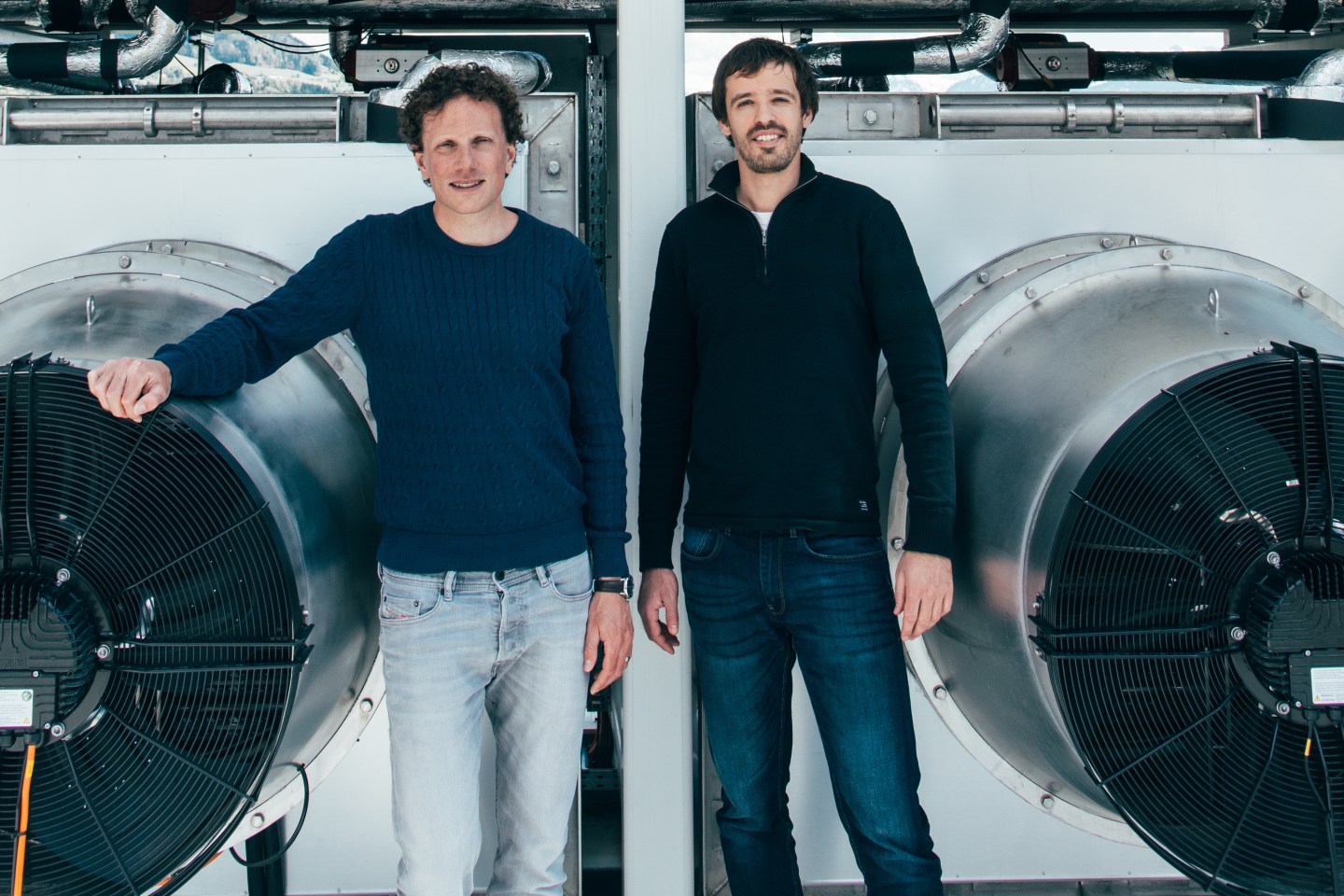
After spending a good chunk of his university years backcountry skiing on the glaciers around the French-Swiss border town of Chamonix, Christoph Gebald figured he knew a thing or two about extreme weather. But then came this winter—in Iceland.
When he spoke to Fortune in mid-February, the engineer-turned-entrepreneur went straight into the weather report: Gale-force winds. Blizzards. Repeat. “Operating under those conditions is a bit challenging,” said Gebald, cofounder and co-CEO of the Swiss green-tech startup Climeworks AG.
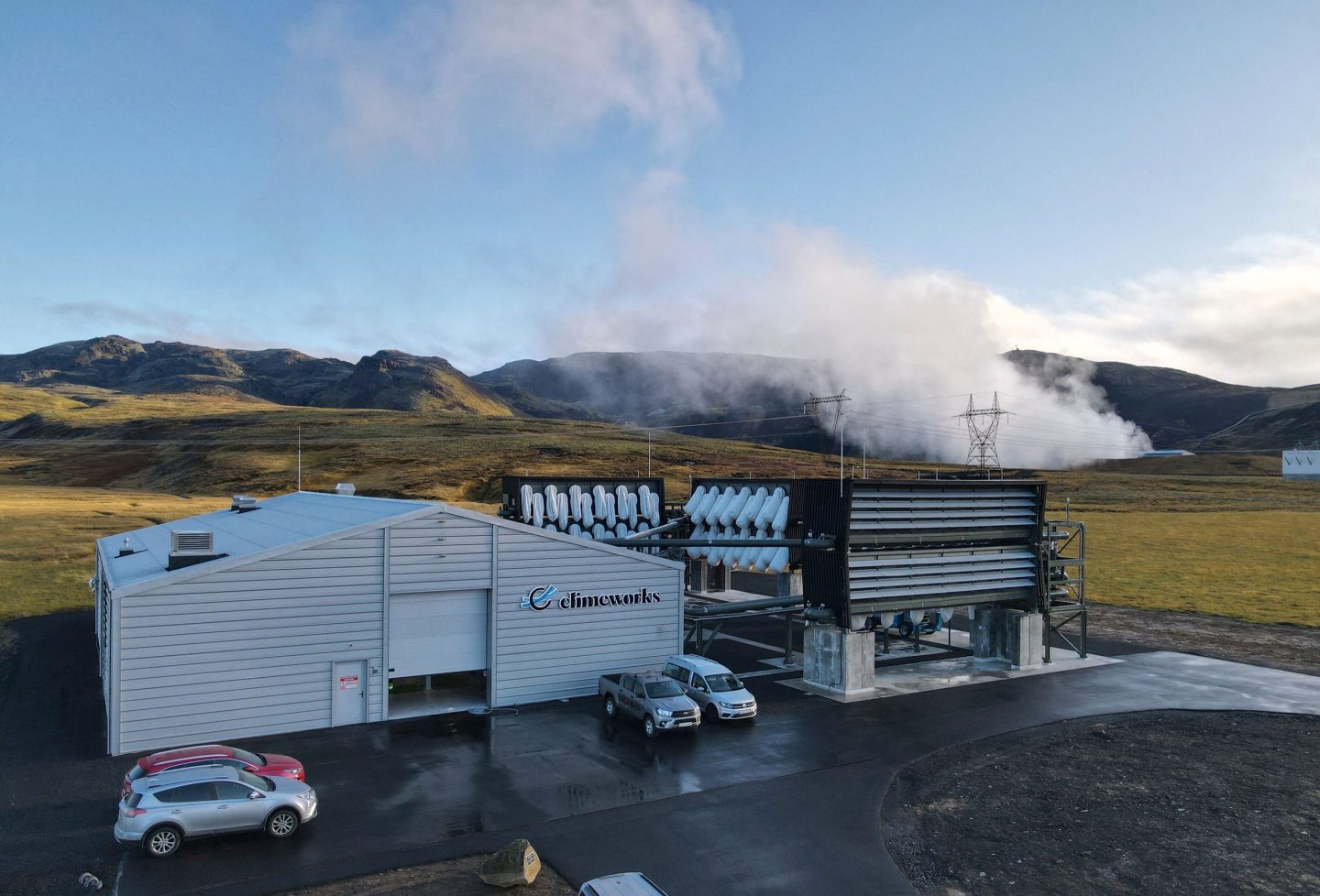
In September, Climeworks, with the help of its Icelandic partners Carbfix and ON Power, made climate-science history when they flipped the switch on Orca, the world’s first and largest direct air capture (DAC) and carbon storage installation.
DAC has captured the imagination of climate hawks and engineers around the world for decades. And now, as the concept finally emerges from the labs, various DAC projects are getting funding from the likes of the Bill & Melinda Gates Foundation, Elon Musk, the European Union, and the U.S. Department of Energy, which sees DAC as a “crucial clean energy technology,” and a possible key to helping the world’s biggest economies hit their net-zero goals.
The basic idea around DAC is that giant fans can be engineered to suck planet-warming CO2 out of the sky; on a very basic level, think of how an air purifier hoovers up dust and funky odors in your living room. What sets DAC apart is that it collects all that bad air, and returns it deep below the earth, usually storing it in geological formations.
Which brings us to Iceland.
‘Part of the learning process’
Climeworks chose the volcanic island nation in the North Atlantic for a few reasons. Iceland has an abundant supply of clean geothermal energy to power the lungs of Orca—its massive fans. It also has plenty of basalt rock. The big by-product of DAC is usually a liquefied carbon dioxide mixture, which needs to be carefully disposed of. In the case of Orca, that CO2 soup gets pumped into the layer of basalt below ground. There, the basalt acts as a sturdy cap. Within a few years, the CO2 mixture will turn to stone, Climeworks says, with little to no risk that it will return to the atmosphere, where it would foul the air and warm up the planet.
In the press release announcing the launch, Climeworks set the bar for Orca to capture and remove 4,000 tons of CO2 a year from the ambient air. That’s not a huge amount; it’s equivalent to the emissions spewed from about 850 cars. And Gebald now admits the company may have to dial that goal back slightly for year one, as it’s had to shut down the fans from time to time to deal with the wind and snow.
“It’s all part of the learning process,” he says.
Still, a growing list of corporations looking to reduce their carbon footprint are teaming with Climeworks. Last year, the insurance giant Swiss Re signed a 10-year carbon removal purchase agreement, in essence paying Climeworks to suck carbon out of the sky to help it meet its net-zero goals. Microsoft, Square, Ocado, and Boston Consulting Group are also paying Climeworks to sequester carbon over the next decade. Individuals who feel guilty about their carbon footprint can buy carbon-reduction subscriptions from the company. Want to remove a monthly 30 kilograms of CO2 from the atmosphere as you begin to fly around the world again? That subscription package will cost you €30 (or about $34) per month.
That business line started innocently enough, Gebald says. When he and his business partner and former university roommate, Jan Wurzbacher, would share what they were working on, they’d get enthusiastic responses from friends and family. That’s when the light bulb went off. “Hey, we can democratize climate action,” he recalls thinking. “We take the CO2 back out of the air, full stop, and they can pay us for that. That’s sort of how the invention of the carbon-dioxide-removal-as-a-service model was born.”
In other words, there’s a lot riding on those fans up there in Iceland.
How DAC works
Orca can be found in a desolate valley 20 miles east of the Icelandic capital Reykjavík, on the outskirts of the Hellisheidi geothermal power plant.
It’s hard to miss. Day and night (when the weather cooperates, anyhow), the industrial-size fans that power Orca whiz and whir. The fans are housed in a series of stackable containers, each of which resembles those used on cargo ships.
Orca’s fans are designed to suck the ambient air into a special chamber. There, filters isolate and strip out the CO2 pollutants. The final stage: The pristine air is blown out the other end into the wild. A crucial middle step in the process: The carbon particles that get collected are neutralized at a high temperature, and, with the help of Carbfix’s technology, this unwanted by-product is mixed with water and pumped underground where it slowly turns to rock.
Every ton of carbon dioxide removed from the air by Orca, the company says, “is a ton immediately not contributing to global warming.”
Gebald says Climeworks is scouting out new locations for their next DAC installation. “We get a lot of ‘Can this only be done in Iceland?’ The answer is no,” he says. “This can be done elsewhere. If we were to write it as a simple recipe, the ingredients for us, Climeworks, would be land, geological storage, as well as renewable power.”
“We’re looking at North America and the Northern European countries. I think we’ll announce it somewhere in the middle of this year.”
The big buzz around DAC
The International Energy Agency, for one, is bullish on this out-of-nowhere technology. By the end of the decade, DAC could remove 85 metric megatons of CO2—equivalent to more than 21,000 Orca installations—out of the atmosphere, the IEA projects.
Not surprisingly, there’s suddenly a lot of competition coming from this corner of climate science. Carbon Engineering, a Canadian company, has plans this year to build an even bigger DAC facility in the middle of fracking country, Texas’s Permian Basin, with Occidental Petroleum, and another in Scotland. For the Scottish project, Carbon Engineering will team with Storegga, another startup trying to crack the DAC market. Not to be outdone, Exxon Mobil is working with climate-tech specialists Global Thermostat to jointly develop DAC technology, seeing it as key “to decarbonizing the energy sector in the long term.”
DAC is an oddball in the polarizing world of climate science in that it seems to be bringing together competing interests—and not just Big Oil and climate-tech startups. For example, Democrats and Republicans in Congress see in DAC a promising technology that can reduce America’s roughly 5 billion metric ton carbon footprint. To wit, in the $1.2 trillion infrastructure bill signed by President Biden in November, $3.5 billion is earmarked for the construction of direct air capture hubs around the country. “There is definitely bipartisan support in Congress for direct air capture right now,” Erin Burns, executive director of the climate-focused NGO Carbon180, tells Fortune.
Even as investor interest and political will coalesces around DAC, the science is still a long way from perfection. The big challenge all DAC operators contend with is bringing down the costs of this emerging technology. Arizona State University professor Klaus Lackner, a pioneer in the field, doesn’t see the DAC market taking off until the commercial players can get costs of removing a ton of carbon dioxide to below $100. Climeworks hasn’t hit that number yet: It has shaved down costs over the years, but it’s still “somewhere in the range of $200 to $300 per ton,” says Gebald.
The $100 target, he adds, is likely 15 years out. Getting there will take massive amounts of public subsidies and private funding to bring development and scaling costs down, Gebald says. DAC today, he notes, is “just like the early days for solar and wind programs, and what we’re now seeing for battery-electric vehicles.” Those fields were heavily supported by government as they were getting off the ground.
That’s why fledgling DAC operators see the U.S. infrastructure bill as such a big deal. “The epicenter is now the U.S.,” he says. When asked if Climeworks will be applying for a chunk of Uncle Sam’s billions, he doesn’t hesitate: “Oh, yes,” says Gebald. “Definitely.”
Check out Fortune’s Brainstorm Design Conference, taking place May 23-24 in Brooklyn, N.Y. For more details and to apply to attend, click here.