• Home
  • Latest
  • Fortune 500
  • Finance
  • Tech
  • Leadership
  • Lifestyle
  • Rankings
  • Multimedia
CommentaryAI

Rise of the (fast food) robots: How labor shortages are accelerating automation

By
Michael Joseph
Michael Joseph
Down Arrow Button Icon
By
Michael Joseph
Michael Joseph
Down Arrow Button Icon
November 29, 2021, 6:56 AM ET
All major fast food chains have invested in ways to automate their operations.
All major fast food chains have invested in ways to automate their operations.Bloomberg—Getty Images

When you think of innovative industries, fast food might not be the first type of business that springs to mind. But as an investor, your options for innovative companies aren’t limited to new frontiers like electric vehicles, online gambling, or space stocks.

Innovation is also a growth driver in the seemingly humdrum business of fast food. In many ways, innovations have shaped fast food as we know it today. A quick glimpse at the early years of the world’s largest fast food restaurant demonstrates how new ideas can translate to big upside for shareholders.

Innovation is a fast food ‘supersizer’

The original McDonald’s restaurant was opened in 1940 in San Bernardino, California. Using their own operational innovation, the application of production line manufacturing to fast food (dubbed the ‘Speedee Service System’), the McDonald brothers had a local hit.

Harry Sonneborn doesn’t get much pop culture recognition in the McDonald’s story, but the financial innovations he executed still shape the company today. Any time you hear an assertion that McDonald’s is in the real estate business and not in the hamburger business, think Sonneborn.

The company is so well known that many readers have probably already thought of other innovations: menu items like the Big Mac or Filet-O-Fish, the introduction of the Happy Meal, and of course the creation of Ronald McDonald.

Fast food in the age of COVID

More recently, COVID-19 forced restaurants to pivot. Ghost kitchens popped up to crank out delivery and takeout orders. But with global vaccination rates steadily rising and the Delta wave subsiding, more customers want to sit down and eat. That means reopening dining areas and hiring more staff–no easy task given today’s global labor shortages.

A year after COVID-19 was declared a pandemic, the US restaurant industry found itself short of 1.2 million employees compared to the prior year. There is no singular reason. Stimulus checks and unemployment benefits likely kept some workers at home. Others must have spent that time retraining for a different job.

Whatever the case, the tight employment market has remained persistent. In the U.S., the labor force participation rate is at its lowest point since the 1970s. McDonald’s made headlines earlier this year for offering $50 to job applicants just for showing up for an interview.

Hiring is one challenge. Retaining is another. Several companies have experienced organized employee walkouts over the past year as workers lobby for better working conditions. A photo of a Burger King sign went viral in July, as employees and a general manager quit in unison. The sign outside the restaurant read “WE ALL QUIT” and “SORRY FOR THE INCONVENIENCE”.

Floating higher wages to attract employees is not a long-term solution. Most restaurants operate on razor-thin margins. What’s more, they are plagued by high employee turnover. A ready supply of low-cost labor, typically in the form of young and unskilled workers, is a vital ingredient in the fast food industry’s recipe for success. Rising wages combined with a lack of workers are encouraging companies to look towards machines to fill roles that were once exclusively the domain of humans.

The future is now

Depending on where you live, you may have already been a witness to the early stages of what is likely a monumental transformation in how our food will be ordered, prepared, and delivered.

Who hasn’t had this happen: You go through a drive-through, shout your food order through a crackly microphone, the speakers hiss some feedback at you alongside what may have been a human voice repeating your order… and you wind up with a bag of food, bearing little resemblance to what you ordered.

This woeful experience may soon come to an end. In Chicago, 10 McDonald’s locations are using artificial intelligence software to take drive-through orders.

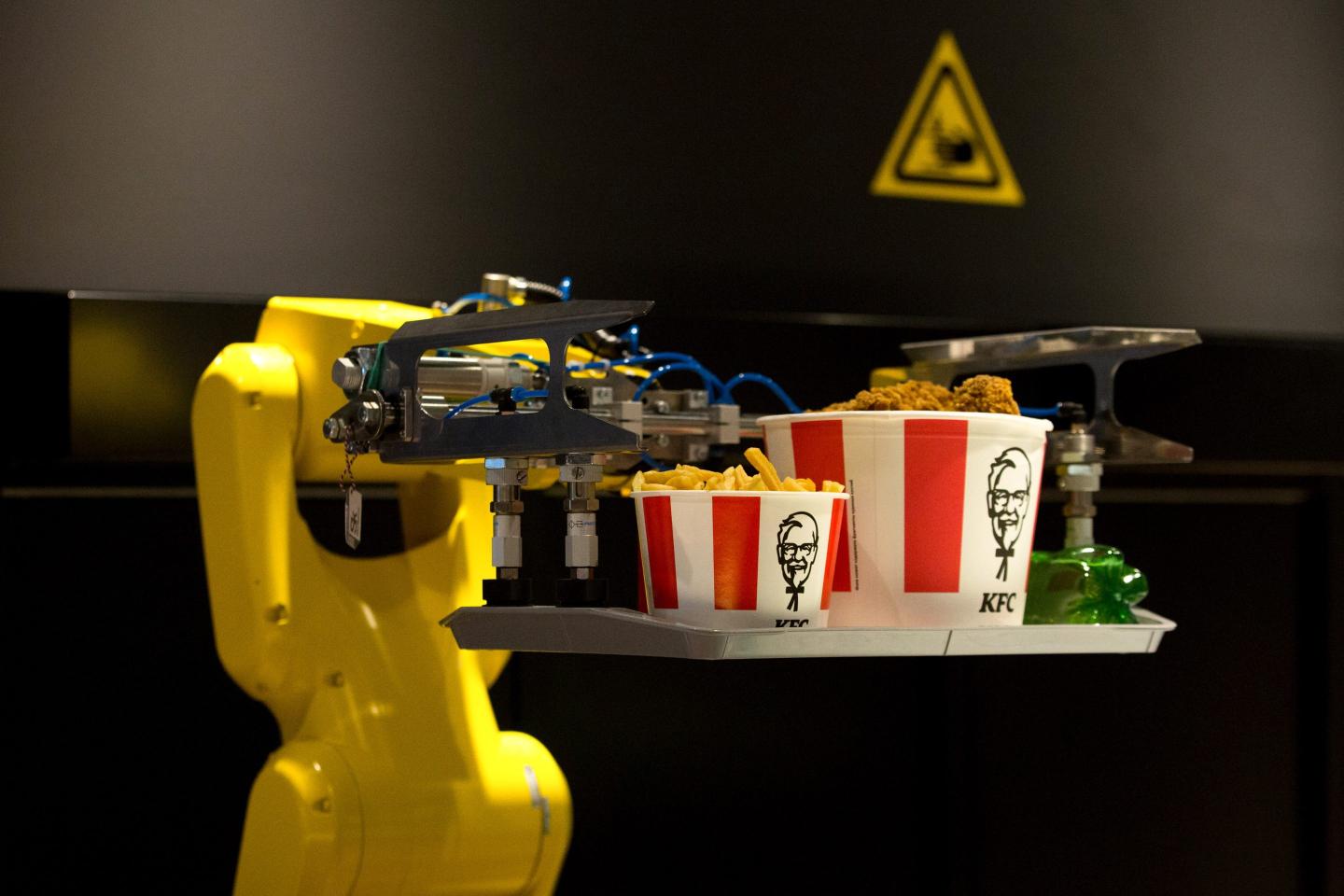
The race to integrate automation with operations extends far beyond The Golden Arches. “Flippy” is a burger-grilling machine created by Miso Robotics. U.S. hamburger chain White Castle has announced plans to introduce Flippy in 10 additional sites after a successful trial last year. Around the same time, Hyundai Robotics announced that they are partnering with KFC to develop chicken-cooking robots.

On the delivery front, Grubhub has partnered with autonomous vehicle developer Yandex to roll out food-delivering robots across U.S. college campuses. The Ohio State University presently has 50 self-driving rovers dedicated to delivering food to hungry students. Plans are to expand to 100 rovers on OSU’s campus, and of course to dispatch armies of delivery robots at universities across the U.S.

Chick-fil-A has partnered with Kiwibot to start test-delivering fried chicken sandwiches. Domino’s, now a self-described “tech company that sells pizza”, has invested in autonomous pizza delivery cars. These are just a few examples in the fast food technological arms race. Many more are sure to follow.

It seems, for lack of a better term… natural. Many tasks in the restaurant industry are monotonous and easily automated. Sharp knives, hot oil, and slippery floors do not make for the safest working environment. Using robots in operations should increase efficiency and productivity. They don’t stage walkouts or even call in sick. They can work long hours and won’t jump ship for more lucrative opportunities.

This will, of course, require a meaningful capital outlay. Emergen Research estimates the global food tech market will reach $342 billion by 2027. So, companies will have to spend some cash, but they will be rewarded with more efficient and predictable operations, a more consistent product, and what is always music to a shareholder’s ears: improved profit margins.

All of this of course begs the question: What happens to the workers being replaced? There are nearly five million people employed in the fast food industry in the U.S. alone. Not every worker is anxious to hand over their spatula to Flippy, but if the rise of the fast food robots encourages people to broaden their skillset and seek greater opportunity elsewhere, the world will be doubly better for it.

Michael Joseph, CFA, is a vice president and deputy chief investment officer at Stansberry Asset Management. Stansberry Asset Management is an investor in McDonald’s Corporation and this report should not be construed as investment advice.

More must-read commentary published by Fortune:

  • We can’t walk blindly into the metaverse
  • I know how lobbyists make sure Americans don’t get dental care–I was one of them
  • Millennials and Gen Z are a growing force in investing. The market needs to catch up
  • Great leaders show gratitude beyond Thanksgiving
  • Don’t let them tell you inflation is good for the poor. It’s not

Subscribe to Fortune Daily to get essential business stories straight to your inbox each morning.

About the Author
By Michael Joseph
See full bioRight Arrow Button Icon

Latest in Commentary

Finance
Lorem ipsum dolor sit amet, consectetur adipiscing elit, sed do eiusmod tempor incididunt ut labore et dolore magna aliqua. Ut enim ad minim veniam
By Fortune Editors
October 20, 2025
Finance
Lorem ipsum dolor sit amet, consectetur adipiscing elit, sed do eiusmod tempor incididunt ut labore et dolore magna aliqua. Ut enim ad minim veniam
By Fortune Editors
October 20, 2025
Finance
Lorem ipsum dolor sit amet, consectetur adipiscing elit, sed do eiusmod tempor incididunt ut labore et dolore magna aliqua. Ut enim ad minim veniam
By Fortune Editors
October 20, 2025
Finance
Lorem ipsum dolor sit amet, consectetur adipiscing elit, sed do eiusmod tempor incididunt ut labore et dolore magna aliqua. Ut enim ad minim veniam
By Fortune Editors
October 20, 2025
Finance
Lorem ipsum dolor sit amet, consectetur adipiscing elit, sed do eiusmod tempor incididunt ut labore et dolore magna aliqua. Ut enim ad minim veniam
By Fortune Editors
October 20, 2025
Finance
Lorem ipsum dolor sit amet, consectetur adipiscing elit, sed do eiusmod tempor incididunt ut labore et dolore magna aliqua. Ut enim ad minim veniam
By Fortune Editors
October 20, 2025

Most Popular

Finance
Lorem ipsum dolor sit amet, consectetur adipiscing elit, sed do eiusmod tempor incididunt ut labore et dolore magna aliqua. Ut enim ad minim veniam
By Fortune Editors
October 20, 2025
Finance
Lorem ipsum dolor sit amet, consectetur adipiscing elit, sed do eiusmod tempor incididunt ut labore et dolore magna aliqua. Ut enim ad minim veniam
By Fortune Editors
October 20, 2025
Finance
Lorem ipsum dolor sit amet, consectetur adipiscing elit, sed do eiusmod tempor incididunt ut labore et dolore magna aliqua. Ut enim ad minim veniam
By Fortune Editors
October 20, 2025
Finance
Lorem ipsum dolor sit amet, consectetur adipiscing elit, sed do eiusmod tempor incididunt ut labore et dolore magna aliqua. Ut enim ad minim veniam
By Fortune Editors
October 20, 2025
Finance
Lorem ipsum dolor sit amet, consectetur adipiscing elit, sed do eiusmod tempor incididunt ut labore et dolore magna aliqua. Ut enim ad minim veniam
By Fortune Editors
October 20, 2025
Finance
Lorem ipsum dolor sit amet, consectetur adipiscing elit, sed do eiusmod tempor incididunt ut labore et dolore magna aliqua. Ut enim ad minim veniam
By Fortune Editors
October 20, 2025
Fortune Secondary Logo
Rankings
  • 100 Best Companies
  • Fortune 500
  • Global 500
  • Fortune 500 Europe
  • Most Powerful Women
  • World's Most Admired Companies
  • See All Rankings
  • Lists Calendar
Sections
  • Finance
  • Fortune Crypto
  • Features
  • Leadership
  • Health
  • Commentary
  • Success
  • Retail
  • Mpw
  • Tech
  • Lifestyle
  • CEO Initiative
  • Asia
  • Politics
  • Conferences
  • Europe
  • Newsletters
  • Personal Finance
  • Environment
  • Magazine
  • Education
Customer Support
  • Frequently Asked Questions
  • Customer Service Portal
  • Privacy Policy
  • Terms Of Use
  • Single Issues For Purchase
  • International Print
Commercial Services
  • Advertising
  • Fortune Brand Studio
  • Fortune Analytics
  • Fortune Conferences
  • Business Development
  • Group Subscriptions
About Us
  • About Us
  • Press Center
  • Work At Fortune
  • Terms And Conditions
  • Site Map
  • About Us
  • Press Center
  • Work At Fortune
  • Terms And Conditions
  • Site Map
  • Facebook icon
  • Twitter icon
  • LinkedIn icon
  • Instagram icon
  • Pinterest icon

Latest in Commentary

hollywood
CommentaryMarketing
I spent 20 years learning to navigate an industry. Then I built a campaign for the man who’s dismantling it
By Matti YahavApril 29, 2026
15 hours ago
aging
HealthLongevity
We’re the CEOs of Peloton and the Hospital for Special Surgery. Living longer isn’t enough, we need to live better, too
By Bryan T. Kelly and Peter SternApril 29, 2026
16 hours ago
gen z
Commentarydisruption
AI won’t kill your job — it will kill the path to your first one
By Jeffrey Sonnenfeld, Stephen Henriques, Johan Griesel, Andrew Alam-Nist and Peter YuApril 29, 2026
17 hours ago
greer
CommentaryTariffs
No, tariffs are not strengthening the economy
By Alex DuranteApril 29, 2026
18 hours ago
AI is changing who gets to be an expert. Are your colleagues ready to become ‘directors of intelligence’?
AIProductivity
AI is changing who gets to be an expert. Are your colleagues ready to become ‘directors of intelligence’?
By Bruce BroussardApril 29, 2026
19 hours ago
gen z
CommentaryEducation
Gen Z has the wrong idea about college. Your career doesn’t start after you graduate 
By Ashley BigdaApril 29, 2026
20 hours ago

Most Popular

Apple cofounder Ronald Wayne—whose stake would be worth up to $400 billion had he not sold it in 1976—says that at 91, he has no regrets
Success
Apple cofounder Ronald Wayne—whose stake would be worth up to $400 billion had he not sold it in 1976—says that at 91, he has no regrets
By Preston ForeApril 27, 2026
3 days ago
‘Take the money and run’: Johns Hopkins economist Steve Hanke on why the UAE quit OPEC
Energy
‘Take the money and run’: Johns Hopkins economist Steve Hanke on why the UAE quit OPEC
By Shawn TullyApril 29, 2026
22 hours ago
‘The cost of compute is far beyond the costs of the employees’: Nvidia executive says right now AI is more expensive than paying human workers
AI
‘The cost of compute is far beyond the costs of the employees’: Nvidia executive says right now AI is more expensive than paying human workers
By Sasha RogelbergApril 28, 2026
2 days ago
Jamie Dimon gets candid about national debt: ‘There will be a bond crisis, and then we’ll have to deal with it’
Economy
Jamie Dimon gets candid about national debt: ‘There will be a bond crisis, and then we’ll have to deal with it’
By Eleanor PringleApril 29, 2026
18 hours ago
‘They left me no choice’: Powell isn’t going anywhere—blocking Trump from another Fed appointee
Banking
‘They left me no choice’: Powell isn’t going anywhere—blocking Trump from another Fed appointee
By Eva RoytburgApril 29, 2026
10 hours ago
More than two-thirds of U.S. schools say they’re unable to afford the cost of student free lunch—and MAHA’s dietary guidelines may make it worse
Economy
More than two-thirds of U.S. schools say they’re unable to afford the cost of student free lunch—and MAHA’s dietary guidelines may make it worse
By Sasha RogelbergApril 29, 2026
20 hours ago

© 2026 Fortune Media IP Limited. All Rights Reserved. Use of this site constitutes acceptance of our Terms of Use and Privacy Policy | CA Notice at Collection and Privacy Notice | Do Not Sell/Share My Personal Information
FORTUNE is a trademark of Fortune Media IP Limited, registered in the U.S. and other countries. FORTUNE may receive compensation for some links to products and services on this website. Offers may be subject to change without notice.