Many years from now, when the trauma of the COVID-19 pandemic is behind us, we will look back and recognize 2020 as a turning point in the science of vaccines. The achievements of research and manufacturing executives at companies like Pfizer and Moderna are nothing short of incredible.
Those achievements deserve a distribution strategy that matches their speed and effectiveness. So far, that strategy has fallen woefully short. The federal government set a goal to administer 20 million doses by the end of 2020. We administered only 2.1 million. States have adopted ad hoc and often counterproductive distribution schemes. If the current pace continues, it will take years to reach herd immunity and return to normal.
As the incoming Biden administration takes the reins on our nation’s vaccination program, it will be interesting to see how a new, federally directed plan accelerates vaccinations to the pace that will be necessary to overcome the pandemic this year.
But one thing is certain: As we untangle an overwhelmingly complex logistical problem, it is incumbent upon both the public and private sectors to get this right. Tens of thousands of lives are at stake. As someone who has spent 13 years focused on health care logistics, especially the mismatch between health care supply and demand, I have a few recommendations that will help to ensure that vaccination distribution runs smoothly.
Expand the capacity of our health care system
America’s health care system typically supports 1.2 billion doctor visits each year. Even at that level, many offices and regions are strained for capacity. It takes, on average, 29 days for a patient to actually see a doctor after an initial call.
The vaccination program is a demand shock. For effective immunity in the U.S., we need to vaccinate 200 million people, or approximately 70% of the population. That requires 400 million new patient interactions for a two-dose vaccine. This represents a 33% increase in care encounters—happening, of course, under incredible time pressure. We must think creatively about how to create more capacity.
In a system with high demand and low supply, it is essential to minimize bottlenecks and single points of failure. While we should commend leading pharmacies like CVS and Walgreens for stepping up to the challenge, it would be a mistake to rely on them and a handful of others alone.
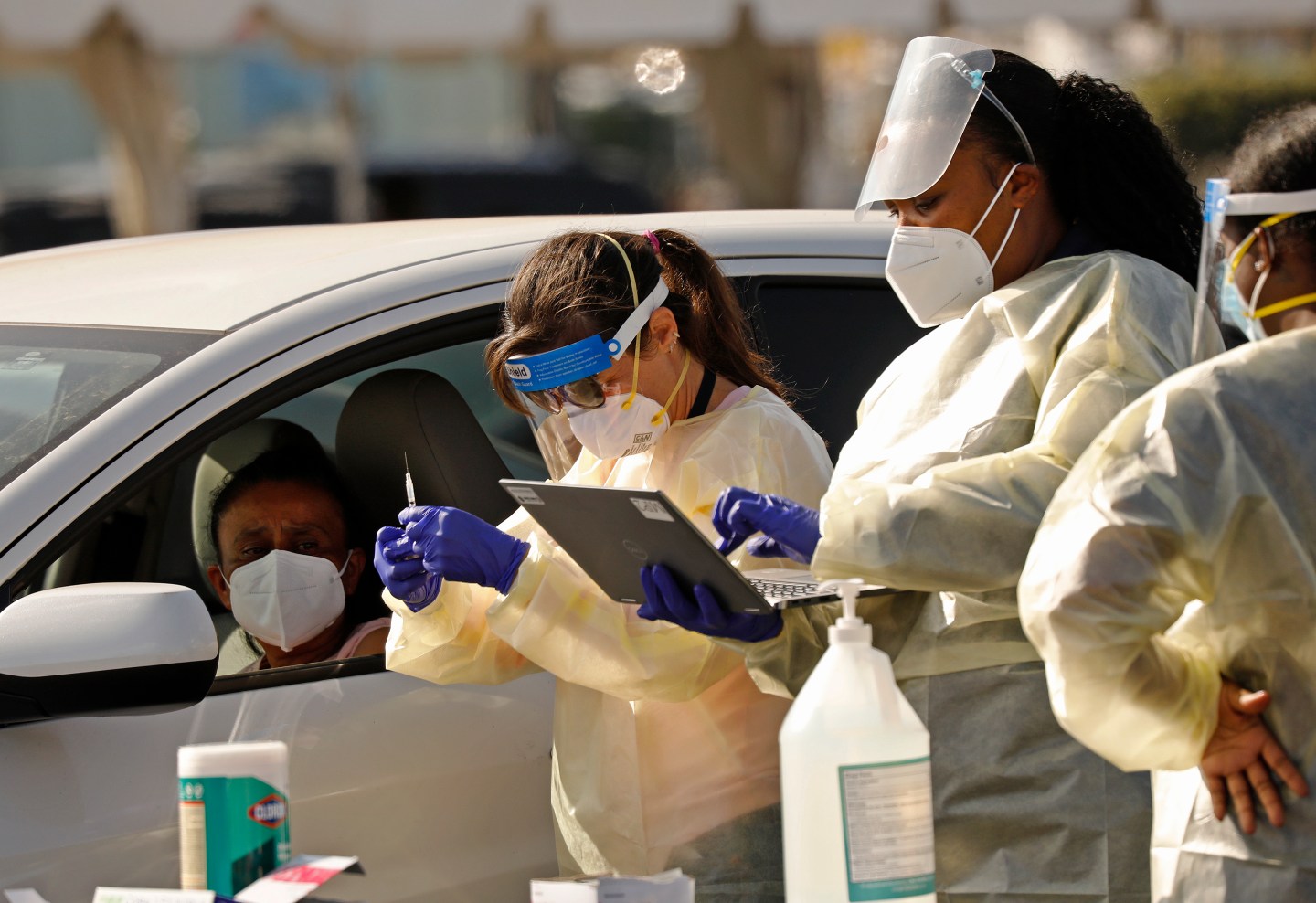
To quickly vaccinate the American population, we must broaden the number of distribution points. To do that, we should be ready to leverage all levels of our existing health care infrastructure, including ambulatory care settings. We have a very distributed health care system for good reason: It helps create trust and care continuity with neighborhood doctors, who can provide culturally competent care in their communities.
For approved vaccines that do not require special equipment, we should administer vaccinations in as many care settings as possible. The Moderna vaccine, for example, comes in small enough batches and can be stored in a regular fridge. We should make it generally available in doctors’ offices.
Empower all health care providers to administer vaccines
To unlock the full capacity of our nations’ providers, we will need to grant a critical mass of local health care providers the ability to actually administer the vaccine. Health care professionals often talk about practicing at the “top of their license.” This is a saying that encourages medical providers of all kinds to up-level their work and utilize the full extent of their education and training.
The vaccination program offers an opportunity for us to think creatively about providers practicing at the top of their license. Today, a patchwork of outdated state rules prevents many highly qualified health care professionals from getting access to and distributing the new vaccines. If we allow only primary-care physicians, internists, and pharmacists to administer a vaccine, we are closing ourselves off from critical pools of care supply.
We should allow all qualified providers, regardless of specialty, to administer the vaccine. If we enable a much broader suite of specialists, including ob/gyns, dermatologists, ENTs, and even dentists, to vaccinate patients, we will flex our system’s capacity and reach herd immunity much more quickly. We will save lives.
Leverage patients’ trust in their providers
Many Americans are skeptical about the vaccine. Public health campaigns will certainly combat this skepticism by using government and public health officials, scientists, local leaders, and celebrities to help increase patients’ trust and willingness to take the vaccine. But we need to use every tool in our toolkit.
Thankfully, local doctors have often spent decades building up trust with patients in their community. We need to leverage those long-standing relationships and build on the goodwill and trust that already exist between a patient and their doctor. These relationships are especially vital in minority communities. At Zocdoc, we are giving doctors and health systems access to free, easy-to-use vaccine scheduling software so that as supply becomes available, they have the technology they need to care for their patients during this critical time.
To further support this trusted provider network, state governments should provide medical professionals with clarity as to when the vaccine will be made available and how they should prioritize their patients. We also need to arm them with information and messaging that will enable them to communicate the safety and urgency of the vaccine to their patients.
Perhaps most importantly, we need the vaccination process to feel familiar and routine to patients. The best way to do so is to make it as organic and woven into patients’ typical care experience as possible. For the average patient, it should feel no different than going to visit their doctor for a flu shot.
Ultimately, I am optimistic that when we bring together the best and brightest minds to work on solving this complex problem, we can deliver a distribution system that matches scientists’ stellar achievements. And with a healthy dose of pragmatism, I have every confidence that we will be able to quickly defeat the virus and begin to return to normal.
Oliver Kharraz, MD, is the founder and CEO of Zocdoc.