This article is part of Fortune‘s quarterly investment guide for Q4 2020.
If 2020 was the year that upended personal lives, workplaces, and how we view health and safety, it may also be the year we reached another tipping point: in how we invest.
Between April and June, as the COVID-19 pandemic gained speed worldwide, funds that prioritize ESG investing—buying stock in companies with an environmental, social, and governance mission—saw global assets under management hit a record $1 trillion, according to Morningstar. That was on the back of net inflows of $7.1 billion in those three months alone.
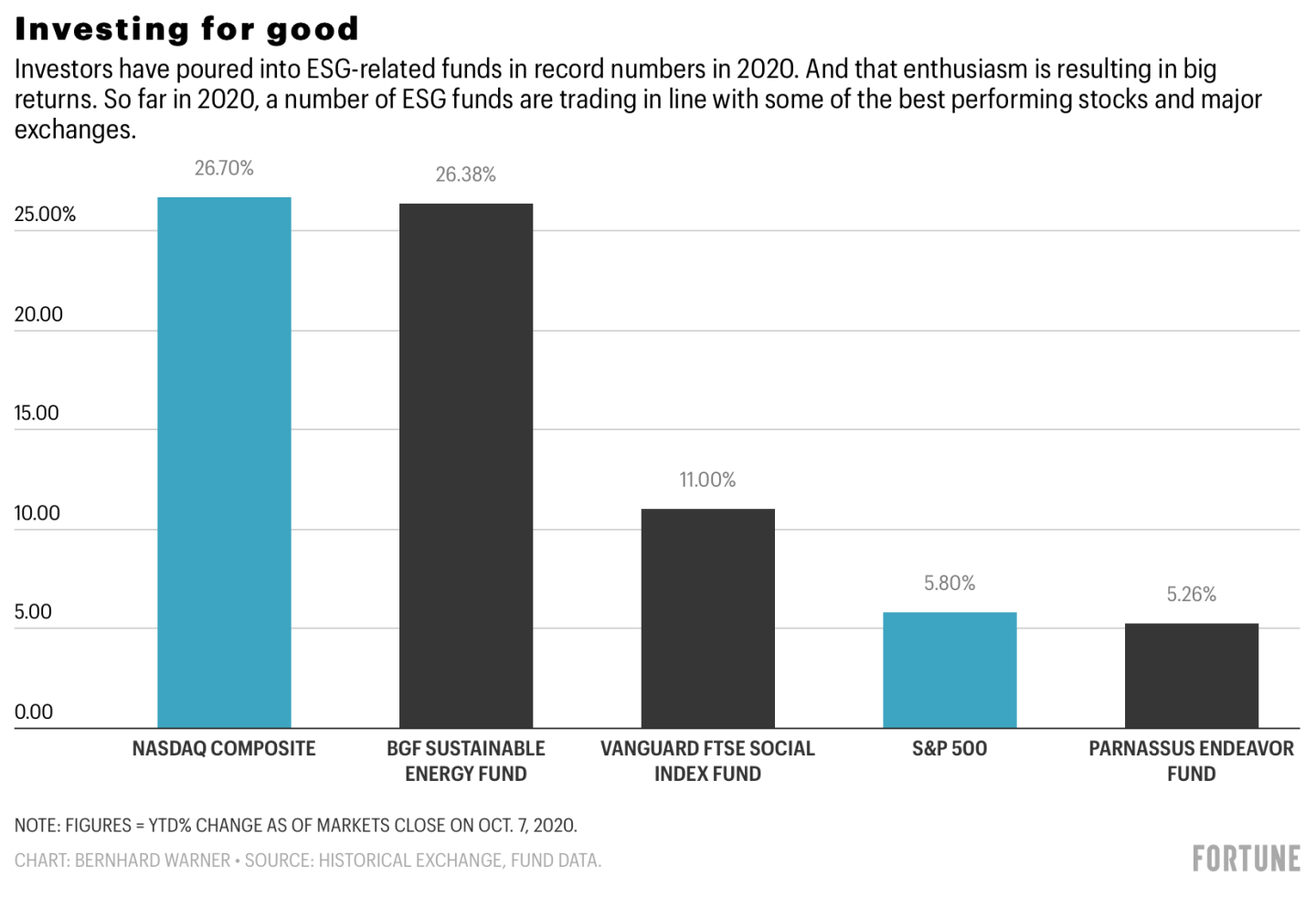
Well-known funds in the U.S. include the Vanguard FTSE Social Index Fund (+11% YTD, as of Oct. 8), which excludes stocks in companies in adult entertainment and tobacco, among other sectors; the Parnassus Endeavor Fund (+5.26% YTD), which excludes some sectors and puts an emphasis on companies with good workplaces; and the BGF Sustainable Energy Fund (+26.38% YTD), which focuses on companies in renewable and sustainable energy.
Two of the three—Vanguard FTSE Social Index and the BGF Sustainable Energy funds—are far outperforming the S&P 500 this year while Parnassus Endeavor Fund is bang in line with the benchmark S&P 500, both up a little over 5% in 2020 (as of Oct. 8).
ESG experts say that generation-defining events of the past year—from the pandemic to racial justice protests to the West Coast wildfires—have only helped fuel momentum that was already there.
“I think now we are in a moment where, in the mainstream portfolio, ESG will be mandatory,” says Michael Herskovich, head of corporate governance at BNP Paribas Asset Management in Paris.
Doing it right, however, still requires a clear-eyed vision, a strategy—and a hefty dose of skepticism.
Here’s how to get started.
Think about what you want to achieve
“ESG is super personal,” says Robert Jenkins, global head of research at Refinitiv Lipper. After all, ESG investing requires you to place a bet, so to speak, on your values. And with so much money on the line, you ought to take an honest look at precisely what it is you care about.
But fear not: ESG experts, including Jenkins, point out that sacrificing returns for investing in good works is no longer a given.
While some experts point out that high ESG scores can be a proxy for a forward-looking management team (and, at least before COVID, that translated to relatively low volatility), others note that it’s difficult to find many companies that check every E, S, and G box.
Once you’re clear about your investment budget, and what risk you can tolerate, narrow it down to questions like: Do you value a low-carbon footprint? What about board diversity? Does that matter to you?
If you choose “low carbon,” for example, then think about whether you want to focus on cutting out companies with high-carbon footprints. Another consideration: Do you want to use your investment as a cudgel to push companies to invest in cleaner operations or reexamine their supply chains?
These are the kinds of questions on the minds of large fund managers. It’s important to know where you stand on these matters, too.
Decide on your strategy
Depending on how much you have to invest, the first place to start is with your existing investments—including your pension. Many institutional investors will now provide you with information on how they integrate ESG and may even be members of investor networks like Climate Action 100+, which engages with companies on lowering their emissions.
If you want to go for passive investing, there are nearly endless options for ETFs that focus on issues ranging from diversity in the management ranks to emissions to social equality. Think about whether you want a product that “screens” out certain sectors or companies—like coal—or is focused on certain industries—like renewable energy.
But if you’ve got the money, ESG is one area where an actively managed fund is frequently worth the fees, says Jenkins. Because ESG is so difficult to track and standardize, doing it properly is time- and research intensive.
Actively managed, established funds can also have a role in engaging directly with companies—a path many experts see as the most effective way to push for change. CCLA, a London-based manager for charities and the public sector, has a policy of “divest the worst and engage the rest,” says Peter Hugh Smith, the chief executive. “Then you have a seat at the table.”
Remain skeptical
Whatever route you pick, prepare to do some research. (Sorry, passive investors.)
Complicating things, ESG investing has long struggled with a lack of transparent, regular, and standardized information that allows you to truly compare apples to apples.
That’s getting easier though as a growing number of NGOs and mission-based investment funds are increasingly doing the work for ESG investors. For example, some put out comparable rankings to help you check emissions reductions targets.
That said, ESG investing may require you to dig well beyond a company’s annual reports and profit projections.
One place to start is with the company’s regulatory disclosures, says the Rev. Kirsten Snow Spalding, senior program director for the Investor Network at Ceres. “If you can’t see it in the disclosures, then it was probably just the marketing department,” she says.
Also look for whether goals are clear, measurable—and near term. The current CEO won’t be around when it comes time to see if a company followed through on its “net zero by 2050” target, says Cynthia Cummins, director of private sector climate mitigation at World Resources Institute.
You need information on how they’re going to achieve that goal—and what their targets are in the years leading up to 2050.
And if the targets are confusing? That can be a red flag, too, warn the experts.
The opposite is true as well—an overwhelming data dump can be designed to obfuscate the facts on the ground.
If a company initiative or target seems vague, confusing, or wishy-washy, think twice about whether it really represents a commitment to ESG.
Explore Fortune’s Q4 investment guide:
- The biggest economic threat facing the next administration
- These 6 economic charts tell the story of Trump’s presidency
- What Wall Street’s favorite election indicators say about who will win the White House in 2020
- 10 stocks to buy now: These names should perform well no matter who wins the White House
- ESG investing is bigger than ever. Here’s how you can save the world, and your portfolio
- This year’s ‘October surprise’ could impact your portfolio for years to come
- The next President will hold a lot of sway over Tesla’s biggest profit center
- Q&A: Former Commerce Secretary Penny Pritzker talks America’s R&D problem, taxes, and the country’s economic outlook
Subscribe to Fortune Daily to get essential business stories straight to your inbox each morning.