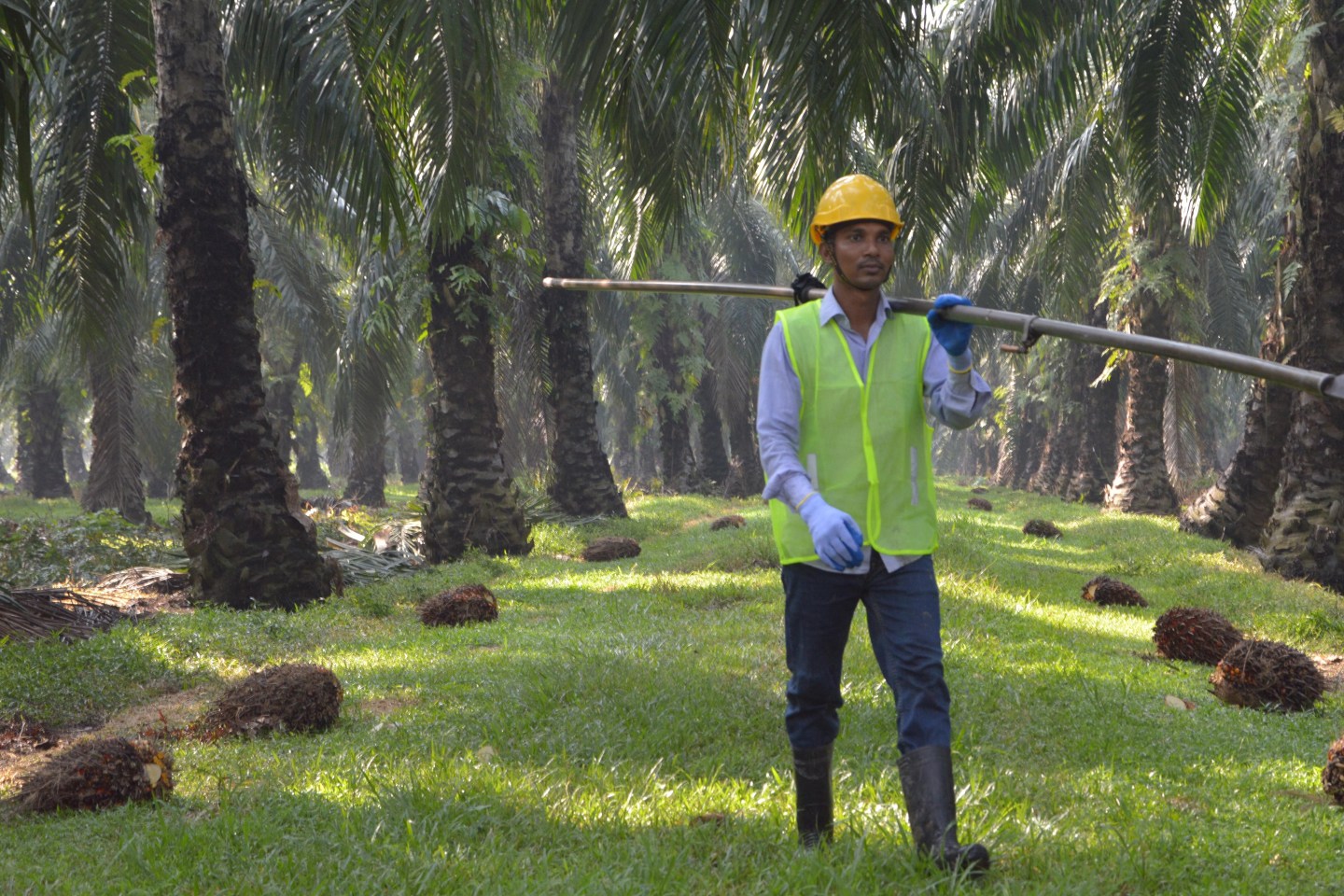
Palm oil. In our snacks, our shampoo, our household products.
A ubiquitous raw material—used in half of the world’s packaged goods—that is driving deforestation and putting at risk the human rights of many.
Can one of the most controversial ingredients on the planet be used sustainably?
The answer to date has been no. While there’s been some progress by global businesses to stop deforestation in their palm oil supply chains, forest area has continued to decline globally in the last several years. According to Global Forest Watch data, the past four years have been the highest on record for tropical forest area loss. What’s more, recent scientific reports have made it clear that protecting and restoring natural ecosystems is an integral part of addressing climate change and limiting global temperature rise to 1.5 degrees Celsius.
These challenges have been further heightened by the coronavirus pandemic, which has exposed the systemic vulnerabilities of global communities and the fragile health of our planet.
While at face value, the simple solution may be to stop using palm oil altogether, it’s important to recognize this would mean walking away from the farmers whose livelihoods depend on the ingredient and pivoting toward something else that may in fact drive even more deforestation.
Like many global businesses, we at Mars have been working tirelessly to try to solve the complex issues of deforestation and human rights challenges in the palm oil supply chain over the past decade. We have tried—and witnessed from our peers across the industry—the different approaches to address deforestation, with varying degrees of success.
Getting our hands around this issue is not only critical for the health of our planet, but also the health of our business. Consumers are now buying products not only because of the product and price, but also because they’re interested in the company behind the brand. Issues such as deforestation are a direct threat to our business—as well as a threat to society and the planet overall—which is why it’s crucial we take action now.
It’s become increasingly clear that in order to effectively tackle societal and environmental issues—such as deforestation associated with palm oil—we need to entirely redesign and transform global business supply chains.
This demands closer partnership with suppliers and other stakeholders to deploy sufficient monitoring and verification of their supply chains to ensure that no deforestation is occurring.
That’s exactly what we are trying to do at Mars. A year ago, we were sourcing from over 1,500 palm mills around the world—a number disproportionately complex to the nature of our operations and ambition. I asked our team: If Mars is purchasing 0.1% of the world’s palm oil, shouldn’t we only be sourcing from a handful of mills?
We went with a new approach: radical simplification.
By drastically simplifying our entire palm oil supply chain, we’re reducing the number of mills we source from and bringing that number down to less than 100 by next year.
As a result of the simplification, as well as a rigorous process of ongoing mapping, monitoring, and supply chain management, we now have a deforestation-free palm oil supply chain.
And we’ve discovered that a pipeline redesigned for the planet and people can also be more efficient for business. For example, by partnering with UniFuji to supply our Asia-Pacific business, we have now reduced operations from 780 mills to just one, with palm being grown in one plantation, processed through just one mill and one refinery before reaching Mars. As a result, the palm that’s delivered is fresher, requires less processing, and reduces our processing costs.
This shows that making radical changes throughout our supply chains can benefit the health of the planet, farmers and workers, and our business. They don’t have to be mutually exclusive.
Beyond fixing our own supply chain, we believe it’s also critical to play a role in driving systemic change by requiring that our suppliers not only sell us clean palm oil, but also only sell clean material to all their customers.
If enough companies follow this path and begin to pressure their suppliers for action, we can reach a tipping point to drive industrywide transformation that will protect the health of our planet.
The world is demanding that global businesses take bold action to rebuild a better, more equitable society, and to put sustainability at the heart of their operations. It’s time for us all to step up to the challenge.
Barry Parkin is chief sustainability and procurement officer at Mars.
Subscribe to Fortune Daily to get essential business stories straight to your inbox each morning.











