• Home
  • Latest
  • Fortune 500
  • Finance
  • Tech
  • Leadership
  • Lifestyle
  • Rankings
  • Multimedia
Magazine

Even after a giant fall, stocks are still expensive by historical standards

Shawn Tully
By
Shawn Tully
Shawn Tully
Senior Editor-at-Large
Down Arrow Button Icon
Shawn Tully
By
Shawn Tully
Shawn Tully
Senior Editor-at-Large
Down Arrow Button Icon
March 11, 2020, 3:00 PM ET

Think back to a simpler time. 

For instance, January and February. Though it seems distant now, the S&P 500 hit its all-time high of 3394 on Feb. 19. “The stock markets previously had priced in a Goldilocks scenario and entered the year with an elevated price-to-earnings multiple, providing little cushion,” says Jared Franz, an economist at investment giant Capital Group. Then came the coronavirus.

As the effects of the coronavirus continued to spread throughout late February and March, the stock market sustained a series of blows. Investors were not only plagued by uncertainty, they also began to reassess the rich premiums they had been paying for all sorts of assets. And once they started asking “How much is this market really worth?” the answer was bleak indeed. “In the past cycle, the elixir was that when the Fed eases, the price of risk assets goes up,” says Liz Ann Sonders, chief investment strategist at Charles Schwab. “That narrative is now undergoing an epic shift. Credit is tightening even though rates are falling, and that’s hitting valuations.”

The bedrock metrics show one thing for sure: Even after the repeated drops, stocks have simply gone from outrageously overpriced to overpriced. The coronavirus was the catalyst that kicked off the current cycle of doubt, but there’s another factor at play too: For most of 2019, stock prices roared ahead while earnings stalled, creating a mismatch between inflated valuations dependent on rising profits and profits that hit a wall. And, says Franz, that wall has only grown higher: “Earnings expectations for the S&P 500 were already muted and have come down further given potential supply disruptions” caused by the coronavirus outbreak.
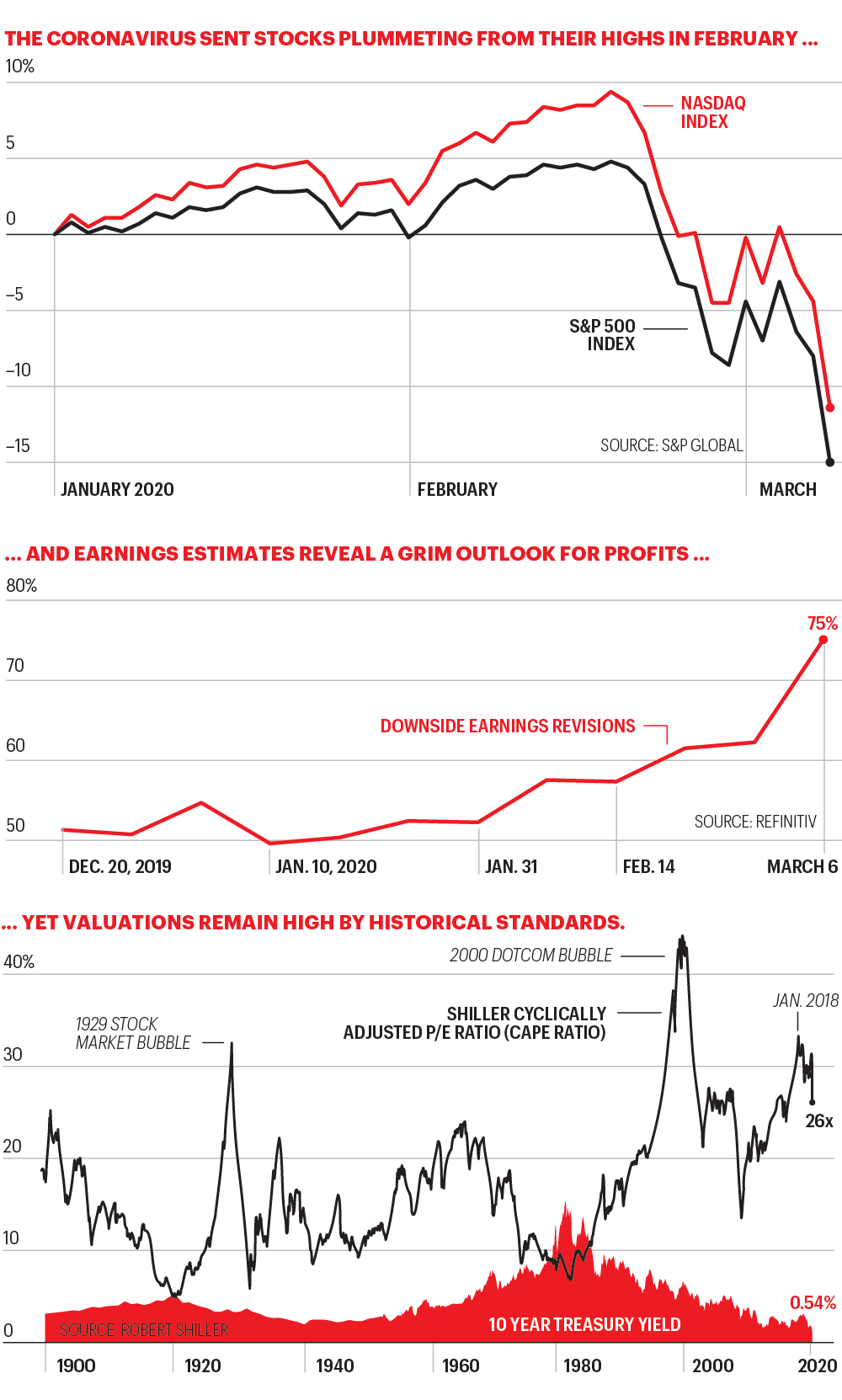
At the S&P 500’s mid-February summit, the price-to-earnings ratio stood at 24.2, based on S&P projected 12-month trailing earnings, through Q1 2020, of $140. That’s 21% above its 20-year average of roughly 20, and almost 40% over the 70-year norm of 17.5. The steep drop of 19% through March 9 lowered the multiple to 19.6—near the average of the past two decades, an era in which they have been richly priced.

As always, equities deliver returns in two packages: dividends and capital gains. Let’s start with dividends. At the recent peak, rising prices had driven the yield to just 1.87%. The selloff has lifted yields to almost 2.2%, better but still below the average of over 3% since 1951. This year, companies spent an amount equal to 42% of their earnings on those dividends. So, on the dividend front, investors are being poorly rewarded for their risk. 

On the capital gains side, there are three driving factors: share buybacks, growth in profits, and “multiple expansion,” or a rising price-to-earnings ratio. Today, S&P 500 companies are spending the equivalent of all earnings that don’t go to dividends on buybacks. (They are able to fund internal investment through added borrowing.) If the S&P continues to steer the cash equivalent of more than half its profits to repurchases, share counts will fall by 3.0%. That would lift earnings per share by a like amount, so if the P/E—the figure by which you multiply those earnings to get the share price—stays at 19.6, the S&P index will advance by the same 3%. Hence, if the current P/E of 19.6 holds, you’ll get a combined 5.2% return from dividends and buybacks alone.

But these improvements when it comes to dividends and capital gains are minor when compared with the abyss below. 

Quarterly earnings went flat starting in Q2 of 2018 and have barely budged since then. With the coronavirus likely to hammer earnings a lot harder than analysts are positing, even no growth now sounds rosy.

And profits are still 40% above where they were three years ago. So today’s 19-plus P/E is putting a high valuation on what looks like an earnings bubble. For confirmation that values are out of whack, look at the CAPE, or cyclically adjusted price/earnings ratio, a measure developed by Robert Shiller, a Yale professor and Nobel laureate. Shiller adjusts the multiple by using a 10-year average of inflation-adjusted profits, a methodology that smooths the lurching swings that make equities look cheap when profits spike and pricey when earnings drop.

Even after the big drop, the Shiller P/E registers 26. It has never stayed at a level that high for long, and the only times it’s been higher were the run-up to the market crash in 1929 and the tech bubble of 2000. If valuations, measured by the Shiller benchmark, return to normal by 2021, the S&P would fall an additional 22%, to 2150.

One thing we can be sure of? Reversion to the mean is a powerful force in the markets—and it usually prevails. 

A version of this article appears in the April 2020 issue of Fortune with the headline “Riding a roller-coaster stock market.”

More must-read stories from Fortune:

—Is this your first stock market crash? Some advice for young investors
—Here are two of the biggest losers from the Saudi Arabia oil price war
—Why investors suddenly turned on pot stocks
—Here are some of the most extreme ways companies are combating coronavirus
—Why it’s so hard to find the next Warby Parker

Subscribe to Fortune’s Bull Sheet for no-nonsense finance news and analysis daily.
About the Author
Shawn Tully
By Shawn TullySenior Editor-at-Large

Shawn Tully is a senior editor-at-large at Fortune, covering the biggest trends in business, aviation, politics, and leadership.

See full bioRight Arrow Button Icon

Latest from the Magazine

Finance
Lorem ipsum dolor sit amet, consectetur adipiscing elit, sed do eiusmod tempor incididunt ut labore et dolore magna aliqua. Ut enim ad minim veniam
By Fortune Editors
October 20, 2025
Finance
Lorem ipsum dolor sit amet, consectetur adipiscing elit, sed do eiusmod tempor incididunt ut labore et dolore magna aliqua. Ut enim ad minim veniam
By Fortune Editors
October 20, 2025
Finance
Lorem ipsum dolor sit amet, consectetur adipiscing elit, sed do eiusmod tempor incididunt ut labore et dolore magna aliqua. Ut enim ad minim veniam
By Fortune Editors
October 20, 2025
Finance
Lorem ipsum dolor sit amet, consectetur adipiscing elit, sed do eiusmod tempor incididunt ut labore et dolore magna aliqua. Ut enim ad minim veniam
By Fortune Editors
October 20, 2025
Finance
Lorem ipsum dolor sit amet, consectetur adipiscing elit, sed do eiusmod tempor incididunt ut labore et dolore magna aliqua. Ut enim ad minim veniam
By Fortune Editors
October 20, 2025
Finance
Lorem ipsum dolor sit amet, consectetur adipiscing elit, sed do eiusmod tempor incididunt ut labore et dolore magna aliqua. Ut enim ad minim veniam
By Fortune Editors
October 20, 2025

Most Popular

Finance
Lorem ipsum dolor sit amet, consectetur adipiscing elit, sed do eiusmod tempor incididunt ut labore et dolore magna aliqua. Ut enim ad minim veniam
By Fortune Editors
October 20, 2025
Finance
Lorem ipsum dolor sit amet, consectetur adipiscing elit, sed do eiusmod tempor incididunt ut labore et dolore magna aliqua. Ut enim ad minim veniam
By Fortune Editors
October 20, 2025
Finance
Lorem ipsum dolor sit amet, consectetur adipiscing elit, sed do eiusmod tempor incididunt ut labore et dolore magna aliqua. Ut enim ad minim veniam
By Fortune Editors
October 20, 2025
Finance
Lorem ipsum dolor sit amet, consectetur adipiscing elit, sed do eiusmod tempor incididunt ut labore et dolore magna aliqua. Ut enim ad minim veniam
By Fortune Editors
October 20, 2025
Finance
Lorem ipsum dolor sit amet, consectetur adipiscing elit, sed do eiusmod tempor incididunt ut labore et dolore magna aliqua. Ut enim ad minim veniam
By Fortune Editors
October 20, 2025
Finance
Lorem ipsum dolor sit amet, consectetur adipiscing elit, sed do eiusmod tempor incididunt ut labore et dolore magna aliqua. Ut enim ad minim veniam
By Fortune Editors
October 20, 2025
Rankings
  • 100 Best Companies
  • Fortune 500
  • Global 500
  • Fortune 500 Europe
  • Most Powerful Women
  • Future 50
  • World’s Most Admired Companies
  • See All Rankings
Sections
  • Finance
  • Leadership
  • Success
  • Tech
  • Asia
  • Europe
  • Environment
  • Fortune Crypto
  • Health
  • Retail
  • Lifestyle
  • Politics
  • Newsletters
  • Magazine
  • Features
  • Commentary
  • Mpw
  • CEO Initiative
  • Conferences
  • Personal Finance
  • Education
Customer Support
  • Frequently Asked Questions
  • Customer Service Portal
  • Privacy Policy
  • Terms Of Use
  • Single Issues For Purchase
  • International Print
Commercial Services
  • Advertising
  • Fortune Brand Studio
  • Fortune Analytics
  • Fortune Conferences
  • Business Development
About Us
  • About Us
  • Editorial Calendar
  • Press Center
  • Work At Fortune
  • Diversity And Inclusion
  • Terms And Conditions
  • Site Map
  • Facebook icon
  • Twitter icon
  • LinkedIn icon
  • Instagram icon
  • Pinterest icon

© 2026 Fortune Media IP Limited. All Rights Reserved. Use of this site constitutes acceptance of our Terms of Use and Privacy Policy | CA Notice at Collection and Privacy Notice | Do Not Sell/Share My Personal Information
FORTUNE is a trademark of Fortune Media IP Limited, registered in the U.S. and other countries. FORTUNE may receive compensation for some links to products and services on this website. Offers may be subject to change without notice.


Most Popular

placeholder alt text
North America
'I meant what I said in Davos': Carney says he really is planning a Canada split with the U.S. along with 12 new trade deals
By Rob Gillies and The Associated PressJanuary 28, 2026
3 days ago
placeholder alt text
Politics
The American taxpayer spent nearly half a billion dollars deploying federal troops to U.S. cities in 2025, CBO finds
By Nick LichtenbergJanuary 28, 2026
3 days ago
placeholder alt text
Economy
Right before Trump named Warsh to lead the Fed, Powell seemed to respond to some of his biggest complaints about the central bank
By Jason MaJanuary 30, 2026
18 hours ago
placeholder alt text
AI
Top engineers at Anthropic, OpenAI say AI now writes 100% of their code—with big implications for the future of software development jobs
By Beatrice NolanJanuary 29, 2026
2 days ago
placeholder alt text
Investing
Jerome Powell got a direct question about the U.S. ‘losing credibility’ and the soaring price of gold and silver. He punted
By Eva RoytburgJanuary 29, 2026
2 days ago
placeholder alt text
C-Suite
Fortune 500 CEOs are no longer giving employees an A for effort. Now they want proof of impact
By Claire ZillmanJanuary 28, 2026
3 days ago

Latest from the Magazine

MagazineEducation
The 1966 cover of Fortune Magazine welcomed the Information age. Now the AI era beckons
By Indrani SenJanuary 30, 2026
14 hours ago
MagazineBonds
Bonds 101: What investors need to know about the ‘shock absorber of the portfolio’
By Jeff John RobertsJanuary 29, 2026
2 days ago
MagazineSamsung
How Samsung’s first-ever chief design officer is reinventing the electronics giant for the AI age
By Nicholas GordonJanuary 28, 2026
3 days ago
MagazineHyatt Hotels
Hyatt’s high-end makeover: How Mark Hoplamazian built the Berkshire Hathaway of luxury hotels
By Matthew HeimerJanuary 28, 2026
3 days ago
MagazineData centers
Inside a multibillion dollar AI data center powering the future of the American economy
By Sharon Goldman and Nicolas RappJanuary 27, 2026
4 days ago
MagazineTether
Crypto giant Tether has $187 billion in assets, big plans for U.S. expansion—and a CEO who warns the West is heading toward social collapse
By Jeff John RobertsJanuary 27, 2026
4 days ago