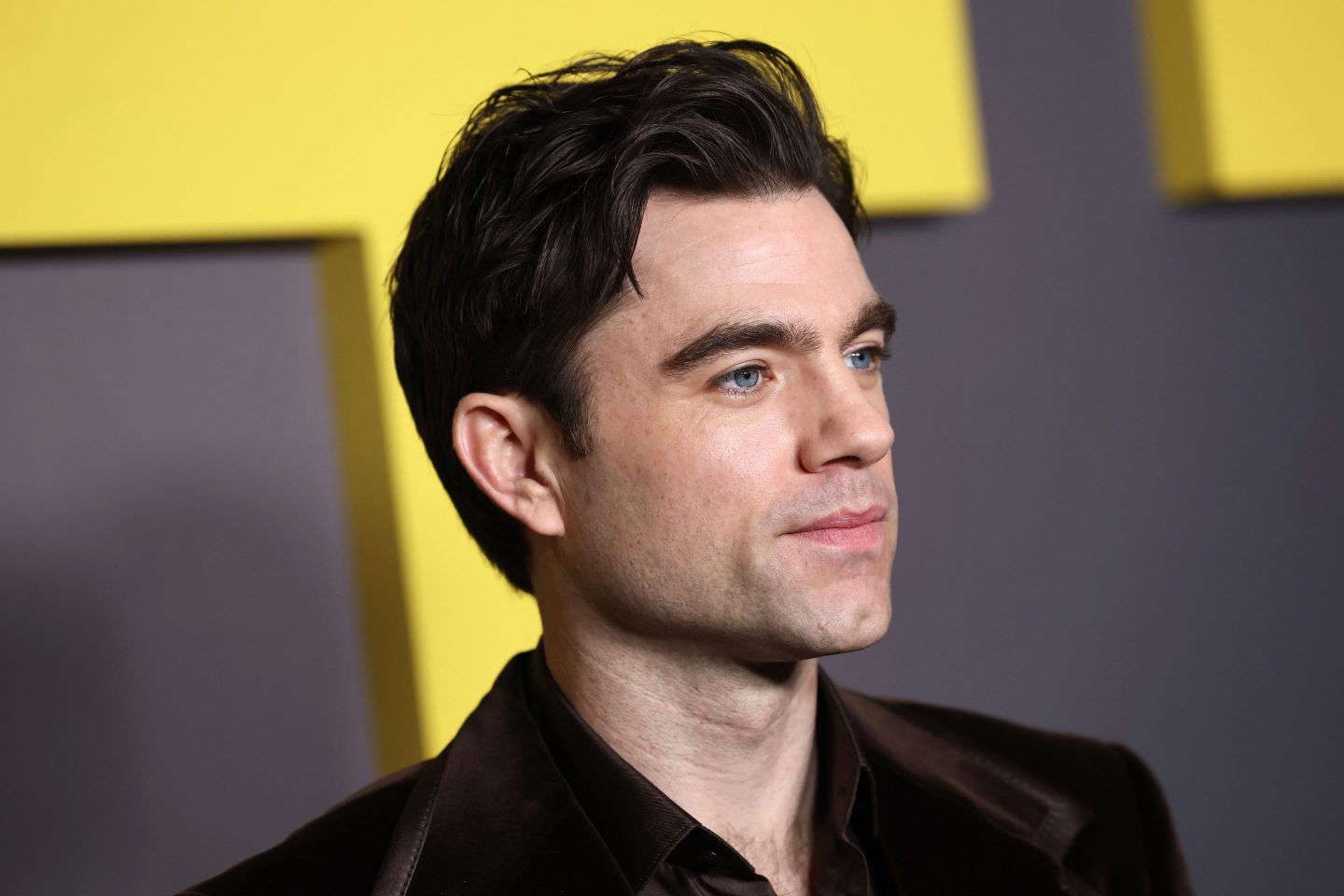
“I consider Martin Scorsese to be a master of camera language,” says cinematographer Rodrigo Prieto—and he should know.
Since getting an out-of-the-blue invitation from Scorsese to shoot The Wolf of Wall Street in 2013, Prieto has become the storied filmmaker’s go-to director of photography. He earned an Oscar nomination for 2016’s Silence and again this year for The Irishman.
“Scorsese has a very specific vision of what he wants to achieve,” Prieto tells Fortune. “He designs the shots he wants, but at the same time he makes you feel like it’s your movie too.”
Prieto revered Raging Bull during his film-student years in Mexico City before making his own mark with visually arresting films including Amores Perros, Babel, and Brokeback Mountain. He’s always marveled at Scorsese’s ability to engage moviegoers with characters they’d probably cross the street to avoid in real life.
“So many Scorsese movies center on characters we would normally find despicable,” he says. “Look at Raging Bull, look at Taxi Driver, look at [Leonardo DiCaprio’s swindler character] Belfort in The Wolf of Wall Street! But somehow, you go for the ride, and a lot of that has to do with getting into the mindset of the character through the camera.”
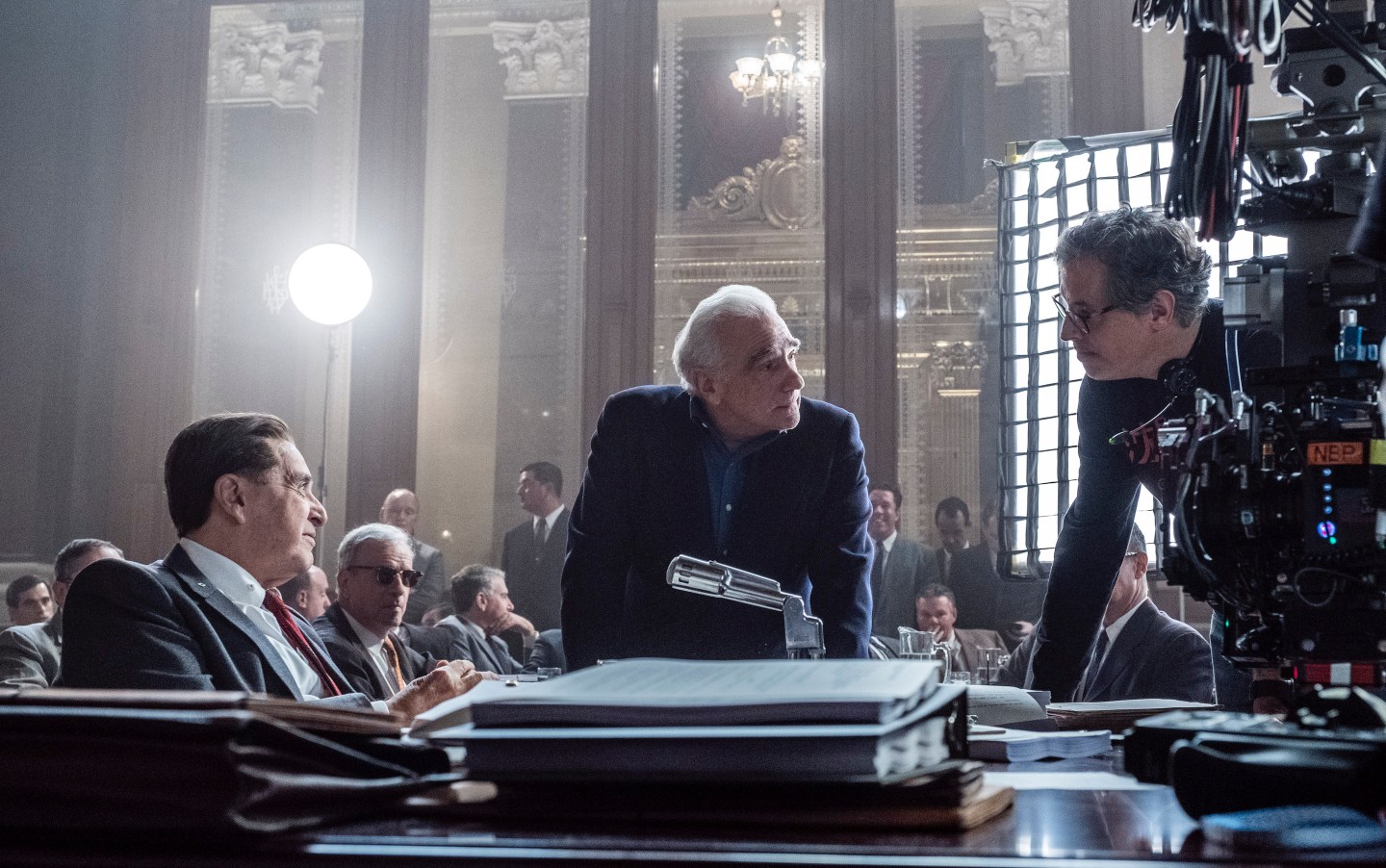
To immerse viewers in the world of Irish hit man Frank Sheeran, played by Robert De Niro, Scorsese tasked Prieto with a formidable array of technical challenges. For starters, Prieto and his crew pioneered a custom-designed “three-headed monster” camera rig. Equipped with two “witness cameras” that record ultraviolet light invisible to the naked eye, Prieto’s setup allowed VFX artists to digitally de-age the actors without forcing them to wear the cumbersome sensors and helmet cams normally deployed for motion capture CGI enhancements.
Prieto also filmed scenes of dialogue with two rigs simultaneously, rather than focusing on one actor at a time per normal practice. “That was really difficult because normally, when you light one actor, it impacts the other actor, and usually not in the best way,” Prieto says. “I devised techniques to control the lighting, and somehow we managed.”
And because The Irishman saga spans six decades, Prieto needed to create a visual vocabulary for each era inhabited by De Niro, Al Pacino as Teamsters boss Jimmy Hoffa, and Joe Pesci in the role of Mobster mentor Russell Bufalino. “Scorsese wanted to give a certain patina to the past,” Prieto says, “because, after all, the movie is about how we remember things and the passage of time.”
‘The Irishman’ and its colorful past
Prieto manipulated his color palette to subtly signal time jumps. “When Scorsese asked me to give each period a different look, I came up with this notion that we remember things through the photographs taken in our past, and those photographs have a certain color because of the emulsions they were printed with at the time,” he says.
“In the ’50s, I found that Kodachrome was very popular. I created something called a Look Up Table that allowed me to match [normal] green to the way that Kodachrome would have reproduced green, which is not necessarily the way your eye sees it. And Kodachrome red is very saturated. That’s why you’ll notice that in our scenes that take place in the ’50s, like when De Niro and Joe Pesci are repairing the truck, their faces are quite red. That’s in emulation of Kodachrome.”
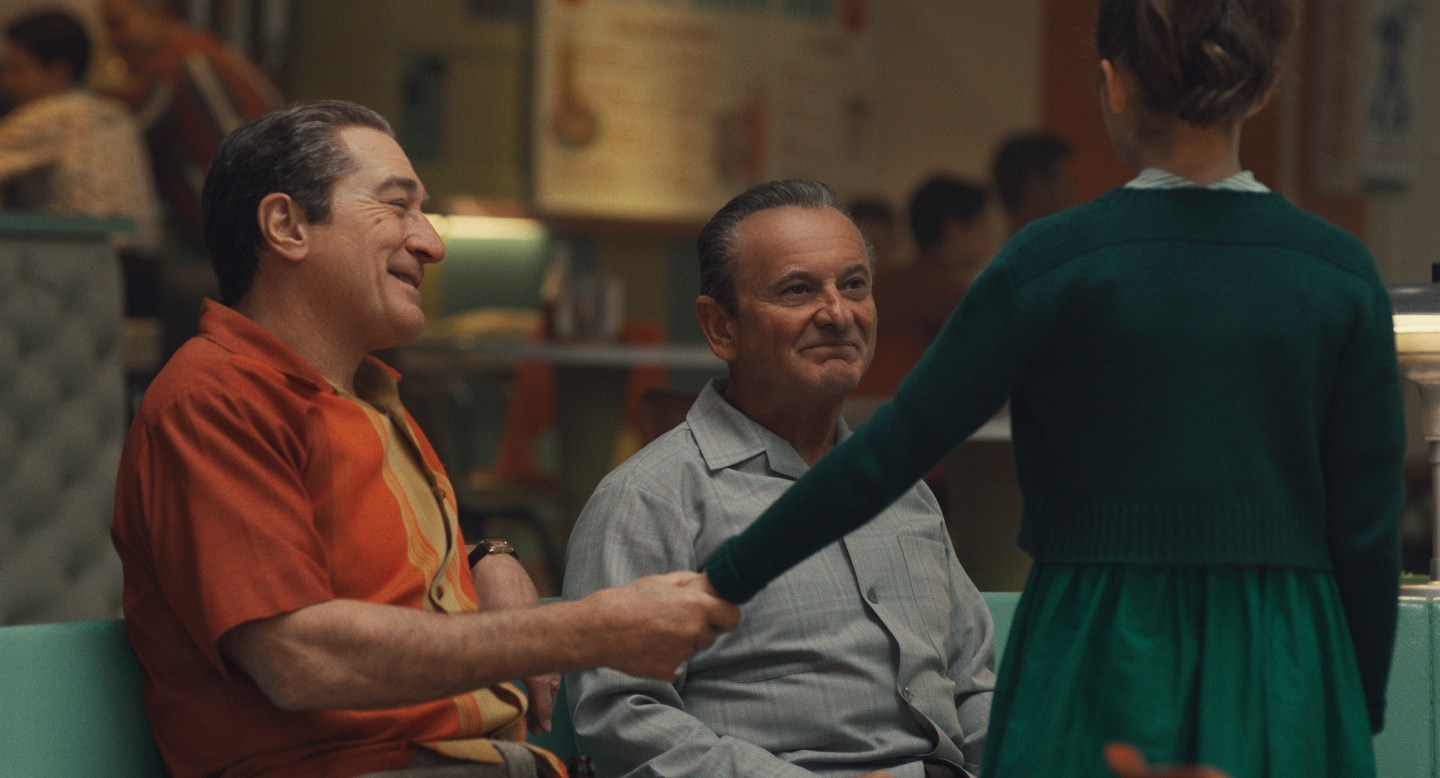
For the ’60s-era chapter of the story, Prieto modeled his palette after vintage Ektachrome film, which skews toward cyan and blue-green, and translates, Prieto says, into colder blacks and cooler shadows.
For The Irishman’s shocking third act, set mainly in a prison and a nursing home where De Niro’s aging Sheeran spends his final days, Prieto set the mood by using a “bleach bypass” process. “The colors are desaturated, and the blacks become deeper and more contrast-y,” he explains. “I also ‘force-developed’ the motion picture negative to create more of a grainy structure. So from the moment Jimmy Hoffa dies, the images become more grainy and less saturated, as if the meaning of everyone’s life kind of goes away. That felt like the right treatment for the lonely part of Frank’s life when he’s looking for his pills or watching TV all by himself.”
Capturing the De Niro mystique
Prieto made a short film with De Niro a few years ago, but The Irishman essentially offered the DP a master class on the difference between film acting and stage performance. “We shot half the movie digitally for the de-aging, but for the half that did not require visual effects, I operated a film camera,” Prieto says.
“I was blown away when I’d look through the optical eyepiece at De Niro. He would do things by literally not doing anything, but I could feel the performance,” Prieto says, laughing as he recalls the actor’s method intensity. “I’d frame a close-up of De Niro, and his face wouldn’t move at all, yet you could sense all these tremendous emotions that his character is swallowing and burying. Like when De Niro’s character gets on the plane to go to Detroit and kill Hoffa, it’s just a man sitting there, right? But somehow, there’s this magic projected to the camera. I don’t know how he does it.”
The direct approach
In keeping with The Irishman’s title character, the camerawork favored simplicity over elaborate camera movement. Cinematic form followed character function, Prieto says.
“Marty talked to me about how Frank Sheeran approaches his work, which happens to be killing people, in this very methodical way. He scopes the place, he chooses the weapon, he decides how to go in and get out,” Prieto says. “Like clockwork, Frank figures out the most efficient way to do his job, so it was the same with the camera. The most efficient way to film a killing is to just put the camera on a tripod and film it from a distance. Very simple. Very direct. And that’s because Frank’s character is not eloquent. He doesn’t talk a lot. He only says what needs to be said. And so, the camera does the same thing.”
More must-read stories from Fortune:
—How much is an Oscar worth?
—Bombshell‘s Charlize Theron and John Lithgow reflect on the film’s indelible impact
—HBO’s McMillion$ shows how cheaters scammed McDonald’s Monopoly game
—American Factory directors on capturing what “globalization looks like on a human scale”
—Taika Waititi on Kiwi humor, directing as Hitler, and why kids should see Jojo Rabbit
Follow Fortune on Flipboard to stay up-to-date on the latest news and analysis.