

• Home
  • Latest
  • Fortune 500
  • Finance
  • Tech
  • Leadership
  • Lifestyle
  • Rankings
  • Multimedia
MagazineEconomy

When it comes to the optimism divide between CEOs and investors, somebody’s wrong

Geoff Colvin
By
Geoff Colvin
Geoff Colvin
Senior Editor-at-Large
Down Arrow Button Icon
Geoff Colvin
By
Geoff Colvin
Geoff Colvin
Senior Editor-at-Large
Down Arrow Button Icon
January 21, 2020, 6:30 AM ET
CEO.02.20.Balloon
Photo-Illustration by Matt ChasePhoto-Illustration by Matt Chase

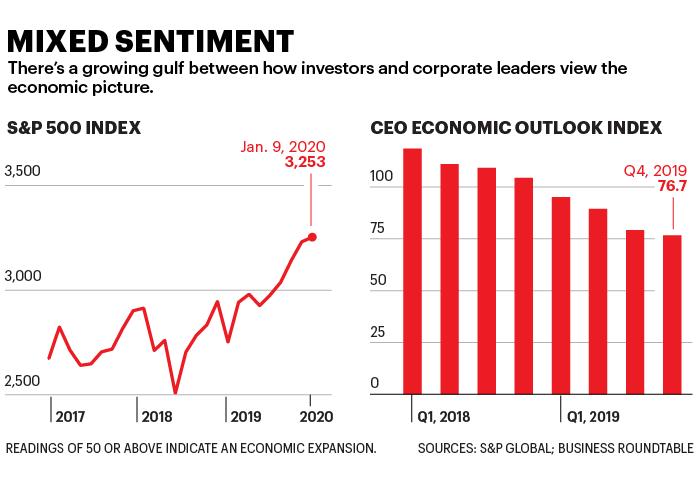
Trouble is brewing when the owners of a business and the managers who run that business see the world in fundamentally different ways. That’s the uncomfortable situation right now at America’s publicly traded corporations. The owners—investors—see a brilliant future for U.S. companies, bidding their stocks up to record highs. But the managers—CEOs—see a far darker future, as revealed in surveys of CEO sentiment. The contrast is starker than it has been in years, perhaps decades. “Somebody’s wrong,” says investment strategist Rob Arnott of Research Affiliates, “and is going to have to change their plans.”

Investors’ ebullience is obvious in the stock market, where dollars do the talking. But the deep pessimism of CEOs is less visible and has gone largely unnoticed. They’re invariably upbeat when speaking to investors, but when CEOs respond anonymously to surveys, their mood shifts dramatically. The economic outlook of CEOs surveyed by the Business Roundtable recently worsened for the seventh consecutive quarter. Most of the bosses don’t expect a recession, but the possibility of one is now their No. 1 worry, up from No. 3 a year ago, says a survey by the Conference Board. The Roundtable CEOs say their plans for capital investment and for hiring have decreased significantly. When America’s biggest companies are cutting back on the two main factors of production—capital and labor—the outlook would not seem bright.

Yet stocks keep surging. What gives? Are CEOs and investors looking at the same world? The answer, which helps explain this bizarre conflict, is that in many ways they are not.

“CEOs have been in a desperate struggle to generate earnings growth,” says Savita Subramanian, chief of U.S. equity research at Bank of America. That has been hard because “sales growth has been relatively tepid” over the past 12 months, she says. “CEOs realize a lot of the levers they’ve used to generate growth in earnings per share—cost cutting, share buybacks—are running out of steam. You can’t do those things forever.” Add a slowing economy and rising labor costs to the picture, and CEO gloom makes sense.

Yet investors, looking outside companies rather than inside them, see a different world. The consumer is healthy and the Fed is friendly. What’s not to like? “The narrative of low rates is driving sentiment,” says Arnott. “People are starting to really rely on the ‘Fed put’ ”—the expectation that the Fed will rescue the economy from any impending recession. “That’s dangerous. The Fed isn’t as powerful as some people think.”

Investors don’t see the CEOs’ worries in large part because they aren’t looking for them. Remember that investors aren’t individuals, for the most part. They’re overwhelmingly institutions such as mutual funds and pension funds, which in the past decade have largely forsaken value investing, with its fuddy-duddy focus on a company’s ability to deliver long-term profits with little debt. Instead, they’ve pursued growth and yield, strategies that have worked well. But experience says they don’t work well indefinitely.
Separating investors even further from CEOs is the widespread use of so-called quant funds, largely driven by algorithms. “Most of them are momentum-based,” says Subramanian. You simply buy what’s going up. “So you’re super bullish right now.” To a momentum algo, all those CEO worries are irrelevant.

Wall Street analysts may be encouraging investors to ignore mounting risks even more than usual. Research shows that analysts are habitually overoptimistic in predicting profit growth for individual companies. The further out the forecast, the more extravagant it is; then, as the actual earnings report draws closer, analysts scale back their estimates toward reality. They’ve done it for decades, and are doing it now. For example, they predicted a year in advance that profits for the S&P 500 would grow 12.1% in last year’s third quarter, says data from Refinitiv. Actual profit growth: –0.3%.

You’d think investors would learn to discount analysts’ long-term estimates. But the too-bullish problem gets worse in a slowing economy like the one we’re in. “When economic growth slows, [the size of the forecast error] increases,” say McKinsey researchers. Analysts are still reassuring investors that they needn’t worry. The aggregate forecast for profit growth in 2020’s fourth quarter is a knockout 14.5%.

None of which is to say that the despondent CEOs are right and the Champagne-popping investors are wrong, at least not in the short run. “This market looks to us like a bubble,” says Arnott. “But bubbles can go on much further than most people realize. It will end, but we don’t know when.” 

A version of this article appears in the February 2020 issue of Fortune with the headline “The Optimism Divide.”

More must-read stories from Fortune:

—25 ideas that will shape the 2020s
—Why it’s time for a futures market in health care
—What we can learn from the man who tried to sell the Eiffel Tower—twice
—Food-delivery services feeling pressure to finally turn a profit
—Disney is ready to roll out new Star Wars sagas as one story ends
Subscribe to Fortune’s forthcoming Bull Sheet for no-nonsense finance news and analysis daily.

About the Author
Geoff Colvin
By Geoff ColvinSenior Editor-at-Large
LinkedIn iconTwitter icon

Geoff Colvin is a senior editor-at-large at Fortune, covering leadership, globalization, wealth creation, the infotech revolution, and related issues.

See full bioRight Arrow Button Icon

Latest from the Magazine

Finance
Lorem ipsum dolor sit amet, consectetur adipiscing elit, sed do eiusmod tempor incididunt ut labore et dolore magna aliqua. Ut enim ad minim veniam
By Fortune Editors
October 20, 2025
Finance
Lorem ipsum dolor sit amet, consectetur adipiscing elit, sed do eiusmod tempor incididunt ut labore et dolore magna aliqua. Ut enim ad minim veniam
By Fortune Editors
October 20, 2025
Finance
Lorem ipsum dolor sit amet, consectetur adipiscing elit, sed do eiusmod tempor incididunt ut labore et dolore magna aliqua. Ut enim ad minim veniam
By Fortune Editors
October 20, 2025
Finance
Lorem ipsum dolor sit amet, consectetur adipiscing elit, sed do eiusmod tempor incididunt ut labore et dolore magna aliqua. Ut enim ad minim veniam
By Fortune Editors
October 20, 2025
Finance
Lorem ipsum dolor sit amet, consectetur adipiscing elit, sed do eiusmod tempor incididunt ut labore et dolore magna aliqua. Ut enim ad minim veniam
By Fortune Editors
October 20, 2025
Finance
Lorem ipsum dolor sit amet, consectetur adipiscing elit, sed do eiusmod tempor incididunt ut labore et dolore magna aliqua. Ut enim ad minim veniam
By Fortune Editors
October 20, 2025

Most Popular

Finance
Lorem ipsum dolor sit amet, consectetur adipiscing elit, sed do eiusmod tempor incididunt ut labore et dolore magna aliqua. Ut enim ad minim veniam
By Fortune Editors
October 20, 2025
Finance
Lorem ipsum dolor sit amet, consectetur adipiscing elit, sed do eiusmod tempor incididunt ut labore et dolore magna aliqua. Ut enim ad minim veniam
By Fortune Editors
October 20, 2025
Finance
Lorem ipsum dolor sit amet, consectetur adipiscing elit, sed do eiusmod tempor incididunt ut labore et dolore magna aliqua. Ut enim ad minim veniam
By Fortune Editors
October 20, 2025
Finance
Lorem ipsum dolor sit amet, consectetur adipiscing elit, sed do eiusmod tempor incididunt ut labore et dolore magna aliqua. Ut enim ad minim veniam
By Fortune Editors
October 20, 2025
Finance
Lorem ipsum dolor sit amet, consectetur adipiscing elit, sed do eiusmod tempor incididunt ut labore et dolore magna aliqua. Ut enim ad minim veniam
By Fortune Editors
October 20, 2025
Finance
Lorem ipsum dolor sit amet, consectetur adipiscing elit, sed do eiusmod tempor incididunt ut labore et dolore magna aliqua. Ut enim ad minim veniam
By Fortune Editors
October 20, 2025
Fortune Secondary Logo
Rankings
  • 100 Best Companies
  • Fortune 500
  • Global 500
  • Fortune 500 Europe
  • Most Powerful Women
  • World's Most Admired Companies
  • See All Rankings
  • Lists Calendar
Sections
  • Finance
  • Fortune Crypto
  • Features
  • Leadership
  • Health
  • Commentary
  • Success
  • Retail
  • Mpw
  • Tech
  • Lifestyle
  • CEO Initiative
  • Asia
  • Politics
  • Conferences
  • Europe
  • Newsletters
  • Personal Finance
  • Environment
  • Magazine
  • Education
Customer Support
  • Frequently Asked Questions
  • Customer Service Portal
  • Privacy Policy
  • Terms Of Use
  • Single Issues For Purchase
  • International Print
Commercial Services
  • Advertising
  • Fortune Brand Studio
  • Fortune Analytics
  • Fortune Conferences
  • Business Development
  • Group Subscriptions
About Us
  • About Us
  • Press Center
  • Work At Fortune
  • Terms And Conditions
  • Site Map
  • About Us
  • Press Center
  • Work At Fortune
  • Terms And Conditions
  • Site Map
  • Facebook icon
  • Twitter icon
  • LinkedIn icon
  • Instagram icon
  • Pinterest icon

Latest from the Magazine

Who’s really in control as AI and Big Tech race ahead?
MagazineEurope
Who’s really in control as AI and Big Tech race ahead?
By Francesca CassidyApril 10, 2026
21 days ago
Who owns ideas in the AI age?
MagazinePublishing
Who owns ideas in the AI age?
By Francesca CassidyApril 8, 2026
23 days ago
Southeast Asia’s business leaders want wellness at work—as long as the programs get real results
Magazine100 Best Companies to Work For
Southeast Asia’s business leaders want wellness at work—as long as the programs get real results
By Alice WilliamsApril 8, 2026
23 days ago
So… what are we doing with AI? Innovating in an age of caution
MagazineStrategy
So… what are we doing with AI? Innovating in an age of caution
By Francesca CassidyApril 7, 2026
24 days ago
Anthropic’s research shows that AI can already do a huge portion of many jobs; its top economist talks about how that could shape the future of work
MagazineAutomation
Anthropic’s research shows that AI can already do a huge portion of many jobs; its top economist talks about how that could shape the future of work
By Matthew Heimer and Nicolas RappApril 7, 2026
24 days ago
Fortune Archives: Who gets a seat at the table?
MagazineFortune Archives
Fortune Archives: Who gets a seat at the table?
By Indrani SenApril 5, 2026
26 days ago

Most Popular

Apple cofounder Ronald Wayne—whose stake would be worth up to $400 billion had he not sold it in 1976—says that at 91, he has no regrets
Success
Apple cofounder Ronald Wayne—whose stake would be worth up to $400 billion had he not sold it in 1976—says that at 91, he has no regrets
By Preston ForeApril 27, 2026
4 days ago
China dominates the world's lithium supply. The U.S. just found 328 years' worth in its own backyard
North America
China dominates the world's lithium supply. The U.S. just found 328 years' worth in its own backyard
By Jake AngeloApril 30, 2026
15 hours ago
Google Cloud revenue is now 18% of Alphabet's business. Is this the beginning of the end of Google's search identity?
Big Tech
Google Cloud revenue is now 18% of Alphabet's business. Is this the beginning of the end of Google's search identity?
By Alexei OreskovicApril 29, 2026
1 day ago
Accenture's Julie Sweet blew up 50 years of company history. She says the hardest part is still ahead
Conferences
Accenture's Julie Sweet blew up 50 years of company history. She says the hardest part is still ahead
By Nick LichtenbergApril 29, 2026
2 days ago
With no end in sight, Trump considers new options in Iran war—including the ‘Dark Eagle’ hypersonic missile
Big Tech
With no end in sight, Trump considers new options in Iran war—including the ‘Dark Eagle’ hypersonic missile
By Jim EdwardsApril 30, 2026
23 hours ago
‘The cost of compute is far beyond the costs of the employees’: Nvidia executive says right now AI is more expensive than paying human workers
AI
‘The cost of compute is far beyond the costs of the employees’: Nvidia executive says right now AI is more expensive than paying human workers
By Sasha RogelbergApril 28, 2026
3 days ago

© 2026 Fortune Media IP Limited. All Rights Reserved. Use of this site constitutes acceptance of our Terms of Use and Privacy Policy | CA Notice at Collection and Privacy Notice | Do Not Sell/Share My Personal Information
FORTUNE is a trademark of Fortune Media IP Limited, registered in the U.S. and other countries. FORTUNE may receive compensation for some links to products and services on this website. Offers may be subject to change without notice.