• Home
  • Latest
  • Fortune 500
  • Finance
  • Tech
  • Leadership
  • Lifestyle
  • Rankings
  • Multimedia
TechAI

Startup Cerebras Unveils a Speedy—and Small—Supercomputer

By
Tiernan Ray
Tiernan Ray
Down Arrow Button Icon
By
Tiernan Ray
Tiernan Ray
Down Arrow Button Icon
November 19, 2019, 8:01 AM ET
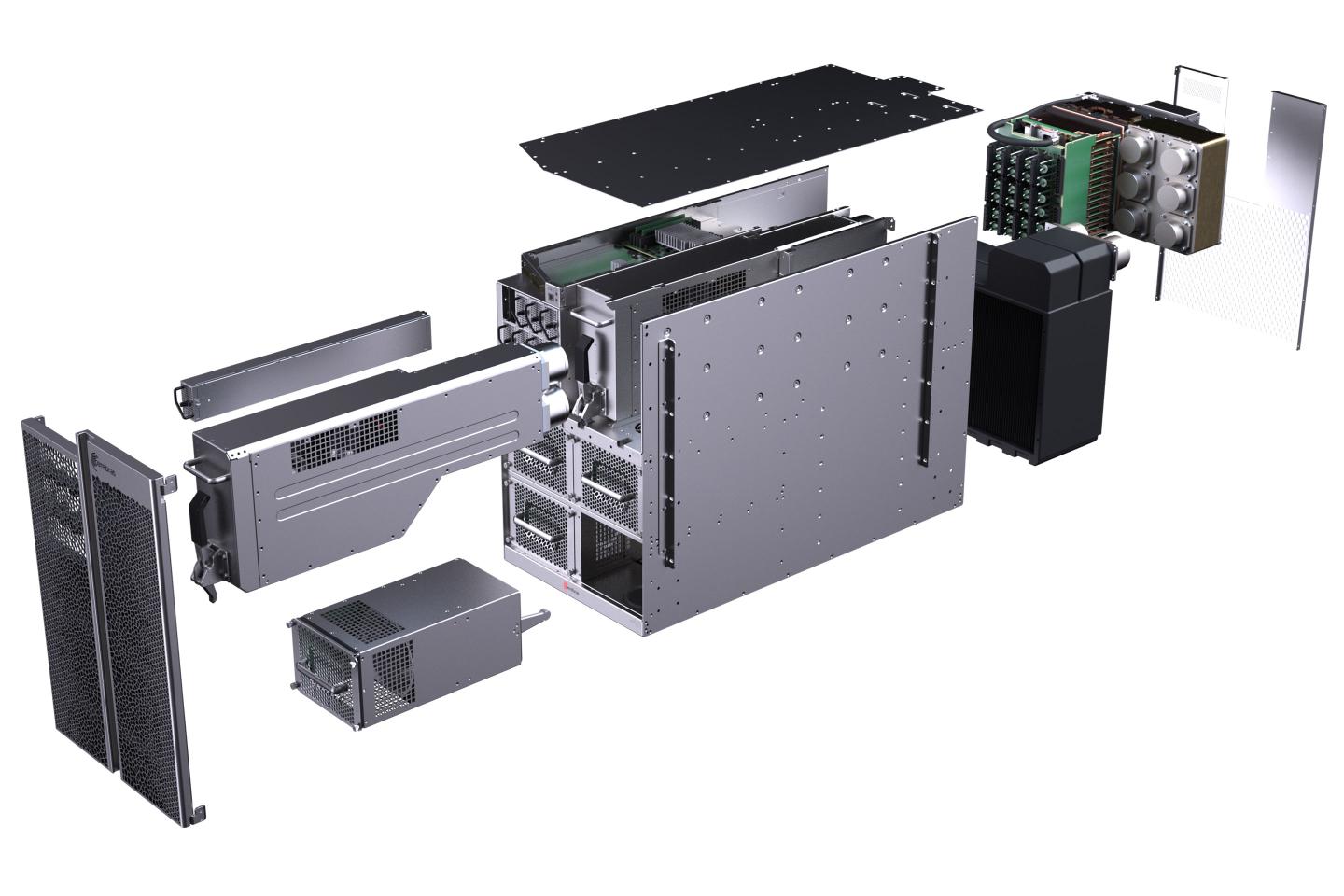
Photograph courtesy of Cerebras.

Half an hour’s drive southwest from downtown Chicago, at Argonne National Laboratory, a major U.S. supercomputing facility, a computer dashboard shows artificial intelligence at work. In rectangles of various sizes, fitted together like a monochromatic Mondrian painting in red, a digital heat map charts the activity of a neural network as it thinks about drugs. At the end of hours of work, the neural network will produce an assessment of the correlation between various drugs and tumor cells that could someday lead to new treatments for cancer. 

Argonne has many very powerful computers, but something different is happening on this dashboard. The system running this AI is 100 times faster than Argonne’s fastest computer. The speed-up not only means that it takes less time to run neural networks; it may ultimately mean a qualitative leap in the kinds of work on cancer drugs the lab can do. What will be revealed, scientists, hope, are connections that they haven’t anticipated yet. 

“Imagine a computer model that we train with the data we have for all known drug molecules,” says Rick Stevens, Argonne’s associate laboratory director for computing, environment and life sciences. “We have the model explore the drug response landscape, and it generates drugs, it generates molecules with desirable properties.”

This is artificial intelligence entering an age of unknown unknowns. Most drug studies look for correlations between a short list of known drugs and a selection of cell lines, to see whether the drug will slow tumor growth. At Argonne, Stevens and his team can simulate all drug molecules for correlations to disease they might never have thought to check. 

The technology that makes that possible sits in a metal box the size of a dormitory fridge. Called the CS-1, the two-foot-high cabinet is the first computer from Silicon Valley startup Cerebras Systems. Cerebras in August unveiled the world’s largest computer chip, almost the size of an entire twelve-inch silicon wafer, called the WSE. The CS-1 computer, as Cerebras cofounder and chief executive Andrew Feldman puts it, is the race-car chassis that houses that WSE race-car engine. 

Feldman claims that the CS-1 is more powerful than larger competing systems that take up multiple racks of equipment, while also consuming less power, thanks to an ingenious heat-extraction system. A copper-colored block sitting behind the giant Cerebras chip, called a cold plate, conducts heat away from the chip. That cold plate is cooled by pipes of cold water running past the plate. Fans then blow cold air, carrying the heat away from the pipes.

Argonne has had the box for only a few months, Stevens explains, but he says “we are very optimistic about what we are seeing so far” in using it. “Having a factor of 100 in training [neural networks] is so important,” he says, because, “you can still remember what the question was when the job finishes.”

Impressive as that hardware is, the Mondrian-style dashboard may represent the more profound breakthrough. Supercomputers and supercomputer-class machines such as Google’s Pod are challenging to program. Somebody has to figure out how to spread a neural net over hundreds, sometimes thousands of individual chips. Argonne has spent years developing such tools for supercomputers such as “Summit” and “Theta.” 
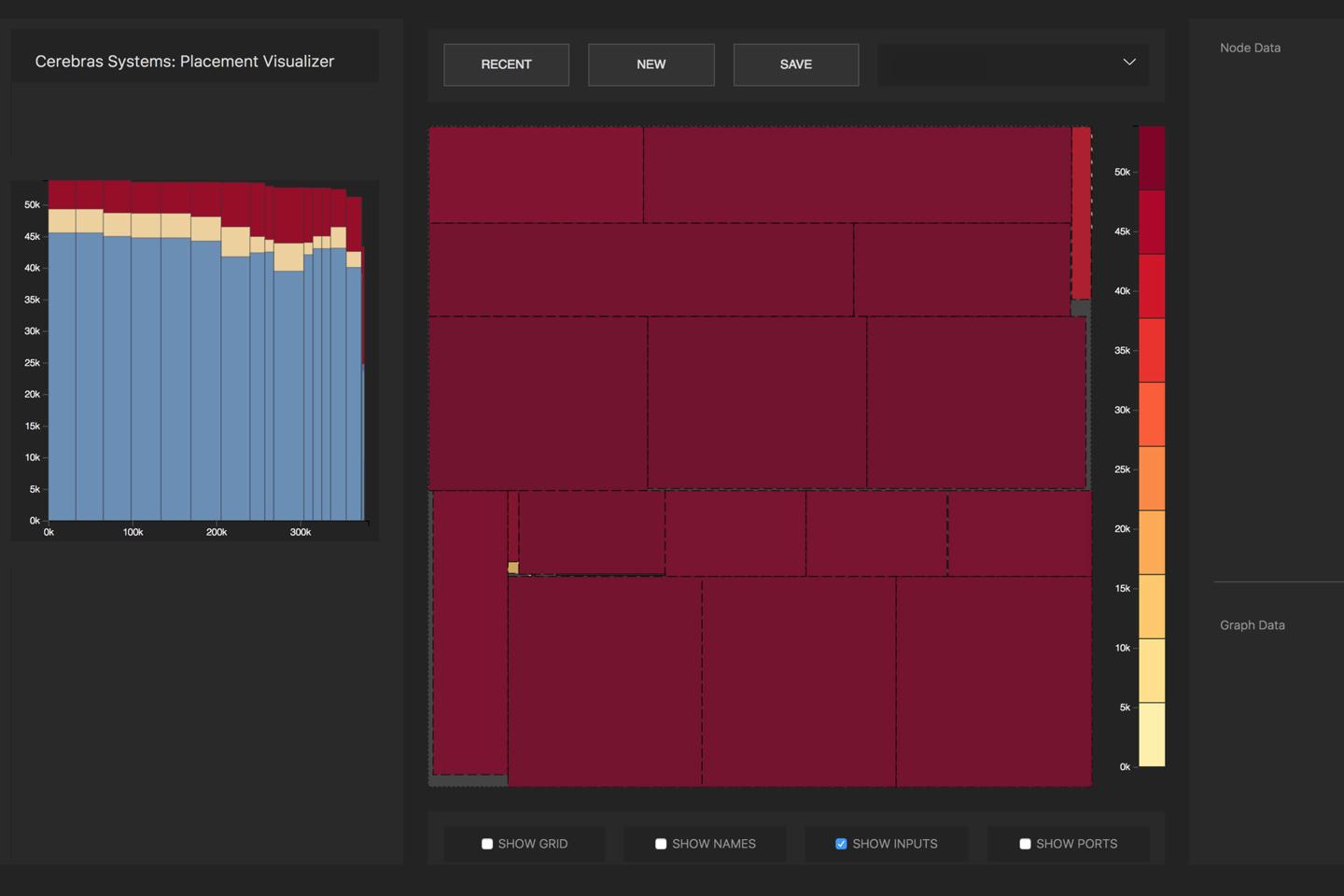
The math operations of a neural net, as represented on the dashboard of the CS-1. (Photograph courtesy of Cerebras.)

The Cerebras CS-1 is just one giant chip in one self-contained cabinet. The entire neural network can be put on that one chip, and Cerebras has made a program that automatically figures out how to do it with whatever neural net scientists may hand it. The program, called a compiler, optimizes how the numerous math operations of a given neural net are spread across the WSE’s circuits. The rectangles of the heat map are the visual representation of those parts of the neural net as they are computed in parallel.

“We have tools to do this” on supercomputers, says Argonne’s Stevens, “but nothing turnkey the way the CS-1 is, [where] it’s all done automatically.”

In a sense, Cerebras is democratizing supercomputers. That makes it somewhat fitting that the machine is being unveiled today in Denver at SC19, this year’s iteration of the International Conference for High-Performance Computing, Networking, Storage and Analysis, an annual gathering where the biggest computer systems make their debut. The Cerebras compiler is turning machines that were the province of teams of scientists into something a grad student could program. 

That ease may open doors to new kinds of AI. One prospective category would include really big experiments, like the molecule search mentioned above. Another would be to add what are called “confidence intervals,” a measure of uncertainty, to studies of drugs. Computing a confidence interval costs extra time, so, on slower systems, it’s only done at the end of long batches of experiments. 

The CS-1 is fast enough that a confidence interval can be done every single time. “It makes research more subtle,” says Stevens of the prospect of having confidence intervals. “It gives you a measure of how close you are in some sense, and so it changes how you approach the problem.” Connections that would turn out to be a waste of time to explore can be more quickly dispensed with, he says.

A third possibility would be the development of entirely new kinds of neural networks, says Stevens. “It’s fast enough that you could explore a large space of [neural] network designs,” he says. “It’s possible there are formulations that will perform better” than what scientists would devise by hand — another unknown unknown.

To Cerebras’s Feldman, it’s all evidence that “making things faster allows you to do things you couldn’t do before, and suddenly you get insights you didn’t have access to.” He makes the analogy to the rise of the dynamo and the electrification of factories. A hundred years ago, the dynamo merely improved existing things such as belt-driven machines. As decades went by, factories were completely reorganized around automated process control because of the dynamo. The nature of manufacturing changed.

The speed-up of research that can happen with the CS-1 may be just such a qualitative change in experimentation, a shift in how AI research happens whose implications have yet to be contemplated.

More must-read stories from Fortune:

—HP Inc.’s printing woes were years in the making. Then Xerox swooped in
—Review: Apple Watch Series 5 is insanely great
—A new Motorola Razr—and its folding screen—could bring phone design back to the future
—Most executives fear their companies will fail if they don’t adopt A.I.
—With new 16-inch MacBook Pro, Apple wants consumers to forget about its keyboard woes
Catch up with
Data Sheet, Fortune’s daily digest on the business of tech.

About the Author
By Tiernan Ray
See full bioRight Arrow Button Icon

Latest in Tech

Finance
Lorem ipsum dolor sit amet, consectetur adipiscing elit, sed do eiusmod tempor incididunt ut labore et dolore magna aliqua. Ut enim ad minim veniam
By Fortune Editors
October 20, 2025
Finance
Lorem ipsum dolor sit amet, consectetur adipiscing elit, sed do eiusmod tempor incididunt ut labore et dolore magna aliqua. Ut enim ad minim veniam
By Fortune Editors
October 20, 2025
Finance
Lorem ipsum dolor sit amet, consectetur adipiscing elit, sed do eiusmod tempor incididunt ut labore et dolore magna aliqua. Ut enim ad minim veniam
By Fortune Editors
October 20, 2025
Finance
Lorem ipsum dolor sit amet, consectetur adipiscing elit, sed do eiusmod tempor incididunt ut labore et dolore magna aliqua. Ut enim ad minim veniam
By Fortune Editors
October 20, 2025
Finance
Lorem ipsum dolor sit amet, consectetur adipiscing elit, sed do eiusmod tempor incididunt ut labore et dolore magna aliqua. Ut enim ad minim veniam
By Fortune Editors
October 20, 2025
Finance
Lorem ipsum dolor sit amet, consectetur adipiscing elit, sed do eiusmod tempor incididunt ut labore et dolore magna aliqua. Ut enim ad minim veniam
By Fortune Editors
October 20, 2025

Most Popular

Finance
Lorem ipsum dolor sit amet, consectetur adipiscing elit, sed do eiusmod tempor incididunt ut labore et dolore magna aliqua. Ut enim ad minim veniam
By Fortune Editors
October 20, 2025
Finance
Lorem ipsum dolor sit amet, consectetur adipiscing elit, sed do eiusmod tempor incididunt ut labore et dolore magna aliqua. Ut enim ad minim veniam
By Fortune Editors
October 20, 2025
Finance
Lorem ipsum dolor sit amet, consectetur adipiscing elit, sed do eiusmod tempor incididunt ut labore et dolore magna aliqua. Ut enim ad minim veniam
By Fortune Editors
October 20, 2025
Finance
Lorem ipsum dolor sit amet, consectetur adipiscing elit, sed do eiusmod tempor incididunt ut labore et dolore magna aliqua. Ut enim ad minim veniam
By Fortune Editors
October 20, 2025
Finance
Lorem ipsum dolor sit amet, consectetur adipiscing elit, sed do eiusmod tempor incididunt ut labore et dolore magna aliqua. Ut enim ad minim veniam
By Fortune Editors
October 20, 2025
Finance
Lorem ipsum dolor sit amet, consectetur adipiscing elit, sed do eiusmod tempor incididunt ut labore et dolore magna aliqua. Ut enim ad minim veniam
By Fortune Editors
October 20, 2025
Fortune Secondary Logo
Rankings
  • 100 Best Companies
  • Fortune 500
  • Global 500
  • Fortune 500 Europe
  • Most Powerful Women
  • World's Most Admired Companies
  • See All Rankings
  • Lists Calendar
Sections
  • Finance
  • Fortune Crypto
  • Features
  • Leadership
  • Health
  • Commentary
  • Success
  • Retail
  • Mpw
  • Tech
  • Lifestyle
  • CEO Initiative
  • Asia
  • Politics
  • Conferences
  • Europe
  • Newsletters
  • Personal Finance
  • Environment
  • Magazine
  • Education
Customer Support
  • Frequently Asked Questions
  • Customer Service Portal
  • Privacy Policy
  • Terms Of Use
  • Single Issues For Purchase
  • International Print
Commercial Services
  • Advertising
  • Fortune Brand Studio
  • Fortune Analytics
  • Fortune Conferences
  • Business Development
  • Group Subscriptions
About Us
  • About Us
  • Press Center
  • Work At Fortune
  • Terms And Conditions
  • Site Map
  • About Us
  • Press Center
  • Work At Fortune
  • Terms And Conditions
  • Site Map
  • Facebook icon
  • Twitter icon
  • LinkedIn icon
  • Instagram icon
  • Pinterest icon

Latest in Tech

AstraZeneca CFO Aradhana Sarin
BankingCFO Daily
How AstraZeneca’s 17,000 AI-certified employees are helping it reach a ‘stretch goal’ of $80 billion in revenue
By Sheryl EstradaApril 30, 2026
1 hour ago
agentic
CommentaryAI agents
Why your data infrastructure — not your AI model — will determine whether Agentic AI scales
By Jeffrey Sonnenfeld, Stephen Henriques, Catherine Dai and Zander JeinthanuttkanontApril 30, 2026
2 hours ago
The startup that wants to give surgeons X-ray vision
NewslettersTerm Sheet
The startup that wants to give surgeons X-ray vision
By Allie GarfinkleApril 30, 2026
2 hours ago
Google Cloud CEO Thomas Kurian at Fortune Brainstorm AI 2025 in San Francisco. (Photo: Stuart Isett/Fortune)
NewslettersFortune Tech
Google Cloud is almost one-fifth of Alphabet’s business
By Andrew NuscaApril 30, 2026
3 hours ago
Photo: Donald Trump
Big TechMarkets
With no end in sight, Trump considers new options in Iran war—including the ‘Dark Eagle’ hypersonic missile
By Jim EdwardsApril 30, 2026
4 hours ago
Google Cloud revenue is now 18% of Alphabet’s business. Is this the beginning of the end of Google’s search identity?
Big TechGoogle
Google Cloud revenue is now 18% of Alphabet’s business. Is this the beginning of the end of Google’s search identity?
By Alexei OreskovicApril 29, 2026
12 hours ago

Most Popular

Apple cofounder Ronald Wayne—whose stake would be worth up to $400 billion had he not sold it in 1976—says that at 91, he has no regrets
Success
Apple cofounder Ronald Wayne—whose stake would be worth up to $400 billion had he not sold it in 1976—says that at 91, he has no regrets
By Preston ForeApril 27, 2026
3 days ago
Jamie Dimon gets candid about national debt: ‘There will be a bond crisis, and then we’ll have to deal with it’
Economy
Jamie Dimon gets candid about national debt: ‘There will be a bond crisis, and then we’ll have to deal with it’
By Eleanor PringleApril 29, 2026
1 day ago
‘They left me no choice’: Powell isn’t going anywhere—blocking Trump from another Fed appointee
Banking
‘They left me no choice’: Powell isn’t going anywhere—blocking Trump from another Fed appointee
By Eva RoytburgApril 29, 2026
19 hours ago
‘The cost of compute is far beyond the costs of the employees’: Nvidia executive says right now AI is more expensive than paying human workers
AI
‘The cost of compute is far beyond the costs of the employees’: Nvidia executive says right now AI is more expensive than paying human workers
By Sasha RogelbergApril 28, 2026
2 days ago
‘Take the money and run’: Johns Hopkins economist Steve Hanke on why the UAE quit OPEC
Energy
‘Take the money and run’: Johns Hopkins economist Steve Hanke on why the UAE quit OPEC
By Shawn TullyApril 29, 2026
1 day ago
More than two-thirds of U.S. schools say they’re unable to afford the cost of student free lunch—and MAHA’s dietary guidelines may make it worse
Economy
More than two-thirds of U.S. schools say they’re unable to afford the cost of student free lunch—and MAHA’s dietary guidelines may make it worse
By Sasha RogelbergApril 29, 2026
1 day ago

© 2026 Fortune Media IP Limited. All Rights Reserved. Use of this site constitutes acceptance of our Terms of Use and Privacy Policy | CA Notice at Collection and Privacy Notice | Do Not Sell/Share My Personal Information
FORTUNE is a trademark of Fortune Media IP Limited, registered in the U.S. and other countries. FORTUNE may receive compensation for some links to products and services on this website. Offers may be subject to change without notice.