The current bull market in stocks is several months past its 10th birthday, and prognosticators have been predicting its demise for at least half its life. You can hardly blame them for being early: Historically, the average bull market has lasted less than five years.
But warnings of an imminent recession—which would be the first since the 2007-09 financial crisis—are finally beginning to drown out the party tunes. The United Nations Conference (Unctad)on Trade and Development recently reported that 2019 would generate the weakest year of expansion in the global economy since 2009. A global recession in 2020 has become a “clear and present danger,” Unctad warned, citing the U.S.-China trade war, high corporate debt, and the threat of a no-deal Brexit as drags on growth. (There’s also the risk that America’s consumers will lose their own bullishness; for more, see our story in this issue.)
Where should investors turn if a slowing economy drags stocks down with it? One rule of thumb applies across industries: Cash is king. Companies with larger-than-average cash reserves and strong free cash flow (a measure of profitability) are better equipped than their competitors to ride out a recession. And investors reward them accordingly, boosting their shares even as their rivals flounder.
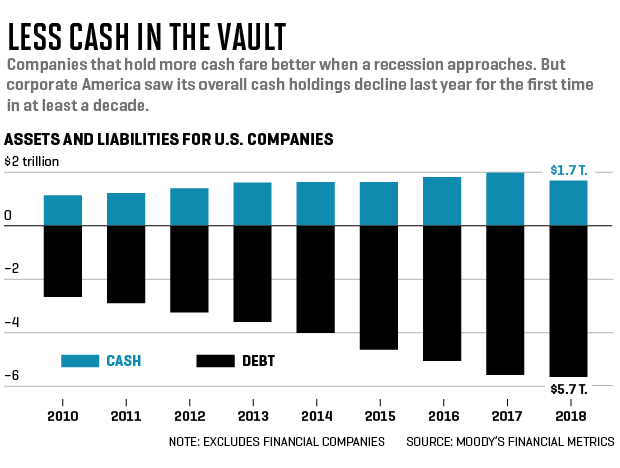
A big cash stockpile may sound like a purely defensive asset—a rainy-day fund to tap if a recession eats into profits. But prodigious reserves can help a company continue building for the future even when its profits wobble. Cash hoards can help management stay committed to long-term investments like research and development, acquisitions, and capital spending, preventing those priorities from falling victim to a slowdown.
Some savvy investors are well aware of this phenomenon—and research suggests that cash giants get a share-price bump well before a recession begins. Robert Nason and Pankaj Patel, professors at Concordia and Villanova universities, respectively, recently studied the performance of more than 1,700 publicly held U.S. manufacturing firms (essentially, any company that made anything tangible, whether it’s airplanes, leather belts, or CPUs) beginning in 2004—more than three years before the Great Recession started. They ranked each company based on the size of i.ts cash holdings relative to total assets, then compared the firms’ performance.
Two interesting results emerged. First: Generally speaking, during the pre-recession years, the more cash a company held, the higher a valuation it earned—suggesting that investors flocked to those stocks as clouds gathered. Second, and just as notable: The pattern shifted after the recession began. From 2008 to 2010, shareholders migrated away from companies that held too much cash, while boosting the value of those that were drawing down reserves. They seemed to be rewarding companies that took advantage of a slump to deploy their savings. When there’s a recession, says Nason, money managers are attracted to companies that “invest their way out of the downturn.”
How can Main Street investors take advantage of corporate cash? One tried and true approach involves investing in high-dividend-paying stocks, which rely on hefty cash holdings to support their steady payouts. Many investors are already chasing those treasure chests: An S&P index that tracks stocks that have consistently increased their dividends over several decades has risen 5.5% over the past 12 months, compared with 1.4% for the S&P 500. The ProShares S&P 500 Dividend Aristocrats ETF (NOBL) offers investors an inexpensive way to get exposure to those stocks.
Investors with an appetite for more concentrated bets can look for companies whose cash troves leave them poised to do particularly well if the economy slackens. These three companies have high levels of cash holdings as well as ample potential to seize future opportunities by investing those reserves.
Like many software makers, cloud-services provider Citrix Systems (CTXS, $97) has begun shifting from one-off licensing agreements with customers to a subscription model. This produces a steadier stream of cash. But it’s a painful transition in the short run because annual subscriptions cost less than multiyear licenses—which helps explain why Citrix’s recent revenue growth has looked sluggish. Still, subscriptions have jumped to 62% of the booking mix, and Deutsche Bank analyst Karl Keirstead says Citrix’s core desktop-business sales have actually accelerated about 10% this year. With cash holdings at 13% of total assets, Citrix has the backstop to cover any hiccups from this transition.
Pharmaceutical stocks have traditionally held steady during downturns; people still have to take their meds when belts are tight. Shares of Eli Lilly (LLY, $107) have slumped this year amid the emergence of new competition for its bestselling drug, diabetes medication Trulicity. But Guggenheim Securities’ Seamus Fernandez argues that the company’s broad product line should help protect it. With no one drug accounting for more than 18% of its revenues, Eli Lilly is better diversified than many of its rivals. Its substantial cash reserves should help it to replenish its pipeline, either through R&D or acquisitions—as should its $8 billion purchase earlier this year of cancer-drug maker Loxo Oncology. And Eli Lilly has a higher-than-average 2.3% dividend yield.
Doctors have long used radiotherapy, or radiation, to treat cancer, and Varian Medical Systems (VAR, $110) commands 70% of the U.S. market for the machines that deliver that treatment. Barriers to entry in the cost-intensive business are high. And while sales of the multimillion-dollar machines can take a hit in a downturn, Varian derives 46% of revenues from maintenance and support for those machines—a “recession resistant” business, says Morningstar analyst Alex Morozov. With cash reserves equal to 13% of total assets, Varian can also continue to invest in research in proton therapy, a newer form of cancer treatment with no single market leader. While it’s years away from potential profitability, Varian has positioned itself as one of two go-to names in that space, says Morozov.
A version of this article appears in the November 2019 issue of Fortune with the headline “When Cash Cushions Your Fall.”
More must-read stories from Fortune:
—Maven, the company that slashed Sports Illustrated, has had its own share of financial woes
—Trump’s hosting G7 at Doral Resort raises questions about struggling property, Deutsche Bank loans
—What Warren Buffett’s move to increase his Bank of America stake says about the health of the economy
—How would you spend a universal basic income? We asked participants around the world—and their answers might surprise you
—Why JPMorgan Chase wants to give more former criminals a second chance
Don’t miss the daily Term Sheet, Fortune’s newsletter on deals and dealmakers.