• Home
  • Latest
  • Fortune 500
  • Finance
  • Tech
  • Leadership
  • Lifestyle
  • Rankings
  • Multimedia
Commentary

How Trump’s Tariff Against Canada Could Lead To A Trade War

By
Alan Wolff
Alan Wolff
Down Arrow Button Icon
By
Alan Wolff
Alan Wolff
Down Arrow Button Icon
April 27, 2017, 9:42 AM ET
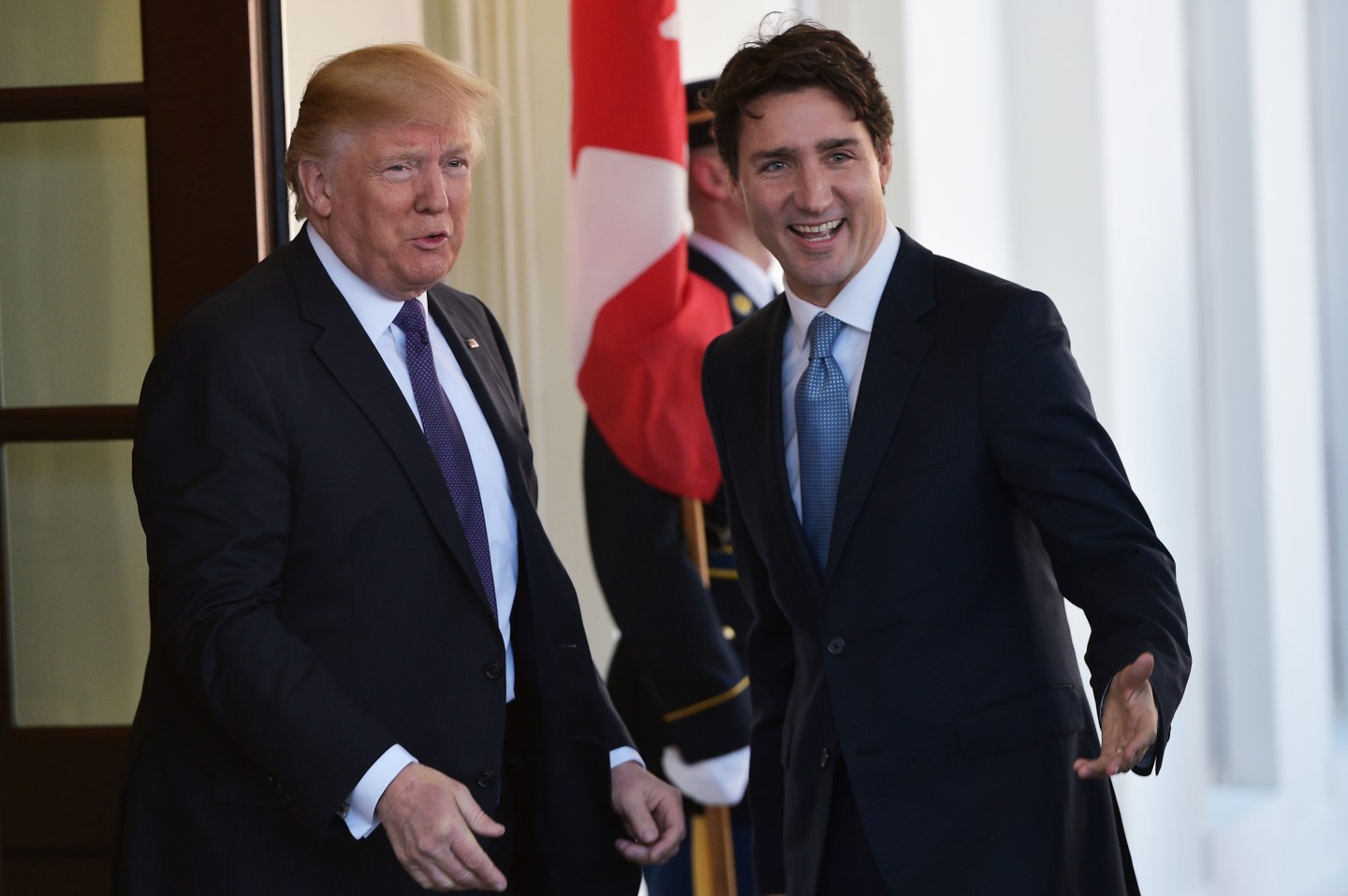
US-CANADA-DIPLOMACY-TRUMP-TRUDEAU
MANDEL NGAN AFP/Getty Images

Earlier this week, the Trump administration announced a preliminary decision to impose a 20% tariff on Canadian softwood lumber imports. The move stems from an ongoing trade issue that dates back at least to the Reagan administration, which is poised to hurt both the US and Canadian economies if the countries can’t resolve it.

Lumber mills in Canada and the U.S. essentially have different ways of buying timber. In Canada, timber comes mostly from trees grown on government-owned lands, while U.S. lumber mills mostly buy their timber from private landowners through competitive bidding. At issue is that the US views Canada’s practice as a subsidy to its lumber industry giving it a competitive advantage over U.S. producers. And since Canada also restricts its log exports, this depresses Canadian timber prices even lower, increasing the advantage Canadian lumber has in the U.S. market.

The US has dealt with this issue for almost four decades. In the past three cases where Commerce found subsidies, Canada agreed to restrict lumber exports to settle the matter. This could happen again. Needless to say, there are no guarantees, and it will likely take a while before the latest case is resolved.

Every industry in the US has a right to file a case with the U.S. government to determine whether imports are being subsidized. Once that’s determined, domestic industries have a right to file a case and get an answer from the U.S. government as to whether a subsidy exists. The Department then continues its investigation to assess a final duty rate. Then an independent agency, the U.S. International Trade Commission, still has to find that the subsidized imports injured the domestic industry before duties are applied. While career civil servants conducted this investigation and the law is supposed to operate without political influence, whoever is in the White House can reasonably claim credit for what his government does.

Trump’s announcement this week comes after the lumber industry filed a case with the US Department of Commerce. Since 1980, it’s the fifth case filed by the industry. In the most recent case, a preliminary finding determined that Canada offered a lumber subsidy of 19.3%.

Each of the last three cases resulted in a U.S. Canada lumber agreement, under which Canada decided that it was better to restrict its lumber exports than having the U.S. impose tariffs. And that is an outcome that would not be surprising this time around as well.

Does that mean that all will be well in U.S.-Canada trade relations insofar as lumber is concerned? There are still risks. Canada can appeal U.S. agency decisions to a World Trade Organization (WTO) panel and under the North American Free Trade Agreement (NAFTA) to a bi-national panel. Challenges to U.S. trade remedies are often successful. President Trump’s 2017 Trade Policy Agenda criticizes international dispute settlement as an interference with U.S. sovereignty. Moreover, during the last lumber case in 2001, the domestic industry also challenged the constitutionality of NAFTA dispute settlement which end rights to appeal to U.S. courts.

If the U.S. government fails to implement an international panel’s decision, that could trigger trade hostilities. If it is a WTO decision, ultimately Canada would have a right to retaliate against U.S. trade. Lumber is a big trade item for Canada, and the retaliation authorized could cost Canada billions of dollars. If a NAFTA panel were disregarded, this could undercut the basis for continuing to have NAFTA, and hundreds of billions of dollars worth of trade between the two countries could be at risk. If Canada and the US cannot come to an agreed or at least tolerable result on lumber trade, the costs to our two economies would be very high. There would be no winners.

Alan Wm. Wolff was a senior trade negotiator with in both Republican and Democratic administrations. He is a Senior Counsel with Dentons LLP. He was counsel to the domestic U.S. industry for several rounds of lumber litigation and negotiated settlements. This article is written on behalf of no client or organization.


About the Author
By Alan Wolff
See full bioRight Arrow Button Icon

Latest in Commentary

Julian Braithwaite is the Director General of the International Alliance for Responsible Drinking
CommentaryProductivity
Gen Z is drinking 20% less than Millennials. Productivity is rising. Coincidence? Not quite
By Julian BraithwaiteDecember 13, 2025
20 hours ago
carbon
Commentaryclimate change
Banking on carbon markets 2.0: why financial institutions should engage with carbon credits
By Usha Rao-MonariDecember 13, 2025
21 hours ago
Dr. Javier Cárdenas is the director of the Rockefeller Neuroscience Institute NeuroPerformance Innovation Center.
Commentaryconcussions
Fists, not football: There is no concussion protocol for domestic violence survivors
By Javier CárdenasDecember 12, 2025
2 days ago
Gary Locke is the former U.S. ambassador to China, U.S. secretary of commerce, and governor of Washington.
CommentaryChina
China is winning the biotech race. Patent reform is how we catch up
By Gary LockeDecember 12, 2025
2 days ago
millennial
CommentaryConsumer Spending
Meet the 2025 holiday white whale: the millennial dad spending $500+ per kid
By Phillip GoerickeDecember 12, 2025
2 days ago
Sarandos
CommentaryAntitrust
Netflix, Warner, Paramount and antitrust: Entertainment megadeal’s outcome must follow the evidence, not politics or fear of integration
By Satya MararDecember 12, 2025
2 days ago

Most Popular

placeholder alt text
Success
Apple cofounder Ronald Wayne sold his 10% stake for $800 in 1976—today it’d be worth up to $400 billion
By Preston ForeDecember 12, 2025
2 days ago
placeholder alt text
Economy
Tariffs are taxes and they were used to finance the federal government until the 1913 income tax. A top economist breaks it down
By Kent JonesDecember 12, 2025
2 days ago
placeholder alt text
Success
40% of Stanford undergrads receive disability accommodations—but it’s become a college-wide phenomenon as Gen Z try to succeed in the current climate
By Preston ForeDecember 12, 2025
2 days ago
placeholder alt text
Economy
The Fed just ‘Trump-proofed’ itself with a unanimous move to preempt a potential leadership shake-up
By Jason MaDecember 12, 2025
2 days ago
placeholder alt text
Success
Apple CEO Tim Cook out-earns the average American’s salary in just 7 hours—to put that into context, he could buy a new $439,000 home in just 2 days
By Emma BurleighDecember 12, 2025
2 days ago
placeholder alt text
Economy
For the first time since Trump’s tariff rollout, import tax revenue has fallen, threatening his lofty plans to slash the $38 trillion national debt
By Sasha RogelbergDecember 12, 2025
2 days ago
Rankings
  • 100 Best Companies
  • Fortune 500
  • Global 500
  • Fortune 500 Europe
  • Most Powerful Women
  • Future 50
  • World’s Most Admired Companies
  • See All Rankings
Sections
  • Finance
  • Leadership
  • Success
  • Tech
  • Asia
  • Europe
  • Environment
  • Fortune Crypto
  • Health
  • Retail
  • Lifestyle
  • Politics
  • Newsletters
  • Magazine
  • Features
  • Commentary
  • Mpw
  • CEO Initiative
  • Conferences
  • Personal Finance
  • Education
Customer Support
  • Frequently Asked Questions
  • Customer Service Portal
  • Privacy Policy
  • Terms Of Use
  • Single Issues For Purchase
  • International Print
Commercial Services
  • Advertising
  • Fortune Brand Studio
  • Fortune Analytics
  • Fortune Conferences
  • Business Development
About Us
  • About Us
  • Editorial Calendar
  • Press Center
  • Work At Fortune
  • Diversity And Inclusion
  • Terms And Conditions
  • Site Map

© 2025 Fortune Media IP Limited. All Rights Reserved. Use of this site constitutes acceptance of our Terms of Use and Privacy Policy | CA Notice at Collection and Privacy Notice | Do Not Sell/Share My Personal Information
FORTUNE is a trademark of Fortune Media IP Limited, registered in the U.S. and other countries. FORTUNE may receive compensation for some links to products and services on this website. Offers may be subject to change without notice.