• Home
  • Latest
  • Fortune 500
  • Finance
  • Tech
  • Leadership
  • Lifestyle
  • Rankings
  • Multimedia
CommentaryLeadership

What the Wells Fargo Fake Accounts Scandal Says About Flaws at the SEC

By
Eleanor Bloxham
Eleanor Bloxham
Down Arrow Button Icon
By
Eleanor Bloxham
Eleanor Bloxham
Down Arrow Button Icon
October 18, 2016, 9:59 AM ET
John Stumpf
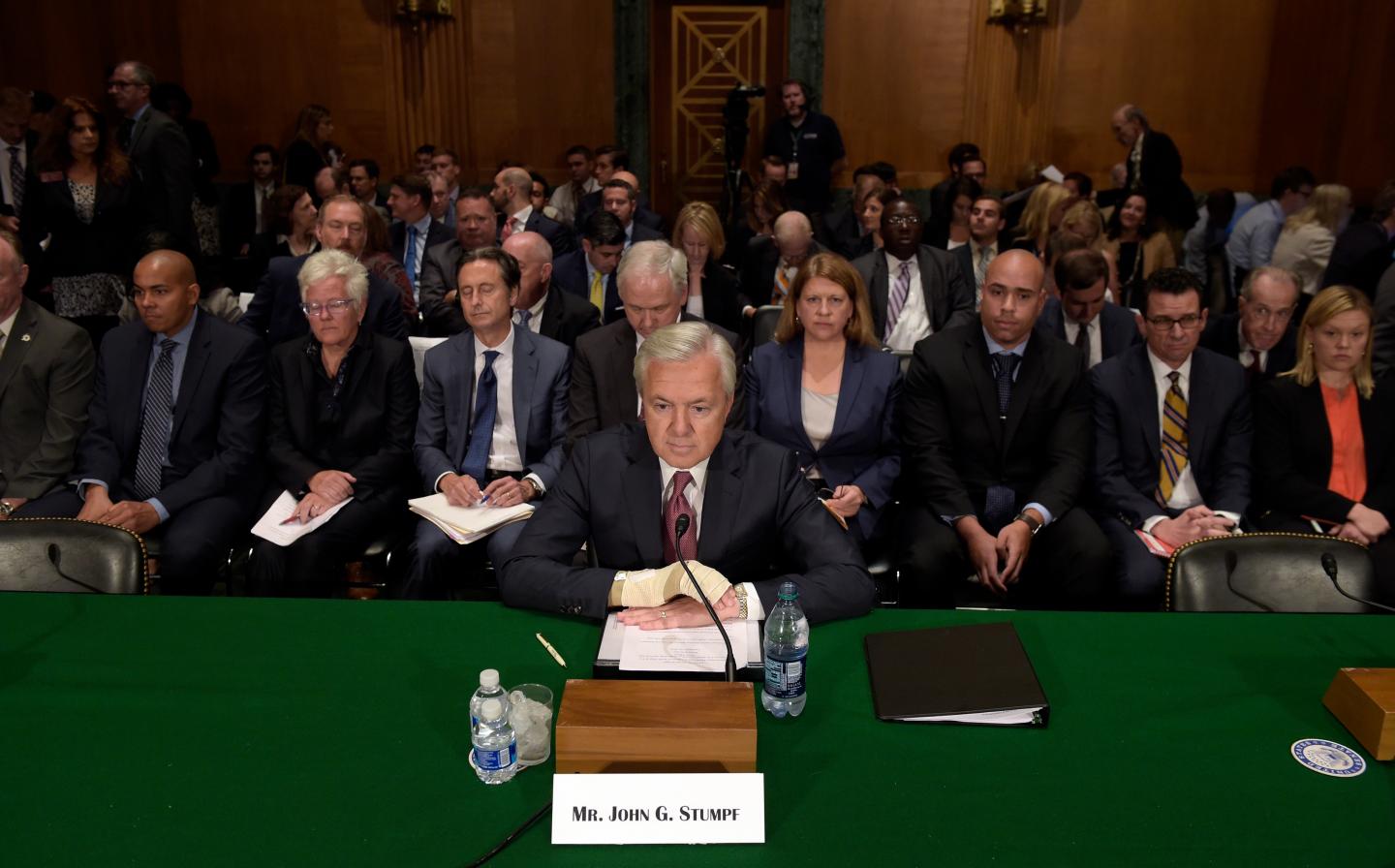
Wells Fargo Chief Executive Officer John Stumpf prepares to testify on Capitol Hill in Washington, Tuesday, Sept. 20, 2016, before Senate Banking Committee. Strumpf was called before the committee for betraying customers' trust in a scandal over allegations that employees opened millions of unauthorized accounts to meet aggressive sales targets. (AP Photo/Susan Walsh)Photograph by Susan Walsh—AP

While all eyes have been on Wells Fargo in the wake of the bank’s fake accounts scandal, there is another, not so apparent culprit at the heart of the crisis: the U.S. Securities and Exchange Commission.

Under SEC Chair Mary Jo White’s watch, the agency has failed to enforce disclosure requirements at Wells Fargo and elsewhere at a time when trust in big business has hit historic lows.

The SEC’s corporate disclosure rules exist to forewarn investors about major issues that could affect a company’s well-being. Yet investors and the public were surprised last month by the alleged wide-spread multi-year Wells Fargo fraud.

The SEC had many opportunities to step in to make sure investors learned about Wells Fargo’s problems much sooner. Instead, the opposite happened. In early 2014, the agency allowed Wells Fargo and another major bank to exclude shareholder proposals from New York’s comptroller that would have provided investors with information on which employees were “capable of exposing them to major losses” because of their “bonus incentives.” As a result, Wells Fargo investors never even had a chance to vote on the measure, despite the Los Angeles Times’ Wells Fargo investigation two months earlier that had revealed “forged client signatures” and “incentive pay linked to sales.”

Under White’s watch, the SEC has been soft in enforcing disclosure requirements related to risky compensation, which were issued after the 2008 financial crisis. Any member of the SEC staff who had reviewed Wells Fargo’s 2013 annual pay report would likely have seen that Wells Fargo CEO John Stumpf and his four top lieutenants’ multi-million dollar paychecks included large stock awards as well as annual bonuses tied to sales measures. This should have been viewed as a red flag that Wells Fargo had risky compensation practices — and the board should have described those risks in its annual investor filings.

Regulators knew following the financial crisis that using sales measures to determine bank bonuses created risky behaviors and advised against them. And paying executives in stock has been a major risk concern since Enron and WorldCom. Dick Fuld, CEO of Lehman Brothers, who oversaw that bank’s collapse in the financial crisis, was the poster child for taking risky actions to goose the stock price. At the Wells Fargo Senate hearing last month, Senator Elizabeth Warren told Stumpf that he had pumped up Wells Fargo’s stock price by touting the bank’s sales culture.

The SEC has also been loath to tangle with the external auditors, the CEOs and the CFOs, who sign off on company’s financial statements. According to a New York Times report, Wells Fargo had fake accounts as far back as 2005. So for an extended time (how long exactly is unclear), Wells Fargo did not know (nor did the board’s audit committee know) whether accounts and income on its books were valid or not. If that is not a material control weakness that should be disclosed (in other words, an operational deficiency, which could cause reported numbers to be wrong), what would be?

The SEC has not just failed by omission. Against investor wishes, White has personally advocated for changes to disclosure rules at all U.S. public companies, which include eliminating important executive compensation information from investors’ voting materials.

If we are to prevent another Wells Fargo-type fiasco, we must do more than focus on one company’s management, as important as that may be. We must also look at the broken regulatory systems that enabled it.

Eleanor Bloxham is CEO of The Value Alliance, an independent board education and advisory firm. She is the author of two books on corporate governance and valuation.

About the Author
By Eleanor Bloxham
See full bioRight Arrow Button Icon

Latest in Commentary

Finance
Lorem ipsum dolor sit amet, consectetur adipiscing elit, sed do eiusmod tempor incididunt ut labore et dolore magna aliqua. Ut enim ad minim veniam
By Fortune Editors
October 20, 2025
Finance
Lorem ipsum dolor sit amet, consectetur adipiscing elit, sed do eiusmod tempor incididunt ut labore et dolore magna aliqua. Ut enim ad minim veniam
By Fortune Editors
October 20, 2025
Finance
Lorem ipsum dolor sit amet, consectetur adipiscing elit, sed do eiusmod tempor incididunt ut labore et dolore magna aliqua. Ut enim ad minim veniam
By Fortune Editors
October 20, 2025
Finance
Lorem ipsum dolor sit amet, consectetur adipiscing elit, sed do eiusmod tempor incididunt ut labore et dolore magna aliqua. Ut enim ad minim veniam
By Fortune Editors
October 20, 2025
Finance
Lorem ipsum dolor sit amet, consectetur adipiscing elit, sed do eiusmod tempor incididunt ut labore et dolore magna aliqua. Ut enim ad minim veniam
By Fortune Editors
October 20, 2025
Finance
Lorem ipsum dolor sit amet, consectetur adipiscing elit, sed do eiusmod tempor incididunt ut labore et dolore magna aliqua. Ut enim ad minim veniam
By Fortune Editors
October 20, 2025

Most Popular

Finance
Lorem ipsum dolor sit amet, consectetur adipiscing elit, sed do eiusmod tempor incididunt ut labore et dolore magna aliqua. Ut enim ad minim veniam
By Fortune Editors
October 20, 2025
Finance
Lorem ipsum dolor sit amet, consectetur adipiscing elit, sed do eiusmod tempor incididunt ut labore et dolore magna aliqua. Ut enim ad minim veniam
By Fortune Editors
October 20, 2025
Finance
Lorem ipsum dolor sit amet, consectetur adipiscing elit, sed do eiusmod tempor incididunt ut labore et dolore magna aliqua. Ut enim ad minim veniam
By Fortune Editors
October 20, 2025
Finance
Lorem ipsum dolor sit amet, consectetur adipiscing elit, sed do eiusmod tempor incididunt ut labore et dolore magna aliqua. Ut enim ad minim veniam
By Fortune Editors
October 20, 2025
Finance
Lorem ipsum dolor sit amet, consectetur adipiscing elit, sed do eiusmod tempor incididunt ut labore et dolore magna aliqua. Ut enim ad minim veniam
By Fortune Editors
October 20, 2025
Finance
Lorem ipsum dolor sit amet, consectetur adipiscing elit, sed do eiusmod tempor incididunt ut labore et dolore magna aliqua. Ut enim ad minim veniam
By Fortune Editors
October 20, 2025
Fortune Secondary Logo
Rankings
  • 100 Best Companies
  • Fortune 500
  • Global 500
  • Fortune 500 Europe
  • Most Powerful Women
  • World's Most Admired Companies
  • See All Rankings
  • Lists Calendar
Sections
  • Finance
  • Fortune Crypto
  • Features
  • Leadership
  • Health
  • Commentary
  • Success
  • Retail
  • Mpw
  • Tech
  • Lifestyle
  • CEO Initiative
  • Asia
  • Politics
  • Conferences
  • Europe
  • Newsletters
  • Personal Finance
  • Environment
  • Magazine
  • Education
Customer Support
  • Frequently Asked Questions
  • Customer Service Portal
  • Privacy Policy
  • Terms Of Use
  • Single Issues For Purchase
  • International Print
Commercial Services
  • Advertising
  • Fortune Brand Studio
  • Fortune Analytics
  • Fortune Conferences
  • Business Development
  • Group Subscriptions
About Us
  • About Us
  • Press Center
  • Work At Fortune
  • Terms And Conditions
  • Site Map
  • About Us
  • Press Center
  • Work At Fortune
  • Terms And Conditions
  • Site Map
  • Facebook icon
  • Twitter icon
  • LinkedIn icon
  • Instagram icon
  • Pinterest icon

Latest in Commentary

hollywood
CommentaryMarketing
I spent 20 years learning to navigate an industry. Then I built a campaign for the man who’s dismantling it
By Matti YahavApril 29, 2026
13 hours ago
aging
HealthLongevity
We’re the CEOs of Peloton and the Hospital for Special Surgery. Living longer isn’t enough, we need to live better, too
By Bryan T. Kelly and Peter SternApril 29, 2026
14 hours ago
gen z
Commentarydisruption
AI won’t kill your job — it will kill the path to your first one
By Jeffrey Sonnenfeld, Stephen Henriques, Johan Griesel, Andrew Alam-Nist and Peter YuApril 29, 2026
15 hours ago
greer
CommentaryTariffs
No, tariffs are not strengthening the economy
By Alex DuranteApril 29, 2026
16 hours ago
AI is changing who gets to be an expert. Are your colleagues ready to become ‘directors of intelligence’?
AIProductivity
AI is changing who gets to be an expert. Are your colleagues ready to become ‘directors of intelligence’?
By Bruce BroussardApril 29, 2026
17 hours ago
gen z
CommentaryEducation
Gen Z has the wrong idea about college. Your career doesn’t start after you graduate 
By Ashley BigdaApril 29, 2026
18 hours ago

Most Popular

Apple cofounder Ronald Wayne—whose stake would be worth up to $400 billion had he not sold it in 1976—says that at 91, he has no regrets
Success
Apple cofounder Ronald Wayne—whose stake would be worth up to $400 billion had he not sold it in 1976—says that at 91, he has no regrets
By Preston ForeApril 27, 2026
2 days ago
‘Take the money and run’: Johns Hopkins economist Steve Hanke on why the UAE quit OPEC
Energy
‘Take the money and run’: Johns Hopkins economist Steve Hanke on why the UAE quit OPEC
By Shawn TullyApril 29, 2026
20 hours ago
‘The cost of compute is far beyond the costs of the employees’: Nvidia executive says right now AI is more expensive than paying human workers
AI
‘The cost of compute is far beyond the costs of the employees’: Nvidia executive says right now AI is more expensive than paying human workers
By Sasha RogelbergApril 28, 2026
2 days ago
Jamie Dimon gets candid about national debt: ‘There will be a bond crisis, and then we’ll have to deal with it’
Economy
Jamie Dimon gets candid about national debt: ‘There will be a bond crisis, and then we’ll have to deal with it’
By Eleanor PringleApril 29, 2026
16 hours ago
Current price of gold as of April 28, 2026
Personal Finance
Current price of gold as of April 28, 2026
By Danny BakstApril 28, 2026
2 days ago
More than two-thirds of U.S. schools say they’re unable to afford the cost of student free lunch—and MAHA’s dietary guidelines may make it worse
Economy
More than two-thirds of U.S. schools say they’re unable to afford the cost of student free lunch—and MAHA’s dietary guidelines may make it worse
By Sasha RogelbergApril 29, 2026
17 hours ago

© 2026 Fortune Media IP Limited. All Rights Reserved. Use of this site constitutes acceptance of our Terms of Use and Privacy Policy | CA Notice at Collection and Privacy Notice | Do Not Sell/Share My Personal Information
FORTUNE is a trademark of Fortune Media IP Limited, registered in the U.S. and other countries. FORTUNE may receive compensation for some links to products and services on this website. Offers may be subject to change without notice.