
Two inconsistent phenomena seemingly can be true at the same time: AI is seen as disrupting jobs, and, yet, on the surface, it appears as if less is happening than meets the eye. Where you stand on AI depends on whom you talk to. Schools now feverishly compete to prepare graduates with simplistic educational remedies driven by competitive branding agendas, providing symbolic curriculum overhauls as recruiting and job-placement signals, regardless of whether such courses share a coherent body of core knowledge. With recent New York Federal Reserve Bank research showing that computer science majors now have more trouble finding jobs than humanities majors, the risk of misleading students with false curriculum certainties is genuine.
As a core course developer at one of the world’s top three business schools confessed to us:
“Our faculty are passionate, but there are two problems. One is that the AI models are developing so quickly and proliferating across so many uses that it’s hard for teachers to put together courses that aren’t quickly outdated. The second problem is that a growing number of students have experience with these models, in some cases a lot of experience, an amount that far outpaces that of the faculty, so it’s hard to develop course material that adds to what they already know.”
We have been revealing consistencies in the commercial and societal implications of the AI frontier since the November 2022 release of OpenAI’s generative artificial intelligence chatbot, ChatGPT. We have shown how the accelerating AI boom exploded from being a parlor game to a pillar of the economy, with major CEOs ramping up overnight to champion revolutionary changes in their business models and core operations. We have also exposed that the sudden spectrum of pioneers, cheerleaders, skeptics, and doomsayers has created a righteous cacophony of confusion, a gloomy, catastrophic end to humanity or its salvation, depending on the bias and experience of the experts cited. On top of this, unparalleled pools of capital have fed strategically contradictory, dizzying deal-making.
The workforce warnings, in particular, are getting louder, with a mix of smart alerts and a cacophony of cliches. Verizon CEO Dan Schulman has bluntly predicted that AI will cause unemployment to rise by up to 30% in the next two to five years. The Boston Consulting Group (BCG) issued a clear-eyed report suggesting that 10%-15% of existing jobs could be eliminated as soon as 2031. Then, of course, Anthropic CEO Dario Amodei has made many headlines forecasting that AI could wipe out half of all entry-level white-collar jobs within five years and push unemployment into double digits.
Others see something very different: a productivity boom, not a wave of layoffs. Yet their data tells a similarly contradictory story. A recent Goldman Sachs analysis, for instance, estimates AI is already reducing U.S. employment by roughly 16,000 jobs per month. At the same time, demand is rising in adjacent areas—from data centers to AI development—creating new roles even as others disappear. In a sweeping global study, the National Bureau of Economic Research found that AI has had little to no impact on employment or productivity in almost 90% of firms over the past three years, based on responses from nearly 6,000 C-suite executives.
On the surface, the broader labor market also looks fine. Unemployment remains near historic lows, around 4%. But look closer, and the cracks begin to appear: unemployment among recent graduates has climbed to nearly 6%, rising twice as fast as the rest of the workforce since 2022.
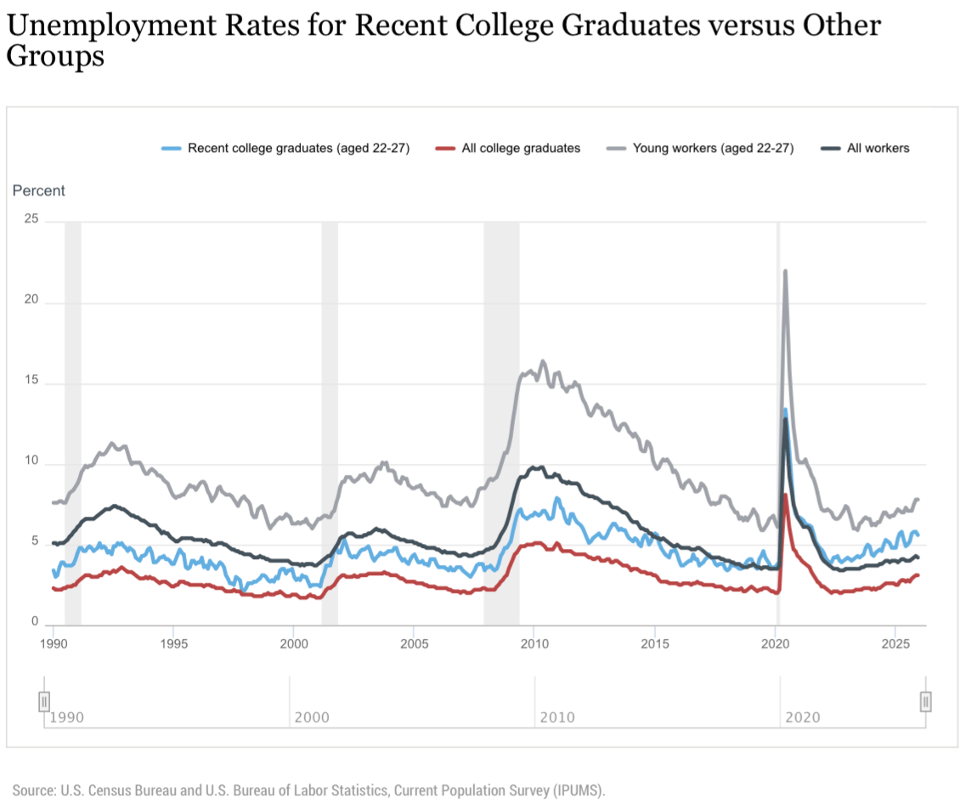
Both sides are right, and both are missing the point. Technological advancements are only beginning. Agentic AI is the next frontier and the real productivity driver that enterprises desire.
The problem is not that the AI jobs debate is exaggerated. It is being framed incorrectly. We keep asking whether AI will trigger mass layoffs, as if disruption must show up all at once. But that is not how this transition unfolds. Across industries, as Agentic AI scales, the changes are already happening—just quietly.
Agentic AI Is Steadily Scaling
The nature of work inside firms is also changing. Early generative AI tools accelerated discrete tasks—drafting text, summarizing documents, writing code, or answering customer questions. Agentic AI will go even further.
Unlike chatbots that respond to prompts, agents can take on broader objectives. They break work into sub-tasks, invoke tools, move across systems, and revise their approach with limited human input. The shift is no longer just from human work to machine assistance—it is from task automation to workflow automation. Currently, the technology is primarily used for low-risk, highly repeatable tasks, but successful applications to more ambitious use cases are emerging.
An analysis from the Yale Chief Executive Leadership Institute tracked how this transition is already underway.
Major banks are deploying agentic systems across retail workflows and credit underwriting, including credit-risk memo production, delivering productivity gains of 20% to 60% and reducing turnaround times by roughly 30%.
Telecommunications operators are implementing agents for customer service and network remediation, with some deployments reporting a more than 60% reduction in manual network operations through automated provisioning.
Manufacturers are using multi-agent systems to reduce R&D cycle times by approximately 50% and increase order intake by 40% in early deployments.
Logistics giant C.H. Robinson is handling approximately 29% more Less-Than-Truckload (LTL) volume while employing 30% fewer employees than in early 2019 and roughly half of carrier bookings are now generated by agents.
Real estate is no exception. Morgan Stanley estimates that 37% of industry roles, or about 2.2 million U.S. jobs, face agentic-displacement risk. One firm in the study had already reduced on-property labor hours by 30% and another had lowered headcount by 15% with entry-level positions—data labelers, junior brokers, leasing associates—among the most exposed.
The labor impact is not that these functions disappear overnight. It is that more of the work is shifting from execution to supervision, requiring less time to complete a task. Across sectors, the pattern is consistent: routine customer service, heavy document analysis, scheduling, quoting, and first-draft production are increasingly handled by agents, while people move toward exception handling, judgment, escalation, and oversight.
That is why the key question is no longer which jobs disappear, but which tasks and workflows are being delegated—and where humans still retain a comparative advantage.
Getting More From The Same
The impact of large language models (LLMs) has already begun to appear in the data, though it is not yet decisive.
A November 2025 study by Erik Brynjolfsson and researchers at Stanford’s Digital Economy Lab found a 16% decline in early-career employment across the most AI-exposed occupations since late 2022, when OpenAI’s ChatGPT was released. The study estimates that the problem will continue to affect many young professionals as they begin their careers, but the long-term consequences are unclear.
Nowhere is this clearer than in entry-level software engineering—though the picture depends on whom you ask. Brynjolfsson discovered that employment among developers aged 22 to 25 has fallen nearly 20% from its late-2022 peak. The online job site Indeed also paints a stark picture: software development job postings have fallen 53% from the same starting point.
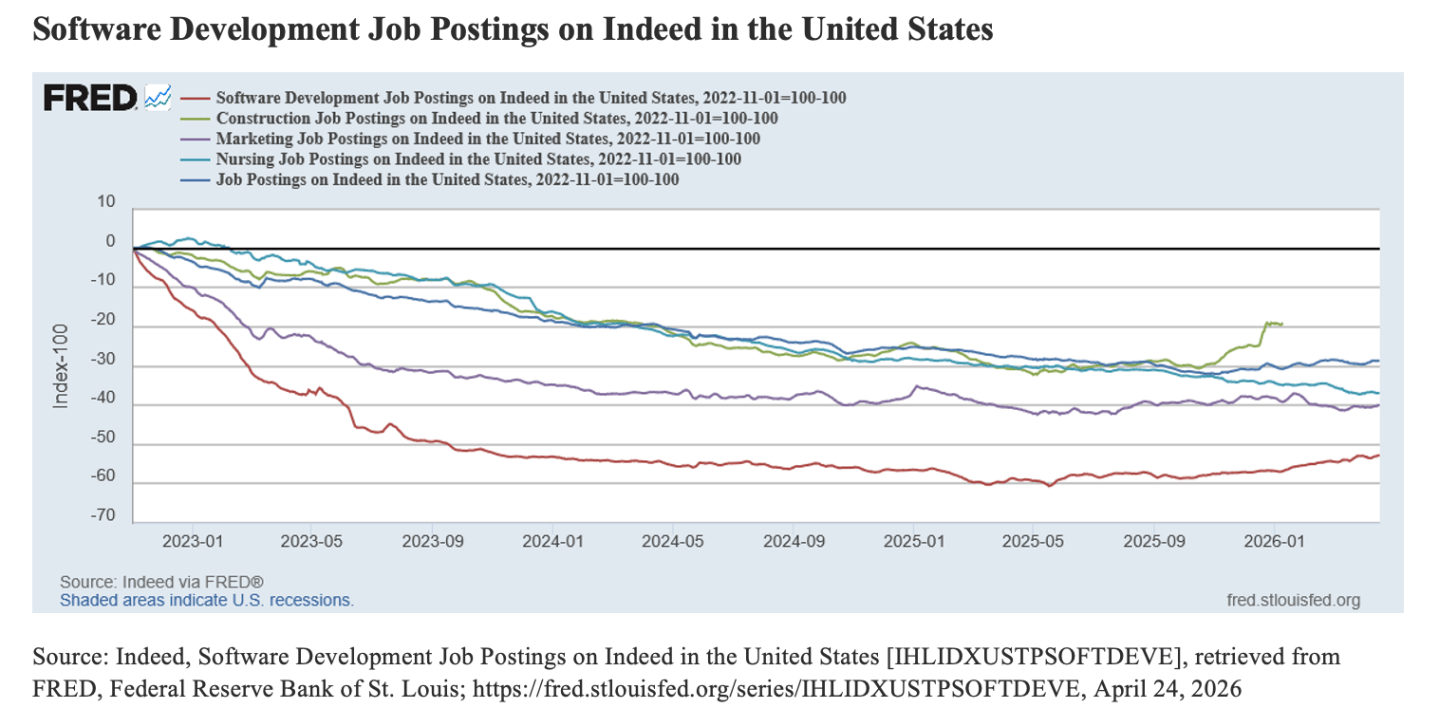
But BCG found that software engineering headcount across all ages in the technology sector has slowed but still grown, albeit at a much slower annual rate of 2% since the public release of ChatGPT. “AI helps engineers do their jobs more effectively rather than replacing them,” the authors conclude. The 2026 Winter Salary Survey from the National Association of Colleges and Employers reports a complementary finding: starting salaries for computer science majors are expected to increase by almost 7% year-over-year.
Similar conflicting patterns are emerging across other technical roles. One respected firm publishes a study forecasting mass firings, while another estimates the net effect is minimal. Given all this noise, the average firm has chosen not to lay off workers on a large scale. Instead, many are silently closing the door to new ones.
Some leaders have sought to provide at least some clarity by explicitly committing not to lay off employees. At Davos, ServiceNow CEO Bill McDermott promised not to lay off employees even as his 30,000-employee company adopts Agentic AI and automates certain functions. As McDermott puts it, if he has only hired “nines and tens,” why should he fire instead of retooling them? IT staff members whose roles have been affected by Agentic AI have already transitioned to become managers of these AI agents or moved into other roles after reskilling at the company’s ServiceNow University.
Where layoffs do occur, they tend to cluster in the precise functions agents now absorb end-to-end. Salesforce CEO Marc Benioff confirmed that the company cut roughly 4,000 customer-service positions after AI agents began handling about half of customer interactions. IBM eliminated 200 HR roles after its agentic “AskHR” system automated high-volume workflows such as routine employee inquiries and administrative document processing.
But these are not broad-based layoffs—rather, they are surgical reductions in the workflows as agentic systems begin to run at scale. A recent McKinsey survey points to the trajectory: while 43% of companies expect AI not to change the size of their workforce, 32% expect AI to decrease their employee base by at least 3% within the next year. Against a U.S. voluntary turnover rate of 13% per year as of 2025, those headcount targets can largely be met by slowing or freezing the replacement of workers who leave of their own accord.
The broader labor market reflects the same pattern. Hiring has slowed to levels last seen in 2010, when unemployment was nearly 10%. Economists have started calling this a “big freeze”: companies are not firing, but they are not hiring either. Employment looks stable. Opportunity is not.
This is what AI-driven disruption looks like in practice. Firms are not cutting headcount but are getting more output from the same workforce. As productivity rises, the need for new recruits falls. Existing employees reskill. Advertised roles go unfilled and hiring slows. The impact shows up not as layoffs but as fewer pathways into the workforce.
At the same time, firms are reducing their reliance on external labor. The first jobs to disappear are often outsourced—call centers, agencies, and offshore support. That makes the early impact easy to miss. It does not always show up in traditional employment data.
Uncertainty is amplifying the trend. Over the past several years, firms have faced a rapid succession of shocks, from inflation and rising interest rates to recurring fears of recession and geopolitical instability. In that environment, companies have become far more cautious about long-term investments in talent. Hiring entry-level workers is, by definition, a bet on the future. New employees take time to train and rarely contribute immediately. When the outlook is unclear, that is the easiest investment to delay.
Longer-term structural forces are reinforcing the squeeze. As populations age and workers remain in the labor force longer, career progression has slowed. Older employees are holding on to roles for longer, delaying the upward movement that typically creates space for new entrants. Research on the “age pay gap”—the difference in earnings between workers under 35 and those over 55—finds that it has widened by more than 60% in the United States over the past four decades, reflecting a growing premium on experience.
If LLMs have sparked conversations about the consequences of AI on the labor force, agentic systems will catalyze those expected outcomes. The entire labor development pipeline must adjust its approach to educating and training the next generation of workers for the jobs of an AI-enabled future.
What Leaders Are Watching
Leaders in higher education are already preparing for that shift. At our Yale Higher Education Summit in January, 100 college and university presidents gathered to discuss the most pressing issues demanding their attention. AI, along with federal intervention, was at the top of the list. In a survey conducted ahead of the event, 41% of those leaders reported being highly concerned about the vulnerability of entry-level white-collar roles. Many at the event also shared concerns about the early signs of disruption caused by the technology.
The New York Times published a widely read but troubling story last fall citing a Federal Reserve Bank of New York study that now puts the unemployment rate among recent college graduates (ages 22 to 27) in computer science and computer engineering at 7.0% and 7.8%, respectively, among the highest across all majors and comparable to rates for anthropology, fine arts, and performing arts.
According to our survey, there is a clear shift in the skills employers prioritize in the emerging AI era. Critical thinking and complex problem-solving rank as the most sought-after capabilities by a wide margin. Adaptability, creativity, and technical and data analysis follow close behind. Employers are no longer just looking for workers who can execute tasks. They are looking for those who can exercise reasoning in AI-enabled environments. The scaling of Agentic AI technologies will not only amplify the need for those skills but also for the need for project management, domain knowledge, and sound judgment.
What is less clear is whether academia is preparing graduates enough to meet that bar. Only 10% of respondents said their graduates were sufficiently or very well prepared for AI-enabled workplaces. Nearly a third said they were somewhat or fully unprepared, while almost 60% fell into an unconvincing in-between.
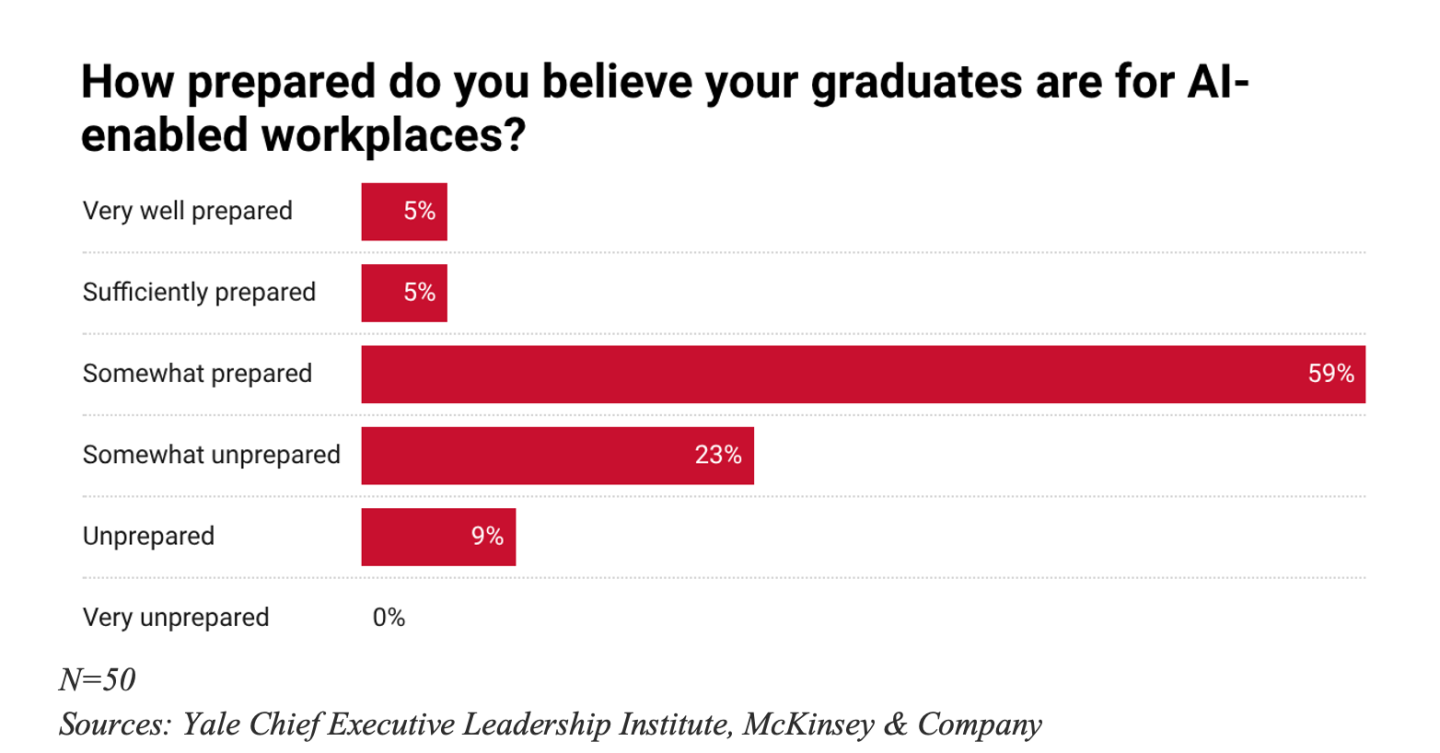
Education is no panacea when it comes to the known tools and techniques to master. Becoming AI savvy is not a product of programs and scholastic credentials. It is a mindset. As Albert Einstein is widely credited with saying, “Wisdom is not a product of schooling but of the lifelong attempt to acquire it.”
The shift is subtle, but its consequences are not. The greatest risk will not be a sudden wave of layoffs. It will be a labor market in which fewer entry-level jobs are created, making it harder for workers to gain experience and advance over time.
That concern is reflected in both employer expectations and worker sentiment.
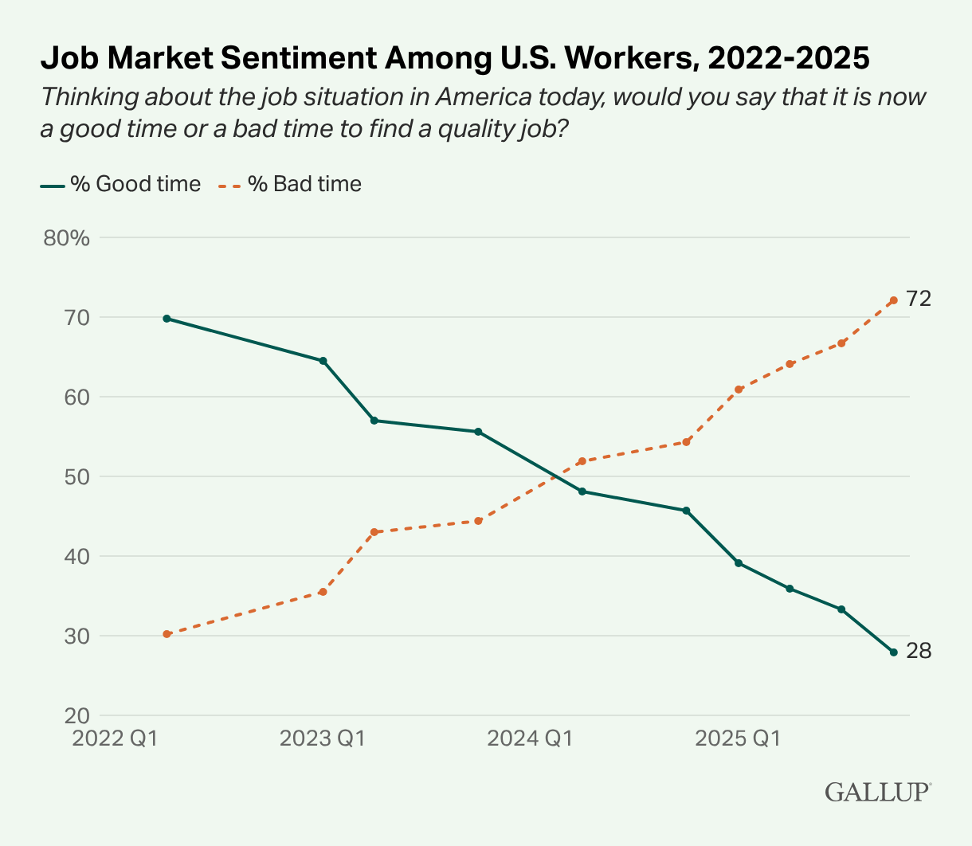
Job market confidence has deteriorated sharply, with the share of U.S. workers who say it is a good time to find a job falling from roughly 70% in 2022 to just 28% more recently. The decline is most pronounced among younger workers and the college-educated, who in a reversal of historical patterns are now more pessimistic than those without degrees—(19% of college graduates say it is a “good time” to find a quality job, versus 35% of those without degrees).
The result is a growing sense of stagnation across the workforce. Workers are staying in roles longer, not necessarily because conditions are improving but because alternatives are harder to find. In surveys, a majority report feeling “stuck”—either unable to move up, move laterally, or move on. That lack of mobility further reduces churn, which regularly creates entry-level opportunities.
What Leaders Need to Do Now
Like past technological shifts, from the automation of manufacturing to the rise of the Internet economy, the effects of AI are unlikely to arrive all at once. But this transition may move faster than those that came before. Software is embedded across nearly all functions of enterprises and can be deployed instantly, allowing firms to adopt new tools without the long timelines required for physical restructuring. And Agentic AI systems are rapidly improving, and implementation is spreading function by function in a matter of months, not years.
If entry-level roles are compressed too aggressively, firms risk weakening their own talent pipelines. At the same time, the jobs that AI creates will not neatly replace the work it automates. Many emerging roles—AI oversight, process redesign, governance, model operations, and data infrastructure—require technical and managerial skills that many displaced workers may not have developed.
This creates a broader policy tension. On the one hand, Agentic AI has the potential to significantly increase productivity and economic growth. On the other hand, it will likely reduce labor demand not through sudden disruption but through a steady narrowing of opportunities at the entry level. The biggest impact of Agentic AI on jobs will not be the layoffs we can see. It will be the opportunities that never materialize—the first steps into the workforce that quietly disappear before anyone notices.
For leaders, the challenge is not just capturing productivity gains. It is simultaneously preserving the pathways that allow workers to build skills over time. The simplistic admonition that schooling alone can prepare workers with the skills they need is misleading. There are no easy courses or credentials to make someone AI savvy. When Jensen Huang of NVIDIA tells people not to worry about learning coding for software tools, there is a strong signal worth heeding. People did not need to understand bubble memory or VoIP architecture to use a telephone.
AI-savvy preparation is more of a mindset and immersion in emerging platforms than mastering a library of analytic tools. John Dewey wrote in his 1916 work Democracy and Education: “Education is not preparation for life—education is life itself.”
This article is part one of a four-part series from the Yale Chief Executive Leadership Institute (CELI) on the state of Agentic AI adoption across industries and sectors. The research is designed to help CEOs understand the current and expected pace at which agentic systems are being deployed—and the strategic decisions that pace forces on them. Over the past six months, CELI researchers analyzed hundreds of company materials and industry analyses and conducted dozens of conversations with senior technology leaders across the U.S. The industries analyzed include Financial Services, Consumer Packaged Goods, Food & Beverage, Healthcare, Insurance, Manufacturing, Professional Services, Real Estate & Housing, Retail, Supply Chain & Logistics, Telecommunications, and Travel & Hospitality, as well as the public sector. The series examines four implications of the findings: labor market effects, data infrastructure readiness, governance and regulatory policy, and customer experience.
With research contribution from Dan Kent, Holden Lee, Catherine Dai, Zander Jeinthanuttkanont, Yevheniia Podurets, Jasmine Garry, and Christian Ruiz Angulo.
The opinions expressed in Fortune.com commentary pieces are solely the views of their authors and do not necessarily reflect the opinions and beliefs of Fortune.