• Home
  • Latest
  • Fortune 500
  • Finance
  • Tech
  • Leadership
  • Lifestyle
  • Rankings
  • Multimedia

Trendingnow

1

Egg companies made $1.22 billion in profit off a $6 carton — now they’re buying their way out of a price-fixing case with 53 million donated eggs

2

Meet the Zillennials: The luckiest micro-generation in the workforce, born between 1993 and 1998

3

Economists have found an answer to slowing cognitive decline: Avoid retiring early, study finds

1

Egg companies made $1.22 billion in profit off a $6 carton — now they’re buying their way out of a price-fixing case with 53 million donated eggs

2

Meet the Zillennials: The luckiest micro-generation in the workforce, born between 1993 and 1998

3

Economists have found an answer to slowing cognitive decline: Avoid retiring early, study finds

This Could Be the Biggest Roadblock to Self-Driving Cars

By
Reuters
Reuters
Down Arrow Button Icon
By
Reuters
Reuters
Down Arrow Button Icon
March 31, 2016, 3:05 PM ET
183813691
Photograph by Mike Clarke — Getty Images
Add Fortune on Google for similar content.

Volvo’s North American CEO, Lex Kerssemakers, lost his cool as the automaker’s semi-autonomous prototype sporadically refused to drive itself during a press event at the Los Angeles Auto Show.

“It can’t find the lane markings!” Kerssemakers griped to Mayor Eric Garcetti, who was at the wheel. “You need to paint the bloody roads here!”

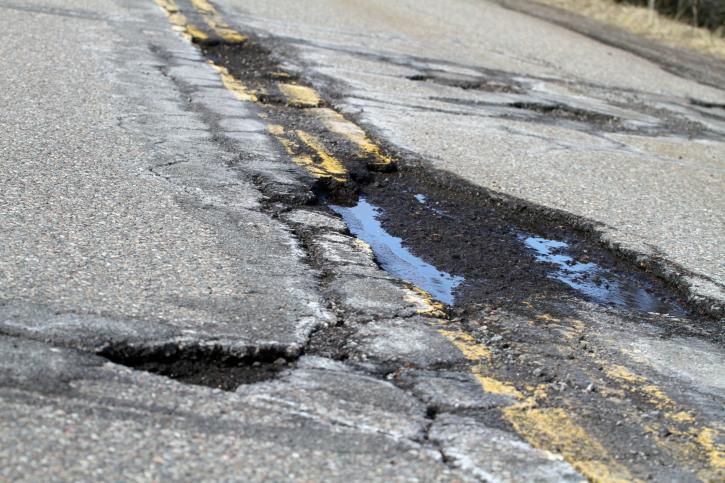
Shoddy infrastructure has become a roadblock to the development of self-driving cars, vexing engineers and adding time and cost. Poor markings and uneven signage on the 3 million miles of paved roads in the United States are forcing automakers to develop more sophisticated sensors and maps to compensate, industry executives say.

Tesla (TSLA) CEO Elon Musk recently called the mundane issue of faded lane markings “crazy,” complaining they confused his semi-autonomous cars.

An estimated 65% of U.S. roads are in poor condition, according to the U.S. Department of Transportation, with the transportation infrastructure system rated 12th in the World Economic Forum’s 2014-2015 global competitiveness report.

Tesla, Volvo, Mercedes, Audi and others are fielding vehicles that can drive on highways, change lanes and park without human help. But they are easily flummoxed by faded lane markers, damaged or noncompliant signs or lights, and the many quirks of a roadway infrastructure managed by thousands of state and local bureaucracies.

In other developed countries, greater standardization of road signs and markings makes it easier for robot cars to navigate. In the U.S., however, traffic lights can be aligned vertically, horizontally or “dog-house” style in two columns. Pavement markings use paint with different degrees of reflectivity—or don’t exist at all.

“If the lane fades, all hell breaks loose,” said Christoph Mertz, a research scientist at Carnegie Mellon University. “But cars have to handle these weird circumstances and have three different ways of doing things in case one fails.”

More Sensors, More Cost

To make up for roadway aberrations, carmakers and their suppliers are incorporating multiple sensors, maps and data into their cars, all of which adds cost.

Mercedes says the “drive pilot” system found in its recently unveiled luxury E Class 2017 sedans works even with no lane markings. The system—which incorporates 23 sensors—takes into account guard rails, barriers, and other cars to keep cars in their lanes up to 84 miles per hour, under “suitable circumstances.”

Boston Consulting Group estimates that initial semi-autonomous features add $4,000 to a car’s price. It estimated carmakers will have to spend more than $1 billion over the next decade in research investment for even more sophisticated autonomous features.


On a good road in daylight, cameras installed around a car are sufficient to distinguish road lines, traffic lights and signs. But without lane markings, the car needs more technology to judge its position.

Enter radar and lidar, which send out radio waves or light pulses to bounce off objects. The data sent back informs the car about objects, their distance and velocity. Triangulating between trees to the right, boulders to the left, and other vehicles ahead, for instance, can give the car its bearings.

A host of companies—including Silicon Valley firms Quanergy and Velodyne and international suppliers like Paris-based Valeo—are vying to reduce the cost and size of lidar from the bulky, $75,000 Velodyne version first seen on the roof of Google’s self-driving car.

In January, Quanergy unveiled a small $250 Lidar with no moving parts. Automakers want the price to drop below $100 for production vehicles, which Quanergy promises to do by 2018.

Sub-par roads are fueling efforts by companies such as Germany’s HERE and Dutch company TomTom to create three dimensional maps that can provide the car’s location on the road within centimeters, said Chris Warrington, CEO of mapping technology company GeoDigital.

Automakers are looking to pay $50-$60 per car for such maps, which may be well below the actual price, said Warrington.

“We know they’re coming, but they don’t exist yet. That’s why lane markings are so important now,” said Gary O’Brien, director of advanced engineering for automotive supplier Delphi Automotive Systems PLC.

O’Brien snaps photos of bad roads when he travels.

“Look at this, there are no lane markings at all!” O’Brien said, showing a picture he took on a desert road in Bluff, Utah where the demarcation between the road and ground is barely visible.

[fortune-brightcove videoid=4796967373001]


“Make Up Your Mind!”

Some officials envision traffic signals that communicate with cars at dangerous intersections and vehicles that can signal each other their positions, direction and speed.

The U.S. Department of Transportation’s “Smart City Challenge,” a competitive grant program, will offer up to $40 million this summer to help one city integrate new technologies, which could include infrastructure for self-driving cars.

The Transportation Research Board, an independent group that advises the government, plans to issue recommendations for standardized lane markings for machine vision by 2017. By then, several automakers say they plan to offer models with some form of autonomous highway driving.

Paul Carlson, a research engineer focused on infrastructure at Texas A&M University, said he gets calls from transportation officials asking how to accommodate robot cars.

He tells them to aim for consistency: “Make up your mind, people! Do you want your traffic lights vertical or horizontal?”

About the Author
By Reuters
See full bioRight Arrow Button Icon
Add Fortune on Google for similar content.

Latest in

Finance
Lorem ipsum dolor sit amet, consectetur adipiscing elit, sed do eiusmod tempor incididunt ut labore et dolore magna aliqua. Ut enim ad minim veniam
By Fortune Editors
October 20, 2025
Finance
Lorem ipsum dolor sit amet, consectetur adipiscing elit, sed do eiusmod tempor incididunt ut labore et dolore magna aliqua. Ut enim ad minim veniam
By Fortune Editors
October 20, 2025
Finance
Lorem ipsum dolor sit amet, consectetur adipiscing elit, sed do eiusmod tempor incididunt ut labore et dolore magna aliqua. Ut enim ad minim veniam
By Fortune Editors
October 20, 2025
Finance
Lorem ipsum dolor sit amet, consectetur adipiscing elit, sed do eiusmod tempor incididunt ut labore et dolore magna aliqua. Ut enim ad minim veniam
By Fortune Editors
October 20, 2025
Finance
Lorem ipsum dolor sit amet, consectetur adipiscing elit, sed do eiusmod tempor incididunt ut labore et dolore magna aliqua. Ut enim ad minim veniam
By Fortune Editors
October 20, 2025
Finance
Lorem ipsum dolor sit amet, consectetur adipiscing elit, sed do eiusmod tempor incididunt ut labore et dolore magna aliqua. Ut enim ad minim veniam
By Fortune Editors
October 20, 2025

Most Popular

Finance
Lorem ipsum dolor sit amet, consectetur adipiscing elit, sed do eiusmod tempor incididunt ut labore et dolore magna aliqua. Ut enim ad minim veniam
By Fortune Editors
October 20, 2025
Finance
Lorem ipsum dolor sit amet, consectetur adipiscing elit, sed do eiusmod tempor incididunt ut labore et dolore magna aliqua. Ut enim ad minim veniam
By Fortune Editors
October 20, 2025
Finance
Lorem ipsum dolor sit amet, consectetur adipiscing elit, sed do eiusmod tempor incididunt ut labore et dolore magna aliqua. Ut enim ad minim veniam
By Fortune Editors
October 20, 2025
Finance
Lorem ipsum dolor sit amet, consectetur adipiscing elit, sed do eiusmod tempor incididunt ut labore et dolore magna aliqua. Ut enim ad minim veniam
By Fortune Editors
October 20, 2025
Finance
Lorem ipsum dolor sit amet, consectetur adipiscing elit, sed do eiusmod tempor incididunt ut labore et dolore magna aliqua. Ut enim ad minim veniam
By Fortune Editors
October 20, 2025
Finance
Lorem ipsum dolor sit amet, consectetur adipiscing elit, sed do eiusmod tempor incididunt ut labore et dolore magna aliqua. Ut enim ad minim veniam
By Fortune Editors
October 20, 2025
Fortune Secondary Logo
Rankings
  • 100 Best Companies
  • Fortune 500
  • Global 500
  • Fortune 500 Europe
  • Most Powerful Women
  • World's Most Admired Companies
  • See All Rankings
  • Lists Calendar
Sections
  • Finance
  • Fortune Crypto
  • Features
  • Leadership
  • Health
  • Commentary
  • Success
  • Retail
  • Mpw
  • Tech
  • Lifestyle
  • CEO Initiative
  • Asia
  • Politics
  • Conferences
  • Europe
  • Newsletters
  • Personal Finance
  • Environment
  • Magazine
  • Education
Customer Support
  • Frequently Asked Questions
  • Customer Service Portal
  • Privacy Policy
  • Terms Of Use
  • Single Issues For Purchase
  • International Print
Commercial Services
  • Advertising
  • Fortune Brand Studio
  • Fortune Analytics
  • Fortune Conferences
  • Business Development
  • Group Subscriptions
About Us
  • About Us
  • Press Center
  • Work At Fortune
  • Terms And Conditions
  • Site Map
  • About Us
  • Press Center
  • Work At Fortune
  • Terms And Conditions
  • Site Map
  • Facebook icon
  • Twitter icon
  • LinkedIn icon
  • Instagram icon
  • Pinterest icon

Latest in

‘Devin-kun’: Japan embraces agents as legacy code and a shrinking workforce create a perfect market for an AI software engineer 
AsiaAI agents
‘Devin-kun’: Japan embraces agents as legacy code and a shrinking workforce create a perfect market for an AI software engineer 
By Nicholas GordonJuly 3, 2026
9 hours ago
‘It’s just his AI and my AI going back and forth’: The workplace phenomenon that’s undermining human relationships
Future of WorkWorkforce
‘It’s just his AI and my AI going back and forth’: The workplace phenomenon that’s undermining human relationships
By Jacqueline MunisJuly 3, 2026
15 hours ago
Chad Hurley and Steven Chen wearing suits
SuccessWealth
YouTube’s founders split over $650 million when they sold to Google in 2006—had they held out, they could have taken a slice of $550 billion
By Preston ForeJuly 3, 2026
15 hours ago
Photo: Paris, france
Environmentclimate change
Brutal heatwave in France is killing 2,000 people per week, undertakers are overwhelmed, and health agency says there’s worse to come
By John Leicester and The Associated PressJuly 3, 2026
15 hours ago
ds
CommentarySoftware
I argued with the father of open source for 2 years. Now the AI fight is the same — only bigger
By David SiegelJuly 3, 2026
17 hours ago
ashok
Commentary250 Years of Innovation
The greatest startup in history: What we can learn from America’s founders at today’s AI frontier
By Ashok N. SrivastavaJuly 3, 2026
17 hours ago

Most Popular

Egg companies made $1.22 billion in profit off a $6 carton — now they’re buying their way out of a price-fixing case with 53 million donated eggs
Law
Egg companies made $1.22 billion in profit off a $6 carton — now they’re buying their way out of a price-fixing case with 53 million donated eggs
By Wyatte Grantham-Philips and The Associated PressJuly 2, 2026
1 day ago
Meet the Zillennials: The luckiest micro-generation in the workforce, born between 1993 and 1998
AI
Meet the Zillennials: The luckiest micro-generation in the workforce, born between 1993 and 1998
By Nick LichtenbergJuly 3, 2026
23 hours ago
Economists have found an answer to slowing cognitive decline: Avoid retiring early, study finds
Economy
Economists have found an answer to slowing cognitive decline: Avoid retiring early, study finds
By Sasha RogelbergJuly 2, 2026
2 days ago
On Wall Street, analysts increasingly don’t believe the U.S. government’s 'misleading' job numbers
Economy
On Wall Street, analysts increasingly don’t believe the U.S. government’s 'misleading' job numbers
By Jim EdwardsJuly 3, 2026
18 hours ago
$25 billion CEO says one-hour interviews are a waste of time—he puts candidates through six hours of tests and wants them to order wine at lunch
Success
$25 billion CEO says one-hour interviews are a waste of time—he puts candidates through six hours of tests and wants them to order wine at lunch
By Orianna Rosa RoyleJuly 3, 2026
23 hours ago
Current price of oil as of July 2, 2026
Personal Finance
Current price of oil as of July 2, 2026
By Joseph HostetlerJuly 2, 2026
2 days ago

© 2026 Fortune Media IP Limited. All Rights Reserved. Use of this site constitutes acceptance of our Terms of Use and Privacy Policy | CA Notice at Collection and Privacy Notice | Do Not Sell/Share My Personal Information
FORTUNE is a trademark of Fortune Media IP Limited, registered in the U.S. and other countries. FORTUNE may receive compensation for some links to products and services on this website. Offers may be subject to change without notice.