• Home
  • Latest
  • Fortune 500
  • Finance
  • Tech
  • Leadership
  • Lifestyle
  • Rankings
  • Multimedia
LeadershipHuman Capital

Does the U.S. Need New Rules for Workers in the Gig Economy?

By
Down Arrow Button Icon
By
Down Arrow Button Icon
February 12, 2016, 1:04 PM ET
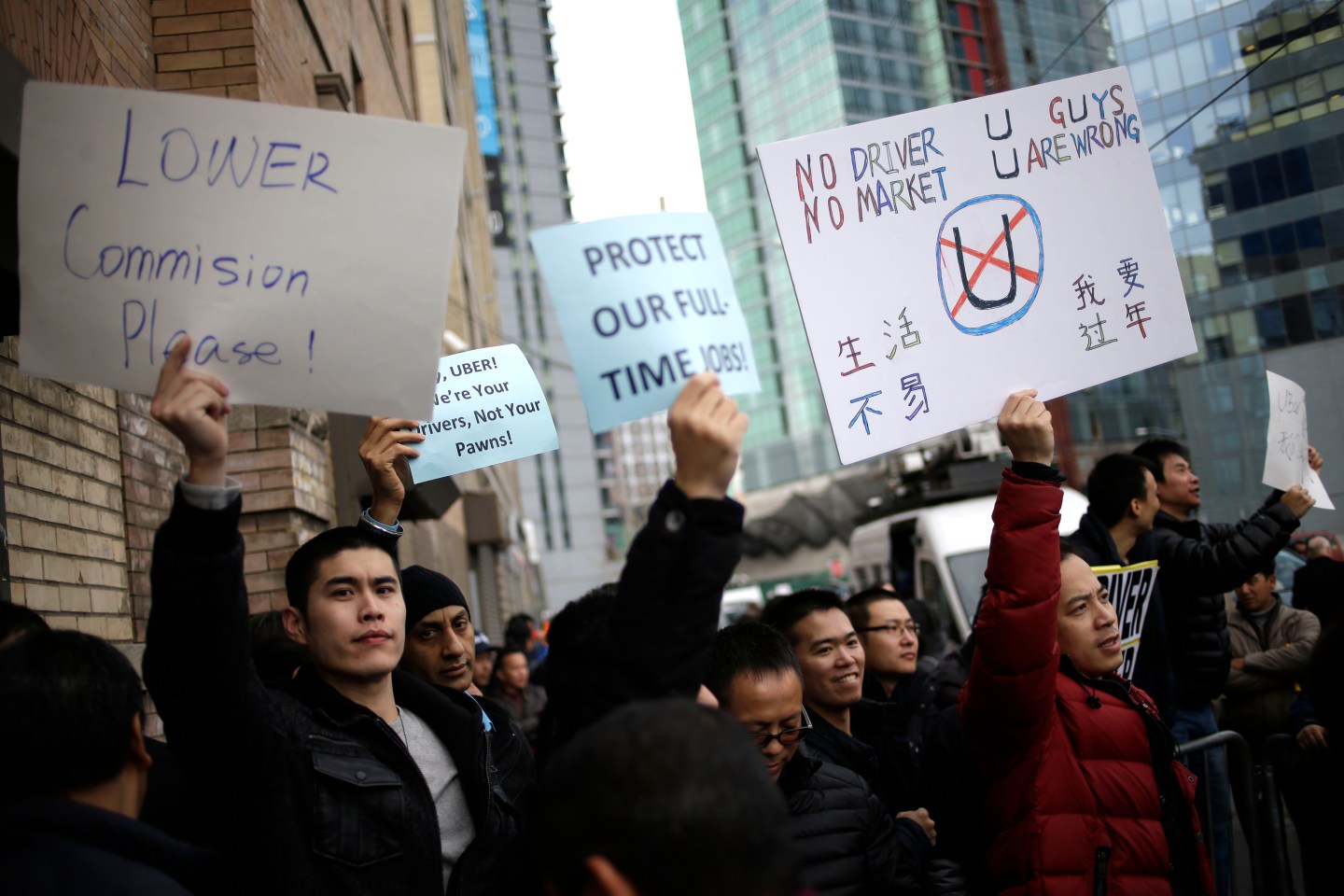
APTOPIX Uber Protest
Uber drivers and their supporters hold signs during a rally at an Uber office in New York, Monday, Feb. 1, 2016. Some Uber drivers in New York City say they are going on strike to protest the company's decision to cut fares in the city by 15 percent. (AP Photo/Seth Wenig)Photograph by Seth Wenig — AP

Are Uber and Lyft drivers, Thumbtack personal trainers, or Handy house cleaners employees? Or are they independent contractors? That question has given rise to a seemingly endless stream of lawsuits. But so far nothing, including the $12.2 million settlement of Lyft drivers’ case last month, has shed any light on which category workers in the smartphone-enabled gig economy belong to.

There’s a simple reason for that. The federal laws that define who is who have not changed much in 60 years. So they don’t fit the fast-growing population that gets its gigs via an intermediary like Uber. Estimated at about 600,000 right now, these workers’ arrangement with employers is in legal limbo.

“We call them ‘independent workers,’” says Seth Harris, an attorney and former acting labor secretary who teaches employment policy at Cornell’s School of Labor & Industrial Relations. “They occupy a gray area between employees and independent contractors. It’s really a third category.”

In a LinkedIn essay, Harris quoted a judge in one recent case who observed that deciding whether gig workers are employees or contractors is like trying to “fit a square peg into one of two round holes.”

Harris would like to see the law catch up with the times. He and Princeton economics professor Alan Krueger wrote a policy proposal advocating for the creation of a new “independent worker” status that would give Uber drivers and their ilk some — but not all — of the same rights as employees.

Under current law, anyone classified as an employee qualifies for a range of benefits, including the right to organize and bargain collectively, civil rights protection, workers compensation, unemployment insurance coverage, overtime pay, and a minimum wage. Independent contractors, including most freelancers, are typically self-employed, which means they operate as separate businesses.

Gig workers, by contrast, are neither fish nor fowl. On the one hand, like independent contractors, gig workers have a lot of leeway in deciding how many hours they want to work, or whether they’ll work at all on any given day. They can also perform tasks for more than one company—both Uber and Lyft, for instance. But on the other hand, they’re a bit like employees, since companies like Uber control many aspects of their work, including fees or fee caps, and can “fire” them at will.

Under Harris and Krueger’s plan, “independent workers” wouldn’t qualify for hours-based benefits, like overtime pay or the minimum wage, nor would they receive unemployment insurance. They would, however, be covered by civil rights laws prohibiting age, sex, and race discrimination. Independent workers would also be allowed to organize and bargain collectively. And companies like Uber would be obliged to withhold income taxes, and pony up a share of the FICA taxes that fund Social Security and Medicare.

That sounds as if creating a third worker category would help workers more than the companies that hire them, but Harris and Krueger maintain that new rules would benefit both sides, and maybe even stem the rising tide of expensive litigation.

“Right now, there’s too much ambiguity,” says Harris. “Neither side knows what its legal rights are, or even if they have any.”

Clearing up the current fog would mean that “companies could attract more workers, with the same flexibility they have now,” Krueger adds. “The law has to evolve to support innovation.”


Latest in Leadership

Nicholas Thompson
C-SuiteBook Excerpt
I took over one of the most prestigious media firms while training for an ultramarathon. Here’s what I learned becoming CEO of The Atlantic
By Nicholas ThompsonDecember 13, 2025
15 hours ago
Lauren Antonoff
SuccessCareers
Once a college dropout, this CEO went back to school at 52—but she still says the Gen Zers who will succeed are those who ‘forge their own path’
By Preston ForeDecember 13, 2025
16 hours ago
Asiathe future of work
The CEO of one of Asia’s largest co-working space providers says his business has more in common with hotels
By Angelica AngDecember 12, 2025
24 hours ago
Donald Trump
HealthHealth Insurance
‘Tragedy in the making’: Top healthcare exec on why insurance will spike to subsidize a tax cut to millionaires and billionaires
By Nick LichtenbergDecember 12, 2025
1 day ago
three men in suits, one gesturing
AIBrainstorm AI
The fastest athletes in the world can botch a baton pass if trust isn’t there—and the same is true of AI, Blackbaud exec says
By Amanda GerutDecember 12, 2025
1 day ago
Brainstorm AI panel
AIBrainstorm AI
Creative workers won’t be replaced by AI—but their roles will change to become ‘directors’ managing AI agents, executives say
By Beatrice NolanDecember 12, 2025
1 day ago

Most Popular

placeholder alt text
Success
Apple cofounder Ronald Wayne sold his 10% stake for $800 in 1976—today it’d be worth up to $400 billion
By Preston ForeDecember 12, 2025
1 day ago
placeholder alt text
Economy
Tariffs are taxes and they were used to finance the federal government until the 1913 income tax. A top economist breaks it down
By Kent JonesDecember 12, 2025
2 days ago
placeholder alt text
Success
40% of Stanford undergrads receive disability accommodations—but it’s become a college-wide phenomenon as Gen Z try to succeed in the current climate
By Preston ForeDecember 12, 2025
1 day ago
placeholder alt text
Economy
The Fed just ‘Trump-proofed’ itself with a unanimous move to preempt a potential leadership shake-up
By Jason MaDecember 12, 2025
1 day ago
placeholder alt text
Economy
For the first time since Trump’s tariff rollout, import tax revenue has fallen, threatening his lofty plans to slash the $38 trillion national debt
By Sasha RogelbergDecember 12, 2025
1 day ago
placeholder alt text
Success
Apple CEO Tim Cook out-earns the average American’s salary in just 7 hours—to put that into context, he could buy a new $439,000 home in just 2 days
By Emma BurleighDecember 12, 2025
1 day ago
Rankings
  • 100 Best Companies
  • Fortune 500
  • Global 500
  • Fortune 500 Europe
  • Most Powerful Women
  • Future 50
  • World’s Most Admired Companies
  • See All Rankings
Sections
  • Finance
  • Leadership
  • Success
  • Tech
  • Asia
  • Europe
  • Environment
  • Fortune Crypto
  • Health
  • Retail
  • Lifestyle
  • Politics
  • Newsletters
  • Magazine
  • Features
  • Commentary
  • Mpw
  • CEO Initiative
  • Conferences
  • Personal Finance
  • Education
Customer Support
  • Frequently Asked Questions
  • Customer Service Portal
  • Privacy Policy
  • Terms Of Use
  • Single Issues For Purchase
  • International Print
Commercial Services
  • Advertising
  • Fortune Brand Studio
  • Fortune Analytics
  • Fortune Conferences
  • Business Development
About Us
  • About Us
  • Editorial Calendar
  • Press Center
  • Work At Fortune
  • Diversity And Inclusion
  • Terms And Conditions
  • Site Map

© 2025 Fortune Media IP Limited. All Rights Reserved. Use of this site constitutes acceptance of our Terms of Use and Privacy Policy | CA Notice at Collection and Privacy Notice | Do Not Sell/Share My Personal Information
FORTUNE is a trademark of Fortune Media IP Limited, registered in the U.S. and other countries. FORTUNE may receive compensation for some links to products and services on this website. Offers may be subject to change without notice.