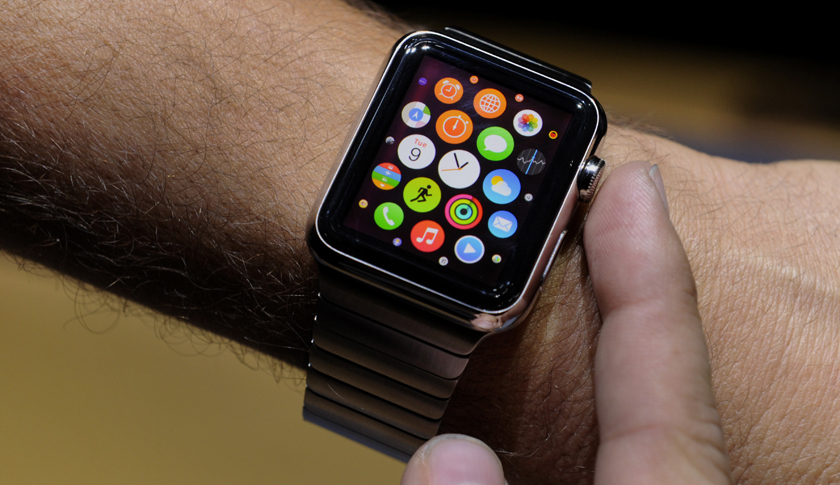
While consumers are still trying to figure out where wearables fit into their lives—if at all—AT&T Mobility is hard at work improving them. The goal: wearable fitness trackers and smartwatches that have cellular connectivity built in so you don’t have to worry about always having your phone nearby to receive calls or text messages.
Fortune recently spoke with AT&T Mobility (T) CEO Glenn Lurie about wearables today, connected wearables of tomorrow, and the impact they will have on our lives. Here is that conversation, edited and condensed for clarity.
Fortune: Can you paint a picture of the current state of the wearable market?
Lurie: We are at the infancy of wearables. I will say right up front: I’ve been very vocal for many years that the wearable will become an independent device — meaning, not necessarily having to be connected to a smartphone.
Today, I think we’re off to a nice start. I think people are starting to understand what a wearable can be. Most of the focus today is around fitness, or the health and wellness space. I do think that that’s going to change dramatically once you start to see fully connected devices.
We did just announce two smartwatches, Samsung’s Gear S2 and the LG Urbane, both with LTE. We are very excited about those, partly because of NumberSync. I think NumberSync is really a massive step for us, and for the overall industry.
What is NumberSync?
If you go back the first big enhancement for really Internet of things, or connected devices was when we went to Mobile Share Value. Our Mobile Share Value allows you to buy a bucket of data, then you can connect multiple devices to your account. Early on it was all about smartphones and tablets, today it’s about smartphones, tablets, cars, wearables, etc.
I think NumberSync is the second massive step and paradigm shift in that it allows you in the simplest way I can say, to take the persona of your smartphone and move it to other devices.
There’s a big simplicity to going for a jog or to dinner and you leaving your five inch smartphone at home. With NumberSync, you can receive calls and texts, and do all the things you can do [on your smartphone], on that wearable that’s on your wrist.
Outside of wearables, where else should we expect to see NumberSync implemented?
The system has the capability to go everywhere. I’ll give you a “day in the life” just for fun. When you wake up in the morning and you have a smartphone next to you in a connected home, you could theoretically have your home phone ring when your smart phone rings. You can have NumberSync linked to your entire home, and you can tell your home and smartphone how you want them to work together.
It’s the same concept we have with our Digital Life product [AT&T’s home security and automation platform]. Today you can tell your home by pressing one button as you leave to lock all the doors, close the garage, and turn the thermostat down.
Reality is, in the future that’s all going to be done for you. Your home is going to know where your smartphone is, your smartphone is going to know where your home is — it’s all going to be linked together. NumberSync is going to play a role in that.
Today you have to get in your car, you have to connect your smartphone to your car with Bluetooth or USB. That’s really going to be old school down the road. The reality is you shouldn’t even have to think about it.
Where do you see wearables going over the next five years?
I think the majority is going to be connected on their own. They’ll be independent, wireless devices.
I do believe we have a massive opportunity to truly dig into some other areas. The number one area is going to continue to be health and wellness. There’s a great opportunity in the healthcare space to make wearable devices a hub for your body.
What I mean by that is, my 77 year-old father is not going to put a device on and sync it with his smartphone. It’s just not going to happen. If I was to hand him a watch or a band that was comfortable and fully connected, I could check on him in a respectful way. I could see his vitals or give a doctor the ability to see his vitals. My dad is taking different medications and we could see his reaction to his meds in real time. These are massively important things.
I’m fortunate, I get to go into the double and triple secret labs and see some of these devices with multiple sensors on them. These sensors have the ability through biometrics to know who is wearing it. So when you put on the band it knows its you, and quits working if you were to take it off.
Now, start thinking about what is possible. The band has location and wireless connectivity. The reality is you’d never need another set of keys again. You’d never need to wear a badge at the office. You probably would be able to pay for anything you wanted, because that band is going to be linked to you. As you approach your car, your car would start and the doors would open, and all the settings would switch to you. Same when you walk into your home or office.
With that in mind, how big of a revenue stream are wearables going to have for AT&T Mobility?
A lot. I can’t give you numbers. What I can tell you is when you look at all the things we’re doing, especially AT&T, we are a leader in the Internet of Things space, have been for a long time. We view this as one of the key verticals in the space. We’re working with companies on every front.
The easiest way for me to say it is: It’s limitless.
As this technology gets better and less expensive to build, the number of uses is endless. There’s revenue to be made in selling hardware. There’s revenue to be made in the data analytics side of wearables. There’s revenue to be made in utilizing our networks.
All the car manufacturers are saying I want those wearables working for my car first. And all the farmers driving farm equipment want the same thing.
What percentage of wearables in 2016 will have some sort of cellular connectivity built into them?
It’s hard to say. When you start thinking about the watches we just announced (Samsung’s Gear S2 and LG Urbane) with 4G LTE inside of them, you’re talking about multiple hundred dollar items that are a little bit more expensive. You’re still going to see a lot of inexpensive fitness tracking bands that will probably still be dominant.
I think when we start looking at the five-year timeframe, you will see a higher percentage of fully connected devices.
This year has been interesting for wearables. Fitbit has taken off, Apple seems to be doing pretty well. Yet wearables as a whole haven’t really gained a lot of traction.
It’s one thing when people buy a wearable, it’s another at how long they use it. One of the reasons I think we’re seeing that is because wearables aren’t fully connected. It’s because the problems they solve are not big enough, or don’t bring enough value to the customer for them to say, “I can’t live without it.”
Think back to when we launched the first iPhones, when smartphones first came to be and got big. We’ve watched as people got into smartphones, and now you cannot pry a phone out of someone’s hand. They’d rather leave anything at home but their phone.
Are wearables all hype? Watch this Fortune video to find out: