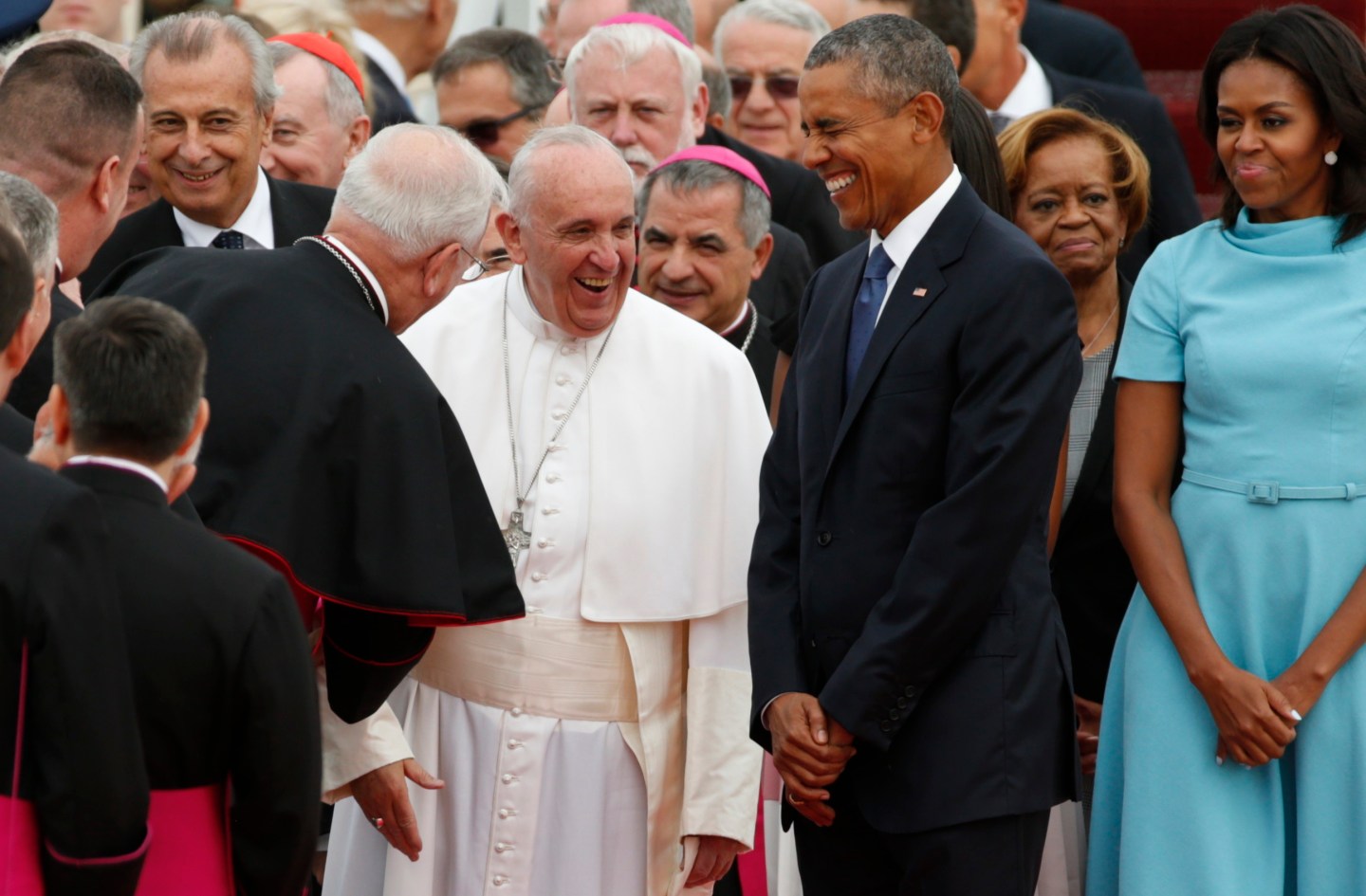
Pope Francis is visiting Washington, New York and Philadelphia this week.
His visit comes in the wake of his remarkable call for every Catholic parish, religious community, monastery and sanctuary in Europe to take in one refugee family that has fled “death from war and hunger.” We can perhaps expect much the same appeal for the parishes and sanctuaries of the United States.
As a scholar working on the idea of sanctuary in medieval literature, I am struck by the extent of the pope’s embrace of migrants and refugees, whom he has said the Church should shelter “without distinction or limits … without frontiers.”
A historic place of shelter
Although the Catholic Church has been far from consistent in defense of those in flight from war and persecution, the pope is drawing on a rich history of the Church as a place of shelter for the dispossessed. For the Church, this is a history that begins with Exodus and continues with the Holy Family’s flight into Egypt. Founded on narratives of migration, the Church in its turn seeks to alleviate the suffering of refugees.
The pope’s far-reaching appeal also recalls the medieval history of legal sanctuary. Throughout Europe, under Canon Law, flight to the church offered people a respite from hasty vengeance or legal prosecution. Anyone who fled for his life to the nearest church was sheltered there. Sanctuary protected anyone and everyone, regardless of guilt or innocence, wealth or poverty, allowing time for penance and negotiation.
To be sure, the medieval law of sanctuary was not unconditional.
Sanctuary seekers in England — where the best records were kept — might negotiate with their accusers and emerge unscathed. More often, after 40 days, they would emerge, confess their crimes, give up their belongings and go into exile. If a person had committed sacrilege — stealing holy vessels, for example — or killed someone within the Church, then he could not escape punishment in sanctuary. Indeed, canon lawyers worried about the consequences of giving sanctuary to criminals who might not seek penance, but rather commit further crimes from under the protection of the Church.
Looking back to medieval sanctuary reminds us that the laws of refuge change over time. Protecting those in flight always balances between unconditional hospitality — sanctuary for everyone, no matter the circumstances — and conditional hospitality – sanctuary limited by rules about who might expect refuge, where, and for what reasons.
When the pope calls for churches to harbor refugees, he calls on European Catholics — and their governments — to change the conditions under which they grant hospitality.
The current crisis involves more than 11 million Syrians alone. In that context, with enormous camps in Turkey, Jordan and Lebanon for registered refugees, more than half of whom are children, Europe’s arguments about quotas show a shocking lack of compassion.
Crossing religious boundaries
President Obama’s announcement that the United States will accept an additional 10,000 Syrian refugees over the next year is woefully inadequate. If parishes in Europe heed the pope’s call, Catholic sanctuaries would house 500,000 immigrants — far more than the 40,000 who entered Germany before it closed its borders September 13, but far fewer than the number who need a place to go. Clearly, the bureaucratic conditions of developed countries surrounding immigration and asylum are thoroughly inadequate to the circumstances of the current crisis.
When the pope asks every parish to house a family, he means to personalize the crisis. He means to transcend quotas and numbers, to urge wealthier countries to shoulder more of the burden. And he means to refute the idea articulated by leaders like Slovakia’s Interior Ministry Spokesman Ivan Netik, who said that Slovakia could not accept Muslim immigrants: “We don’t have any mosques in Slovakia, so how can Muslims be integrated if they are not going to like it here?”
The pope’s call to Europe’s Catholic parishes specifically crosses religious boundaries — welcoming people regardless of religious creed.
His demand recalls the peculiarly American history of antagonism to Catholic immigrants. In the 19th and early 20th centuries, when immigrants from Catholic countries such as Ireland, Poland and Italy began to arrive in great numbers, anti-Catholic sentiment ran high. New immigration laws like the 1921 Emergency Quota Act limited the number of people who could enter the country legally, to 3% of each nationality’s population according to the 1910 Census. Catholic churches became centers of social life and legal protection for people who were deemed incapable of being assimilated due to their faith.
Pope Francis’ call for sanctuary across religious divisions draws on the Church’s complex history of protecting refugees. In the U.S. and Central America, the Church went on to protect other Catholic immigrants in the Sanctuary Movement of the 1980s. Pope Francis extends that history across the boundaries of faith in order to protect Muslims who are — like early 20th-century Catholics in America — the objects of vilification today.
The reality of mass migration is not new. Opposition to new immigrants on the basis of race, geography and creed is not new. The pope has called for a robust resistance to such prejudices. He has thus asked the world to look carefully at the conditions under which we welcome refugees.
In answering his call, we might take it even further. Instead of identifying quotas, Europe and America alike should “reason not the need,” to use the words of King Lear in his desperate and homeless state. The conditions of hospitality should conform more to the circumstances of the needy than to the economic anxieties of the wealthy.
When the pope comes to the United States, he will be visiting a nation of immigrants — Protestant, Catholic, Jewish, Muslim, and others alike. Many Americans are descended from people who came to this country before anyone counted how many could come. The pope’s call for hospitality reminds us of this, and suggests that our doors should, in turn, be open wide.
Elizabeth Allen is an associate professor of English at the University of California, Irvine. This article originally appeared on The Conversation.

Subscribe to Fortune Daily to get essential business stories straight to your inbox each morning.