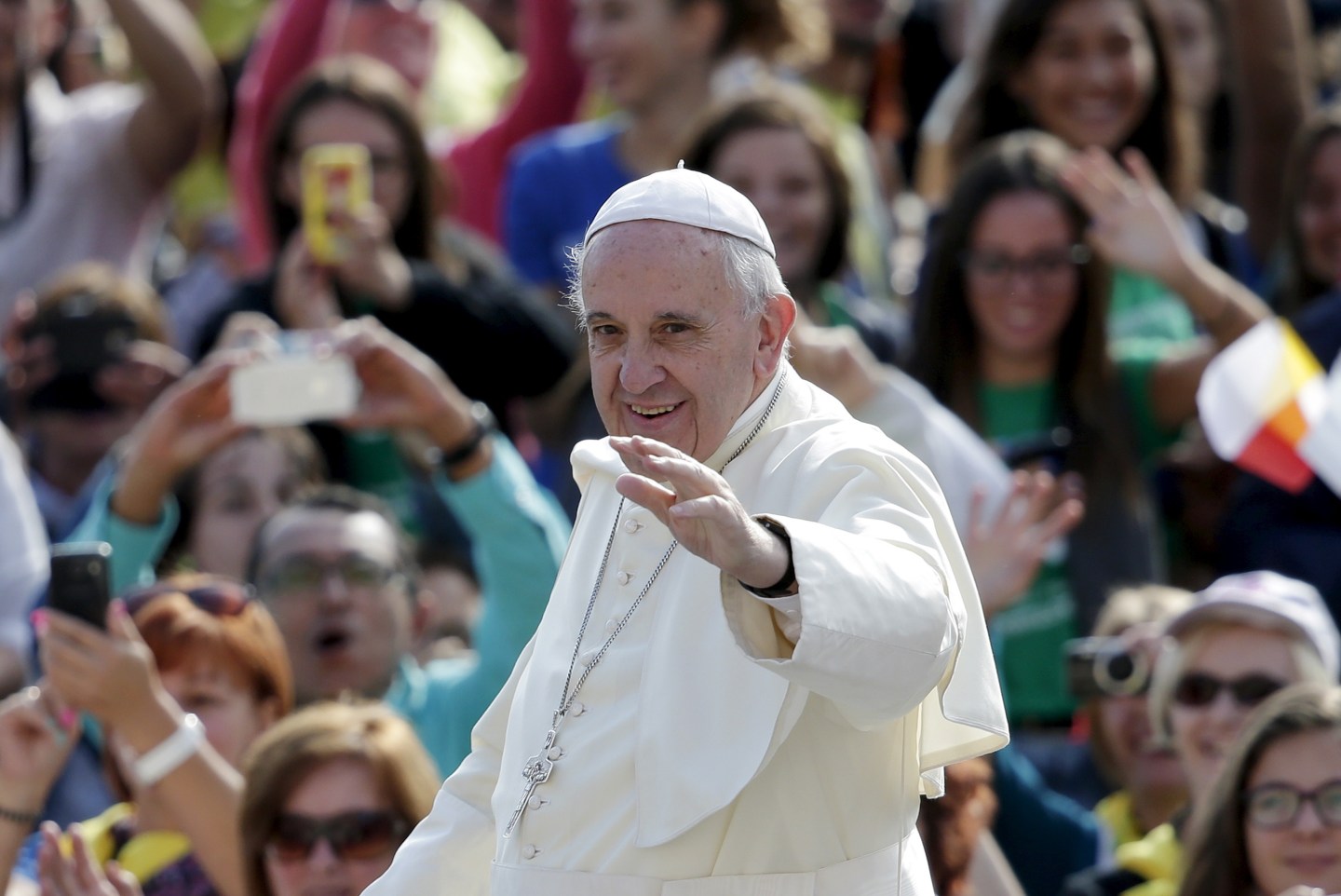
During Pope Francis’ visit to the United States next week, he will insist that the church transcends partisan politics, and I’m sure he means this sincerely. But that won’t prevent his visit from having political ramifications.
For several decades, the Roman Catholic Church in the U.S. has drawn closer and closer to the Republican Party, mostly because of their shared opposition to abortion. Catholics have always bristled at the charge that their religion was subsumed by this one issue, and Pope Francis is committed to reminding the world that the church cares about more than just sex and reproduction.
He isn’t about to revise the church’s basic teachings on these matters, but he fervently wants to change the topic of conversation. This presents a major problem for the GOP, because on nearly every other public issue it is starkly at odds with Catholic teachings. And not because Pope Francis is too liberal. Rather, it’s because he’s too conservative on an issue that serves as a cornerstone of the Republican Party: free-market capitalism.
This is one of the issues, along with climate change, that the pope has focused on in recent months. In July, for example, he called unbridled capitalism the “dung of the devil.” While to American ears this may sound liberal, it’s actually a very conservative viewpoint.
And unfortunately for Republicans, this is likely going to be a topic he’ll bring up during his speech before Congress.
Pope Francis is hardly a liberal
Some in the American press have characterized Pope Francis as more liberal than his predecessors. This is a serious misunderstanding. Of all the possible adjectives we might use to describe the pontiff, “liberal” is definitely not among them.
We Americans tend to forget that the liberal tradition is based on a twofold commitment to both individual liberty (on questions of personal lifestyle, for example) and free-market capitalism. Liberal U.S. Democrats may want to soften the edges of capitalism with regulation, but they don’t want to overthrow capitalism altogether.
The leadership of the Catholic Church, in contrast, has never reconciled itself with liberalism. Back in 1864, Pope Pius IX denounced anyone who would even suggest that “the Roman pontiff can, and ought to, reconcile himself and come to terms with progress, liberalism and modern civilization.” Since then, the church has softened its stance on “progress” and “modern civilization,” but liberalism remains a problem. As Popes John Paul II and Benedict XIV made clear, this rejection of liberalism entails constraints on individual liberty in the areas of sexuality, reproduction and marriage. Now Pope Francis is reminding us of the other side of this anti-liberalism: a rejection of capitalism. Just as people are not free to conduct their sexual lives as they see fit, neither are they free to do whatever they want in the economic sphere.
Rather, he’s a consistent conservative
In this sense, Francis is a consistent conservative — even more conservative than the Republicans who are nervous about his upcoming visit.
Many Americans, who tend to associate capitalism with the right and anti-capitalism with the left, are unaware that many of the earliest attacks on laissez faire economics came from conservatives, and that the Catholic Church has been a key player in developing a conservative rebuttal to liberal capitalism.
Catholic conservatives, like Francis, want to conserve harmonious social relations and a Christian understanding of economic justice, just as they want to conserve what the church takes to be traditional family values. Free-market capitalism, in contrast, is all about change: the change that comes when massive retail chains undermine family shops, when agribusinesses destroy small farms, and when financial consultants “downsize” a corporation and wipe out a community’s economic foundation.
The Catholic Church’s type of conservatism opposes financiers who place the pursuit of profit over the needs of maintaining a peaceful, stable community.
And above all, this type of conservatism will condemn anyone whose private greed harms the public good. This isn’t socialism. Catholic teaching can be easily reconciled with hierarchies and inequality, as long as justice is served and social harmony is maintained.
Problems exist for the left and the right
Catholicism is a problem for American politicians (Democrats and Republicans alike), but not because the church offers some sort of mixture of left and right, liberalism and conservatism. The church is consistently conservative, and this challenges Democrats (who promote individualism, innovation and disruption in the cultural realm) and Republicans (who favor individualism, innovation and disruption in the economic realm).
During the pope’s visit, therefore, he is likely to make every American politician squirm. The Democrats have grown accustomed to this in recent decades (some priests have refused prominent liberal Catholics communion over the abortion issue). Now it’s the Republicans’ turn. But in this case, it’s about the roots of our economic system.
Brian Porter-Szücs is a history professor at the University of Michigan. His article originally appeared in The Conversation.