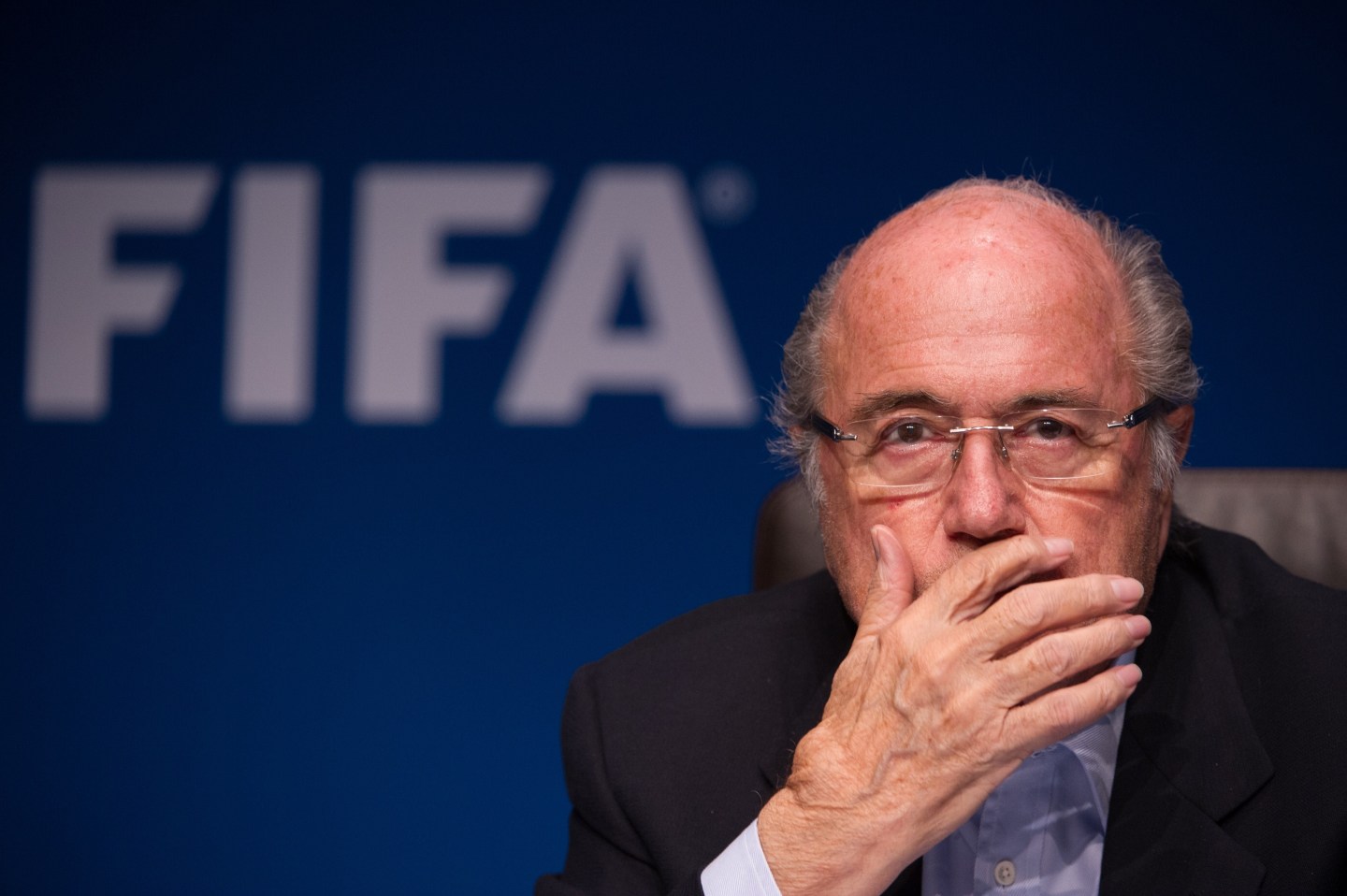
For 17 years, Sepp Blatter reigned supremely over his FIFA kingdom.
Though he was elected to his position, his rule was absolute. Four years ago, he ran unopposed in elections. And even after decades of accusations of financial mismanagement, he remained wildly popular among FIFA’s 209 members. In the most recent election, just days after 14 senior soccer officials were indicted and arrested on charges of bribery and institutional corruption, his victory was so massive that his opponent withdrew from the competition before the voting process had even concluded.
It was only after the U.S. Justice Department pressured an associate of Blatter to wear a wiretap that Blatter was finally dethroned.
Why is it that a leader as popular as Sepp Blatter acted with such blatant disregard for moral constraints and presided over a culture of corruption?
It turns out that a lot of the problem has to do with something so simple yet so fundamental: power. Both Blatter and FIFA had A LOT of it.
Blatter held power because FIFA works differently from every other world body. Each of FIFA’s 209 member countries had the same single vote during FIFA Presidential elections, regardless of their population or whether they had ever participated in a World Cup. And over the years, Blatter divided FIFA’s revenues so that resources poured into poor countries — countries that had long been neglected by FIFA and desperately needed the infusion. And this distribution of resources did something else— it secured Blatter’s position by ensuring that scores of nations would loyally vote for Blatter.
How powerful was FIFA? Well, its own president declared that it is “more influential than any country in the world or any religion through the positive emotions football triggers.” Those emotions evoked by soccer enabled FIFA to preside over a massive pot of resources: amassing $14.5 billion since 1999.
Of course, the power that Blatter and FIFA held wasn’t all bad. In fact, power is a catalyzing force that moves our world forward and unleashes our potential to accomplish great things. Often, feelings of power are constructive and most of us will perform better when we feel more powerful. After all, this feeling helps us to deliver a confident presentation and ask for the raise that we deserve. And power helped Blatter expand soccer throughout the world.
As we mention in our forthcoming book, Friend & Foe: When to Cooperate, When to Compete, and How to Succeed at Both, the effects of power don’t stop there. Power can cause us to think, feel and act in ways that get us into trouble — sometimes serious trouble. And it’s not just individuals: Institutions that have greater power often suffer the same fate.
Our research over the last 15 years shows that power fundamentally transforms people by making them feel both invisible and invincible. For Blatter, these feelings cost him his crown. For FIFA more broadly, it is likely to lead many of its executives to prison.
The feelings of invisibility and invincibility lead people to feel disinhibited and do things they really shouldn’t be doing. We might be tempted to misreport our expenses, lie to a business partner, or even ask for a bribe, but normally our inhibition system kicks in and we resist temptation. The same is true about saying inappropriate things that come to mind. We might think something, but (thankfully) we resist the temptation to say it.
Few leaders offer deeper insight into the harmful effects of power than Sepp Blatter. For example, when asked about what might increase interest in women’s soccer, Blatter replied that female soccer players ought to wear “tighter shorts.” And during a minute of silence held for Nelson Mandela who had died just the day before, Blatter started speaking after 11 seconds. In these, and other cases, Blatter acted without inhibition.
And the same is true for FIFA. The sense of disinhibition led FIFA executives to feel comfortable forcing other countries to abandon their principles and enact laws favoring the Federation. For example, FIFA forced Brazil to undo its ban on the sale of alcohol in football arenas, as FIFA secretary general Jérôme Valcke bluntly said: “Excuse me if I sound a bit arrogant, but that’s something we won’t negotiate.” In South Africa, FIFA set up their own independent courts that bypassed the legal system of the country.
When we feel powerful, we feel entitled. We feel as if the normal rules don’t apply to us. And we feel that we will never get caught. In Blatter’s case, people have leveled accusations against him for over a decade. In fact, 11 executive committee members accused him of financial mismanagement in 2002! But Blatter was undeterred and openly declared his feeling of invincibility, “I believe in God. And I believe in me.” And because of FIFA’s power, its executives felt invincible too. When asked if he would consider vacating his post in the wake of the scandal, Valcke summarily rejected the presumption: “I’m beyond reproach.”
The power Blatter held enabled him to accomplish great things for football. But it also caused him to act recklessly. Because of his popularity and the power invested in FIFA, for years he was not held accountable for his actions. All of this changed when the US Justice Department unleashed its indictments. It took a long time, but it is how Blatter used his power that finally ended his reign.
Maurice Schweitzer is the Cecilia Yen Koo Professor of Operations and Information Management at the Wharton School at the University of Pennsylvania. Adam Galinsky is the Vikram S. Pandit Professor of Business at the Columbia Business School at Columbia University. Both are authors of the book, Friend & Foe: When to Cooperate, When to Compete, and How to Succeed at Both.