• Home
  • Latest
  • Fortune 500
  • Finance
  • Tech
  • Leadership
  • Lifestyle
  • Rankings
  • Multimedia
TechAerospace

The next space race will be among Fortune 500 companies

By
Clay Dillow
Clay Dillow
Down Arrow Button Icon
By
Clay Dillow
Clay Dillow
Down Arrow Button Icon
January 27, 2015, 1:31 PM ET
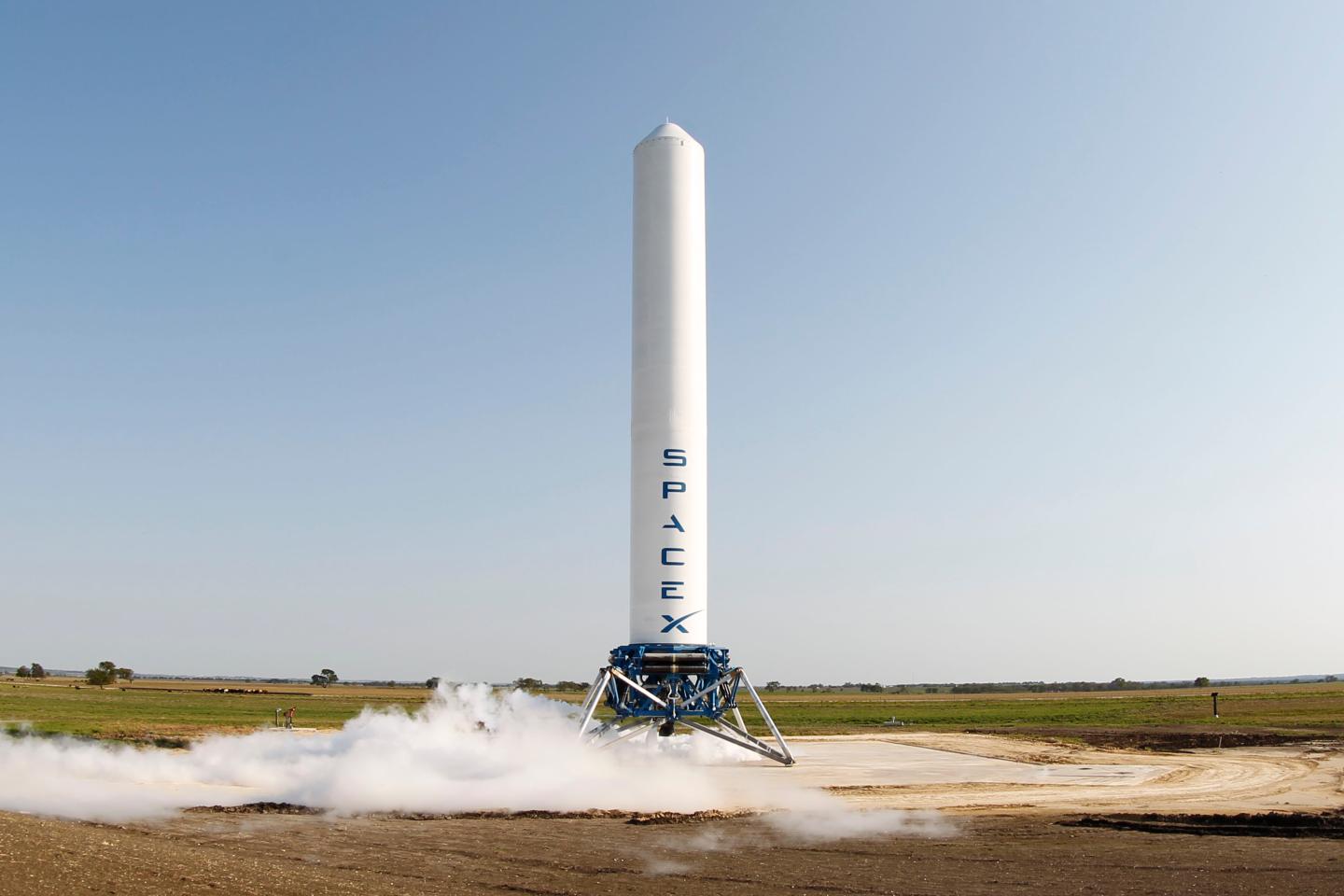
SpaceX Grasshopper reusable rocket program
SpaceX's Grasshopper, a 10-story vehicle that the company is using to test rocket reusability.Courtesy of Chris Thompson/SpaceX

“Close, but no cigar. This time.”

Behold the words of SpaceX founder Elon Musk, offering a post-op summary of the fiery crash-landing of one of his company’s first stage rocket boosters aboard a floating barge in the Atlantic earlier this month. It smacked of the billionaire entrepreneur’s typical comedic understatement. Video accompanying the comment, delivered in a tweet, shows the rocket coming in too fast and too steep before exploding in a magnificent fireball. It was a far cry from the soft landing Musk and SpaceX had planned.

Most of the press called it a failure. Musk called it “close.” Experts familiar with the commercial spaceflight industry are calling it what it is: evidence that 2015 will be the year SpaceX manages to successfully bring a first stage rocket booster and its nine rocket engines safely back to Earth for reuse, potentially cutting the cost of space launch in half and upending the commercial launch industry.

But lost in the whiz-bang awesomeness of rocket launches (and crashes) is the way SpaceX’s reusable rocket technology could impact industries beyond those associated with space, such as telecommunications and imaging. The cost of space access could drop from its current range of between $65 million and $70 million to something more like $30 million, or even $20 million, putting it within reach of companies and industries that couldn’t consider it before.

“When launch costs drop, new customers will emerge,” says Dick “Rocket” David, CEO of space industry information provider NewSpace Global. “But most of the customers that will be interested don’t even realize today what impact access to space will have on their business models.”

SpaceX wanted to bring its first stage booster back to Earth for a simple reason: the rocket boosters that are typically jettisoned after their fuel runs out cost millions of dollars to develop and manufacture. If the company can return a stage to Earth intact for refurbishment and reuse, it can dramatically reduce what has long been considered a cost of doing business.

There remain questions: how much it costs to refurbish a rocket booster and how many times a single booster can be reused, for example. And space industry analysts think costs could go lower still. Musk has suggested that he’s eventually shooting for a sub-$10 million launch price. But merely halving the cost of launch could stoke increased demand for launch services and bring a flood of new entrants into the orbital domain.

How all this impacts the average Fortune 500 firm remains to be seen, but two things are almost certain to happen in the near term. First, the services that companies and individuals currently get from space will become better, less expensive, and more accessible, says Carissa Christensen, managing partner at defense, space, and technology consultancy Tauri Group. That’s not necessarily a groundbreaking development, but it’s certainly a meaningful one. Companies spend a whole lot of money on communications, imagery, and other data collected and relayed by orbiting satellites. In some industries, the high cost of satellite services keep smaller companies from competing as effectively with their larger counterparts. “Cheaper, cooler, and better things from space is kind of a big deal,” Christensen says. “The benefit of much cheaper satellite services is not trivial.”

Second, a huge number of new entrants and new dollars will pile into the orbital domain—and in fact already are. Just last week, SpaceX announced plans to build out a network of micro-satellites over the next five years that would blanket the globe in internet. This week the company announced that Google (GOOG) and investment bank Fidelity (FNF) have invested $1 billion in the project, valuing SpaceX at $10 billion. Another satellite internet startup known as OneWeb—launched by Google’s former satellite internet project lead, Greg Wyler, who left the company in September—also announced last week that it has secured funding from Richard Branson’s Virgin Group and Qualcomm (QCOM) to create a satellite network of its own. The $2 billion project plans to launch 648 small satellites weighing 285 pounds each starting in 2018, each of which will require a ride into an orbit.

Analysts are optimistic that space launch activity will create new opportunities that could in turn further boost investment in the space.

“Keep in mind that whenever you start launching more satellites, when you make launch services cheaper and bring new players into the market, you have a lot of spinoff effects,” Marco Caceres, director of space studies at aerospace and defense consultancy Teal Group. “You have an expanding market, you have submarkets. And you have investors taking a second, a third, a fourth look at companies like SpaceX and the ones that will follow. Venture capital will start flowing back into the market like it did in the 1990s.”

Emerging space companies are already baking lower launch costs into their business plans. Space is to the decade ahead what the Internet was to the 1990s, NewSpace Global’s David says. It’s not necessarily going to upend your revenue streams tomorrow. But if you’re not thinking about how space access impacts your business and how to leverage it to your advantage, you’re setting yourself up as the Barnes and Noble (BKS) to someone else’s Amazon (AMZN).

“The challenge is understanding the impact something like a reusable first stage booster will have upon a very terrestrial business model today,” NewSpace Global’s David says. “If you’re Coca-Cola, if you’re Walmart, if you’re Toyota, if you’re Lukoil—what does a satellite have to do with your business model today? What will falling launch costs have to do with your business model in the future? From our perspective, the companies capable of connecting those dots will be able to capture tremendous financial growth opportunities. Those who fail to understand that connection to their very terrestrial business models could end up on the wrong side of financial evolution in the next decade.”

Most companies don’t think of themselves as “space companies,” David says. But it’s hard to find a company on the Fortune 500 that isn’t intimately connected to terrestrial assets—real estate, agriculture, transportation infrastructure, energy infrastructure, brick and mortar facilities. The ability to connect all those assets in a proprietary way, to monitor them in realtime and generate accurate and instantaneous information about them will ensure a competitive edge for companies in the 21st century.

That’s especially true for firms who rely on fast, accurate information—and proprietary access to that information—to generate revenue. “Is it obvious that someone like BlackRock or Apollo would care about having their own satellites?” David says. “I think if you were to poll most PE firms and IBs on Wall Street they would say, ‘Space? You gotta be kiddin’ me.’ But what we’re going to see in the near term as launch costs come down, as more satellites are lifted, is an increase in knowledge at higher frequency. That’s going to lead to results that could change the very nature of financial analysis.”

Whether or not Stamford-based energy traders will soon find themselves jockeying for the choicest orbits from which to count oil tankers in the Strait of Malacca is anyone’s guess. But the takeaway from SpaceX’s most recent rocket recover “failure” is this: access to space is access to knowledge, and the next space race will be among companies vying to be a “space company.”

About the Author
By Clay Dillow
See full bioRight Arrow Button Icon

Latest in Tech

Finance
Lorem ipsum dolor sit amet, consectetur adipiscing elit, sed do eiusmod tempor incididunt ut labore et dolore magna aliqua. Ut enim ad minim veniam
By Fortune Editors
October 20, 2025
Finance
Lorem ipsum dolor sit amet, consectetur adipiscing elit, sed do eiusmod tempor incididunt ut labore et dolore magna aliqua. Ut enim ad minim veniam
By Fortune Editors
October 20, 2025
Finance
Lorem ipsum dolor sit amet, consectetur adipiscing elit, sed do eiusmod tempor incididunt ut labore et dolore magna aliqua. Ut enim ad minim veniam
By Fortune Editors
October 20, 2025
Finance
Lorem ipsum dolor sit amet, consectetur adipiscing elit, sed do eiusmod tempor incididunt ut labore et dolore magna aliqua. Ut enim ad minim veniam
By Fortune Editors
October 20, 2025
Finance
Lorem ipsum dolor sit amet, consectetur adipiscing elit, sed do eiusmod tempor incididunt ut labore et dolore magna aliqua. Ut enim ad minim veniam
By Fortune Editors
October 20, 2025
Finance
Lorem ipsum dolor sit amet, consectetur adipiscing elit, sed do eiusmod tempor incididunt ut labore et dolore magna aliqua. Ut enim ad minim veniam
By Fortune Editors
October 20, 2025

Most Popular

Finance
Lorem ipsum dolor sit amet, consectetur adipiscing elit, sed do eiusmod tempor incididunt ut labore et dolore magna aliqua. Ut enim ad minim veniam
By Fortune Editors
October 20, 2025
Finance
Lorem ipsum dolor sit amet, consectetur adipiscing elit, sed do eiusmod tempor incididunt ut labore et dolore magna aliqua. Ut enim ad minim veniam
By Fortune Editors
October 20, 2025
Finance
Lorem ipsum dolor sit amet, consectetur adipiscing elit, sed do eiusmod tempor incididunt ut labore et dolore magna aliqua. Ut enim ad minim veniam
By Fortune Editors
October 20, 2025
Finance
Lorem ipsum dolor sit amet, consectetur adipiscing elit, sed do eiusmod tempor incididunt ut labore et dolore magna aliqua. Ut enim ad minim veniam
By Fortune Editors
October 20, 2025
Finance
Lorem ipsum dolor sit amet, consectetur adipiscing elit, sed do eiusmod tempor incididunt ut labore et dolore magna aliqua. Ut enim ad minim veniam
By Fortune Editors
October 20, 2025
Finance
Lorem ipsum dolor sit amet, consectetur adipiscing elit, sed do eiusmod tempor incididunt ut labore et dolore magna aliqua. Ut enim ad minim veniam
By Fortune Editors
October 20, 2025
Fortune Secondary Logo
Rankings
  • 100 Best Companies
  • Fortune 500
  • Global 500
  • Fortune 500 Europe
  • Most Powerful Women
  • Future 50
  • World’s Most Admired Companies
  • See All Rankings
Sections
  • Finance
  • Fortune Crypto
  • Features
  • Leadership
  • Health
  • Commentary
  • Success
  • Retail
  • Mpw
  • Tech
  • Lifestyle
  • CEO Initiative
  • Asia
  • Politics
  • Conferences
  • Europe
  • Newsletters
  • Personal Finance
  • Environment
  • Magazine
  • Education
Customer Support
  • Frequently Asked Questions
  • Customer Service Portal
  • Privacy Policy
  • Terms Of Use
  • Single Issues For Purchase
  • International Print
Commercial Services
  • Advertising
  • Fortune Brand Studio
  • Fortune Analytics
  • Fortune Conferences
  • Business Development
  • Group Subscriptions
About Us
  • About Us
  • Editorial Calendar
  • Press Center
  • Work At Fortune
  • Diversity And Inclusion
  • Terms And Conditions
  • Site Map
  • About Us
  • Editorial Calendar
  • Press Center
  • Work At Fortune
  • Diversity And Inclusion
  • Terms And Conditions
  • Site Map
  • Facebook icon
  • Twitter icon
  • LinkedIn icon
  • Instagram icon
  • Pinterest icon

Latest in Tech

‘Downward mobility is incredibly radicalizing’: The college bargain is broken. What comes next could reshape America
EconomyColleges and Universities
‘Downward mobility is incredibly radicalizing’: The college bargain is broken. What comes next could reshape America
By Nick LichtenbergApril 10, 2026
2 hours ago
Who’s really in control as AI and Big Tech race ahead?
MagazineEurope
Who’s really in control as AI and Big Tech race ahead?
By Francesca CassidyApril 10, 2026
4 hours ago
Photo: Donald Trump
EconomyMarkets
U.S. and Iran begin peace talks as Trump’s White House goes to war against the media, insider traders, and the Pope
By Jim EdwardsApril 10, 2026
5 hours ago
Fortune Brainstorm Tech 2019 in Aspen, Colo. (Photo: Fortune)
NewslettersFortune Tech
Who’s speaking at Fortune Brainstorm Tech 2026
By Andrew NuscaApril 10, 2026
6 hours ago
Schools across America are quietly admitting that screens in classrooms made students worse off and are reversing years of tech-first policies
InnovationEducation
Schools across America are quietly admitting that screens in classrooms made students worse off and are reversing years of tech-first policies
By Marco Quiroz-GutierrezApril 10, 2026
7 hours ago
Dario Amodei
NewslettersTerm Sheet
What Anthropic’s too-dangerous-to-release AI model means for its upcoming IPO
By Beatrice NolanApril 10, 2026
7 hours ago

Most Popular

The U.S. government is spending $88 billion a month in interest on national debt—equal to spending on defense and education combined
Economy
The U.S. government is spending $88 billion a month in interest on national debt—equal to spending on defense and education combined
By Fortune EditorsApril 9, 2026
1 day ago
A Meta employee created a dashboard so coworkers can compete to be the company's No. 1 AI token user—and Zuckerberg doesn't even rank in the top 250
AI
A Meta employee created a dashboard so coworkers can compete to be the company's No. 1 AI token user—and Zuckerberg doesn't even rank in the top 250
By Fortune EditorsApril 9, 2026
1 day ago
Gen Z doesn't want your full-time job. They want several part-time roles, and it's reshaping the entire workforce
Success
Gen Z doesn't want your full-time job. They want several part-time roles, and it's reshaping the entire workforce
By Fortune EditorsApril 9, 2026
1 day ago
Mark Cuban admits he made a mistake letting go of the Mavericks: 'I don't regret selling. I regret who I sold to'
Investing
Mark Cuban admits he made a mistake letting go of the Mavericks: 'I don't regret selling. I regret who I sold to'
By Fortune EditorsApril 9, 2026
23 hours ago
'I hate working 5 days': Zoom CEO says traditional work schedules are becoming obsolete—and predicts a 3-day workweek by 2031
Success
'I hate working 5 days': Zoom CEO says traditional work schedules are becoming obsolete—and predicts a 3-day workweek by 2031
By Fortune EditorsApril 9, 2026
1 day ago
Current price of oil as of April 9, 2026
Personal Finance
Current price of oil as of April 9, 2026
By Fortune EditorsApril 9, 2026
1 day ago

© 2026 Fortune Media IP Limited. All Rights Reserved. Use of this site constitutes acceptance of our Terms of Use and Privacy Policy | CA Notice at Collection and Privacy Notice | Do Not Sell/Share My Personal Information
FORTUNE is a trademark of Fortune Media IP Limited, registered in the U.S. and other countries. FORTUNE may receive compensation for some links to products and services on this website. Offers may be subject to change without notice.