The U.S. always seems to be in competition with China—economically, technologically, militarily. But how do the two countries stack up when it comes to measuring the health of its people?
Going by what we know about China’s approach to aging—revering and caring for their elderly population, with about 41% of older adults living with an adult child and circumventing the loneliness epidemic—might lead to the conclusion that they’ve got public health better figured out.
But the reality is far more complex.
Looking at traditional markers of health shows that the two countries are largely neck and neck. The United States has a long life expectancy—79.46 years—beating out China’s, at 78.02, by a hair, according to the United Nations. But if current trends hold, by 2044, China will inch past the U.S.’s 82.39-year life span and reach 82.4, according to U.N. projections—particularly since U.S. life expectancy, which has been rising following a pandemic dip, remains the lowest in the developed world.
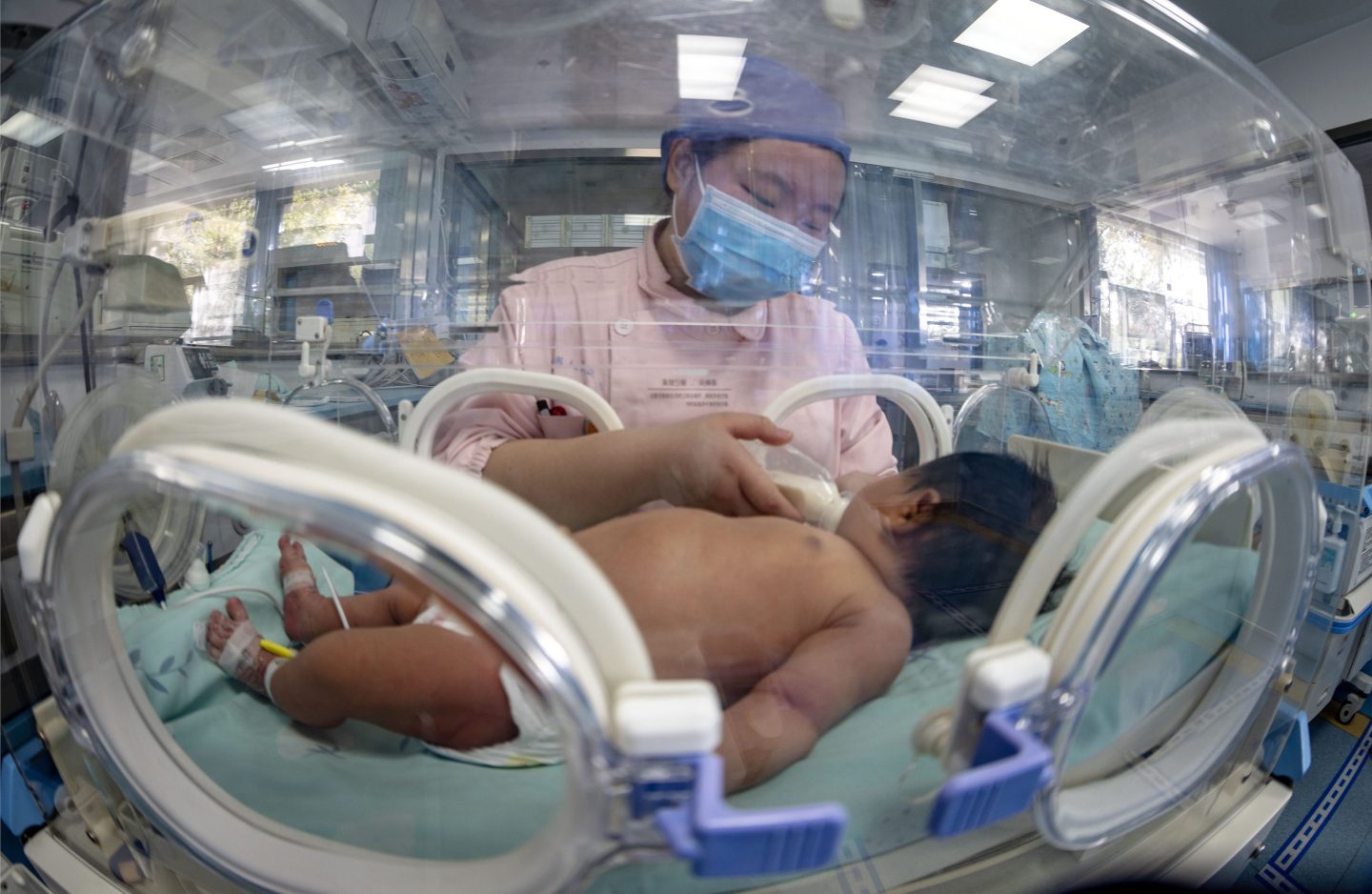
The infant mortality rate, which compares the number of deaths of infants (those under 1) in a given year per 1,000 live births in that same year, shows China in a slightly better position, with a rate of 3 vs. America’s 3.17, according to the World Health Organization.
Another standard indicator, the maternal mortality rate, is the annual number of deaths per 100,000 live births from any cause related to or aggravated by pregnancy (excluding accidental or incidental causes). Figures, per the World Health Organization, show the U.S. at a slight advantage, with a rate of 19.85 compared with China’s 20.4.
So it’s a tight race. But what about illnesses, both physical and mental?
Rates of cancer, heart disease, and more
According to comparative 2024 estimates, the U.S. was to have 2.5 million new cancer cases—with breast cancer the most prevalent—and 640,000 cancer deaths. China, meanwhile, saw more cancer cases and deaths—3.2 million and 1.7 million, respectively, with lung cancer the most prevalent type of new diagnoses.
Cardiovascular health is the leading cause of death in the U.S, responsible for 20% of all deaths annually. In China, the leading cause of death is stroke, with cardiovascular disease in general responsible for more than 44% of deaths each year.
Suicide mortality rates, while far from painting a complete picture of a nation’s mental health, are at least an indication. And here, the U.S. has more troubling statistics, with a rate of 16.14 (per 100,000) compared with China’s rate of 8.07, according to WHO.
Road traffic deaths in China are worse, with a rate of 17.4 (per 100,000) vs. this country’s 14.2.
But when it comes to violent gun deaths (including suicides and accidents), the more alarming stats by far come out of the U.S.—where leaders from President Biden to Surgeon General Vivek Murthy have referred to gun violence as “an epidemic,” and where firearms killed more children and teens, ages 1 to 17, than any other cause. Its per capita rate is 14.6 vs. China’s low .013, according to 2021 statistics.
Lifestyle differences and effect on life span, health span
How we live has a direct effect on not only how long we live, but for how many of those years we remain in good health.
The economy of wellness—the pursuit of activities and lifestyles that lead to a state of holistic health, from nutrition and exercise to complementary medicine and preventive care—represents a $6.3 global market (as of 2023). The U.S. and China are locked in the No. 1 and No. 2 spots once again, according to the newest country rankings from the Global Wellness Institute, with the U.S. in the lead at $2.015 billion vs. China’s $870 billion.
Also good indicators of wellness are indicators of unhealthiness—vices, specifically.
Take consumption of soda, which a recent study links to higher risks of cardiovascular disease and type 2 diabetes, and which is connected to long-known risks ranging from tooth decay to obesity. The U.S. is the second-highest consumer of carbonated soft drinks (second only to Mexico), with a per capita consumption of 618 8-oz. servings compared with just 56 in China, according to 2019 data.
Smoking is believed to be the biggest cause of death and disease that you can control. About half of all life-long smokers will die early, losing on average about 10 years of life, with most smoking-related deaths due to lung cancer, chronic obstructive pulmonary disease (COPD), or coronary heart disease (CHD). And China, the largest producer and consumer of tobacco in the world, is home to more than 300 million adult smokers—equalling a per capita rate of 26.6%—nearly one-third of the world’s total, according to the World Health Organization.
America’s adult smoking rate, meanwhile, has fallen by 73% since 1965, according to the American Lung Association, to 11.6% (as of 2022).
Alcohol has a clear link to at least seven different types of cancer, including breast and colorectal cancers. It can also lead to issues including liver disease, pancreatitis, and damage to the cardiovascular system. And when it comes to alcohol consumption rates, the U.S. is more voracious, with 8.93 liters per capita vs. China’s 4.48, according to the CIA’s World Factbook (which has 2019 as the most recent available statistics for both countries).
And then there’s how we eat. Ultra-processed food (UPF) has become one of the most closely-eyed health risks in recent years, and a recent study found that 70% of the food supply in the U.S. is “ultra-processed,” therefore linked to a higher risk of developing a range of health issues, from cancer to cardiovascular disease. And in China, sales of UPF are growing, according to UNICEF, and diets dominated by UPF are driving a rise in childhood obesity there.
Still, the adult obesity rate in the U.S. is 42.4% vs. 14% in China—though it’s expected to rise along with interest in fast food and with a more desk-bound culture due to technological advances.
When it comes to fitness, the gym industry has developed rapidly in China, largely due to increasing disposable incomes and health awareness: It’s now a $7.8 billion industry, according to a recent industry report—a drop in the bucket, compared with the U.S.’s $33.25 billion fitness industry, but certainly on the rise.
Finally, while China has for years supported earlier retirement than the U.S. (60 for men and as early as 50 for women), that’s changing. Recent legislation will gradually push that to 63 for men and 55 or 58 for women, depending on their occupation. In the U.S., retirees can begin collecting Social Security at age 62, although full benefits don’t apply until the age of 67 for those born in 1960 or later.
Health care systems
A recent U.S. News & World Report ranking of well-developed public health systems put Sweden at No. 1—while the U.S. was at No. 19, and China at No. 27.
While about 95% of China’s population is covered by government-sponsored (free) insurance known as single-payer (as compared to 92% of Americans covered by either private or public insurance), there are some major care gaps, according to a recent Forbes analysis. That’s particularly true in rural areas, and when it comes to types of coverage, including “the absence of coverage” for dental, vision, mental-health, and long-term care.
Care is also largely hospital-centric, resulting in higher costs, particularly out-of-pocket ones, and long wait times, the story noted.
America’s healthcare system gets plenty of its own flak—for its high per capita costs, relatively poor health outcomes (including some of the above, such as infant mortality), and unfair access. In fact, another ranking recently put the U.S. in dead last, overall, out of 10 high-income countries.
That ranking also put the U.S. last in three of five categories—equity, health outcomes, and access to care, despite spending more than any other nation included in the assessment.
“We have a wonderful sick care system that takes care of very sick people,” Asaf Bitton, executive director of Harvard’s T.H. Chan School of Public Health’s Ariadne Labs, told the Washington Post in 2023, “but a very inadequate health care system.”
More on public health: