Europe is locked in a “friendshoring” tussle that looks unlikely to go away any time soon. It threatens to upend the continent’s access to energy, food, and semiconductors.
According to the boss of leading tech consultancy Capgemini, attempts to shore up supplies of the latter will be a decades-long process.
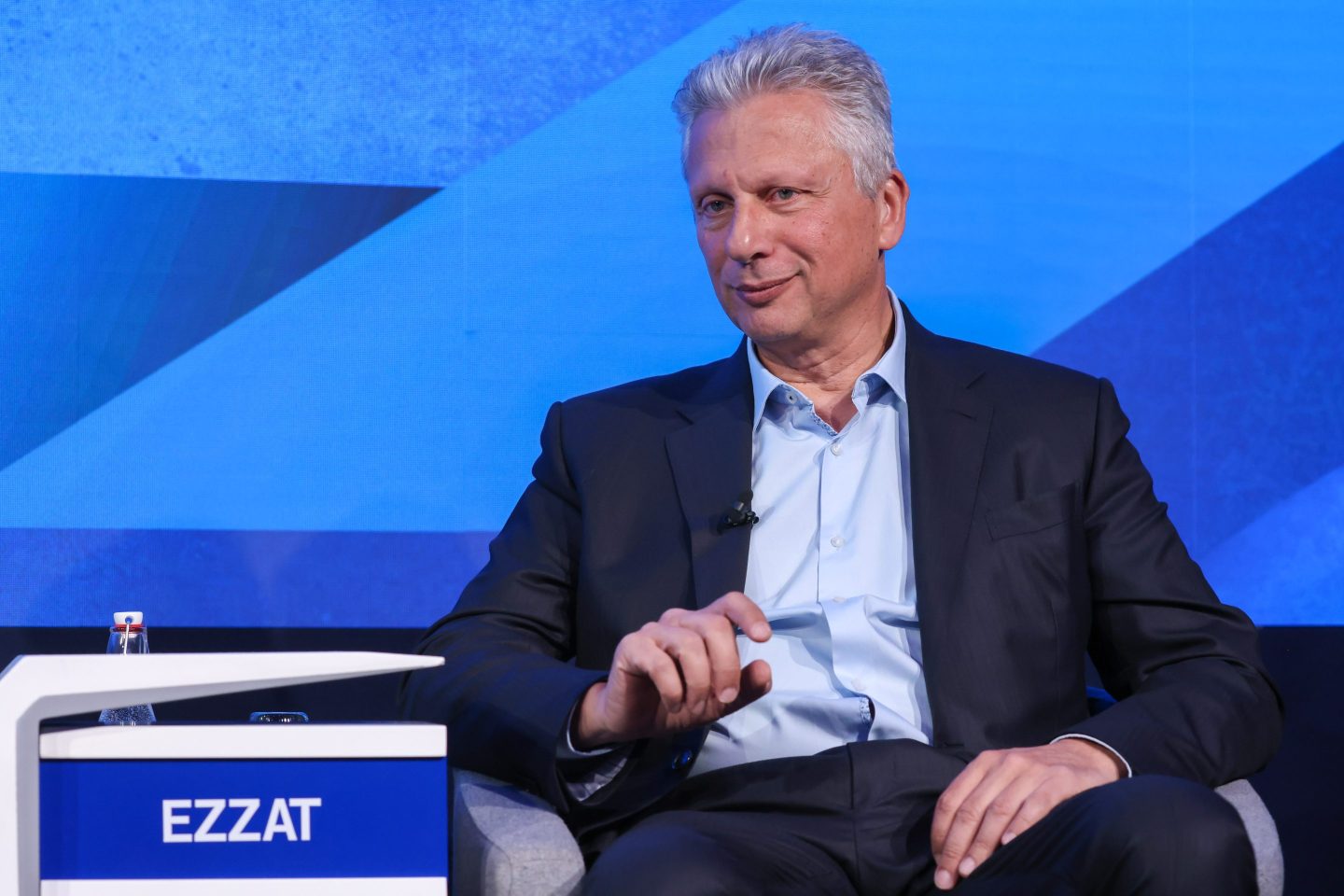
In an interview with Fortune, Capgemini CEO Aiman Ezzat offered a bracing wake-up call to a continent struggling to grow its economy and stuck in the middle of a wave of geopolitical crises.
A study published by the global tech and sustainability consultant last week found around half of business leaders, particularly those working in tech, were planning to do their business with countries politically aligned to their own in a bid to mitigate risk.
And as logical a move as it may be, it faces many formidable barriers to success.
‘Friendshoring’ here to stay
“Friendshoring” or “nearshoring,” where countries aim to mitigate risk by trading with political allies rather than those that make the most economic sense, has soared in recent years as supply chains show their fragility and geopolitical tensions mount.
Both issues have been thrust back into the spotlight following Houthi rebel attacks on the Red Sea shipping route that feeds into the Suez Canal.
The attacks have had major impacts on European manufacturers, with Tesla suspending production in Germany and Ikea warning of its own delays.
They have also made logistics experts sit up and take notice.
Jonathan Colehower, global supply chain practice lead at UST, told Fortune that if he was asked six months ago whether “friendshoring” away from the Middle East was a sensible strategy, he would have said no.
“However, after seeing this disruption out of the Far East with the Suez Canal, I’m more and more in favor of a policy of Southeast Asia plus one. If you’re going to manufacture it in China, for example, that’s great. But you have to prove that you have an alternative.”
Euro chips
This rising urgency for economic sovereignty, particularly in the world of technology, begs the question of whether European chipmakers might be able to increase their foothold in the soaring global semiconductor market.
The EU has a supply and demand problem when it comes to semiconductors, which go into everything from electric vehicles to AI-powered computers: It consumes twice as many as it produces. The bloc wants to erase that trade gap by 2030.
To do so, the EU launched its $43 billion European Chips Act, which sought to build out native chip suppliers and tempt foreign manufacturers to set up shop on the continent.
Europe’s answer to U.S. President Biden’s CHIPS Act appeared to be garnering early results, with Taiwan Semiconductor Manufacturing Company (TSMC) announcing in August a €10 billion ($11 billion) investment to set up a factory in Dresden, Germany.
However, Aiman Ezzat, the CEO of Capgemini, gave a stark warning to Europe in its quest to lessen its reliance on the rest of the world.
“Whatever investment you do in Europe to try to build chips, from a volume perspective, even over 10 years, your level of dependency will remain huge,” Ezzat said.
“The majority of the chips are coming from somewhere else. What you have to consider is, ‘Are there some critical areas where I can try to reduce my dependency?’ But the overall picture from a volume perspective doesn’t fundamentally change, so the dependency is still there.
“The catch-up game is so huge that [Europe] will really take decades to be independent.”
At the mercy of big players
Ezzat’s warning is a stark reminder that while Europe is making strides to become independent, the continent will remain at the mercy of the geopolitical movements of bigger players if it wants to keep its access to the latest tech in the medium term.
Beyond disruption to shipping routes, Europe will need to interrogate the resilience of the source of its chip supply.
Taiwan Semiconductor Manufacturing Company, one of the continent’s—and the world’s—biggest suppliers of chips, is at the heart of an increasingly tense territorial dispute with China.
The company has also previously complained about a lack of skilled workers when trying to open factories in the West.
No way out?
Capgemini’s Ezzat told Fortune the many companies considering “friendshoring” in the last decade, as the geopolitical landscape turned increasingly frosty, have found themselves faced with a series of obstacles.
“You have a geopolitical situation where people realize the world is not completely open, which means you have to manage that risk, in terms of how you manage your global supply chain, your sourcing, your exchanges,” Ezzat said.
The cost of enhanced supply chain security is likely to be economic inefficiencies. A worst-case scenario could put that cost into the trillions.
Gita Gopinath, first managing deputy director of the International Monetary Fund (IMF) warned that a potential “Cold War II” could wipe $7 trillion of dollars from global GDP as a result of trade wars.
Still, while Ezzat agrees there are economic costs to nearshoring, he and Capgemini regard it as advantageous over the long term.
“The fact that you are not only cost-oriented by definition creates some inefficiencies, but if you look at the long term, and you add the risk factor, it is not less economically efficient,” Ezzat says.
‘Century of humiliation’
Europe’s ambitious tech strategy has its doubters, however, for a simple reason: it has rarely matched up with reality in the past.
The continent has lagged behind the U.S.’s runaway tech success at each of the industry’s revolutions, the AI boom being just the latest example.
Chip companies were the toast of the U.S. stock market in 2023, largely driven by demand for technologies to enhance their AI capabilities. AI semiconductor leader NVIDIA tripled in value last year.
Demand in the States has caused exciting new European entrants to distance themselves from Europe’s anemic growth.
U.K.-based Arm Holdings shunned a listing on the London Stock Exchange in favor of the U.S. Nasdaq. Several other companies are shying away from Europe and flocking to the promise of the States ahead of the next tech revolution.
Among major industry players, there is increasingly a perception Europe’s reputation hangs in the balance.
Nigel Toon, the CEO of British chip designer Graphcore, said the continent faced a “century of humiliation” if it failed to invest in tech adequately.
A stuttered path to chip independence looks like it could be the latest in myriad risks for the stumbling continent.