• Home
  • Latest
  • Fortune 500
  • Finance
  • Tech
  • Leadership
  • Lifestyle
  • Rankings
  • Multimedia
Leadership
Europe

Europe could face a ‘century of humiliation’ warns CEO of Nvidia rival, who says startups fare better in America

Orianna Rosa Royle
By
Orianna Rosa Royle
Orianna Rosa Royle
Associate Editor, Success
Down Arrow Button Icon
Orianna Rosa Royle
By
Orianna Rosa Royle
Orianna Rosa Royle
Associate Editor, Success
Down Arrow Button Icon
October 25, 2023, 7:58 AM ET
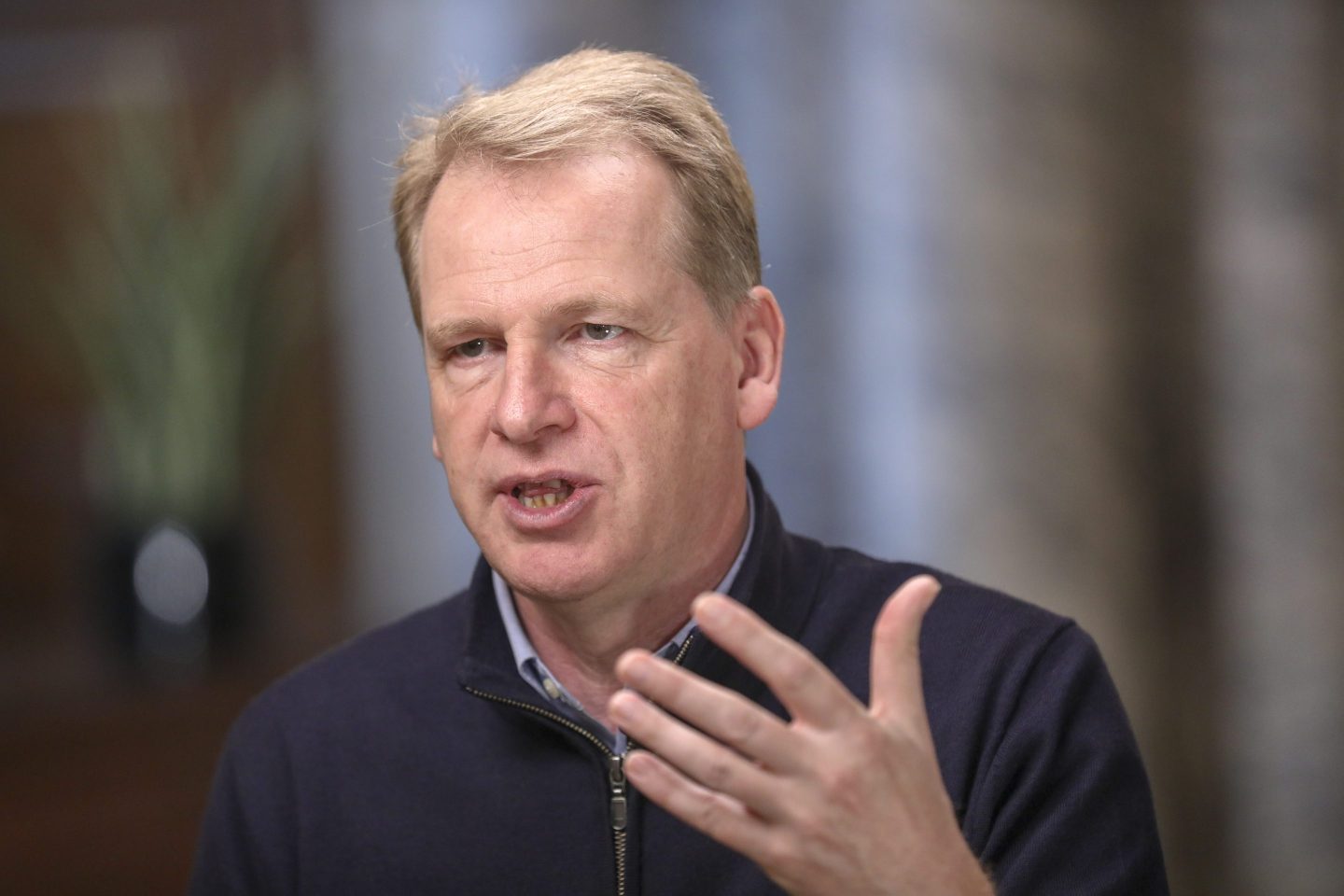
Nigel Toon, chief executive officer of Graphcor
According to Graphcore CEO Nigel Toon, there is more investment and support for artificial intelligence in the States.Simon Dawson—Bloomberg via Getty Images

European technology startups would have more success if they upped stakes for the States—at least, that’s according to British chip designer Graphcore’s chief executive, Nigel Toon.

Recommended Video

“We’d probably have it easier if we moved to the U.S.,” he said in an onstage interview at the Bloomberg Technology Summit in London on Tuesday. 

Why? Because, according to Toon, there is just more investment and support for computing technology across the pond.

Toon even went as far as to say that the U.K. and Europe could enter a “century of humiliation” if they fail to invest enough in new technology.

Pointing to China’s mediocre growth during the industrial revolution, he added: “We risk, as the U.K. and Europe, being left behind in this technology war.” 

Founded in 2016 as a possible rival to Nvidia in AI chips, Graphcore was one of Britain’s most promising startups when it raised $222 million at a $2.8 billion valuation two years ago. But its value has since plummeted to $204.6 million last year, as revenue tumbled by 46%.

In comparison, Graphcore’s British rival Arm Holdings, which supplies core chip technology to the likes of Apple and Nvidia, went public on the American stock market Nasdaq last month. It sold about 95.5 million shares and was valued at a whopping $65 billion. 

Toon blamed his company’s widening losses on the complexities of the new technology, while also criticizing the U.K.’s planned investment into computing as inadequate. 

“Countries are like companies at the end of the day,” he said, Bloomberg reported. “You cannot just live on your past.”

U.K. prime minister Rishi Sunak wants the country to lead in AI regulation

Toon’s comments come as Britain’s prime minister, Rishi Sunak, is set to host the world’s first global AI safety summit next week.

The chief executives of the world’s three major artificial intelligence labs—OpenAI, GoogleDeepmind, and Anthropic—are all expected to be in attendance. Meanwhile, Tesla owner Elon Musk’s xAI startup is expected to send a representative.

The summit’s agenda refers to the importance of “responsible capability scaling”—the idea that companies should develop their cutting-edge models according to a set of guidelines—and companies will be asked to publish policies laying out how they are committing to “safe AI development and deployment.”

But as Sunak plans to make Britain a global leader in regulation of the technology, some prominent industry leaders have warned that over-regulation of AI in Europe could slow down progress and leave European startups falling behind.

EU slowing down AI progress

The EU is reportedly within “touching distance” of passing the world’s first laws on artificial intelligence, which could introduce rules for everything from homemade chemical weapons made through AI to copyright theft of music, art and literature.

“The EU AI Act is meant to provide added levels of governance to organizations developing high-risk applications of AI,” Andrew Gamino-Cheong, chief technology officer and cofounder of Trustible, an AI governance management platform, told the Banker. 

“For those in higher-risk categories, the Act will purposefully slow down AI development to ensure proper testing on safety, fairness, privacy, and other considerations are taken into account before deploying a model,” he added.

And many notable figures in tech think that’s a good thing: Billionaire tech mogul Musk, for one, has repeatedly called for a pause in the development of AI until it’s regulated for the sake of humanity. Likewise, “Godfather of AI” Geoffrey Hinton quit his top Google gig to warn the public about the “existential risk” posed by digital intelligence, earlier this year.

But ultimately, even though the law has been designed to restrict Big Tech companies, the same restrictions will apply to Europe’s much smaller startups.

The added red tape will not only give business owners a headache when trying to comply with it, but as Toon predicted, might tempt them to leave the continent altogether.

“European innovation will get hurt. Suddenly it’ll turn out you’ll have to comply with so many regulations and, as a startup, you can’t even afford to have a lawyer,” Piotr Mieczkowski, Digital Poland’s managing director, told Sifted. 

“You’ll tell a VC that you’ll need $1m for a start to understand what’s going on—they’d rather pay the same in the U.S., and everything will be tested on the spot, with no regulations.”

Join us at the Fortune Workplace Innovation Summit May 19–20, 2026, in Atlanta. The next era of workplace innovation is here—and the old playbook is being rewritten. At this exclusive, high-energy event, the world’s most innovative leaders will convene to explore how AI, humanity, and strategy converge to redefine, again, the future of work. Register now.
About the Author
Orianna Rosa Royle
By Orianna Rosa RoyleAssociate Editor, Success
Instagram iconLinkedIn iconTwitter icon

Orianna Rosa Royle is the Success associate editor at Fortune, overseeing careers, leadership, and company culture coverage. She was previously the senior reporter at Management Today, Britain's longest-running publication for CEOs. 

See full bioRight Arrow Button Icon

Latest in Leadership

Nicholas Thompson
C-SuiteBook Excerpt
I took over one of the most prestigious media firms while training for an ultramarathon. Here’s what I learned becoming CEO of The Atlantic
By Nicholas ThompsonDecember 13, 2025
3 hours ago
Lauren Antonoff
SuccessCareers
Once a college dropout, this CEO went back to school at 52—but she still says the Gen Zers who will succeed are those who ‘forge their own path’
By Preston ForeDecember 13, 2025
4 hours ago
Asiathe future of work
The CEO of one of Asia’s largest co-working space providers says his business has more in common with hotels
By Angelica AngDecember 12, 2025
12 hours ago
Donald Trump
HealthHealth Insurance
‘Tragedy in the making’: Top healthcare exec on why insurance will spike to subsidize a tax cut to millionaires and billionaires
By Nick LichtenbergDecember 12, 2025
19 hours ago
three men in suits, one gesturing
AIBrainstorm AI
The fastest athletes in the world can botch a baton pass if trust isn’t there—and the same is true of AI, Blackbaud exec says
By Amanda GerutDecember 12, 2025
19 hours ago
Brainstorm AI panel
AIBrainstorm AI
Creative workers won’t be replaced by AI—but their roles will change to become ‘directors’ managing AI agents, executives say
By Beatrice NolanDecember 12, 2025
19 hours ago

Most Popular

placeholder alt text
Economy
Tariffs are taxes and they were used to finance the federal government until the 1913 income tax. A top economist breaks it down
By Kent JonesDecember 12, 2025
1 day ago
placeholder alt text
Success
Apple cofounder Ronald Wayne sold his 10% stake for $800 in 1976—today it’d be worth up to $400 billion
By Preston ForeDecember 12, 2025
24 hours ago
placeholder alt text
Success
40% of Stanford undergrads receive disability accommodations—but it’s become a college-wide phenomenon as Gen Z try to succeed in the current climate
By Preston ForeDecember 12, 2025
23 hours ago
placeholder alt text
Economy
For the first time since Trump’s tariff rollout, import tax revenue has fallen, threatening his lofty plans to slash the $38 trillion national debt
By Sasha RogelbergDecember 12, 2025
19 hours ago
placeholder alt text
Economy
The Fed just ‘Trump-proofed’ itself with a unanimous move to preempt a potential leadership shake-up
By Jason MaDecember 12, 2025
17 hours ago
placeholder alt text
Success
At 18, doctors gave him three hours to live. He played video games from his hospital bed—and now, he’s built a $10 million-a-year video game studio
By Preston ForeDecember 10, 2025
3 days ago
Rankings
  • 100 Best Companies
  • Fortune 500
  • Global 500
  • Fortune 500 Europe
  • Most Powerful Women
  • Future 50
  • World’s Most Admired Companies
  • See All Rankings
Sections
  • Finance
  • Leadership
  • Success
  • Tech
  • Asia
  • Europe
  • Environment
  • Fortune Crypto
  • Health
  • Retail
  • Lifestyle
  • Politics
  • Newsletters
  • Magazine
  • Features
  • Commentary
  • Mpw
  • CEO Initiative
  • Conferences
  • Personal Finance
  • Education
Customer Support
  • Frequently Asked Questions
  • Customer Service Portal
  • Privacy Policy
  • Terms Of Use
  • Single Issues For Purchase
  • International Print
Commercial Services
  • Advertising
  • Fortune Brand Studio
  • Fortune Analytics
  • Fortune Conferences
  • Business Development
About Us
  • About Us
  • Editorial Calendar
  • Press Center
  • Work At Fortune
  • Diversity And Inclusion
  • Terms And Conditions
  • Site Map

© 2025 Fortune Media IP Limited. All Rights Reserved. Use of this site constitutes acceptance of our Terms of Use and Privacy Policy | CA Notice at Collection and Privacy Notice | Do Not Sell/Share My Personal Information
FORTUNE is a trademark of Fortune Media IP Limited, registered in the U.S. and other countries. FORTUNE may receive compensation for some links to products and services on this website. Offers may be subject to change without notice.