• Home
  • Latest
  • Fortune 500
  • Finance
  • Tech
  • Leadership
  • Lifestyle
  • Rankings
  • Multimedia
TechSemiconductors
Asia

The U.S.’s chipmaking sector is ringing the alarm about Washington’s chip war with China

By
Lionel Lim
Lionel Lim
Asia Reporter
Down Arrow Button Icon
February 21, 2025, 5:00 PM ET
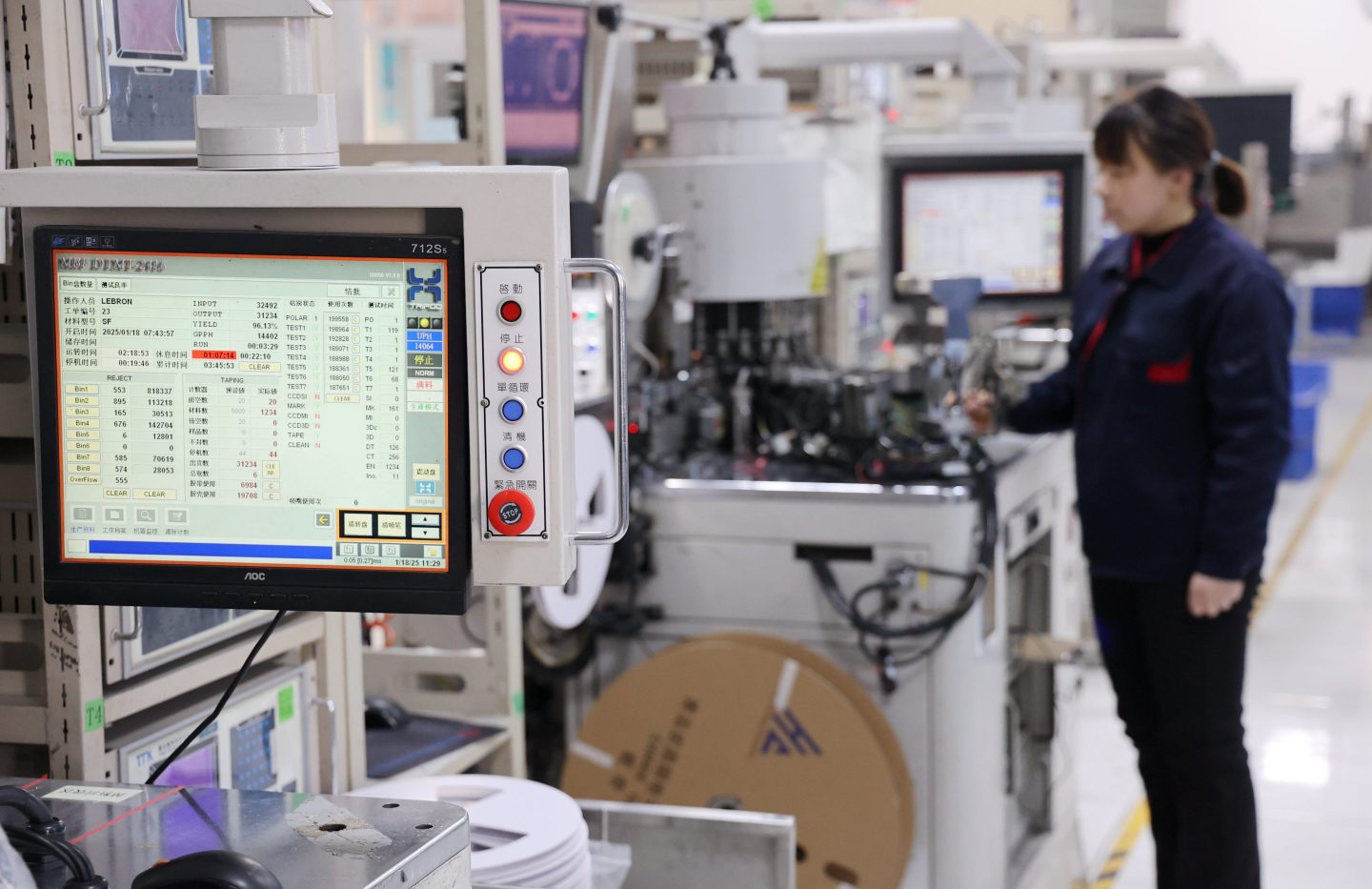
At a semiconductor manufacturer in Binzhou, China, on Jan. 20, 2025.
At a semiconductor manufacturer in Binzhou, China, on Jan. 20, 2025.Costfoto/NurPhoto/Getty Images

For years, the U.S. chip sector complained that Washington’s chip controls would hurt their business and spur the creation of a Chinese competitor—yet these warnings rang hollow as revenue kept hitting records thanks to the AI boom.

Recommended Video

But recent earnings reports from equipment manufacturers like Applied Materials and Lam Research show the U.S.’s broadside against China’s chip sector may be starting to bite. 

Applied Materials, the largest U.S. chip equipment manufacturer, issued a lukewarm revenue forecast last week, citing the risk of new export controls from Washington. Revenue from China, the company’s largest market, dropped 25% in the most recent quarter to reach $2.2 billion, out of a total $7.2 billion.

China’s contribution to Applied Materials’ revenue has dropped from 45% a year ago to 31% today.

And the company thinks it’ll drop even further. “For Q2, we expect that China as a percentage of total revenue will be about five percentage points lower than in Q1,” CFO Brice Hill told analysts last week. 

Equipment manufacturers, for now, are still reporting an increase in overall revenue, as the tech industry piles into the AI boom. But analysts warn these companies will sorely miss what China has: a lot of semiconductor manufacturing, and a consumer market eager to snap up the products that use those chips. 

“China is not just a semiconductor manufacturing hub,” says Moonsup Shin, head of hardware, semiconductor, and data centers for Asia-Pacific at Bain & Company. “Around or more than 50% of the semiconductors manufactured by Chinese manufacturers are consumed in China.”

And worse, there’s no ready-made alternative waiting. Regions like Southeast Asia are investing in local manufacturing to position themselves as neutral territory in a chip war. Yet in practice, these up-and-comers lack both China’s manufacturing and consumer demand.

Downward slide

Applied Materials isn’t the only manufacturer of chipmaking equipment worried about China controls. Lam Research’s China revenue over the last three months of 2024 dropped 10% year on year to reach $1.4 billion. China’s revenue contribution also dropped, from 40% a year ago to 31% now.

“Our sales to customers in China, a significant region for us, have been impacted and are likely to be materially and adversely affected by export license requirements and other regulatory changes, or other governmental actions in the course of the trade relationship between the U.S. and China,” Lam Research warned in its earnings report. 

The dips and warnings come after the mainland Chinese market grew to form a significant part of these companies’ revenues. 

China revenue at KLA Tencor, another major American equipment maker, is largely holding up, which David Chuang, a senior research analyst at Isaiah Research, credits to the company’s metrology tools. China doesn’t yet have a domestic alternative for KLA Tencor’s products, used in measurements and inspections, meaning Chinese foundries “will do anything to acquire metrology tools,” Chuang says.

Why does China matter?

While China’s chip industry doesn’t yet make the most cutting-edge semiconductors, it dominates in what the industry calls “mature” chips, older-generation components used in everything from electric vehicles to home appliances. 

“China remains a major region for manufacturing of legacy node logic and memory chips, adding to its role as the world’s largest consumer of ICs [integrated circuits],” wrote KLA Tencor in its earnings statement.

The flood of Chinese shoppers snapping up consumer electronics means a huge demand for chips, which in turn sustains China’s chip sector. Overseas demand for devices from companies like Huawei, Xiaomi, and Transsion only adds to China’s demand for chips. 

Chip export controls

Since 2019, the U.S. has aggressively policed chip sales to China, slapping sanctions on individual companies like Huawei and Semiconductor Manufacturing International Corp. (SMIC).

The U.S then introduced export controls in 2022 that not only restricted China’s access to advanced chips, but also to the equipment needed to make those chips. The U.S. later tightened those restrictions, and pushed other countries like the Netherlands and Japan to impose their own rules.

Ironically, regulations helped equipment companies, at least initially. Chinese chip manufacturers rushed to stockpile machinery owing to fears that Washington might impose tougher export controls later.

But that rush of demand may start to ease, as Beijing pours more money into the chip sector in a drive for self-sufficiency. China is now encouraging firms to use domestic equipment where possible, shrinking the available market for foreign companies.

That, Chuang says, creates a “double negative” as American chipmakers are squeezed by both Washington’s and Beijing’s policies. 

China doesn’t yet have the ability to produce the cutting-edge machines made by U.S. and other non-Chinese firms. Yet Shin points out that Chinese companies have had some success in substituting noncritical equipment. 

Analysts have also previously suggested that manufacturers have been able to use older equipment in innovative ways to create more advanced chips.  

The U.S. and Japan, more developed markets, are both investing in new onshore chip plants in a bid to decouple their supply chains from China. Yet both Shin and Chuang think these markets won’t grow to the same extent as China.

Shin suggests India could be a replacement for China, given its large consumer population and ambitions to be a tech powerhouse. But it’ll take a long time for the country to catch up: India needs to build its ecosystem almost entirely from scratch. 

But even then, there may not be a replacement for the Chinese chip sector. “It’ll be hard to replace what the Chinese companies buy,” Chuang says. 

Join us at the Fortune Workplace Innovation Summit May 19–20, 2026, in Atlanta. The next era of workplace innovation is here—and the old playbook is being rewritten. At this exclusive, high-energy event, the world’s most innovative leaders will convene to explore how AI, humanity, and strategy converge to redefine, again, the future of work. Register now.
About the Author
By Lionel LimAsia Reporter
LinkedIn icon

Lionel Lim is a Singapore-based reporter covering the Asia-Pacific region.

See full bioRight Arrow Button Icon

Latest in Tech

Finance
Lorem ipsum dolor sit amet, consectetur adipiscing elit, sed do eiusmod tempor incididunt ut labore et dolore magna aliqua. Ut enim ad minim veniam
By Fortune Editors
October 20, 2025
Finance
Lorem ipsum dolor sit amet, consectetur adipiscing elit, sed do eiusmod tempor incididunt ut labore et dolore magna aliqua. Ut enim ad minim veniam
By Fortune Editors
October 20, 2025
Finance
Lorem ipsum dolor sit amet, consectetur adipiscing elit, sed do eiusmod tempor incididunt ut labore et dolore magna aliqua. Ut enim ad minim veniam
By Fortune Editors
October 20, 2025
Finance
Lorem ipsum dolor sit amet, consectetur adipiscing elit, sed do eiusmod tempor incididunt ut labore et dolore magna aliqua. Ut enim ad minim veniam
By Fortune Editors
October 20, 2025
Finance
Lorem ipsum dolor sit amet, consectetur adipiscing elit, sed do eiusmod tempor incididunt ut labore et dolore magna aliqua. Ut enim ad minim veniam
By Fortune Editors
October 20, 2025
Finance
Lorem ipsum dolor sit amet, consectetur adipiscing elit, sed do eiusmod tempor incididunt ut labore et dolore magna aliqua. Ut enim ad minim veniam
By Fortune Editors
October 20, 2025

Most Popular

Finance
Lorem ipsum dolor sit amet, consectetur adipiscing elit, sed do eiusmod tempor incididunt ut labore et dolore magna aliqua. Ut enim ad minim veniam
By Fortune Editors
October 20, 2025
Finance
Lorem ipsum dolor sit amet, consectetur adipiscing elit, sed do eiusmod tempor incididunt ut labore et dolore magna aliqua. Ut enim ad minim veniam
By Fortune Editors
October 20, 2025
Finance
Lorem ipsum dolor sit amet, consectetur adipiscing elit, sed do eiusmod tempor incididunt ut labore et dolore magna aliqua. Ut enim ad minim veniam
By Fortune Editors
October 20, 2025
Finance
Lorem ipsum dolor sit amet, consectetur adipiscing elit, sed do eiusmod tempor incididunt ut labore et dolore magna aliqua. Ut enim ad minim veniam
By Fortune Editors
October 20, 2025
Finance
Lorem ipsum dolor sit amet, consectetur adipiscing elit, sed do eiusmod tempor incididunt ut labore et dolore magna aliqua. Ut enim ad minim veniam
By Fortune Editors
October 20, 2025
Finance
Lorem ipsum dolor sit amet, consectetur adipiscing elit, sed do eiusmod tempor incididunt ut labore et dolore magna aliqua. Ut enim ad minim veniam
By Fortune Editors
October 20, 2025
Rankings
  • 100 Best Companies
  • Fortune 500
  • Global 500
  • Fortune 500 Europe
  • Most Powerful Women
  • Future 50
  • World’s Most Admired Companies
  • See All Rankings
Sections
  • Finance
  • Leadership
  • Success
  • Tech
  • Asia
  • Europe
  • Environment
  • Fortune Crypto
  • Health
  • Retail
  • Lifestyle
  • Politics
  • Newsletters
  • Magazine
  • Features
  • Commentary
  • Mpw
  • CEO Initiative
  • Conferences
  • Personal Finance
  • Education
Customer Support
  • Frequently Asked Questions
  • Customer Service Portal
  • Privacy Policy
  • Terms Of Use
  • Single Issues For Purchase
  • International Print
Commercial Services
  • Advertising
  • Fortune Brand Studio
  • Fortune Analytics
  • Fortune Conferences
  • Business Development
About Us
  • About Us
  • Editorial Calendar
  • Press Center
  • Work At Fortune
  • Diversity And Inclusion
  • Terms And Conditions
  • Site Map

© 2025 Fortune Media IP Limited. All Rights Reserved. Use of this site constitutes acceptance of our Terms of Use and Privacy Policy | CA Notice at Collection and Privacy Notice | Do Not Sell/Share My Personal Information
FORTUNE is a trademark of Fortune Media IP Limited, registered in the U.S. and other countries. FORTUNE may receive compensation for some links to products and services on this website. Offers may be subject to change without notice.


Most Popular

placeholder alt text
Economy
The $38 trillion national debt is to blame for over $1 trillion in annual interest payments from here on out, CRFB says
By Nick LichtenbergDecember 17, 2025
3 days ago
placeholder alt text
AI
Meta’s 28-year-old billionaire prodigy says the next Bill Gates will be a 13-year-old who is ‘vibe coding’ right now
By Eva RoytburgDecember 19, 2025
23 hours ago
placeholder alt text
Success
As graduates face a ‘jobpocalypse,’ Goldman Sachs exec tells Gen Z they need to know their commercial impact 
By Preston ForeDecember 18, 2025
2 days ago
placeholder alt text
Success
The scientist who helped create AI says it’s only ‘a matter of time’ before every single job is wiped out—even safer trade jobs like plumbing
By Orianna Rosa RoyleDecember 19, 2025
20 hours ago
placeholder alt text
Success
Billionaire who sold two companies to Coca-Cola says he tries to persuade people not to become entrepreneurs: ‘Every single day, you can go bankrupt’
By Dave SmithDecember 19, 2025
19 hours ago
placeholder alt text
Economy
‘This is a wacky number’: economists cry foul as new government data assumes zero housing inflation in surprising November drop
By Eva RoytburgDecember 18, 2025
2 days ago

Latest in Tech

Sam Altman looks down and to the side, frowning.
AIOpenAI
Sam Altman says he’s ‘0%’ excited to be CEO of a public company as OpenAI drops hints about an IPO: ‘In some ways I think it’d be really annoying’
By Sasha RogelbergDecember 19, 2025
16 hours ago
AIDebt
AI hyperscalers have room for ‘elevated debt issuance’ — even after their recent bond binge, BofA says
By Jason MaDecember 19, 2025
17 hours ago
Late Apple cofounder Steve Jobs
SuccessCareers
Steve Jobs sold his Volkswagen to raise $1,300 for Apple’s first computer. He became a millionaire just two years later at 23
By Emma BurleighDecember 19, 2025
18 hours ago
Yann LeCun smiles and adjusts his glasses
AIVenture Capital
AI whiz Yann LeCun is already targeting a $3.5 billion valuation for his new startup—and it hasn’t even launched yet
By Dave SmithDecember 19, 2025
18 hours ago
David Baszucki with his thumbs up
SuccessCareer Advice
Roblox CEO David Baszucki went from window cleaner to billionaire tech leader. He says a secret to success has been trusting his gut
By Preston ForeDecember 19, 2025
18 hours ago
Graphite team standing in an office
AICoding
Exclusive: Cursor acquires code review startup Graphite as AI coding competition heats up
By Beatrice NolanDecember 19, 2025
19 hours ago