
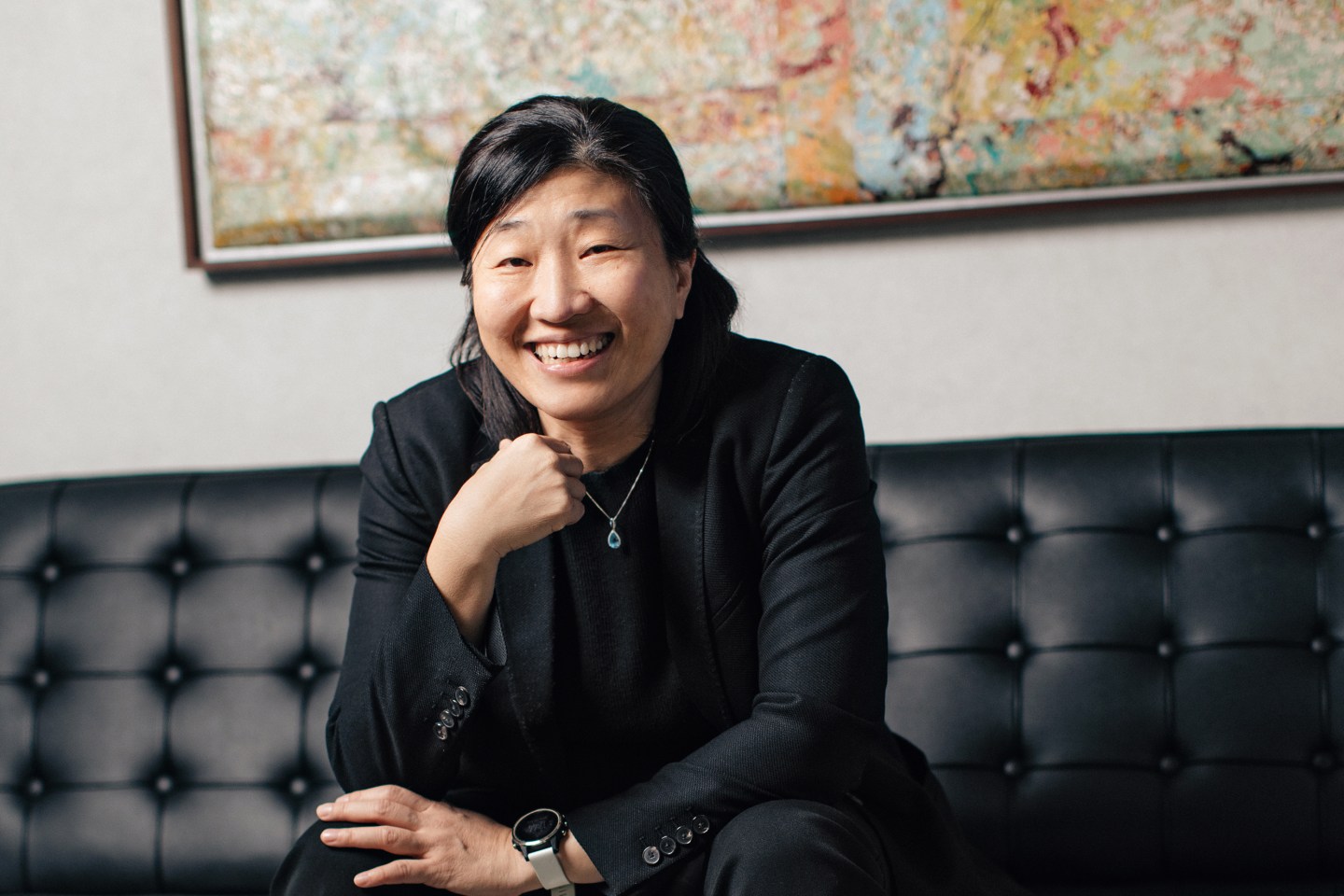
Singaporean venture capitalist Jenny Lee’s track record features the biggest names in Asian tech, including e-commerce giant Alibaba, ride-hailing companies Didi and Grab, and phone maker Xiaomi.
Yet Lee’s path to becoming one of Asia’s most prominent venture capitalists started in the hangars of Singapore’s air force, as an engineer working on fighter-jet engines. That hands-on experience helps her today as an investor, giving her a “common language” that allows her to talk to technology entrepreneurs about projects from their conceptual stages through their final delivery.
Lee got an MBA from Northwestern’s Kellogg School of Management right at the nadir of the dotcom bust in 2001. But that only encouraged her: “It can’t get worse, right?” she says. She borrowed 300,000 Singapore dollars ($220,000) to reimburse the firm that paid for her business degree and moved to Hong Kong to tap into the booming Chinese internet sector. She set up GGV Capital’s first China office in 2005.
Almost two decades later, as the senior managing partner behind Granite Asia—a spinoff of GGV Capital with $5 billion in assets under management—Lee ranks No. 33 on the Fortune Most Powerful Women Asia list.
Granite Asia owes its start to geopolitics. In July 2023, a U.S. House of Representatives committee said it would probe investments by U.S. venture capital firms, including GGV Capital, into China’s AI and semiconductor sectors.
Two months later, GGV announced that it was splitting in two: It divided into a U.S.-based fund, called Notable Capital, and a Singapore-based fund focused on China and Southeast Asia.
In March, Lee took the reins of the now-independent Asian fund, named Granite Asia as a callback to GGV Capital’s original name, Granite Global Ventures.
What’s your strategy, now that Granite Asia is in charge of its own destiny?
Lee: We always felt there was a lack of capital focus in Asia toward Asian companies. You have a diverse region, both an aging population and a young population, climate change issues, geopolitical concerns, all that stuff.
With the rebranding, our vision is to become the dominant capital platform for startups, founders, and businesses across the region: capital for the region that’s anchored in the region.
How is the U.S.-China relationship changing the world of investment? Do investors need to be worried about political risk?
As investors, we need to have the ability to read the tea leaves. In Asia, the tea leaves are pointing to a very obvious bifurcation. As we go forward, the globe is going to go into cluster economies. Today, it’s the U.S. and China. Tomorrow, it may be a different region.
This is a pretty dynamic game of chess. Products have to be a bit more nuanced, a bit more regional, and a bit more country-specific. It helps to bring in the right talent, attract the right deal flow, and also achieve the objective that the country wants to set up. A one-fund-fits-all model is not going to work going forward.
The real consideration will be exits and liquidity, whether any political policy or action reduces a company’s ability to go public, whether locally or overseas.
Granite Asia is expanding to new types of financing like private credit. Is that a better fit for what Asian firms need?
Enterprise-grade companies in Asia are going into their second or third generation of succession planning. Historically, they have grown their businesses by bootstrapping with local bank loans. But as they navigate the next 20 years, there’s a willingness and openness to engage with venture capital.
How can they now ensure the company is going to transition to the next generation with the right construct? It may be opening up the board to independent or financing investors who have the experience to help them grow. And maybe they will take on credit as a way to get to know these investors.
In Hong Kong, and even in Singapore, there’s a generation where the owner may not want to sell completely. There’s a gap between a buyout and the tech-centered world of venture capital.
What opportunities in Asia are you looking at?
One theme is around health. We cannot rely on the West to do all the sequencing and drug discovery, because not all the discoveries will be completely suitable for Asia.
With geopolitics, a new opportunity has arisen: diversifying your supply chain. It could be manufacturing IP in Singapore and the Middle East, then assembling in larger markets like Indonesia, Malaysia, Thailand, Vietnam, even down to India.
It’s leveraging the Global South and the broader Asia region to offer an alternative supply chain to businesses around the world.
Private equity deal value in Southeast Asia was down about 40% last year, according to Bain. What needs to be done to unlock investment in the region?
It’s a demand and supply issue. You need to ensure that Asia has capital across the stages of company evolution and growth to ensure that the capital is there when companies need to grow.
You need to have the Taylor Swift of IPOs, one that everyone is eager to join. But that, by itself, is not enough. You need good issuers: startups from Asia that want to list in Asia. The founders probably want to be here: The brands and products have more appeal here. But if you don’t resolve the issues with capital and investment here, companies can’t close the loop. Having a lot of capital, but no great issuers, doesn’t solve the issue.
Is gender representation in the Asian tech sector improving? Are you seeing more female founders?
Yes, we are. I just met a woman entrepreneur. She’s in her fifties. She’s been a housewife and a caretaker the last 30 years. She’s now an empty nester and therefore has time for her passion. She’s starting a new food brand in the healthy snack space.
Diversity is good. Women leaders who were so focused on building their careers in large companies now, in their fifties, sixties, and seventies, have the opportunity to be mentors.
This article appears in the October/November 2024: Asia issue of Fortune with the headline “Capital for Asia, rooted in Asia.”
More from the October/November issue of Fortune:
–See who made the 2024 Fortune Most Powerful Women Asia list
–Meet Martha Sazon, who leads the Philippines-based finance superapp GCash
–Women in Asia are reaching the top of the corporate world
–Xiaohongshu and its young, female, Chinese user base are transforming travel and shopping
Explore the 2024 Fortune Most Powerful Women Asia list.