On a brisk Monday morning before Thanksgiving, a Secret Service motorcade rolled through Vega, a town of fewer than 1,000 people in the Texas Panhandle. Someone of national significance had flown in on a private jet from Florida. His coming to town was “kept very, very quiet,” said Quincy Taylor, a county commissioner, the owner of Vega’s only grocery store, and the editor of the town’s newspaper. “I probably wasn’t supposed to know,” she admitted.
The VIP broke his silence a few hours later. “Hey, friends, it’s Eric Trump,” President Trump’s son said in a post on Instagram. Behind him, rows of computer servers stretched into the distance. “Welcome to American Bitcoin.”
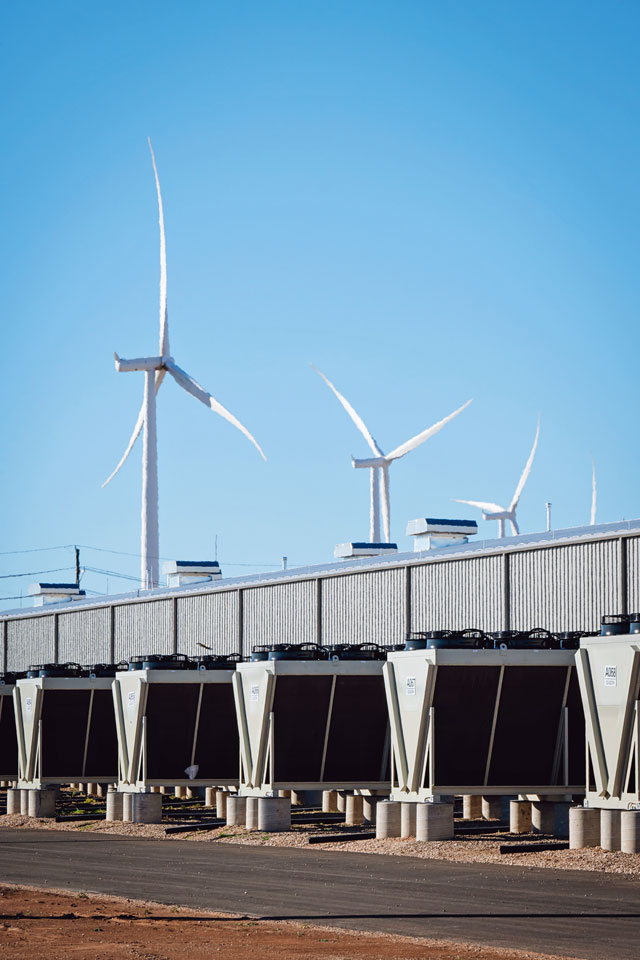
The post came after the 42-year-old scion had toured a data center the length of five football fields—his first visit since it went online in late June. The facility sits on a former cow pasture next to fields of spinning wind turbines, which power the data center up to 45% of the time. “I find great beauty in this,” said Eric, wearing jeans, a blazer, and a button-down as he strolled the rows of servers with a Fortune reporter and video team. “I really do—very different than the kind of real estate that I’m used to.”
This real estate reflects a rare physical footprint for a crypto industry whose value exists primarily on the internet. Over the past few years, the U.S. has quietly become the leader in the creation of Bitcoin, and American Bitcoin—where Eric Trump is cofounder and chief strategy officer— aims to ride this Bitcoin mining wave.
More recently, the crypto industry has also become intertwined with a Trump corporate brand best known for traditional real estate. In just over a year, the family has made at least $1 billion in pretax earnings from multiple crypto ventures that share a common playbook with American Bitcoin: attracting savvy partners and executing complicated transactions that position the family’s business organizations to scoop up profits.
American Bitcoin, created in March 2025, also aligns with President Trump’s push to Americanize key industries, from steel to AI to crypto, and frame them as strategic resources where America should be dominant. That message has been baked into the mining venture’s branding since inception. In his Instagram post, Eric boasted that the business is “using American energy to mine Bitcoin right here on American soil.” In conversation with Fortune, he said he and his father shared the goal of making the U.S. “the crypto capital of the world,” and that Bitcoin mining was central to U.S. domination of the emerging industry. “If we don’t do it, someone else will,” he said.
The company’s success is far from guaranteed. Like all the Trump crypto holdings, American Bitcoin faces scrutiny over potential conflicts of interest. What’s more, the company must show it can withstand a hyper-volatile crypto market: Since it went public in September, its share price has plummeted alongside a steep decline in Bitcoin’s value.
Its cofounder told Fortune he’s taking the long view. “Cryptocurrency, if you look back in three years, in five years, and 10 years, I think these are the endeavors that are going to win,” Eric said.
Blinking lights on a wall of servers went from their customary green to an angry red. They were overheating. And every minute a server was down threatened the Vega data center’s Bitcoin output, and by extension its revenue.
Three technicians jumped onto a white warehouse cart and sped down a central aisle to the panel of ailing mining servers, which (like most in the industry) were designed with the help of Chinese Bitcoin-mining-chip manufacturer Bitmain. Working methodically, the Amarillo-based engineers identified the problem: a loose wire. “If you hit the right one, it could bring down the whole conveyance,” said one technician.
The repair effort and the giant facility in which it took place reflect how much Bitcoin mining has changed since 2009, the year the cryptocurrency launched. Back then, it was possible to mine 50 Bitcoins at a time—around $4.6 million worth, at current prices—on a home laptop. Today, the noise and machinery of Eric Trump’s Vega operation show how industrial-scale the process has become.
To appreciate why, it’s helpful to understand Bitcoin’s origins. Its pseudonymous inventor, Satoshi Nakamoto, launched Bitcoin as a protest of sorts against the profligacy of central banks and governments. Unlike other currencies, it is anti-inflationary—there will never be more than 21 million Bitcoins—and it is supported by a decentralized network rather than a bank or government.
The mining process distributes new batches of the currency, while also requiring miners to expend energy to maintain that network. Miners race to be the first to solve a random math problem that is generated every 10 minutes or so. The winning miner signs off on a “block” of Bitcoin transactions that it adds to the blockchain. In return, the winner receives a payout of Bitcoin, which today amounts to 3.125 coins per reward, plus the opportunity to collect additional transaction fees.
Winning the competition, however, has become exponentially harder as the network has grown. It now requires massive computing power, specialized chips—and tremendous amounts of energy. In the U.S., crypto mining accounts for as much as 2.3% of electricity consumption, the Energy Information Administration estimated in 2024—putting it on par with some of the country’s most energy-intensive industries.
Today there are clusters of mining computers in locations worldwide where cheap energy is easily accessible—places like Vega. Affordable energy, in turn, has helped the U.S. build its Bitcoin mining market share, since the cheaper the power, the more likely the miners can turn a profit on their coins. The U.S. accounted for 38% of mining activity in the fourth quarter of 2025, far above Russia’s second-best 16%, according to Bitcoin mining company Luxor Technology. At this point, Bitcoin is literally made in America.
Spurred by President Trump, who issued an executive order in March 2025 to create a strategic Bitcoin reserve, Republicans have framed the asset as a new front in the economic competition with Russia and China. “The Bitcoin for America Act will position our country to lead—not follow—as the world navigates the future of sound money and digital innovation,” said Rep. Warren Davidson (R-Ohio) in a November statement advocating for the bill.
It was amid the president’s push to make America a “Bitcoin superpower” that Eric Trump’s venture took shape. He found a partner in 31-year-old Asher Genoot.
Genoot had been in Bitcoin mining for several years, starting a company called US Bitcoin and becoming CEO of Hut 8 after the two companies merged in 2023. He works out of Miami and moves in the same circles as the Trumps in southern Florida, where the president holds court at his Palm Beach club Mar-a-Lago. “We had about 100 of the same friends,” Eric said.
After meeting a few months earlier, Genoot and Eric started talking business in February 2025, over pizza at a Trump golf club in nearby Jupiter. Eric and his brother Donald Trump Jr. had just launched a corporate entity called American Data Centers; perhaps there could be a tie-in with Genoot’s company.
“I realized how punitive the financial institutions were in this country, and I fell in love with this new era of finance.”
American Bitcoin cofounder Eric Trump
In fact, there could be: Hut 8 already owned several Bitcoin mining facilities across the U.S. and Canada—warehouses of servers, close to cheap power sources. “We’re long energy,” Genoot said. “And we build infrastructure assets, whether that be data centers that mine Bitcoin or data centers that go and support AI compute.” (“I would never have considered mining had I not seen the scale to which they had built,” Eric added in a statement.)
What followed was a headspinning series of financial transactions. Genoot and Eric agreed to split off Hut 8’s Bitcoin mining operation into a separate, Trump-linked company. (“It has to have the word ‘American’ in it,” Eric recalled saying about the name.) Hut 8 retained 80% ownership, and shareholders of American Data Centers received the other 20%; the remainder of Hut 8, meanwhile, became a pure data center and power infrastructure play.
Late last March, the partners unveiled their new project, then raised $220 million in a private equity funding round led by Solari Capital, whose founder, AJ Scaramucci, is a son of investor and Trump supporter turned dissident Anthony Scaramucci. (“Bitcoin transcends politics,” AJ told Fortune.) In September, American Bitcoin went public, with Genoot as executive chairman.
Like some other mining ventures, the company employs a hybrid business model that also involves running a “digital-asset treasury.” Digital-asset treasuries raise money by issuing debt and equity, then use that cash to buy crypto for their balance sheets. The business premise, pioneered by Michael Saylor and his company Strategy, relies on the assumption that investors will buy a treasury company’s stock to profit from digital assets without owning them directly.
Saylor has become one of Bitcoin’s most devoted evangelists and a friend of Eric’s. He even pitched Eric on mortgaging Mar-a-Lago to buy more Bitcoin. Eric demurred, he said, “But I go, ‘You know…there’s a second-best play, right?’”
Shortly after it went public in September, Eric couldn’t have been more ecstatic about his second-best play. American Bitcoin was worth nearly $8.5 billion at its height on Sept. 9, while Hut 8 was valued at more than $3 billion. In the third quarter of 2025, American Bitcoin generated $64 million in revenue, primarily from the 563 Bitcoin it mined during those three months. It was “pretty awesome for a company just coming out of the gate,” Genoot said. And as of early January, the new company had about $500 million worth of Bitcoin on its balance sheet—enabling it to vault into the top 20 of the largest Bitcoin digital asset treasuries.
Sitting in an atrium near the servers, Eric talked about the factors that made him a crypto convert. “I happened to become the most debanked human being in the history of debanked human beings,” he said. “Capital One pulled our accounts. JPMorgan pulled our accounts. Bank of America pulled our accounts.”
President Trump and Eric Trump, along with others in their family, have said many banks either stopped doing business with them or refused to take their deposits after the president and many of his supporters disputed the results of the 2020 election.
Banking privacy laws have largely prevented banks from commenting on why they might have stopped working with the Trumps—or even if they worked with the Trumps at all. JPMorgan Chase and Bank of America declined to comment on specific customers’ accounts, and Capital One did not respond to requests for comment. More broadly, the three banks have denied that they debank customers because of political affiliations. “This is false,” wrote lawyers for Capital One in response to a lawsuit the Trumps filed against the bank in which they alleged their accounts were closed because of their political beliefs. “While Capital One closes bank accounts occasionally, it does so for legally and regulatorily permissible reasons.”
Still, the experience was one the Trumps shared with some crypto entrepreneurs, who believed that they and their companies had been debanked because of regulators’ suspicions about the businesses’ validity.
Eric says his family’s battle with the banks prompted him to turn to crypto. “I realized how punitive the financial institutions were in this country,” he said, “and I fell in love with this new era of finance.” Like other crypto diehards, he sees Bitcoin as an improvement over the middlemen, fees, and delays associated with traditional banking. “It’s cheaper, faster, more transparent than any other form of finance,” he said.
Eric wasn’t the only Trump warming to crypto. Although Donald Trump once said that Bitcoin “seems like a scam,” he went on to launch his own collection of NFTs, or collectible images that exist on the blockchain. By 2024, during his campaign to reclaim the White House, he was proclaiming his intention to make the U.S. a dominant force in crypto. And once in office, he signed bipartisan legislation to regulate stablecoins; issued crypto-friendly executive orders, in a reversal of the cryptoskepticism of the Biden administration; and pardoned several people convicted of crypto-related crimes.
Amid this political push, the Trump family’s sprawling business has diversified beyond its original real estate empire and come to look more like a crypto conglomerate. But one strategy has been consistent: The family expands its range by attaching the Trump name to products and businesses largely developed and operated by others.
Eric and his brother Don Jr. led the family business, the Trump Organization, after the elder Trump began his first term in 2017. That company owns a substantial real estate portfolio, but also licenses the Trump name for a fee to developers and other entrepreneurs—generating an income stream with a minimal investment from the organization itself.
In crypto, the family has adopted analogous strategies. The Trump family’s public social media company, Trump Media & Technology Group (TMTG), has launched a number of crypto-related investment products, including exchange-traded funds, but it has leaned on digital-asset exchange Crypto.com to build and administer them. World Liberty Financial, perhaps the most lucrative of the Trump family’s crypto endeavors, has worked closely with Binance, the world’s largest crypto exchange, to launch and promote its own stablecoin.
American Bitcoin is a similarly asset-light investment. The company says it has only five employees. While it owns almost 78,000 Bitcoin mining servers, American Bitcoin doesn’t own or operate the Vega facility itself, or employ its technicians; that’s also true of the company’s three other data centers. Instead, American Bitcoin pays Genoot’s Hut 8 to run its mining operations.
“It’s the playbook of take the Trump brand, generate a bunch of attention, get the money, and then pay other people to do the work,” said Austin Campbell, a longtime crypto executive and adjunct professor at New York University who teaches classes on blockchain technology.
An American Bitcoin spokesman says of Campbell’s description, “That characterization is inaccurate. American Bitcoin’s leadership and founding partners are actively building the business for the long term.”
By most measures, these crypto ventures have been lucrative. They netted more than $1 billion in pretax profits for the year through October, according to the Financial Times—most of it earned through sales of the cryptocurrency attached to World Liberty Financial and the memecoin $TRUMP. And while their on-paper valuations wax and wane with the gyrations of the markets, the family’s crypto ventures were worth north of $3 billion as of early January, according to an analysis by Fortune and data from crypto analytics firm Nansen. That estimate includes stakes in the memecoin and World Liberty Financial’s currency, holdings that Fortune discounted because of their limited liquidity. The rough valuation also includes shares in crypto-related public companies, including American Bitcoin and TMTG. (The Trump Organization did not respond to requests for comment.)
In early January, World Liberty Financial applied for a federal banking charter. A Trump crypto company was seeking regulatory approval from a decidedly pro-crypto Trump administration. That’s the kind of intersection of the Trump family’s business interests with President Trump’s powers that has raised alarms in Washington.
There is, to be sure, a growing sentiment in tech and investing circles that policymakers and advisors might make better decisions if they have some skin in the game. But the president wields much greater authority over policy—and policies that benefit the crypto community now almost by definition benefit the family’s businesses.
Ethics experts say that the Trump family’s crypto bets have created unprecedented conflicts of interest. “Is he making these decisions because he thinks this is a good thing?” asked Richard Briffault, a professor at Columbia Law School who researches government ethics, in reference to the president’s crypto policies. “Or is he making these decisions because he knows what’s going to have a direct effect on his family’s finances?”
“Neither the President nor his family have ever engaged, or will ever engage, in conflicts of interest,” said Karoline Leavitt, the White House press secretary, in a statement. She added that the administration “is fulfilling the President’s promise to make the United States the crypto capital of the world.”
Eric Trump has also repeatedly pushed back against intimations of impropriety. He told Fortune that there’s a “wall” between his business interests and his father’s policymaking. “My father has no involvement in the Trump Organization,” he said. “He has no involvement in our crypto business. This is a company that I run, and he does a great job running the United States of America.”
Beyond rhetorical battles over propriety, there’s the question of whether any public company in crypto—an industry inherently tied to politics and regulatory action—can maintain momentum after President Trump leaves office. But the bigger near-term threat to American Bitcoin is a recent collapse in the crypto market.
As of mid-January its price was down more than 25% from its mid-autumn peak, after investors grew anxious over signs of a softening U.S. economy. That tumble coincided with a substantial drawdown in American Bitcoin’s stock, which was down more than 70% since its early-September IPO. (Other digital asset treasury companies saw their stocks tumble at around the same time.)
The volatility has spread to other Trump crypto assets as well. But Eric, in late November, was unperturbed. “I’ve got more conviction on cryptocurrency right now than ever before,” he said. “Volatility is our friend.” In fact, he, Genoot, and other insiders bought more shares of American Bitcoin in December and early January—in time to benefit from a post–New Year bounce.
The residents of Vega are not particularly attuned to the ups and downs of the crypto market. Some townspeople said the American Bitcoin mine hasn’t substantially impacted life in the community, whose biggest claim to fame is its proximity to the historic Route 66.
But others view the data center as a net positive. “It’s going to provide some jobs for a rural area that doesn’t always have jobs,” said Kari Mays, Vega’s assistant city secretary. And local residents do know about the Trumps’ role. “[The town] would probably love to tell that story,” said Taylor, the grocery store owner and newspaper editor, about Eric’s motorcade driving through rural Texas. It’s that brand appeal—whether in Vega or in the top echelons of the crypto community—that has helped propel the Trumps from crypto newcomers to central players.
This article appears in the February/March 2026 issue of Fortune with the headline “Eric Trump’s Bitcoin factory.”