The American century — a phrase coined by Fortune founder Henry Luce — had a soundtrack. It was Chuck Berry on the radio and Coca-Cola in the cooler, Levi’s jeans, and Marlboro billboards stretching across Europe. American culture didn’t conquer the world through military force—it did it through desirability. People wanted to be American. That aspiration was a kind of geopolitical superpower that no missile silo could replicate.
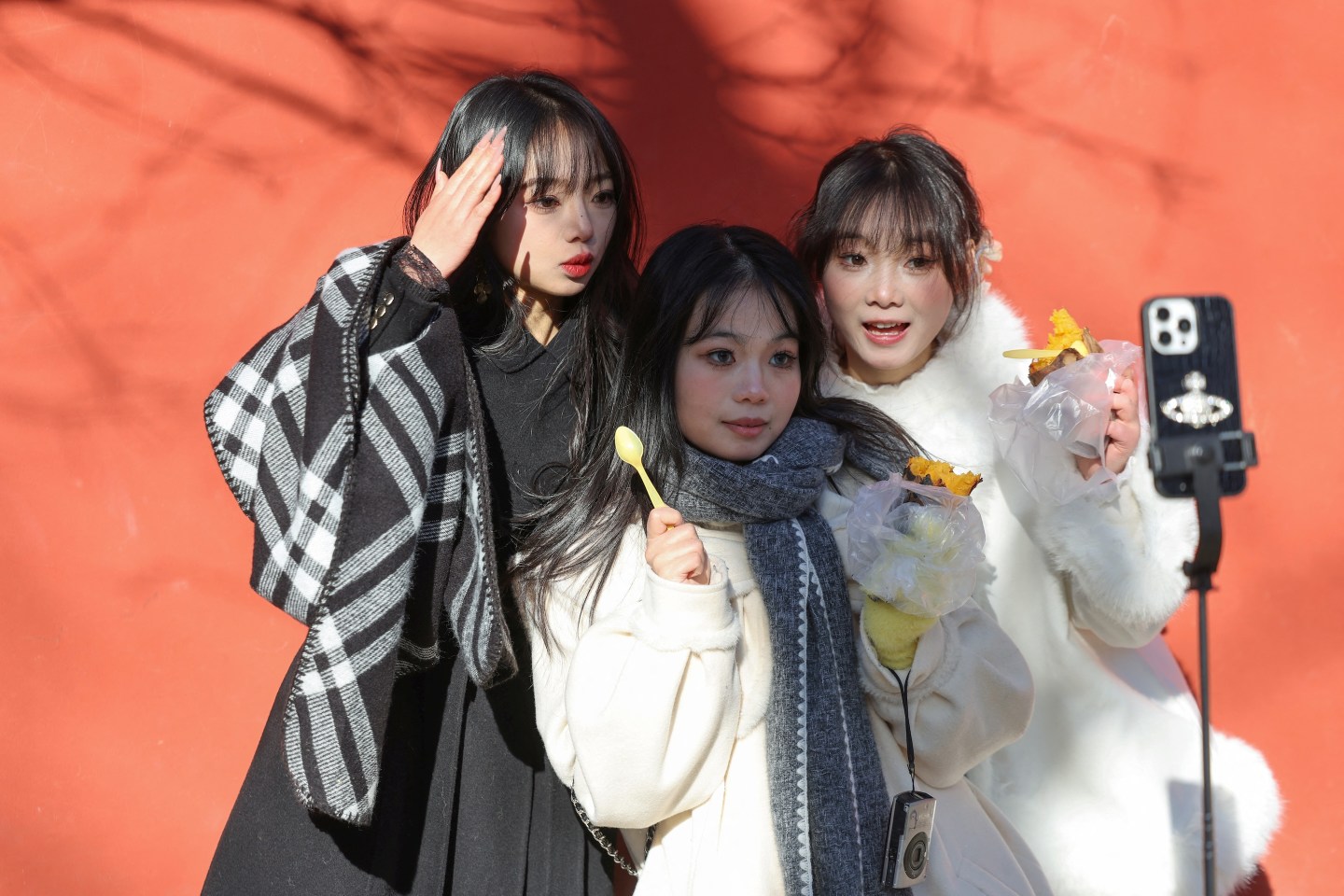
Now something is shifting, at least online. On TikTok, a growing wave of Gen Z creators—American first, then European, then global—are declaring themselves to be in their “Chinese era.” They’re drinking hot water. They’re eating hotpot. They’re wearing slippers indoors and marveling at the electric buzz of Chinese city life. They’re calling it “Chinamaxxing.” And increasingly, they mean it as more than a joke.
Welcome to the “Becoming Chinese” moment. Beneath its ironic, meme-friendly surface, the trend has ignited a genuine debate: Is this the first credible crack in American soft power dominance—or is it simply Gen Z doing what Gen Z does?
What they’re actually glamorizing
Spend five minutes in the Chinamaxxing corner of TikTok, and a clear aesthetic emerges. The videos cluster into a few recognizable genres. There’s “wellness and longevity mode” — warm water with fruit, herbal teas, gua sha, early bedtimes, gentle morning exercises, all framed as ancient secrets to soft living. There’s “uncle core,” in which creators affectionately mimic Chinese retirees: tracksuits, sidewalk squatting, communal street-side beers, a whole visual argument against American hustle culture.
And then there’s the infrastructure porn. Bullet trains gliding into spotless stations. Drone shows over neon-lit Shenzhen skylines. Chinese EVs. Walkable, dense neighborhoods. Drone food delivery. Contactless payment for a noodle soup that costs the equivalent of two dollars. These clips, often set to ambient or synthwave music, are edited to make American commuters watching on cracked phone screens feel something specific: that the future is being built somewhere else.
As tech commentator Afra Wang put it, “These young people have watched their physical reality remain frozen while China built entire cities. When you can’t build high-speed rail, but you can scroll through videos of Chinese infrastructure, of course, the future starts to look Chinese.”
The subtext of every “very Chinese era” video isn’t really about China. It’s about what young Americans feel they’ve been denied. Chinamaxxing romanticizes things that feel structurally out of reach at home — compact, affordable-looking apartments; public transit that works; streets safe to walk at night; multigenerational households as an antidote to loneliness; communal meals as an antidote to atomization. The comparison is implicit but unmissable: they have this, and we don’t.
A mirror, not a window
The numbers underneath the memes are brutal. A four-year U.S. public university costs $50,000 to $60,000 for in-state students; the equivalent in China runs $3,000 to $5,000 for the whole degree. American households spend roughly $5,177 a year on healthcare, with medical debt touching nearly half of all adults. China’s subsidized system costs somewhere between $350 and $565 annually. Housing eats 25% to 35% of an American paycheck. In China, rent in major cities often runs 60% to 70% lower.
Gen Z Americans now carry an average of $94,000 in student-loan debt, and the psychological weight of that number is fueling what Alice Lassman has called “disillusionomics” — a generational rejection of traditional financial prudence rooted in the belief that the old rules no longer apply. One-third of Gen Z says they believe they’ll never own a home. Many are planning to forgo children. Youth unemployment hit 10.8% last year against a 4.3% national average.
This is the context in which “becoming Chinese” lands. It isn’t that Gen Z has carefully studied comparative political economy and chosen Beijing. It’s that they were raised on a promise — get the degree, get the job, get the house, get the healthcare — that increasingly feels like a lie. American higher education, once the most reliable on-ramp to the middle class, now generates crippling debt in exchange for credentials that pay less in real terms than they did for their parents. Tuition at U.S. public universities has increased 153.8% since the early 1980s in inflation-adjusted terms, growing 65% faster than currency inflation and 35% faster than wages. The institution, sold as the gateway to prosperity, has become its single largest private obstacle.
Slate‘s Nitish Pahwa captured the emotional logic cleanly: “You told us we couldn’t have a high-speed railroad and universal health care, and it turns out they have it across the street! I’m going to live at their house now!” It is, as he described it, a petulant-toddler reaction to a broken promise — and one that Western institutions have given Gen Z ample grounds to throw.
A generation assembling itself
Reid Litman, a consulting director at Ogilvy who studies Gen Z behavior, told Fortune he doesn’t read Chinamaxxing as a wholesale rejection of American culture. “It’s not Western Gen Z turning against American culture or choosing China instead,” he said. “It’s something much more native to how this generation builds identity and uses the internet.”
His point cuts to the core of what makes this different from anything a Cold War-era analyst would recognize. Gen Z, Litman argued, doesn’t treat identity as fixed or inherited — it’s assembled. “Pieces are borrowed, remixed, and layered over time, the same way they approach music, fashion, or language. When someone says they’re in their ‘very Chinese era,’ it’s not a geopolitical statement. It’s a signal of a phase — closer to trying something on than switching sides.”
That framing matters. But it doesn’t defuse the broader signal. The content gaining traction — tea rituals, slow routines, dense and futuristic cities, food culture that feels abundant and communal — maps precisely onto what young people say is missing from their own lives. “China becomes less of a destination,” Litman said, “and more of a canvas to project those desires.” A sense of wellness and calm. A feeling of prosperity. An everyday beauty that American strip-mall culture conspicuously fails to provide.
The meme propaganda couldn’t buy
However you read the motivation, the cultural moment is real — and its origins are instructive. The trend traces to 2025, when American gaming streamer IShowSpeed toured China and broadcast his genuine awe at its technological energy to millions of followers. Chinese-American TikToker Sherry Zhu amplified it with sardonic tutorials on “how to become Chinese” that went viral in 2025, some of which drew millions of views. The great migration of U.S. users to China’s Xiaohongshu, or RedNote, in early 2025 — triggered by the threatened TikTok ban — put Americans and Chinese netizens in direct contact at unprecedented scale, and the cross-pollination accelerated from there.
Shaoyu Yuan, a scholar who studies Chinese soft power, told NPR the trend operates on two tracks at once: one that “weakens American narrative authority by highlighting content that highlights U.S. dysfunction,” and another that “makes China look more attractive.” The Week The dysfunction track, crucially, writes itself. Nobody needs Beijing to fabricate footage of American potholes, ER bills, or decaying Amtrak cars.
Chinese officialdom has noticed. The Chinese ambassador to the U.S. has cited the trend publicly while pushing for expanded tourist visas. State outlet Global Times has begun amplifying it. Chinese foreign ministry spokesperson Lin Jian welcomed the international interest, saying it reflected a broader understanding of Chinese culture beyond “traditional symbols, such as the Great Wall, kung fu, pandas, and Chinese cuisine.” But this is Beijing’s central dilemma — and the most important Cold War lesson it should heed. State embrace is the soft power killer. What resonates as a genuine cultural moment curdles quickly into propaganda the moment party fingerprints appear.
Litman’s analysis suggests the Chinese government may not need to act at all. “There’s little to suggest a top-down push driving this specific behavior,” he said. “What’s more evident is a shift in tone — compared to the COVID era, the posture now feels more curious and less distant.”
The turbulent 2020s as an accelerant
Henry Luce, it’s worth remembering, was a staunch Republican and a massive proponent of 20th-century American internationalism, capitalism, and anti-communism — a worldview whose ultimate vindication was the 1989 fall of the Iron Curtain. American soft power during the Cold War was paradoxically most effective precisely when it felt least engineered. Hollywood produced anti-communist films at Washington’s quiet urging, but what global audiences absorbed was aspiration: big cars, wide suburbs, the sense that anything was possible. The suburban supermarket may have actually won the Cold War — Boris Yeltsin famously recalled the physical pain of walking through a Houston grocery store in 1989 and seeing its shelves stocked.
Consumer culture was itself ideological. As historian Eric Foner has written, it demonstrated the superiority of the American way of life to communism and effectively redefined the nation’s mission as the export of freedom itself. Blue jeans smuggled behind the Iron Curtain weren’t just denim — they were a vote against the system.
The unsettling symmetry of the current moment is that the infrastructure videos and hot-water memes are playing the same role in reverse. Bullet-train footage isn’t just rail — it’s a vote. And the vote is being cast by a generation that has no Cold War precedent for its view of China. New Pew Research data shows American adults under 34 view China far more favorably than those over 50. The 2020s have been a decade of compounding American institutional failure — a pandemic, political rupture, an affordability crisis, student loan servicers treated as adversaries, a healthcare system that bankrupts the sick, and a growing sense that the system is not working as advertised. Chinese modernity, filtered through a TikTok feed, offers an implicit counter-narrative: cities that work, infrastructure that impresses, a culture that feels rooted and forward-moving simultaneously.
The contrast is oversimplified, and critics are right to say so. Wages in China are significantly lower than in the U.S.; youth unemployment is a serious problem there; workplace demands can be punishing. The videos don’t show any of that. But the videos don’t have to. Their power lies in the specific comparison they invite — not “is China better in every way,” but “why does an ordinary life there appear to include things an ordinary life here no longer does.”
Litman acknowledges the nuance. “It’s never fully sincere or fully ironic,” he said of the trend’s Gen Z texture. “It carries humor, but also real curiosity — bits of truth, bits of silliness, and a layer of escapism holding it all together.” The tension between genuine interest and aesthetic shorthand isn’t a flaw of the trend. It’s how Gen Z operates — comfortable holding contradictions without resolving them.
The bigger picture
For Chinese Americans who grew up mocked for their food, their customs, their Chinese-ness, the trend carries its own complicated charge — a 5,000-year-old civilization reduced to a lifestyle aesthetic, now embraced on the same platforms where it was once invisible. Some in the diaspora have pushed back sharply, calling it “Orientalism by any other name.” The critique is fair. It also doesn’t cancel out what the trend signals.
Litman’s final word is probably the right one for calibration. “This kind of exploration is only possible because of American culture,” he said. “It’s more about play and expressing desires than a true turning away.” Gen Z is using global culture as a palette, and right now, China is the color they’re reaching for.
But the Cold War analogy cuts in both directions. American culture won the ideological struggle of the twentieth century not because Washington planned it perfectly, but because it generated something the other side couldn’t manufacture: a genuine, bottom-up, organic want. The “Becoming Chinese” trend, for all its irony and imprecision, is producing exactly that kind of signal — uncoerced, youth-driven, and spreading on its own momentum.
The American century was built on the world’s desire to be American, a desire so powerful that it didn’t require irony or caveats. The question the turbulent 2020s is forcing is a simpler and more unsettling one: what happens when the generation that was supposed to inherit the American promise looks around at their student loans, their rent, their medical bills, and their crumbling train stations — and decides they’d rather be something else?