
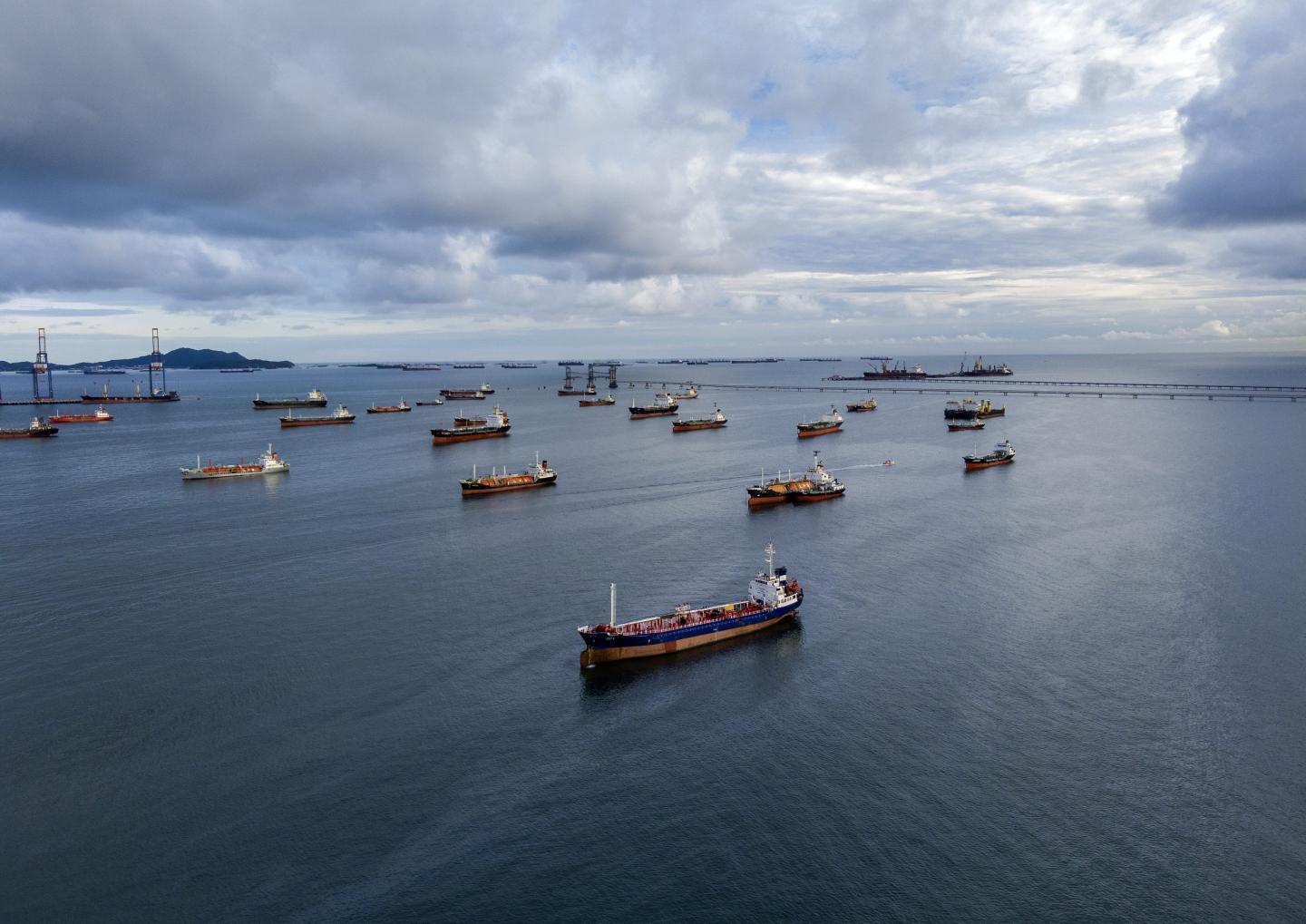
Early on April 13, the oil tanker Rich Starry—loaded with Iranian crude and headed for China—made a dramatic U-turn. Instead of exiting the Strait of Hormuz, as it had planned, the ship joined a stationary flotilla of about 800 other vessels, including 400 oil and gas tankers, most of which have remained idle and stranded since late February.
“We have not seen any transits from tankers since the U.S. blockade began this morning,” said Claire Jungman, director of maritime risk and intelligence for Vortexa, while noting the abrupt turnaround of the Rich Starry.
As peace talks between the U.S. and Iran fell apart over the weekend—although back-channel communication continues—President Donald Trump decided the U.S. would initiate its own blockade over the watery choke point through which roughly 20% of the world’s oil and liquefied natural gas typically flows.
Instead of Iran letting through almost 10% of the normal traffic through a financial tolling system, traffic has for now been reduced to zero as oil prices spiked back above $100 per barrel on April 13.
Oil forecaster Dan Pickering said the question now is, “Who’s going to have the guts to go through first?”
“We now have two governments both claiming they control the right to enter and exit the strait, and essentially, I don’t think we have any idea yet how this is going to play out,” said Pickering, founder of Pickering Energy Partners consulting and research firm.
“The president sort of indicated he’s willing to accept $100 [per barrel] oil,” he added. “I don’t know if this is going to turn into any more violence, but it’s clearly the next level of this economic warfare at a minimum.”
How it’s straightened out
U.S. Central Command, which deployed a series of warships for the blockade, said vessels from non-Iranian ports that haven’t paid tolls are now free to transit. But those ships also are afraid of falling under Iranian attacks. Trump said any of Iran’s high-speed attack boats that approach the U.S. blockade “will be immediately ELIMINATED.”
However, it’s unclear if, for instance, the U.S. would forcibly stop a Chinese tanker carrying Iranian oil. Tensions could easily escalate amid the tenuous two-week ceasefire announced last week.
French President Emmanuel Macron said he is working with the United Kingdom on forming a conference of countries ready to peacefully help restore “freedom of navigation in the strait.”
“This strictly defensive mission, distinct from the belligerents, will be deployed as soon as the situation allows,” Macron announced.
So, why did it take nearly six weeks into the war for the U.S. to take proactive measures to secure the strait?
“I don’t think they wanted to turn off another 2 million barrels a day [of Iranian oil] to the marketplace,” Pickering said. “Now, this is certainly a way to turn up the pressure on Iran without having to go in and put boots on the ground and attack Kharg Island.”
In the meantime, workers on the stranded vessels rely on rationed food and water, fishing, and some supplies brought in by small ships from Gulf states nations.
And the rest of the world suffers without the fuel, natural gas, heating oil, fertilizer, helium, and much more. The most impacted Asian nations have implemented a series of conservation measures creating demand destruction for energy.
But even with Saudi Arabia and the United Arab Emirates rerouting some of their oil supplies and with many nations drawing from their emergency stockpiles, the world will continue to face more shortages, Pickering said.
“I think what we’re headed for is 5 million barrels a day of demand destruction because of a lack of availability,” Pickering said. “That is coming over the next few months if things don’t loosen up, and the hard part is they don’t look like they’re going to loosen up.
“The impacts will continue to ratchet up. It still probably looks like it gets worse before it gets better.”