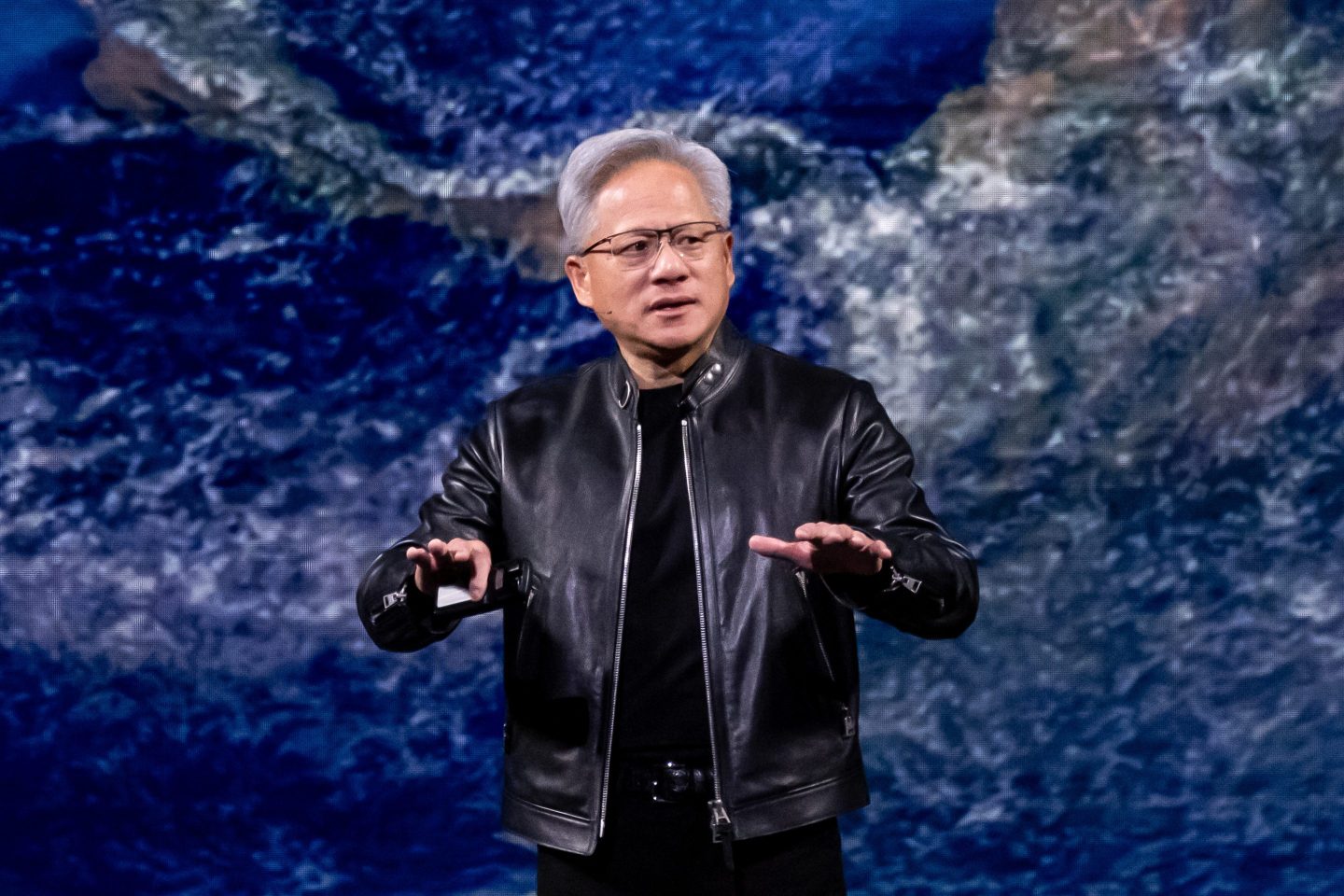
Jensen Huang’s Nvidia GTC is kind of like tech’s Super Bowl Halftime Show.
Everyone wants to be there, and if you’re not there, you inevitably end up hearing about it. And on Monday afternoon, Huang hit on agentic AI, the fast-approaching future of compute, offered a chip demand outlook, and emphasized the idea of “AI factories.” For startups and growing private companies, here are a few things to consider:
Talk to Nvidia’s agent. First, say hello to NemoClaw: The perennially leather-jacket-clad Huang unveiled NemoClaw, a new open source platform focused on agentic AI. The name is seemingly intentional, likely referencing the recent success of viral AI agent OpenClaw, while giving companies enterprise-grade privacy and security controls. “Every company in the world today needs to have an OpenClaw strategy, an agentic system strategy,” Huang told the audience. “This is the new computer.”
Physical AI has arrived. Huang emphasized that physical AI, especially robotics, is Nvidia’s next major market, perhaps worth one trillion or more. Many VCs would agree with Huang’s assessment, as billions of venture dollars have flowed into AI-era robotics companies like industrial-focused Skild AI and humanoid builder Apptronik.
Nvidia wants to do it all. Fortune’s Sharon Goldman says it all comes down to how Nvidia sees its own future. She writes: “Nvidia made it clear at GTC that it is positioning itself not just as a chipmaker but as the provider of entire AI computing systems powering the new “inference” phase of AI. (Inference is about powering AI outputs, not just training, and it will require an enormous new round of infrastructure investment.) That ambition goes beyond Nvidia’s traditional “picks and shovels” role.”
Read on Sharon’s take about why Nvidia hasn’t seen more AI-fueled backlash here.

Term Sheet Podcast… This week’s guest is someone I’ve been wanting to meet in person for some time: Winston Weinberg, Harvey CEO and cofounder. Harvey’s a legal AI leader, and the company’s 3.5 years old with an $11 billion valuation. Winston and I talked about Harvey’s rise, AI’s “partner and compete” paradigm, and his formula for finding focus. Watch the episode here.
See you tomorrow,
Allie Garfinkle
X: @agarfinks
Email: alexandra.garfinkle@fortune.com
Submit a deal for the Term Sheet newsletter here.
Joey Abrams curated the deals section of today’s newsletter. Subscribe here.
VENTURE CAPITAL
- RoboForce, a Milpitas, Calif.-based AI robotics company, raised $52 million in funding. YZi Labs led the round and was joined by others.
- Standard Template Labs, a New York City-based AI-powered service management platform, raised $49 million in seed funding. ICONIQ and CRV led the round.
- Native, a Seattle, Wash.-based cloud security platform, raised $42 million in funding. Ballistic Ventures led the round and was joined by existing investors General Catalyst, YL Ventures, and Merlin Ventures.
- Mestag Therapeutics, a Cambridge, U.K.-based biotech company looking to develop treatments for patients with cancer and inflammatory diseases, raised $40 million in funding from SV Health Investors, Johnson & Johnson, Forbion, GV, and Northpond Ventures.
- Turquoise, a San Diego, Calif.-based health care pricing and payment platform, raised $40 million in Series C funding. Oak HC/FT led the round and was joined by existing investors Andreessen Horowitz, Adams Street Partners, and Yosemite.
- BusRight, a New York City-based student transportation technology company, raised $30 million in funding. Volition Capital led the round.
- Hanover Park, a New York City-based AI-powered fund administrator, raised $27 million in Series A funding. Emergence Capital, Lux, and Susa led the round.
- Knox Systems, an Austin, Texas-based federal AI-managed cloud provider, raised $25 million in funding. B Capital led the round and was joined by M12, Okta Ventures, MongoDB Ventures, Hearst Ventures, and others.
- Tracebit, a London, U.K.-based cybersecurity company, raised $20 million in Series A funding. FirstMark led the round and was joined by Accel and others.
- Conduit Health, a New York City-based platform that connects Medicare and Medicaid patients with medical supplies and services, raised $17 million in Series A funding. Drive Capital led the round and was joined by existing investors XYZ Ventures, Twelve Below, Eniac Ventures, and others.
- Multiply, a San Francisco-based developer of self-learning advertisement technology, raised $9.5 million in funding. Mayfield led the round and was joined by Sorenson Capital and others.
- Rubi, a San Francisco-based developer of technology designed to turn carbon emissions into textiles, raised $7.5 million in funding. AP Ventures and FH One Investments led the round and were joined by Talis Capital, CMPC Ventures, H&M Group, Understorey Ventures, and angel investors.
- Tenkara, a San Francisco-based developer of operations agents for manufacturers, raised $7 million in funding. True Ventures led the round and was joined by HF0, WndrCo, Articulate Capital, Night Capital, and others.
- Mave Health, a San Francisco-based neurotech company, raised $2.1 million in seed funding. Blume Ventures led the round and was joined by others.
PRIVATE EQUITY
- Icelanderic, a portfolio company of New Heritage Capital, acquired SOMA LABS, a Middlesex, N.J.-based supplement manufacturer. Financial terms were not disclosed.
- VisuSewer, a portfolio company of Fort Point Capital, acquired United Survey, an Oakwood Village, Ohio-based swerve inspection, cleaning, and rehabilitation services provider. Financial terms were not disclosed.
FUNDS + FUNDS OF FUNDS
- Sands Capital, an Arlington, Va.-based growth equity firm, raised $1.1 billion for its third Global Innovation Fund focused on late-stage tech companies.
PEOPLE
- Northleaf Capital Partners, a Toronto, Ontario-based private equity firm, appointed John Rikhtegar as Vice President, Private Equity & Venture Capital. Previously, he was with The Royal Bank of Canada.
Fortune AIQ: One Strategy, Real AI Results
AI transformation can be overwhelming—there are countless tools, strategies, and approaches competing for attention, often without any proven results. But for some companies, AI’s biggest impact can be attributed to a single tool, strategy, or approach. Explore all of Fortune AIQ, and read the latest playbook below:
–How to decide if gen AI is the right path for your product
–Inside Bank of America’s ‘build once’ AI strategy
–Why Pinterest is going all in on open-source AI
–How cutting out product management enabled Kilo to compete in the hyper-fast AI coding market
–How Seismic’s AI incubation team became its ultimate AI strategy