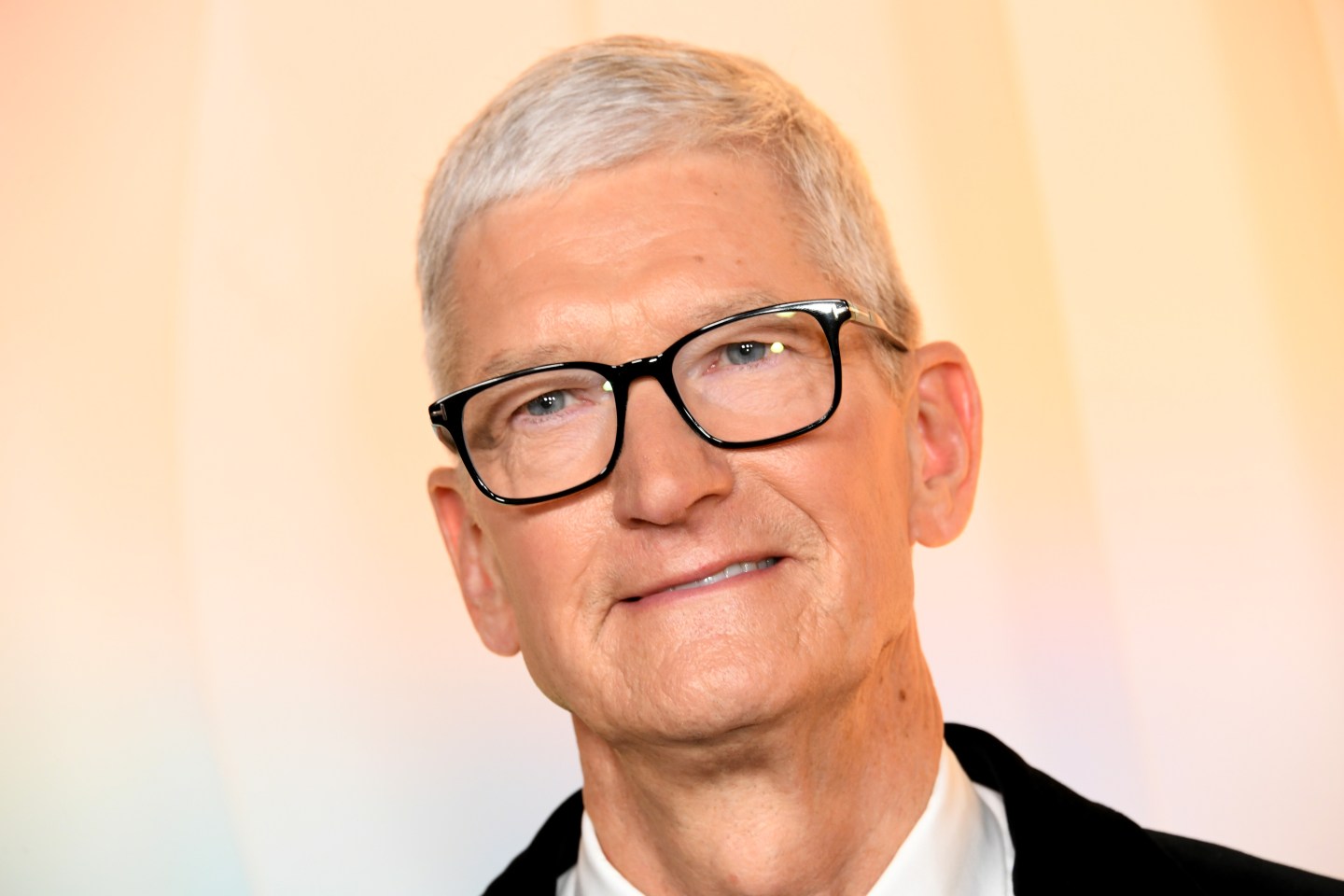
When Apple CEO Tim Cook and his executive team received their performance targets for fiscal 2025, the board set a modest bar for bonus payouts. The new targets, including sales and operating profit, did not require Apple’s leadership to expand the business—the board set goals at the same level or below the prior year’s results, citing “trade policy” and an “uncertain macroeconomic outlook.”
At the end of the fiscal year, Cook and his team delivered lights-out, extraordinary results anyway, not only blowing past the lackluster bar set by the board, but handily surpassing the prior year’s results, with net sales increasing 6% and operating income increasing 8%.
Cook collected the maximum bonus payout of $12 million—just as he would have, had the company not performed as well, thanks to the safety net offered by Apple’s board.
Apple’s board is hardly unique. An exclusive analysis of pay data from 50 public companies by Compensation Advisory Partners (CAP), published Friday, reveals how corporate boards across America use a range of techniques—more-conservative targets, widened performance curves, and flattened payout ranges—to protect CEO compensation from uncertainties like the chaos of President Trump’s Liberation Day tariffs in 2025. According to CAP’s findings, total pay for CEOs in 2025 rose 8% year-over-year, with annual bonus payouts up 4%. Meanwhile, median financial performance was generally flat to up, with median revenue growing 2.9% and earnings per share down slightly at negative 1.6%, the analysis found. Even among companies with the weakest payouts due to underperformance, CEOs still collected 87% of their target bonuses, up from 77% the year before. The share of companies that landed in the lowest bonus payout tier was down, from 15% in 2024 to 9% in 2025.
Now, with the Iran conflict erupting weeks after most companies finalized their 2026 incentive goals—and global stock markets down roughly $3.5 trillion—some market observers expect that boards will soon be holding the same conversations again.
“They’re not necessarily making decisions today, but they’re just having the conversation about the approaches they might consider at year end, and let’s see how the year plays out,” said Joanna Czyzewski, a co-author of the study and principal at CAP.
To be sure, some of the change among the weakest-performing companies in the CAP report is because of improving results. “Some of it is definitely business improvement,” noted Lauren Peek, a partner at CAP and co-author of the study. But, she said, there are a lot of ways companies can soften the blow of uncertainty and curveballs like tariffs.
“You might have growth in your targets, you might have widened the curve and the wings,” Peek said. “It’s—for lack of better words—easier to get into the money, because at the end of the day, these executives are trying to do the right thing.”
The Escape Hatch
Among the early-filer companies in the CAP study, their fiscal years end between August and October 2025. That means Trump hadn’t even won the election when they were budgeting and planning for the 2025 fiscal year. Company proxy statements, which include compensation details, provide examples as to how some companies dealt with impending tariffs which later came to fruition on April 2, 2025, before the Supreme Court struck them down last month. (Trump has since imposed a global 15% tariff.)
At personal computer and printing giant HP, the company didn’t wait for tariffs to hit before crafting a plan. In January 2025, at the same time the board locked in HP’s fiscal 2025 performance goals, the HR and compensation committee approved an explicit tariff carveout. Then, when it came time to calculate bonuses for CEO Enrique Lores and his executive team at year-end, the committee stripped out the “net impact of tariff-related costs” from both annual and long-term incentive calculations, the company disclosed in its proxy statement. HP said the adjustments “reflect the net impact of the tariffs after management’s actions, including significant and swift movement of the company’s manufacturing and supply chain along with additional cost reductions and price increases.” That included shifting more than 30% of HP’s manufacturing from China to Southeast Asia and Mexico.
Ultimately Lores and the executive team earned 67.3% of their target bonus on average. HP described the tariff hit as having “unexpected magnitude” on its financial results and annual and long-term incentive plan calculations after the relevant goals had been set, suggesting that the bonus payouts would have been lower had the tariff impact not been excluded. The compensation committee also used discretion to bring down the executive payouts in line with the broader employee pool, a small acknowledgment of the optics of shielding C-suite executives while the broader workforce takes it on the chin. Lores collected $1.9 million and then stepped down from HP in February and joined PayPal as its new CEO this month.
HP did not respond to a request for comment.
Peek, who spoke generally and not about any specific companies, acknowledged the reputational pressure some of these decisions can carry.
“If the company is making these adjustments and giving executives a big payout at the same time as significant layoffs, I’m not sure shareholders would formally comment on that, but the overall optics would be seen in the press,” said Peek.
Hedging the Goals
Other companies handled uncertainty earlier, back at the goal-setting stage before a carveout would be on the table. Unlike HP, Apple didn’t strip out any costs after the fact, the board made goals conservative at the start.
For the past three fiscal years, Apple’s compensation committee has set at least one bonus target at or below the prior year’s actual results. Bonuses pay out at Apple based on hitting threshold, target, and maximum performance. Hitting threshold earns 50% of the target payout for that measure, hitting the target gets them 100%, and clearing the top rung, the maximum, means executives can double their bonus opportunity.
For fiscal 2025, Apple’s people and compensation committee appear to have faced a conundrum. Apple’s fiscal year begins in late September and the committee sets goals prior to the start of the fiscal year. President Trump was campaigning against Vice President Kamala Harris and his agenda included massive new tariffs on imports that would hit Apple’s China-based manufacturing significantly. Trump’s tariff rollout wouldn’t happen for roughly another six or seven months when the committee was setting goals. In hashing them out, the committee considered financial results from prior years “as a reference point” but chose goals for 2025 that would “reflect strong financial results commensurate with the projected business and economic conditions for the current fiscal year,” the report in Apple’s 2026 proxy statement reads.
The fiscal 2024 results were key for determining the goals for fiscal 2025.
In fiscal 2024—which saw Apple launch its iPhone 16 and $3,499 Vision Pro virtual reality headset—Apple delivered record net sales of $391 billion and operating income results of $123.2 billion. The results were 2% and 8% year-over-year increases, respectively.
For fiscal 2025, the board set the net sales target at $391 billion—the exact same as the prior year’s actual result. The operating income target was set at $118.5 billion, some $4.7 billion lower than the prior year’s actual result. In doing so, the proxy points to “trade policies and impacts and foreign currency” fluctuations as the rationale for the goal-setting but the committee doesn’t specify a certain anticipated hit to profit margins.
Ultimately, Cook and Apple delivered extraordinary results so strong the structural safety net constructed for the year may have been moot. Net sales in fiscal 2025 swelled to $416.2 billion and operating income was $133.1 billion—bashing past the maximum performance thresholds by more than $14 billion in net sales and $9 billion in operating income. Cook and the other named executive officers took home maximum payouts on their annual bonuses, which for Cook equated to $12 million, according to Apple’s disclosures.
The same broad pattern also appeared in fiscal years 2023 and 2024 when Apple set at least one target at or below the prior year’s actual results. During fiscal years 2021 and 2022, the targets were both set above the prior year’s actual results.
Apple did not respond to requests for comment.
In the proxy, the compensation committee explained the reasons behind the approach, and wrote that it made the decisions after considering business scenarios “and once again focusing on the underlying business performance rather than the absolute growth rates.”
Generally, companies don’t lower the bar in goal setting arbitrarily, they align targets with their financial budgets to measure performance against what they reasonably anticipate, Czyzewski noted. In setting comp-related goals, companies take into consideration their strategic growth for the year, including growth expectations, and headwinds and tailwinds in the industry and broader economy when they set budgets, added Peek. Target incentive goals are usually set at budget and should “be achievable but stretch,” she said.
“If the goals are too easy, then executive pay may not align with the shareholder experience,” Peek said. “If the goals are too difficult or aspirational, then the award may be demotivating if it is believed that all or most of the award cannot be achieved.”
That’s why board committees have conversations at the beginning of the year about financial metric definitions and possible adjustments, Czyzewski said.
“The intent when goals are set is to ‘get it right’ and account for what is both in and out of the executive team’s control—and set realistic goals,” she said. “But when the unexpected happens, it is good to have a plan and parameters for evaluating results and ensuring pay aligns with performance.”
That way, the conversations at the end of the year will be less about pure board discretion and more about evaluating outcomes within the performance framework.
“If companies are setting targets with their budget,” Czyzewski said, “you’re still aligning them to what finance actually thinks is achievable.”
Taking the Hit
In contrast, not every company reached for tools in the kit, although few businesses have the size and risk profile of Apple.
TransDigm, which produces pumps, valves, and other parts for aircraft, explicitly told investors that it had the authority to ratchet up payouts by 20%, but didn’t do it in fiscal 2025. The company beat its target goals but did not clear the maximum. CEO Kevin Stein collected $2.6 million.
Similarly, carbon black manufacturer Cabot told investors it “retains the discretion” to adjust payments, but declined to do it in fiscal 2025. CEO Sean Keohane collected $1.4 million after hitting 90% of target against performance and 130% of target for his individual performance, resulting in a 102% payout.
Executives at lawn and grounds equipment manufacturer Toro landed between threshold and target for its goals, resulting in a payout of 81.6% for CEO, which translated to $1.3 million for chairman and CEO Richard Olson.
The Iran Choice
Most companies with a calendar fiscal year approved their 2026 incentive goals in February or the first week of March. Iran erupted days later.
“So even the latest of those probably had those goals approved about two or three days before the news broke about the Iran situation,” said Czyzewski, referring to the fact that calendar year companies did not have an opportunity incorporate the conflict into their goal setting process. “It’s impacting everyone this year, but no one knows how much.”
Whether boards respond the same way they did to tariffs depends heavily on how the conflict unfolds, said Czyzewski. Companies are likely to look for precedent, added Peek— including how boards responded to the Iraq invasion in 2003.
“It would be looking into a crystal ball that we just do not know, because we don’t know how long this conflict is going to last,” she said.
And, of course, tariffs are still on the table too.
“If you did not make a carve-out last year, you’re probably not going to make one this year,” said Peek. “But if you did—and you still feel like tariffs are going to significantly impact you—you might still consider using that lever.”
The Compensation Advisory Partners analysis published on Friday covered 50 public companies with revenues ranging from $1.1 billion to $416 billion.