
The biggest names in tech descended on San Francisco last week for Morgan Stanley’s annual TMT Conference, armed with record earnings, soaring stock prices, and an AI arms race minting new fortunes at historic speed. But between the fireside chats and investor panels, one question kept surfacing that no amount of compute spend could answer.
“What will our kids do?”
Morgan Stanley analyst Adam Jonas flagged it as the single most common investor question he fielded throughout the conference. For all the breathless optimism about large language models and agentic AI, anxiety about what this technology means for the next generation of workers pervaded a room full of some of the world’s most powerful business leaders. (In January, The Wall Street Journal called Jonas “the Wall Street star betting his reputation on robots and flying cars,” noting that he is the bank’s “global embodied AI strategist,” the first position of its kind for the investment bank.)
Sam Altman just said the quiet part out loud
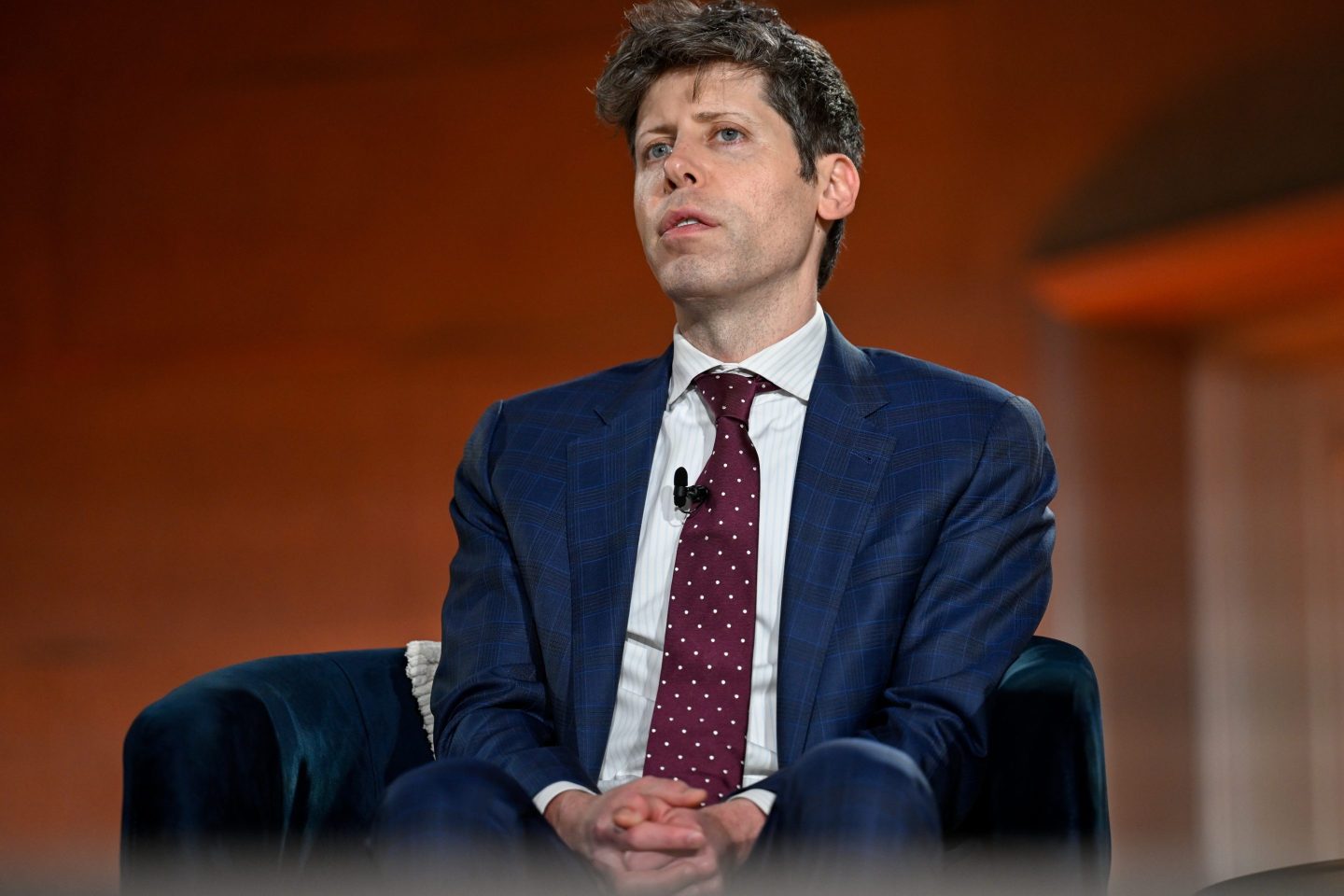
OpenAI CEO Sam Altman told conference goers he can envision one or five people running an entire company—and said that transition has compressed to the next few years. He had been even blunter at a separate summit in India just days before: “The world is not prepared…. We are going to have extremely capable models soon. It’s going to be a faster takeoff than I originally thought.”
Citrini Research founder James Van Geelen, whose finance Substack rocked the markets in February with a viral doomsday AI post in line with Altman’s warnings, told Bloomberg’s Odd Lots podcast that the essay was an extrapolation of this exact idea.
“Everybody in in venture capital has been talking about who’s going to be the first one-person unicorn because of agentic AI,” he said. “I don’t know if we’re there yet. I haven’t really kept on top of that, but that does seem like something plausible to me.”
OpenAI’s GPT-5.4, released the week of the conference, posted record scores across a battery of AI evaluations—the latest evidence of the capability leap Morgan Stanley’s analysts say the market is still not pricing in.
Nvidia CEO Jensen Huang summed up the moment in three words: “Compute equals revenue.” He called demand for computing power “higher than incredibly high,” with Amazon Web Services ramping “like mad” and the major U.S. AI labs needing “a few million” net new GPUs.
The layoffs CEOs didn’t want to talk about—but did
What made this year’s conference different from prior years wasn’t the optimism. It was the candor.
Multiple executives laid out, in clinical detail, the AI-driven efficiencies that had led their companies to execute significant reductions in force. A recent Morgan Stanley survey of roughly 1,000 executives across five countries found an average net workforce reduction of 4% over the past 12 months—directly attributable to AI adoption. That covers only the sectors in which AI is currently most advanced. The pace of adoption is still accelerating.
Morgan Stanley noted that University of Chicago economist Alex Imas, whose work Morgan Stanley highlighted at the conference, posted on his influential Substack recently: “I believe the newest batch of aggregate data—which shows a big upwards revision—is showing signs of AI productivity gains.”
He also noted Harvard economist and former Obama economic advisor Jason Furman now agrees with Stanford’s AI guru Erik Brynjolfsson that the aggregate productivity numbers are reflecting an AI productivity boost that had thus far been mostly documented in micro studies. Translation: The jobs impact economists once debated in theory is now showing up in the macro data.
Imas told Fortune earlier this month he was “amazed and alarmed,” because the advancements in AI are remarkable for multiple reasons.
“It feels like this is the most exciting time to be alive, especially if you’re interested in research,” he said. “I can do things that I’ve never been able to do as far as the type of research that I’m doing. But at the same time, I have little kids. I’m super worried about what sort of jobs they’re going to have.”
The richest people will be fine. Everyone else?
Morgan Stanley’s analysts were candid about who stands to win and lose. Their modeling projects an increase in spending from high-income consumers, whose portfolios are swelling with AI-driven gains—and a reduction in spending from middle- and upper-middle-income consumers whose jobs are most exposed to automation.
Assets that can’t be replicated by AI—luxury resorts, rare earths, proprietary data, authentic human experiences—are expected to hold or climb in value. Agreeing with a central plank of Citrini’s essay, Morgan Stanley predicted “transformative AI” will drive deflation, higher capex, changes in asset valuations and national competitiveness.
“We are continually surprised at how quickly, and violently, this prediction has become a key investor debate and driver of performance of stocks across many sectors,” the bank said, explaining the concept at heart concerns how increasingly powerful AI tools drive deflation in pricing of products and services “across a wide range of industries where AI ostensibly ‘replicates’ the work done by humans at a severely reduced cost.”
‘2026 is gonna be insane’
Perhaps the most striking quote of the conference didn’t come from a keynote. It came from a retirement announcement.
Jimmy Ba, cofounder of xAI, said upon stepping down: “Recursive self-improvement loops likely do live in the next 12 months. It’s time to recalibrate my gradient in the big picture. 2026 is gonna be insane and likely the busiest and most consequential year for the future of our species.”
Several executives at U.S. LLM labs echoed this sentiment at the conference, warning near-term AI progress would “surprise, and potentially shock, investors.” Morgan Stanley’s own analysts said they believe a non-linear jump in model capabilities will become evident between April and June of this year.
For the CEOs packed into conference rooms in San Francisco last week, the machines are getting smarter faster than anyone predicted—and the question of what the next generation will actually do for work, income, and identity is, for now, still unanswered.
For this story, Fortune journalists used generative AI as a research tool. An editor verified the accuracy of the information before publishing.