• Home
  • Latest
  • Fortune 500
  • Finance
  • Tech
  • Leadership
  • Lifestyle
  • Rankings
  • Multimedia
CommentaryAmerican Dream

America marks its 250th birthday with a fading dream—the first time that younger generations will make less than their parents

By
Mark Robert Rank
Mark Robert Rank
and
The Conversation
The Conversation
Down Arrow Button Icon
By
Mark Robert Rank
Mark Robert Rank
and
The Conversation
The Conversation
Down Arrow Button Icon
February 8, 2026, 7:15 AM ET
birthday
Happy 250th birthday, America.Getty Images

Few ideas are as central to the nation’s identity as that of the American Dream.

Recommended Video

With the 250th birthday of the United States coming up in July 2026, it’s worth stepping back to examine a concept essential to the nation’s self-image.

The term “American Dream” was actually coined in the 1930s by historian James Truslow Adams. Ever since the establishment of the Colonies, however, America has been viewed as a land where individual and collective hopes and aspirations can be realized.

From the idea of America as a shining “city on a hill” to the Declaration of Independence’s guarantee of “life, liberty, and the pursuit of happiness,” the nation has been premised on high aspirations. The concept of the American Dream has epitomized these hopes, and it continues to be present throughout our cultural landscape.

As a social scientist, I set out to explore what Americans thought about the American Dream in today’s society. I interviewed scores of people, from an elderly man sleeping on the street to a billionaire entrepreneur.

I wanted to know exactly how they defined the American Dream – and whether it has become harder to achieve today than in the past.

Defining the dream

From pickup trucks and lawn tractor ads to the labeling of undocumented immigrant children as Dreamers, references to the American Dream in contemporary life are ubiquitous. Washington, D.C., is now home to a brand-new, US$500 million museum, the Milken Center for Advancing the American Dream, devoted to celebrating the idea and its history.

It turns out that for most people I interviewed, the American Dream consists of three basic ideas.

The first is what might be called an economic bargain: If you work hard and play by the rules, you should expect to have a financially secure life. This includes owning a home, being able to afford raising kids and retiring in comfort.
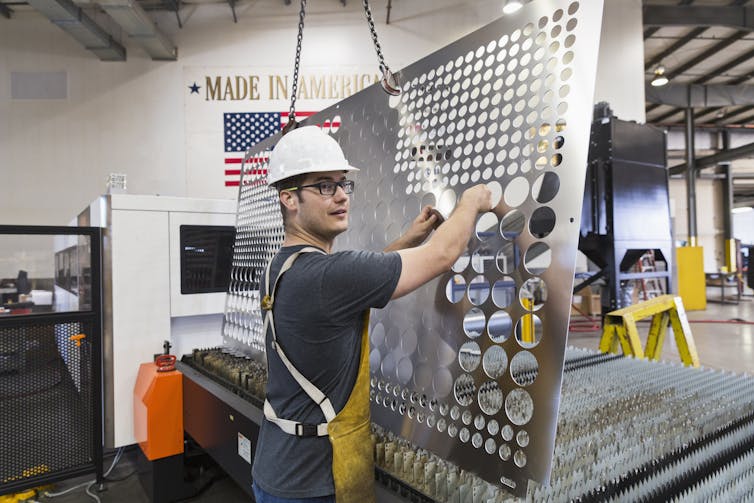
A man wearing a white safety helmet holds up a piece of sheet metal with holes punched through it.
With the shift of the U.S. economy from manufacturing to service, many jobs are inadequate for paying household bills. Tetra Images/Don Mason via Getty Images

Second, the American Dream is centered on hope and optimism. It is about personal progress and the belief that the nation’s best days lie ahead. It’s the idea that each generation should do better than the previous one, and that upward economic mobility is essential for bringing this about.

The third and final idea people expressed was having the freedom to pursue their hopes to reach their full potential. For many, this is the epitome of the American Dream.

At its best, the U.S. is seen as allowing individuals the freedom to live the life they want. Liberty and rugged individualism have been hallmarks of America since its beginnings, so it should come as no surprise that they are also central to the American Dream.

Economically more elusive?

Given this, has the American Dream become more or less difficult to achieve over time? Unfortunately, for a growing number of Americans, it appears to be more difficult.

First, the goal of leading an economically secure life in exchange for hard work has become more elusive. Data from the Census Bureau indicates that median wages for full-time male workers have essentially flatlined since 1973. The economy has been producing more low-wage and part-time jobs. Many of these lack benefits, such as health insurance.

Less-skilled workers, such as truck drivers and postal clerks, have actually lost ground in terms of income. At the same time, housing, medical care, child care and higher education costs have dramatically increased over the past 40 years.

A woman holding a paper program listens attentively as part of a ceremony.
A small group of individuals prepare to take the naturalization oath to become U.S. citizens. O2O Creative via Getty Images

What about upward mobility and the hope for each generation to do better economically than the previous one? There is some evidence that one reason the middle class is shrinking is that more people have entered upper-income tiers.

Still, younger generations will actually earn, on average, less as adults than their parents did. This is the first time in U.S. history that this is the case. The formerly taken-for-granted idea of generational progress and moving forward appears to have stalled.

Upward economic mobility for lower-income workers has also slowed over the past 50 years, making it harder to climb the ladder of opportunity.

Dissatisfied, not dreaming

Finally, what about personal freedom? Survey data indicates that greater numbers of Americans feel they have less control over their lives and futures than in the past.

For more than 20 years, Gallup has asked the question, “In this country, are you satisfied or dissatisfied with your freedom to choose what you do with your life?” The percentage of Americans reporting being satisfied has dropped notably over the past two decades. In 2007 it was 87%, but by 2024 it had fallen to 72%. For women, the number was even lower, declining from 85% in 2007 to 66% in 2024.

By comparison, the average for the wealthiest countries in the Gallup survey was 86%. Consequently, on all three counts it appears that the American Dream is becoming harder to achieve.

An aspirational hope

These trends are important for making sense of the polarization and general negativity found in America today. Too many Americans feel that they’ve been left behind and that the American Dream has become a distant reality.

For these Americans, the words of the late comedian and social commentator George Carlin ring true: “It’s called the American Dream because you have to be asleep to believe it.”

Yet the American Dream is a powerful metaphor and aspiration that continues to inspire many in this country. Among those I interviewed, there was a strong consensus that it represents the very best of what America has to offer.

There is no other country that has quite the equivalent of the American Dream. As the nation enters its next 250 years, working toward reestablishing the concept as a reality for millions of people who have fallen behind may be vital to maintaining the essence of the American promise.

Mark Robert Rank, Professor of Social Welfare, Washington University in St. Louis

This article is republished from The Conversation under a Creative Commons license. Read the original article.

The Conversation
Join us at the Fortune Workplace Innovation Summit May 19–20, 2026, in Atlanta. The next era of workplace innovation is here—and the old playbook is being rewritten. At this exclusive, high-energy event, the world’s most innovative leaders will convene to explore how AI, humanity, and strategy converge to redefine, again, the future of work. Register now.
About the Authors
By Mark Robert Rank
See full bioRight Arrow Button Icon
By The Conversation
See full bioRight Arrow Button Icon

Latest in Commentary

Finance
Lorem ipsum dolor sit amet, consectetur adipiscing elit, sed do eiusmod tempor incididunt ut labore et dolore magna aliqua. Ut enim ad minim veniam
By Fortune Editors
October 20, 2025
Finance
Lorem ipsum dolor sit amet, consectetur adipiscing elit, sed do eiusmod tempor incididunt ut labore et dolore magna aliqua. Ut enim ad minim veniam
By Fortune Editors
October 20, 2025
Finance
Lorem ipsum dolor sit amet, consectetur adipiscing elit, sed do eiusmod tempor incididunt ut labore et dolore magna aliqua. Ut enim ad minim veniam
By Fortune Editors
October 20, 2025
Finance
Lorem ipsum dolor sit amet, consectetur adipiscing elit, sed do eiusmod tempor incididunt ut labore et dolore magna aliqua. Ut enim ad minim veniam
By Fortune Editors
October 20, 2025
Finance
Lorem ipsum dolor sit amet, consectetur adipiscing elit, sed do eiusmod tempor incididunt ut labore et dolore magna aliqua. Ut enim ad minim veniam
By Fortune Editors
October 20, 2025
Finance
Lorem ipsum dolor sit amet, consectetur adipiscing elit, sed do eiusmod tempor incididunt ut labore et dolore magna aliqua. Ut enim ad minim veniam
By Fortune Editors
October 20, 2025

Most Popular

Finance
Lorem ipsum dolor sit amet, consectetur adipiscing elit, sed do eiusmod tempor incididunt ut labore et dolore magna aliqua. Ut enim ad minim veniam
By Fortune Editors
October 20, 2025
Finance
Lorem ipsum dolor sit amet, consectetur adipiscing elit, sed do eiusmod tempor incididunt ut labore et dolore magna aliqua. Ut enim ad minim veniam
By Fortune Editors
October 20, 2025
Finance
Lorem ipsum dolor sit amet, consectetur adipiscing elit, sed do eiusmod tempor incididunt ut labore et dolore magna aliqua. Ut enim ad minim veniam
By Fortune Editors
October 20, 2025
Finance
Lorem ipsum dolor sit amet, consectetur adipiscing elit, sed do eiusmod tempor incididunt ut labore et dolore magna aliqua. Ut enim ad minim veniam
By Fortune Editors
October 20, 2025
Finance
Lorem ipsum dolor sit amet, consectetur adipiscing elit, sed do eiusmod tempor incididunt ut labore et dolore magna aliqua. Ut enim ad minim veniam
By Fortune Editors
October 20, 2025
Finance
Lorem ipsum dolor sit amet, consectetur adipiscing elit, sed do eiusmod tempor incididunt ut labore et dolore magna aliqua. Ut enim ad minim veniam
By Fortune Editors
October 20, 2025
Fortune Secondary Logo
Rankings
  • 100 Best Companies
  • Fortune 500
  • Global 500
  • Fortune 500 Europe
  • Most Powerful Women
  • Future 50
  • World’s Most Admired Companies
  • See All Rankings
Sections
  • Finance
  • Fortune Crypto
  • Features
  • Leadership
  • Health
  • Commentary
  • Success
  • Retail
  • Mpw
  • Tech
  • Lifestyle
  • CEO Initiative
  • Asia
  • Politics
  • Conferences
  • Europe
  • Newsletters
  • Personal Finance
  • Environment
  • Magazine
  • Education
Customer Support
  • Frequently Asked Questions
  • Customer Service Portal
  • Privacy Policy
  • Terms Of Use
  • Single Issues For Purchase
  • International Print
Commercial Services
  • Advertising
  • Fortune Brand Studio
  • Fortune Analytics
  • Fortune Conferences
  • Business Development
About Us
  • About Us
  • Editorial Calendar
  • Press Center
  • Work At Fortune
  • Diversity And Inclusion
  • Terms And Conditions
  • Site Map
Fortune Secondary Logo
  • About Us
  • Editorial Calendar
  • Press Center
  • Work At Fortune
  • Diversity And Inclusion
  • Terms And Conditions
  • Site Map
  • Facebook icon
  • Twitter icon
  • LinkedIn icon
  • Instagram icon
  • Pinterest icon

Latest in Commentary

world's fair
CommentaryRobots
Something big is happening in AI, but panic is the wrong reaction
By Peter CappelliFebruary 28, 2026
4 hours ago
putin
CommentaryRussia
Exclusive analysis: we looked at the 400 western firms still in Russia. Their paltry size strips Putin’s bluff bare naked
By Jeffrey Sonnenfeld, Stephen Henriques, Jake Waldinger and Giuseppe ScottoFebruary 27, 2026
1 day ago
roth
CommentaryLeadership
The AI resource reallocation challenge: How can companies capture the value of time?
By Erik RothFebruary 27, 2026
1 day ago
will
CommentaryAdvertising
I’m one of America’s top pollsters and I’ve got a warning for the AI companies: customers aren’t sold on ads
By Will JohnsonFebruary 27, 2026
1 day ago
the pitt
CommentaryDEI
‘The Pitt’: a masterclass display of DEI in action 
By Robert RabenFebruary 26, 2026
2 days ago
david booth
CommentaryMarkets
3 lessons from investing’s ‘moneyball’ moment
By David BoothFebruary 25, 2026
3 days ago

Most Popular

placeholder alt text
Success
Japanese companies are paying older workers to sit by a window and do nothing—while Western CEOs demand super-AI productivity just to keep your job
By Orianna Rosa RoyleFebruary 27, 2026
1 day ago
placeholder alt text
Success
Walmart exec says U.S. workforces needs to take inspiration from China where ‘5 year-olds are learning DeepSeek’
By Preston ForeFebruary 27, 2026
1 day ago
placeholder alt text
Commentary
'The Pitt': a masterclass display of DEI in action 
By Robert RabenFebruary 26, 2026
2 days ago
placeholder alt text
Law
China's government intervenes to show Michigan scientists were carrying worms, not biological materials
By Ed White and The Associated PressFebruary 26, 2026
2 days ago
placeholder alt text
Innovation
An MIT roboticist who cofounded bankrupt robot vacuum maker iRobot says Elon Musk’s vision of humanoid robot assistants is ‘pure fantasy thinking’
By Marco Quiroz-GutierrezFebruary 25, 2026
3 days ago
placeholder alt text
Economy
Come 2030, the U.S. deficit will be worth 5.9% of GDP—more than spending on Social Security, and equal to major health programs
By Eleanor PringleFebruary 26, 2026
2 days ago

© 2026 Fortune Media IP Limited. All Rights Reserved. Use of this site constitutes acceptance of our Terms of Use and Privacy Policy | CA Notice at Collection and Privacy Notice | Do Not Sell/Share My Personal Information
FORTUNE is a trademark of Fortune Media IP Limited, registered in the U.S. and other countries. FORTUNE may receive compensation for some links to products and services on this website. Offers may be subject to change without notice.