• Home
  • Latest
  • Fortune 500
  • Finance
  • Tech
  • Leadership
  • Lifestyle
  • Rankings
  • Multimedia
CommentaryMinnesota

I’ve studied nonviolent resistance in war zones for 20 years and Minnesota reminds me of Colombia, the Philippines and Syria

By
Oliver Kaplan
Oliver Kaplan
and
The Conversation
The Conversation
Down Arrow Button Icon
By
Oliver Kaplan
Oliver Kaplan
and
The Conversation
The Conversation
Down Arrow Button Icon
February 3, 2026, 1:52 PM ET
minnesota
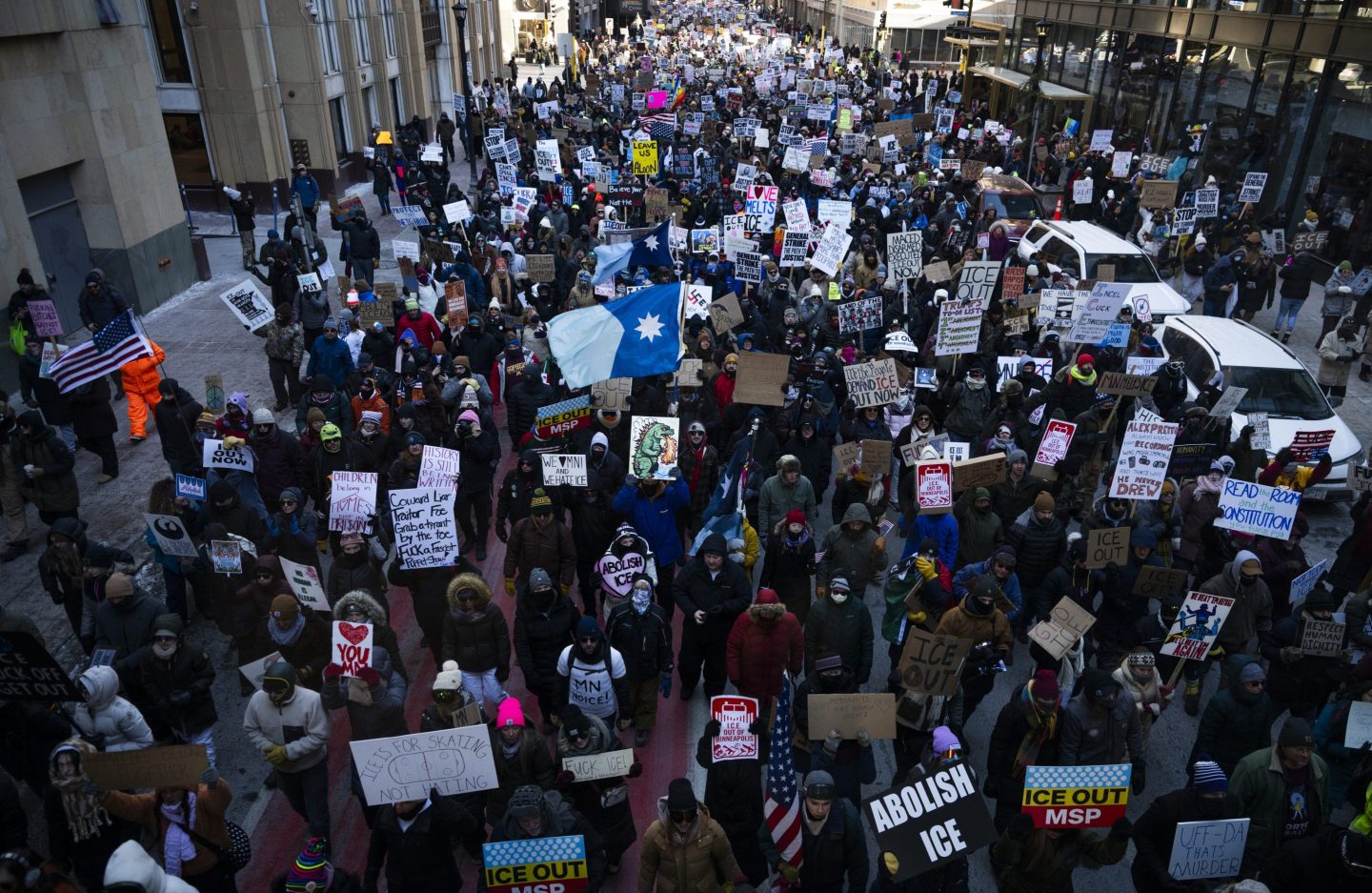
Protestors march during a "Nationwide Shutdown" demonstration against ICE enforcement on January 30, 2026 in Minneapolis, Minnesota. Protests continue calling for an end to immigration raids in the Twin Cities which have already resulted in the deaths of Alex Pretti, a 37-year-old ICU nurse at a VA medical center who died January 24, after being shot multiple times during a brief altercation with border patrol agents, and Renee Good a 37-year-old mother of three children who was killed by ICE agents on January 7th. Stephen Maturen/Getty Images

From coast to coast, groups of people are springing up to protect members of their communities as Immigration and Customs Enforcement and Border Patrol agents threaten them with violent enforcement.

Recommended Video

In Portland, Oregon, community volunteers have delivered food boxes to migrant families scared to leave their homes. In Portland, Maine, nearly a thousand people turned out for a virtual American Civil Liberties Union “Know Your Rights” training event. And in Minneapolis and St. Paul, volunteers have formed networks to give warning with whistles and phone apps when ICE is prowling the streets.

As someone who for two decades has studied nonviolent movements in war zones, I see many parallels between these movements abroad and those that have been organized recently across the U.S. The communities I have studied – from Colombia to the Philippines to Syria – teach lessons about surviving in the midst of danger that Americans have been discovering instinctively over the past year.

These experiences show that protection of their neighbors is possible. Violence can bring feelings of fear, isolation and powerlessness, but unity can overcome fear, and nonviolence and discipline are key for denying the powerful pretexts for further escalation and harm.

But at the same time, the deaths of Americans Renée Good and Alex Pretti, who were part of a nonviolent movement and were killed by immigration agents in Minneapolis, make it clear that acting to protect neighbors requires courage, and prospects are not always certain.

Here are the core lessons I have learned from the people and the groups I have researched.

Two people on a sidewalk, one blowing a whistle and the other filming with a camera at something on the road.
Members of the public take videos and blow whistles at what they think are Immigration and Customs Enforcement agents in unmarked cars driving by in South Portland, Maine, on Jan. 23, 2026. Joseph Prezioso/AFP via Getty Images

1. Organizing is the first step

Community organizing is the act of building social ties, setting decision-making procedures, sharing information and coordinating activities.

In Colombia, I found that it was the more organized communities with vibrant local councils that were better able to protect themselves by avoiding or opposing violence when caught between heavily armed insurgents, paramilitaries and state forces. These organizations provide reassurance to the more hesitant and encourage more people to join in.

America has a strong civic culture and history of organizing, dating back to the Civil Rights Movement and long before, and Minnesota is known for its strong social cohesion. It’s no wonder so many Minnesotans, as well as Chicagoans, Angelenos and other Americans have organized to aid their neighbors and press for justice.

Make no mistake, the act of organizing itself is powerful. I found that insights from the combatants of armed conflicts shed light on this. A former insurgent I interviewed in Colombia quoted to me an adage of Aristotle and Shakespeare: “A single swallow doesn’t make a summer” – meaning there’s safety in numbers.

A mass of people on its own can shift the calculus and behavior of those with weapons and deter them. It’s why there are now many visuals of ICE agents leaving the scene when outnumbered by community members.

2. Adopting nonviolent strategies

Organizing also enables communities to adopt nonviolent methods for accountability and protection without ratcheting up conflict.

These strategies are less political or partisan, since there is usually consensus around promoting safety, which makes it difficult for political figures to oppose. While recent polling on presidential approval and immigration policy still shows a partisan split, ICE is widely unpopular, and a large majority opposes its aggressive tactics.

Americans have taken up many of these nonviolent strategies. They have established early warning networks just as communities did in the Democratic Republic of Congo to guard against attacks by the Lord’s Resistance Army rebel group.

Whether with whistles or WhatsApp, such networks of protectors are sharing information with each other to identify threats and come to each other’s aid.

A screenshot of a Facebook post from the ACLU of Maine noting the large turnout for a 'Know Your Rights training' event on Jan. 23, 2026.
A Facebook post from the ACLU of Maine notes the large turnout for a ‘Know Your Rights’ training event on Jan. 23, 2026. Facebook

3. Setting up safe zones

Communities in places such as the Philippines have also set up safe zones or “peace zones” to publicize their desire to keep violence away from their residents. This is akin to the declaration of “sanctuary cities” in the U.S. for the issue of immigration.

Communities may also apply different kinds of pressure on armed aggressors. While protest is the most visible approach, dialogue is also possible. Pressure can take the form of persuasion as well as shaming to make trigger-happy agents think twice about what they’re doing and use restraint.

In the U.S., protectors have shown great creativity when it comes to exerting pressure. Grandmas and priests are visible symbols who have influence through their moral and spiritual status. The use of humor and farce – such as protesters dressed in frog suits – can help to de-escalate tensions.

It may not always seem like it, but reputations and concerns about accountability matter, even to bullies. That’s why ICE agents don’t want to be seen enacting violence. Hence the face masks, the snatching of protesters’ phones and the misleading statements by officials about violent encounters.

A line of people on their knees, praying, some wearing items that denote they are part of the clergy, with police behind them.
A large group of protesters, including clergy, gather at Minneapolis-St. Paul International Airport in frigid temperatures on Jan. 23, 2026, to demonstrate against immigration enforcement operations in the Twin Cities metro area. Elizabeth Flores/The Minnesota Star Tribune via Getty Images

4. Finding the facts

In the “fog of war,” the powerful may try to twist the facts and mislead and stigmatize communities and individuals to create pretexts for even greater uses of force.

In Colombia and Afghanistan, armed groups falsely accused individuals of being enemy collaborators. Communities addressed this by conducting their own investigations of those accused, after which community elders could vouch for them.

In the U.S., Americans are recording cellphone videos and collecting community evidence to counter official lies, such as accusations of domestic terrorism – and for future efforts to pursue accountability.

Standing up for others

Finally, what’s known as “accompaniment” is also important.

For example, international humanitarian staff and volunteers have gone to communities in places such as Colombia, Guatemala and South Sudan to let armed groups know that outsiders are watching them and acting as unarmed bodyguards for human rights defenders.

In the U.S., volunteers, citizens and religious leaders have used their less vulnerable social statuses to stand up for noncitizens who are under threat, even positioning themselves between immigration agents and those who may be at risk. People from around the country have also sent messages and traveled in solidarity to the cities and states where operations have been carried out.

Yet that can have consequences even for those who believe themselves less likely to be attacked. An ICE agent on Sept. 19, 2025, shot a clergyman in the head with a pepper ball while he was protesting at an ICE detention facility in Chicago.

Acting to protect oneself, other people and communities can involve risks. But civil society has power, too, and many communities in war zones in other countries have outlasted their oppressors. Americans are learning and doing what civilians in war zones worldwide have done for decades, while also writing their own story in the process.

Oliver Kaplan, Associate Professor of International Studies, University of Denver

This article is republished from The Conversation under a Creative Commons license. Read the original article.

The Conversation
Join us at the Fortune Workplace Innovation Summit May 19–20, 2026, in Atlanta. The next era of workplace innovation is here—and the old playbook is being rewritten. At this exclusive, high-energy event, the world’s most innovative leaders will convene to explore how AI, humanity, and strategy converge to redefine, again, the future of work. Register now.
About the Authors
By Oliver Kaplan
See full bioRight Arrow Button Icon
By The Conversation
See full bioRight Arrow Button Icon

Latest in Commentary

Finance
Lorem ipsum dolor sit amet, consectetur adipiscing elit, sed do eiusmod tempor incididunt ut labore et dolore magna aliqua. Ut enim ad minim veniam
By Fortune Editors
October 20, 2025
Finance
Lorem ipsum dolor sit amet, consectetur adipiscing elit, sed do eiusmod tempor incididunt ut labore et dolore magna aliqua. Ut enim ad minim veniam
By Fortune Editors
October 20, 2025
Finance
Lorem ipsum dolor sit amet, consectetur adipiscing elit, sed do eiusmod tempor incididunt ut labore et dolore magna aliqua. Ut enim ad minim veniam
By Fortune Editors
October 20, 2025
Finance
Lorem ipsum dolor sit amet, consectetur adipiscing elit, sed do eiusmod tempor incididunt ut labore et dolore magna aliqua. Ut enim ad minim veniam
By Fortune Editors
October 20, 2025
Finance
Lorem ipsum dolor sit amet, consectetur adipiscing elit, sed do eiusmod tempor incididunt ut labore et dolore magna aliqua. Ut enim ad minim veniam
By Fortune Editors
October 20, 2025
Finance
Lorem ipsum dolor sit amet, consectetur adipiscing elit, sed do eiusmod tempor incididunt ut labore et dolore magna aliqua. Ut enim ad minim veniam
By Fortune Editors
October 20, 2025

Most Popular

Finance
Lorem ipsum dolor sit amet, consectetur adipiscing elit, sed do eiusmod tempor incididunt ut labore et dolore magna aliqua. Ut enim ad minim veniam
By Fortune Editors
October 20, 2025
Finance
Lorem ipsum dolor sit amet, consectetur adipiscing elit, sed do eiusmod tempor incididunt ut labore et dolore magna aliqua. Ut enim ad minim veniam
By Fortune Editors
October 20, 2025
Finance
Lorem ipsum dolor sit amet, consectetur adipiscing elit, sed do eiusmod tempor incididunt ut labore et dolore magna aliqua. Ut enim ad minim veniam
By Fortune Editors
October 20, 2025
Finance
Lorem ipsum dolor sit amet, consectetur adipiscing elit, sed do eiusmod tempor incididunt ut labore et dolore magna aliqua. Ut enim ad minim veniam
By Fortune Editors
October 20, 2025
Finance
Lorem ipsum dolor sit amet, consectetur adipiscing elit, sed do eiusmod tempor incididunt ut labore et dolore magna aliqua. Ut enim ad minim veniam
By Fortune Editors
October 20, 2025
Finance
Lorem ipsum dolor sit amet, consectetur adipiscing elit, sed do eiusmod tempor incididunt ut labore et dolore magna aliqua. Ut enim ad minim veniam
By Fortune Editors
October 20, 2025
Rankings
  • 100 Best Companies
  • Fortune 500
  • Global 500
  • Fortune 500 Europe
  • Most Powerful Women
  • Future 50
  • World’s Most Admired Companies
  • See All Rankings
Sections
  • Finance
  • Leadership
  • Success
  • Tech
  • Asia
  • Europe
  • Environment
  • Fortune Crypto
  • Health
  • Retail
  • Lifestyle
  • Politics
  • Newsletters
  • Magazine
  • Features
  • Commentary
  • Mpw
  • CEO Initiative
  • Conferences
  • Personal Finance
  • Education
Customer Support
  • Frequently Asked Questions
  • Customer Service Portal
  • Privacy Policy
  • Terms Of Use
  • Single Issues For Purchase
  • International Print
Commercial Services
  • Advertising
  • Fortune Brand Studio
  • Fortune Analytics
  • Fortune Conferences
  • Business Development
About Us
  • About Us
  • Editorial Calendar
  • Press Center
  • Work At Fortune
  • Diversity And Inclusion
  • Terms And Conditions
  • Site Map
  • Facebook icon
  • Twitter icon
  • LinkedIn icon
  • Instagram icon
  • Pinterest icon

Most Popular

placeholder alt text
Success
In 2026, many employers are ditching merit-based pay bumps in favor of ‘peanut butter raises’
By Emma BurleighFebruary 2, 2026
1 day ago
placeholder alt text
Future of Work
Ford CEO has 5,000 open mechanic jobs with up to 6-figure salaries from the shortage of manually skilled workers: 'We are in trouble in our country'
By Marco Quiroz-GutierrezJanuary 31, 2026
3 days ago
placeholder alt text
Economy
'I just don't have a good feeling about this': Top economist Claudia Sahm says the economy quietly shifted and everyone's now looking at the wrong alarm
By Eleanor PringleJanuary 31, 2026
4 days ago
placeholder alt text
Personal Finance
Current price of silver as of Monday, February 2, 2026
By Joseph HostetlerFebruary 2, 2026
1 day ago
placeholder alt text
Cybersecurity
Top AI leaders are begging people not to use Moltbook, a social media platform for AI agents: It’s a ‘disaster waiting to happen’
By Eva RoytburgFebruary 2, 2026
1 day ago
placeholder alt text
Big Tech
The Chan Zuckerberg Initiative cut 70 jobs as the Meta CEO’s philanthropy goes all in on mission to 'cure or prevent all disease'
By Sydney LakeFebruary 1, 2026
2 days ago

© 2026 Fortune Media IP Limited. All Rights Reserved. Use of this site constitutes acceptance of our Terms of Use and Privacy Policy | CA Notice at Collection and Privacy Notice | Do Not Sell/Share My Personal Information
FORTUNE is a trademark of Fortune Media IP Limited, registered in the U.S. and other countries. FORTUNE may receive compensation for some links to products and services on this website. Offers may be subject to change without notice.


Latest in Commentary

minnesota
CommentaryMinnesota
I’ve studied nonviolent resistance in war zones for 20 years and Minnesota reminds me of Colombia, the Philippines and Syria
By Oliver Kaplan and The ConversationFebruary 3, 2026
2 hours ago
EuropeLetter from London
Oracle billionaire Larry Ellison’s next big bet: Redefining how long–and how well–we live
By Kamal AhmedFebruary 3, 2026
6 hours ago
davos
CommentaryCareers
While elites debate geopolitics, Americans are rethinking college in the search for economic mobility
By Ed MitzenFebruary 3, 2026
7 hours ago
american dream
CommentaryCapitalism
We need more capitalists, not necessarily more capitalism
By Seth Levine and Elizabeth MacBrideFebruary 3, 2026
7 hours ago
pretti
CommentaryLeadership
What should business leaders say about Alex Pretti’s death?
By Deepak MalhotraFebruary 3, 2026
8 hours ago
Photo of Donald Trump
CommentaryLeadership
What happened at Davos was a warning to CEOs: Their companies are designed for a world that no longer exists
By Ram CharanFebruary 3, 2026
9 hours ago