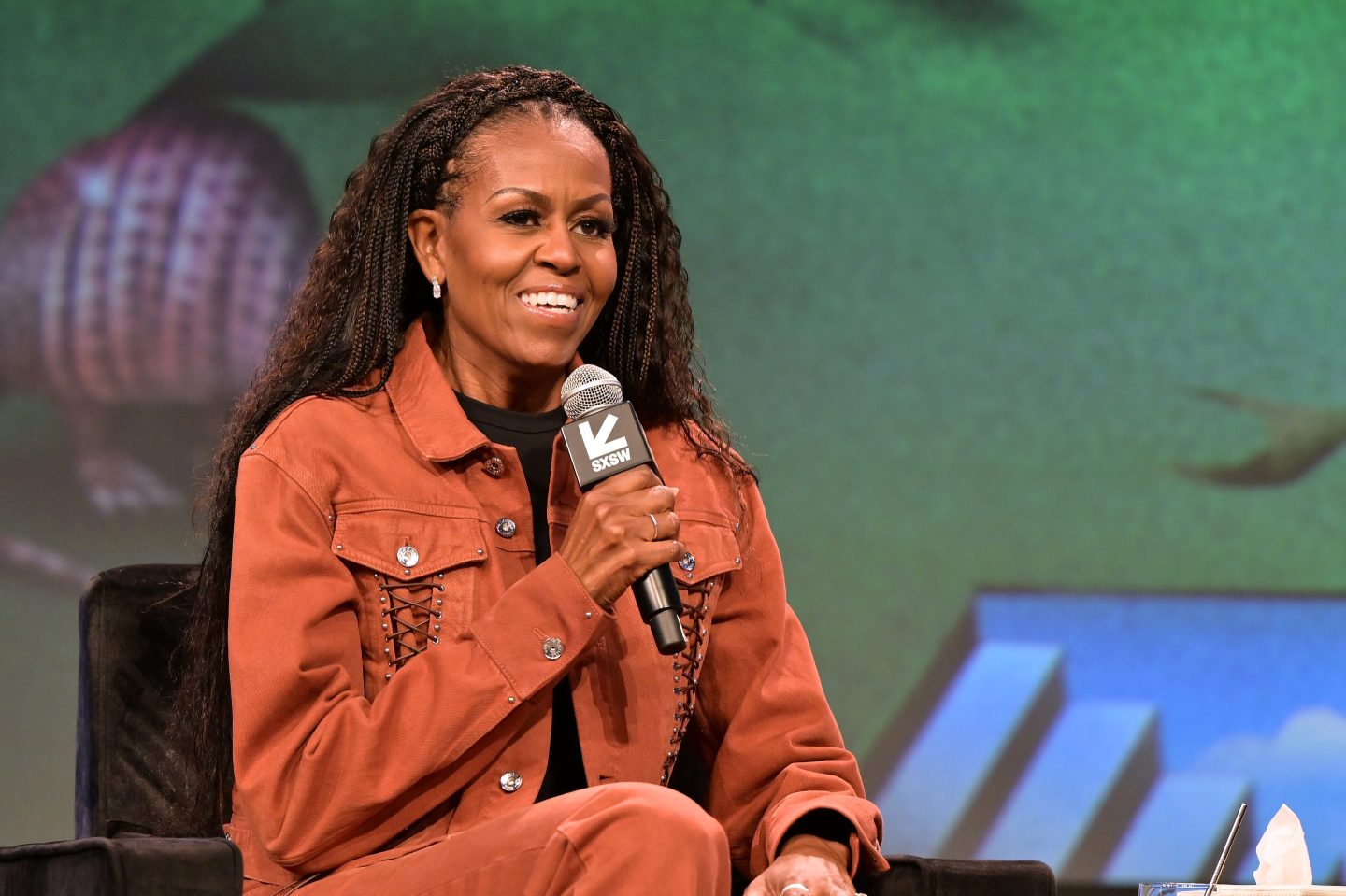
At the 2016 Democratic National Convention, former First Lady Michelle Obama addressed her family’s haters: “When they go low, we go high.”
It’s a simple yet profound motto she and her family adopted to address those who act cruelly, and they’ve chosen to respond with dignity, principle, and grace rather than stoop to their bullies’ level. It was something the family needed to get through the intense scrutiny of former President Barack Obama’s campaign and presidency.
When asked about this mantra during an episode of the Call Her Daddy podcast with Alex Cooper published Wednesday, Obama clarified it’s not about suppressing emotions like anger or pain toward scrutiny, but rather about being “outcome determinative.”
Nearly a decade after that 2016 viral moment, Obama’s clarification lands in a political and cultural environment defined by instant reactions and performative outrage—a time when “going low” can bring engagement, attention, or even votes. Especially in an era in which powerful figures have platforms to express their emotions—whether it be anger or celebration—it’s critical to take a step back and think before you act, she argued.
Leadership and having a platform is “like a gun,” Obama said. “Learn how to use it, put the safety lock on. Because you can cause a lot of damage, but you can also do a lot of good.”
Obama also clarified that this doesn’t mean leaders shouldn’t feel feelings. Rather, she argues, leaders should think before they speak and consider “where you are trying to go with them and let that lead.”
This helps leaders to avoid public “tantrums,” as she called them, and present as more composed and coherent. Not only does the former First Lady use this mantra in her current ventures, like Higher Ground Productions, a production company founded by Michelle and Barack Obama, but it also translates to her personal life.
The kitchen table can be the perfect place to air out frustrations, but people often over-exaggerate their problems, turning them into a level “10.” But when they take a step back, Michelle Obama said, the problem may not be as bad as was first thought.
“You’ll find out that half the stuff you threw out there in anger isn’t even true, and it’s not how you really feel,” Obama said. “So now you should go out and communicate what you really feel, really clearly. To me, that’s what going high is.”
This theme of self-determination is also omnipresent in Obama’s new book, The Look, which also explores her style evolution, identity, and presentation. Her approach also aligns with an executive leadership school of thought that emotional regulation—not suppression—drives performance and trust. It’s the foundation of emotional intelligence, a concept popularized by psychologist Daniel Goleman, as essential to leading effectively under pressure.
“If your emotional abilities aren’t in hand, if you don’t have self-awareness, if you are not able to manage your distressing emotions, if you can’t have empathy and have effective relationships—then no matter how smart you are, you are not going to get very far,” Goleman wrote in his book Emotional Intelligence: Why It Can Matter More Than IQ.
What other leaders say about taking the high road
Obama’s perspective resonates with business leaders who view emotional control as essential to responsibility.
Simon Sinek, famous for his 2009 TED Talk about the concept of “why,” and his “Golden Circle” theory, warns against leaders displaying arrogance and narcissism, instead advocating for composure.
“The job of a leader is to serve the people and the mission, not your own ego,” Sinek wrote in a September 2025 blog post. The best leaders are “the ones who give away credit, take responsibility, and serve quietly, even when no one’s watching.”
Microsoft CEO Satya Nadella during his tenure has also focused on transforming the tech giant’s culture from a “‘know-it-all” culture, focused on defensiveness and arrogance, to one of “learn-it-alls.”
Microsoft must “stay humble, stay hungry, and exhibit a growth mindset,” Nadella told Fortune’s Jeremy Kahn in 2024.
Whether in politics, corporate boardrooms, or public life, Obama’s “go high” mantra serves as a reminder that leadership isn’t about reactive strength—it’s about disciplined intention.