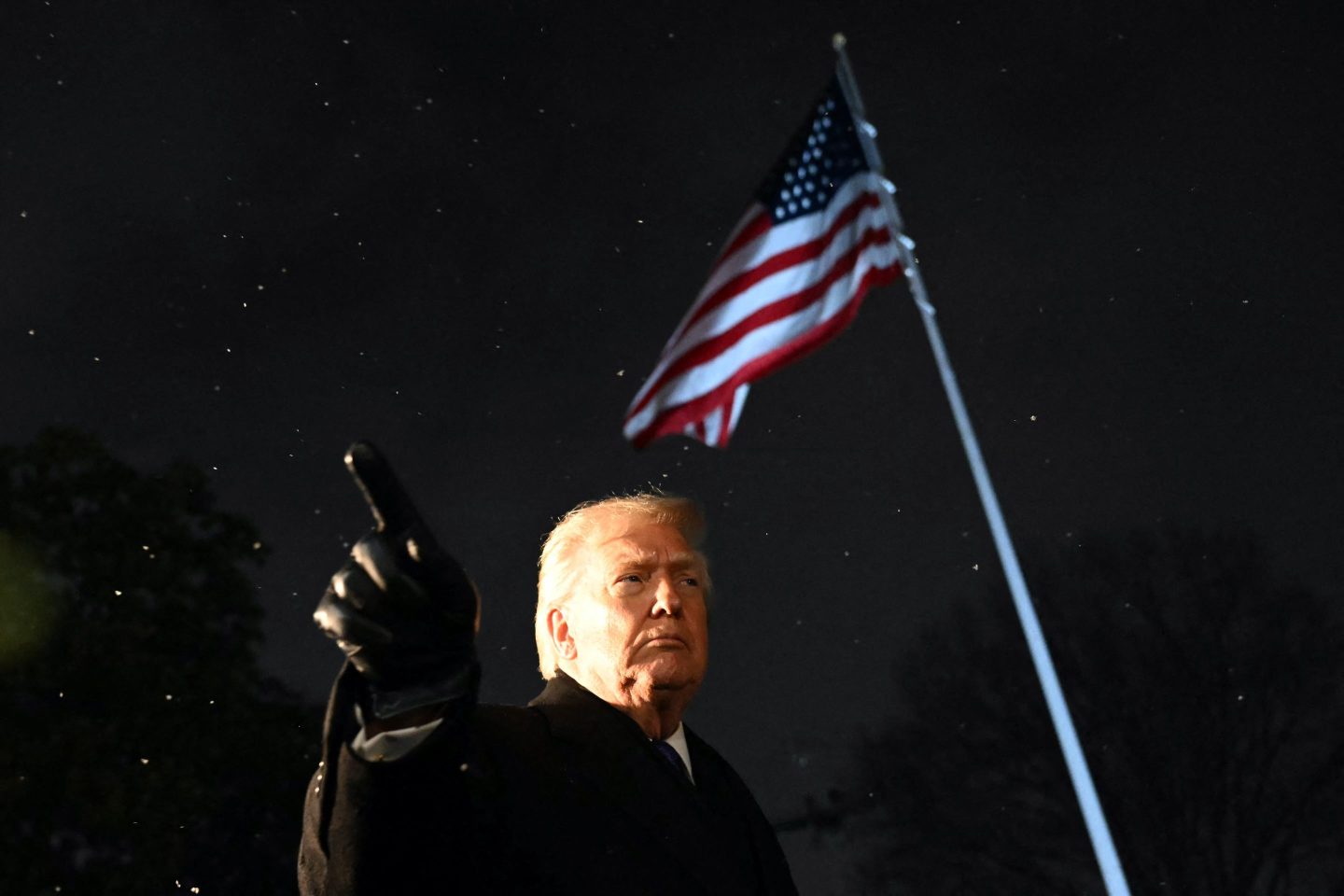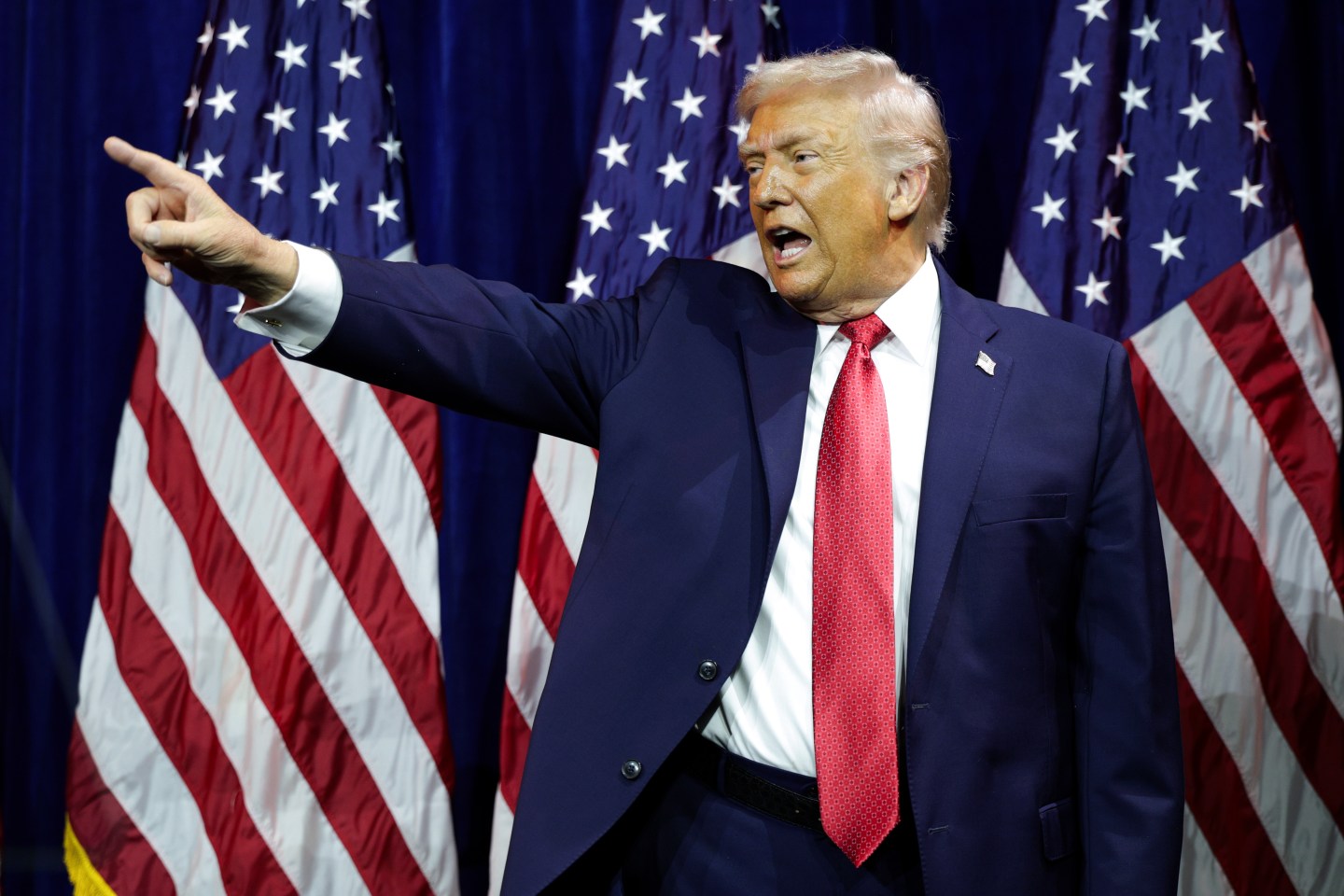
President Donald Trump signed an executive order zeroing in on pay packages for executives at large defense contractors deemed to have underperformed on existing government contracts while chasing newer, bigger deals, according to the White House. At the same time, the order claims, these companies have bought back billions in stock, enriching both shareholders and executives.
“Effective immediately, they are not permitted in any way, shape, or form to pay dividends or buy back stock, until such time as they are able to produce a superior product, on time and on budget,” the order, titled “Prioritizing the Warfighter in Defense Contracting,” states.
The order further directs the Secretary of War to identify contractors that have underperformed the terms of their deals with the government and hatch a plan to resolve delays and production issues. If the resolution plan is insufficient, according to the secretary, future contracts will include provisions banning stock buybacks and dividends and will prohibit tying pay to “short-term financial metrics” such as free cash flow or earnings per share.
Trump elaborated in a post on his messaging platform Truth Social last week, railing against pay packages in the defense industry, claiming they are “exorbitant and unjustifiable” given the delays in delivering military equipment. Until those issues are remediated, “no Executive should be allowed to make in excess of $5 Million Dollars which, as high as it sounds, is a mere fraction of what they are making now,” the president wrote.
The executive order marks the latest federal foray into corporate governance and it directs boards to prioritize a single customer—the U.S. government—over shareholders and even employees, said Lawrence Cunningham, a corporate governance expert. He described the executive order as creating a “new, government-mandated form of ESG,” referring to the environmental, social, and governance framework that grew prominent in recent years and prodded CEOs to focus on their companies’ broader stakeholder impact and not just shareholders. Ironically, the prioritization of ESG was derided as “woke” by critics and the administration has been generally hostile toward ESG. The defense contractor order is conceptually similar in that it prods companies to prioritize a customer over maximizing value for shareholders.
According to data from MyLogIQ, six of the largest publicly traded defense contractors have a combined valuation of $709 billion and employ 700,000 people. All have compensation and capital allocation practices that could potentially violate the terms of the executive order, including the use of free cash flow or earnings per share in determining how much to pay executives, MyLogIQ data shows. Five of the six have spent billions buying back stock in recent years and issuing dividends to shareholders—the exact practices singled out by Trump and the executive order.
In a research note, Morgan Stanley analysts referred to the capital return restrictions as a “stick,” but noted that a separate announcement of a potential $1.5 trillion defense budget represents a “carrot” that could far outweigh limitations on the near $18 billion in buybacks from the defense industry.
“We view this budget development positively for Defense, outweighing possible headwinds from capital return restrictions,” the analysts wrote, maintaining their “Attractive” rating on the defense sector overall.
A directive to boards to prioritize the U.S. government over shareholders by suspending dividends and buybacks “sits uneasily with state corporate law,” Cunningham said, noting that in Delaware and similar jurisdictions where many companies are based, boards are expected to prize shareholder interests, although they can also consider the interests of customers and employees.
During the 2008 financial crisis and the pandemic, companies that took taxpayer-funded bailouts were subject to limits on dividends and buybacks. Therefore, when the government has acted as a financier, there are precedents for payout limits, noted Cunningham.
“What is unusual here is the federal government imposing similar constraints through a customer relationship rather than a capital one,” he said.
In a separate Truth Social post, Trump singled out Raytheon as being the least responsive to the government’s needs and the most aggressive in spending on shareholders. (Raytheon restructured and formally renamed itself RTX in 2023.) Trump threatened that the company would learn “the hard way” that its business with the government would be in jeopardy if it continued buying back stock.
Companies have long argued that stock buybacks are a practice that can boost earnings per share, stock prices, and provide additional cash to shareholders. In the third quarter of 2025, stock buybacks reached $249 billion, up 6.2% from the previous quarter among S&P 500 companies, S&P Global reported last month. Some 333 companies in the S&P 500 reported conducting buybacks during the quarter, with the largest 20 companies accounting for nearly half the buybacks in the index.
The details of the actual executive order, which doesn’t name individual companies, aligns closely with RTX’s capital allocation and compensation decisions, all detailed in the company’s disclosures filed with the Securities & Exchange Commission.
Headquartered in Arlington, Va., RTX is the world’s largest aerospace and defense company, with 185,000 employees globally. According to its most recent annual financial report, sales from its businesses, which include Collins Aerospace, Pratt & Whitney, and Raytheon, reached $80.8 billion. Some 40% came from U.S. government sales, and its backlog of defense contracts totals $93 billion. RTX did not immediately respond to a request for comment.
RTX’s practices tick three of the key boxes included in the executive order, according to MyLogIQ data showing RTX’s most recent proxy statement and annual report:
- Buybacks: RTX completed a $10 billion accelerated buyback program, returning more than $33 billion to shareholders through dividends and share repurchases since a 2020 merger—the shareholder payouts Trump referred to in his Truth Social post.
- Annual bonuses: RTX based 40% of its annual bonuses for top executives on free cash flow.
- Long-term incentives: RTX based 35% of its long-term equity awards on adjusted earnings per share.
Other defense contractors’ compensation and capital allocation practices align with other aspects of the executive order, although the scope varies, MyLogIQ data shows.
Lockheed Martin weights free cash flow at 40% in determining annual cash bonuses for top executives, and at 25% for annual long-term incentives. The company returned $6.8 billion to shareholders through $3.7 billion in stock buybacks and $3.1 billion in dividends.
Northrop Grumman bases a third of executives’ long-term incentive awards on free cash flow and returned $3.7 billion to shareholders in dividends and stock buybacks. In the past five years, the company has invested $13.5 billion in infrastructure and research and development.
In a statement, the company said it aligns with Trump and War Secretary Pete Hegseth on the need for speed. “We’re committed to continuing our industry-leading levels of investment so we can continue to scale production capacity and deliver mission-ready technologies for the nation’s warfighters.”
General Dynamics analyzes free cash flow and earnings per share in determining annual bonuses and returned $3 billion to shareholders in dividends and stock buybacks.
L3Harris bases annual bonuses and long-term incentives in part on free cash flow and returned $1.4 billion to investors in dividends and share repurchases.
Boeing links pay to free cash flow but modified its plan for 2025 to include core earnings per share, alongside free cash flow and revenue as key metrics. Boeing, however, is one of the few defense companies that is not returning capital to shareholders. The company raised capital in 2024 by issuing $18.2 billion in common stock and $5.7 billion in mandatory convertible preferred stock and only declared $72 million in dividends on the latter in 2024.
Total compensation paid to the CEOs of the six companies ranged from $18 million to $24 million in 2024, data shows.
Boeing, General Dynamics, and L3 declined to comment. RTX did not immediately respond to a request for comment.
Cunningham’s view is that the executive order doesn’t single out a particular company—nor does it play favorites.
“I see it as the federal government asserting power over the private sector,” said Cunningham.
Instead of the metrics boards have chosen to analyze in figuring out how much to pay executives, the executive order states that companies deemed to be in violation of its standards must link compensation to “on-time delivery, increased production, and all necessary facilitation of investments and operating improvements required to rapidly expand our United States stockpiles and capabilities.”
Future contracts could require that base salaries be capped at current levels to give the secretary time to “scrutinize the incentive portion of executive compensation to ensure it is directly, fairly, and tightly tied to the above metrics.” If companies opted to change their practices regarding buybacks or compensation, a public filing or announcement is likely to follow the change.
Still, there are numerous questions as to how such an order could be carried out or enforced, Morgan Stanley analysts noted. It’s unclear how the government will measure which problems it thinks companies should rectify and whether the order could extend beyond contractors and to defense suppliers or other tiers of the supply chain. At least one large contractor is interpreting the order as applying to not only defense primes, but also suppliers and defense technology companies like Anduril and Palantir Technologies. The White House did not immediately respond to a request for comment.
A defense industry insider, who declined to be named due to concerns about angering officials, described the order as potentially damaging to the very industrial base it aims to strengthen. The government is the gatekeeper for defense contractors’ wares while sales to foreign militaries flow through the Pentagon.
“What’s different about our industry is we have one customer, and it’s the government,” the person said. “You can’t dial up your neighbor and ask if he wants to buy these things.”
Companies are being asked to invest billions in expanded production capacity with no guarantee the government won’t cancel contracts years later when there’s a new administration. The person pointed to munitions production as emblematic of the issue. For years, the Pentagon has enacted budget cuts to ammunition stockpiles, which is considered an acceptable risk because “you can’t buy 80% of an aircraft carrier” but you can take 20% risk on munitions. Thus, the industrial base reshaped around anticipating lower purchases. Then, when Russia invaded Ukraine and U.S. stockpiles were tapped to supply Kyiv, the production capacity need for a rapid ramp-up had already been used.
“If you want surge capacity in case you go to war, that cots money,” the person said.
Anduril founder Palmer Luckey told Bloomberg he considers the order to be akin to a parent grounding a teenager. The order won’t last forever, Luckey said and when the production and capacity problems are solved, “then we will talk about altering the deal,” he said.
“When you are working on the taxpayer dime, there is no level of oversight or intervention that I am against, conceptually,” Luckey said. “Now, I think some of these might be bad moves and they might not necessarily help the defense base.”
Palantir Technologies, which has a market cap value of $410 billion and under $2 billion in federal contracts, did not immediately respond to a request for comment.
The executive order gives the secretary of the Department of War 30 days to ID defense contractors that meet the criteria for restrictions and then gives contractors 15 days to give the government a remediation plan. The order also directs SEC Chairman Paul Atkins to consider whether adopting regulations on buybacks at defense contractors is warranted.