

• Home
  • Latest
  • Fortune 500
  • Finance
  • Tech
  • Leadership
  • Lifestyle
  • Rankings
  • Multimedia
Future of Workremote work

Meet the ‘empowered non-complier’: A certain kind of valuable worker who flouts return to office whenever they feel like it

Nick Lichtenberg
By
Nick Lichtenberg
Nick Lichtenberg
Business Editor
Down Arrow Button Icon
Nick Lichtenberg
By
Nick Lichtenberg
Nick Lichtenberg
Business Editor
Down Arrow Button Icon
January 3, 2026, 8:00 AM ET
A man works on a laptop in a camper van
Some high-perfomers are ignoring office attendance rules when it suits them—and they are getting away with it.Getty Images

The remote-work wars are largely over by 2025, but not everywhere. The pandemic era of white-collar workers logging on from home and staying there all week ended in 2024, as bosses decided to call them back in to work as many as five days a week. (Amazon was a notable company leading the charge, while Elon Musk famously said remote workers were “pretending” to do their jobs.) But commercial real estate giant JLL found something new in its September 2025 report on the future of hybrid work: a new remote renegade workplace archetype.

Recommended Video

This is not the disengaged quiet quitters of the pandemic era, nor is it a staunch traditionalist. This is what JLL called empowered “non-compliers”: high-value, highly skilled employees who simply ignore office attendance rules when it suits them—and they have the leverage to get away with it.

According to the JLL Workforce Preference Barometer 2025, which surveyed 8,700 office workers globally, a significant disconnect has opened between policy acceptance and actual practice. While 72% of the global workforce views office attendance policies positively, that sentiment does not guarantee they actually show up.

Who are the non-compliers?

The report paints a vivid demographic profile of this group. Unlike “compliers,” who tend to be older and value stability, the empowered non-complier is typically younger—often between 30 and 34 years old. They are frequently found in the tech sector, particularly in North America, and often hold managerial roles.

“They are highly trained, recent hires and often managers,” JLL wrote. “Strikingly, they tend to work at companies offering more perks,” such as high-quality offices, childcare, concierge services, free meals, and well-being programs. For these workers, JLL continued, noncompliance is often driven by personal constraints rather than a dislike of the office itself (or a disregard for all the free food). Many are caregivers who feel their time constraints are “poorly understood and supported at work,” and commuting is a major factor, too.

High performers, with a skill set to navigate job changes, are a higher flight risk because they know they’re valuable on the open market. “Their noncompliance is less a rejection than a calculated decision based on their sense of empowerment,” JLL concludes, adding that this could change if there’s “turbulence” in the labor market. (Certainly, the emergence of what Federal Reserve Chair Jerome Powell called a “low-hire, low-fire” jobs market would qualify as precisely that kind of turbulence.) The report notes that while compliance with mandates is as high as 90% in France and Italy, it drops to 74% in the U.S., where this “empowered” demographic is concentrated.

The broken psychological contract

The rise of the non-complier signals a broader fracture in the “psychological contract” between employer and employee. The report highlights that burnout has become a serious threat to operations, with nearly 40% of global office workers feeling overwhelmed.

When this implicit contract of being valued is broken, the relationship becomes transactional. Employees stop seeking engagement and start seeking compensation, demanding increased commuting stipends or strictly flexible hours. If the office experience feels “commute-worthy”—offering better technology and amenities than home—acceptance of policies rises. However, almost 40% of global respondents believe their office experience needs improvement, citing issues ranging from noise to a lack of nutritious food.

Two management professors, Peter Cappelli and Ranya Nehmeh, told Fortune in October that they had found a similarly broken contract while researching their recent book on remote work, In Praise of the Office. Nehmeh said they found Gen Z’s behavior in the workplace showed signs of a broken contract between worker and management, as it’s a “very transactional” attitude, which she described as “I show up, I do my job, I get out. I don’t want to be part of anything else.”

Both Cappelli and Nehmeh recommended ending remote work, ironically, because of Gen Z, who are lacking a specific type of mentorship at a crucial point in their careers. “I don’t need to be in the office,” Cappelli said, so he often works remotely. “But I can also see how much worse the place is, because people like me are not in the office, and because we’re not in, the junior people aren’t there either, and so nobody’s there, right?” He described the dynamic as “fine for me…but bad for everyone else.” His findings aligned with JLL’s that the empowered non-complier, precisely the sort of high-performing colleague who would be an excellent mentor, that young workers could learn from, are probably not in the office that much themselves.

Ultimately, the empowered non-complier is signaling a shift in what “flexibility” means. It is no longer just about where work happens, but when. Work-life balance has overtaken salary as the top priority for employees globally, cited by 65% of office workers.
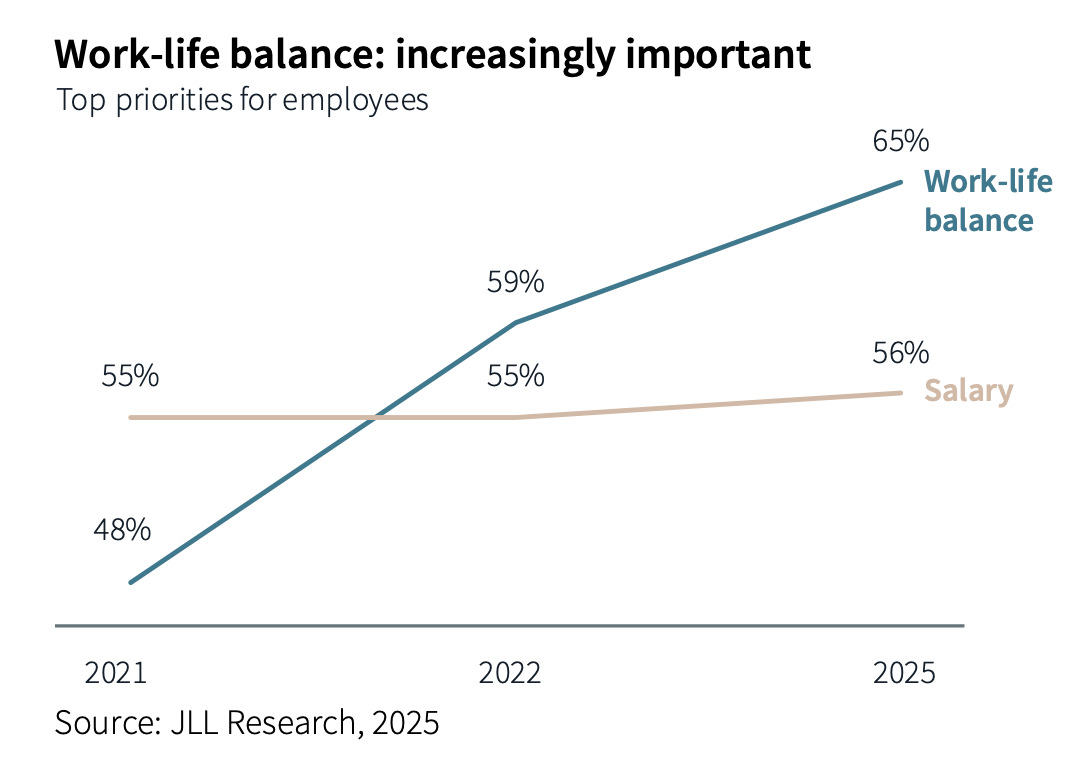
The report suggests that successful organizations will stop relying on blanket mandates and instead “personalize the approach.” For the empowered non-complier, retention hinges on autonomy, and JLL recommends that employers move beyond counting days in the office and focus on “management of time over place,” recognizing that for this valuable cohort, flexibility is the new currency of loyalty.

But as Cappelli told Fortune in October, this won’t be an easy thing, because the problems with remote work are really reflective of wider failures on the part of managers. “Management’s just gotten worse,” he said. Commenting on his finding that remote work has resulted in so many meetings that managers are holding post-meeting meetings to make sure the message got through, he added: “It’s a mess. Those things could be fixed, right? But they’re not being fixed.”

Join us at the Fortune Workplace Innovation Summit May 19–20, 2026, in Atlanta. The next era of workplace innovation is here—and the old playbook is being rewritten. At this exclusive, high-energy event, the world’s most innovative leaders will convene to explore how AI, humanity, and strategy converge to redefine, again, the future of work. Register now.
About the Author
Nick Lichtenberg
By Nick LichtenbergBusiness Editor
LinkedIn icon

Nick Lichtenberg is business editor and was formerly Fortune's executive editor of global news.

See full bioRight Arrow Button Icon

Latest in Future of Work

Finance
Lorem ipsum dolor sit amet, consectetur adipiscing elit, sed do eiusmod tempor incididunt ut labore et dolore magna aliqua. Ut enim ad minim veniam
By Fortune Editors
October 20, 2025
Finance
Lorem ipsum dolor sit amet, consectetur adipiscing elit, sed do eiusmod tempor incididunt ut labore et dolore magna aliqua. Ut enim ad minim veniam
By Fortune Editors
October 20, 2025
Finance
Lorem ipsum dolor sit amet, consectetur adipiscing elit, sed do eiusmod tempor incididunt ut labore et dolore magna aliqua. Ut enim ad minim veniam
By Fortune Editors
October 20, 2025
Finance
Lorem ipsum dolor sit amet, consectetur adipiscing elit, sed do eiusmod tempor incididunt ut labore et dolore magna aliqua. Ut enim ad minim veniam
By Fortune Editors
October 20, 2025
Finance
Lorem ipsum dolor sit amet, consectetur adipiscing elit, sed do eiusmod tempor incididunt ut labore et dolore magna aliqua. Ut enim ad minim veniam
By Fortune Editors
October 20, 2025
Finance
Lorem ipsum dolor sit amet, consectetur adipiscing elit, sed do eiusmod tempor incididunt ut labore et dolore magna aliqua. Ut enim ad minim veniam
By Fortune Editors
October 20, 2025

Most Popular

Finance
Lorem ipsum dolor sit amet, consectetur adipiscing elit, sed do eiusmod tempor incididunt ut labore et dolore magna aliqua. Ut enim ad minim veniam
By Fortune Editors
October 20, 2025
Finance
Lorem ipsum dolor sit amet, consectetur adipiscing elit, sed do eiusmod tempor incididunt ut labore et dolore magna aliqua. Ut enim ad minim veniam
By Fortune Editors
October 20, 2025
Finance
Lorem ipsum dolor sit amet, consectetur adipiscing elit, sed do eiusmod tempor incididunt ut labore et dolore magna aliqua. Ut enim ad minim veniam
By Fortune Editors
October 20, 2025
Finance
Lorem ipsum dolor sit amet, consectetur adipiscing elit, sed do eiusmod tempor incididunt ut labore et dolore magna aliqua. Ut enim ad minim veniam
By Fortune Editors
October 20, 2025
Finance
Lorem ipsum dolor sit amet, consectetur adipiscing elit, sed do eiusmod tempor incididunt ut labore et dolore magna aliqua. Ut enim ad minim veniam
By Fortune Editors
October 20, 2025
Finance
Lorem ipsum dolor sit amet, consectetur adipiscing elit, sed do eiusmod tempor incididunt ut labore et dolore magna aliqua. Ut enim ad minim veniam
By Fortune Editors
October 20, 2025
Rankings
  • 100 Best Companies
  • Fortune 500
  • Global 500
  • Fortune 500 Europe
  • Most Powerful Women
  • Future 50
  • World’s Most Admired Companies
  • See All Rankings
Sections
  • Finance
  • Leadership
  • Success
  • Tech
  • Asia
  • Europe
  • Environment
  • Fortune Crypto
  • Health
  • Retail
  • Lifestyle
  • Politics
  • Newsletters
  • Magazine
  • Features
  • Commentary
  • Mpw
  • CEO Initiative
  • Conferences
  • Personal Finance
  • Education
Customer Support
  • Frequently Asked Questions
  • Customer Service Portal
  • Privacy Policy
  • Terms Of Use
  • Single Issues For Purchase
  • International Print
Commercial Services
  • Advertising
  • Fortune Brand Studio
  • Fortune Analytics
  • Fortune Conferences
  • Business Development
About Us
  • About Us
  • Editorial Calendar
  • Press Center
  • Work At Fortune
  • Diversity And Inclusion
  • Terms And Conditions
  • Site Map

Latest in Future of Work

Future of WorkTech
The typical American plan to study for 22 years and work for 40 ‘is broken,’ VC CEO says. Thanks to AI, employees can’t coast after graduation anymore
By Marco Quiroz-GutierrezJanuary 7, 2026
5 hours ago
middle
Future of WorkJobs
Top economist says latest jobs data shows a ‘jobless expansion’ with no historical precedent—and it’s ‘gut-wrenching’ for the middle class
By Eva RoytburgJanuary 7, 2026
6 hours ago
Woman interviews with hiring manager.
Future of WorkJobs
‘It feels challenging to break through’: Most recruiters say they can’t find talent while 80% of job seekers feel unprepared to find a job
By Jacqueline MunisJanuary 7, 2026
6 hours ago
Lonely young woman in office
SuccessWorkplace Wellness
Lonely staff at a major pharmacy chain are being paid $100 to take time off and text a friend—welcome to Sweden’s ‘friendship hour’
By Emma BurleighJanuary 7, 2026
8 hours ago
SuccessThe Interview Playbook
The curveball questions CEOs are asking job seekers amid Gen Z’s hiring nightmare: ‘Design a car for a deaf person’
By Orianna Rosa RoyleJanuary 7, 2026
14 hours ago
christian klein
CommentarySoftware
The most honest prediction for 2026: nobody knows what’s next
By Christian KleinJanuary 7, 2026
14 hours ago

Most Popular

placeholder alt text
Law
Amazon is cutting checks to millions of customers as part of a $2.5 billion FTC settlement. Here's who qualifies and how to get paid
By Sydney LakeJanuary 6, 2026
1 day ago
placeholder alt text
Economy
Mark Cuban on the $38 trillion national debt and the absurdity of U.S. healthcare: we wouldn't pay for potato chips like this
By Nick LichtenbergJanuary 6, 2026
1 day ago
placeholder alt text
Personal Finance
Janet Yellen warns the $38 trillion national debt is testing a red line economists have feared for decades
By Eva RoytburgJanuary 5, 2026
2 days ago
placeholder alt text
Future of Work
'Employers are increasingly turning to degree and GPA' in hiring: Recruiters retreat from ‘talent is everywhere,’ double down on top colleges
By Jake AngeloJanuary 6, 2026
1 day ago
placeholder alt text
Success
The college-to-office path is dead: CEO of the world’s biggest recruiter says Gen Z grads need to consider trade and hospitality jobs that don't even require degrees
By Orianna Rosa RoyleJanuary 6, 2026
1 day ago
placeholder alt text
Success
Blackstone exec says elite Ivy League degrees aren’t good enough—new analysts need to 'work harder' and be nice 
By Ashley LutzJanuary 5, 2026
2 days ago

© 2025 Fortune Media IP Limited. All Rights Reserved. Use of this site constitutes acceptance of our Terms of Use and Privacy Policy | CA Notice at Collection and Privacy Notice | Do Not Sell/Share My Personal Information
FORTUNE is a trademark of Fortune Media IP Limited, registered in the U.S. and other countries. FORTUNE may receive compensation for some links to products and services on this website. Offers may be subject to change without notice.