President Donald Trump will dole out more than one million checks to American military personnel as the administration seeks to address Americans’ growing cost-of-living concerns.
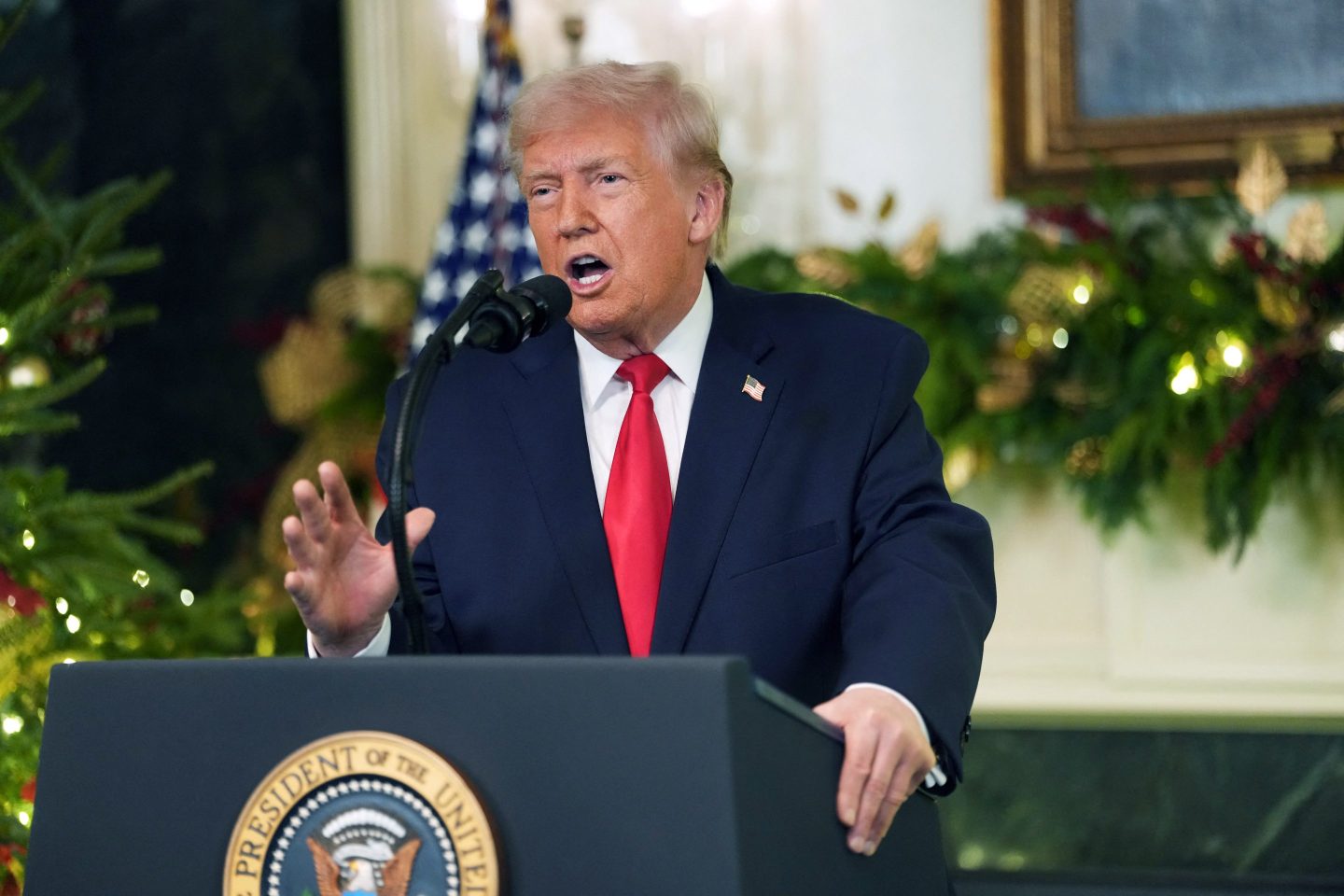
Trump announced in a primetime address on Wednesday a “warrior dividend” for 1.45 million U.S. military personnel to be distributed ahead of the holidays. The announcement of the checks comes as Trump grapples with diminishing approval ratings on the economy and rising concern of an affordability crisis, in part because of the inflationary consequences of his sweeping tariff policy.
As Trump works to assuage economic anxiety—blaming the state of the economy on the Biden administration while simultaneously saying the economy has never been better—Trump alluded to lower mortgage rates and housing reform in addition to his decision to send checks to military members.
“Military service members will receive a special—we call warrior dividend—before Christmas—a warrior dividend,” Trump said. “In honor of our nation’s founding in 1776, we are sending every soldier $1,776. Think of that. And the checks are already on the way.”
The president said the administration has been able to raise a significant amount of money as a result of levies put in place earlier this year.
“We made a lot more money than anybody thought because of tariffs, and the [One Big Beautiful] Bill helped us along,” he said. “Nobody deserves it more than our military.”
A senior administration official told Fortune the one-time “warrior dividend” checks will cost $2.6 billion and act as a housing supplement to eligible service members, including 1.28 million active component military members and 174,000 reserves. Through the One Big Beautiful Bill, Congress appropriated $2.9 million to the Department of Defense for supplements for basic housing allowances.
The White House did not address Fortune’s inquiry about how tariff revenue would finance the checks.
Lagging tariff revenue
The nearly 1.5 million checks are the latest economic relief effort Trump has associated with tariff revenues, including a $12 billion aid package for tariff-roiled farmers and $2,000 rebate checks for Americans. The president also claimed the income could be used to slash the ballooning $38 trillion debt. However, despite the president touting the import taxes as a stream of government income, actual revenue brought in from the levies fall far below White House estimates.
Economists reduced projected tariff revenue after the Trump administration scrapped tariffs on grocery staples like bananas, coffee, and beef last month in an affordability scramble. Pantheon Macroeconomics analysts wrote in a recent report the custom duties are bringing in about $400 billion annually, $100 billion less than the half-a-trillion dollars Treasury Secretary Scott Bessent forecasted in August.
The analysts attributed the more modest revenue in large part to plummeting Chinese imports, which fell 7.5% year-over-year in October, and 7.8% in November, according to supply-chain software company Descartes Systems Group, as U.S. companies sought products from countries like Vietnam, where tariff rates are lower. The weaker imports follow a surge in shipments earlier this year as businesses stockpiled products in an attempt to dodge the brunt of the levies.
Indeed, tariff revenue may have already peaked, with the Treasury Department’s monthly statement released last week showing the government collected $30.75 billion in customs duties in November, down from $31.35 billion collected in October. From April, following the announcement of “Liberation Day” tariffs, until October, revenues have been increasing month-over-month.
Trump’s lofty idea of redistributing tariff revenue to Americans has previously been caveated by his own cabinet. Bessent told Fox News’ Sunday Morning Futures in mid-November “we will see” about tariff-funded rebate checks.
The Treasury secretary said earlier last month in an interview on ABC’s This Week With George Stephanopoulos the $2,000 dividends could instead take the form of tax breaks that have already been signed into law.
“Those are substantial deductions that, you know, are being financed in the tax bill,” Bessent said.