
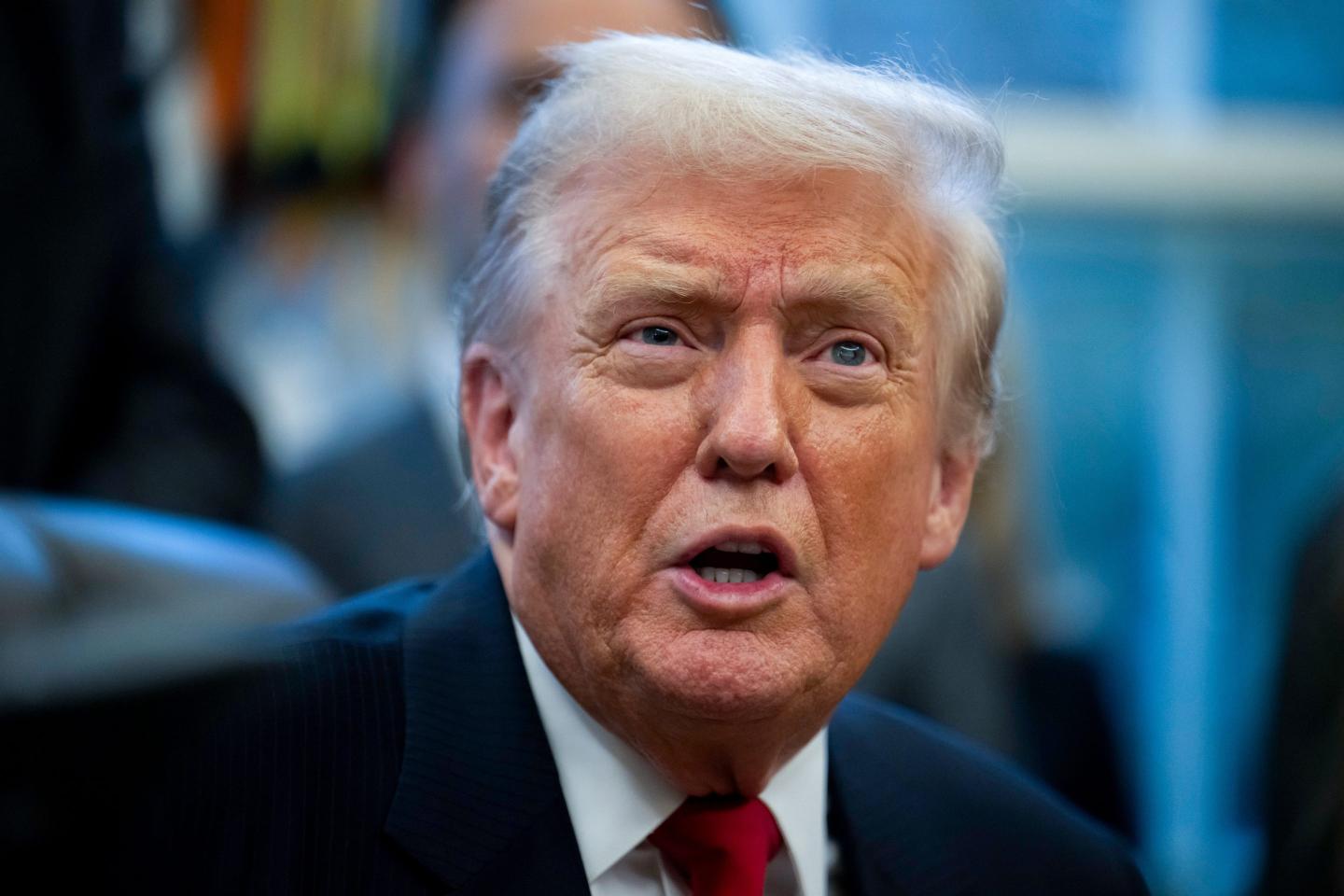
Days before President Donald Trump was sworn in for his second term, he acknowledged the high prices Americans were seeing at the gas pump and grocery store, pledging to bring them down.
“It’s always hard to bring down prices when somebody else has screwed something up like [President Joe Biden] did,” Trump said in a news conference in early January. “We’re going to have prices down. I think you’re going to see some pretty drastic price reductions.”
According to exit polls from the November 2024 election, Americans resonated with Trump’s messaging around prices. Exit polls indicated a higher proportion of voters without college degrees and those making less than $100,000 per year cast their ballot for Trump, cementing a rightward shift for the working class that has been trending in that direction for about a decade.
But those patterns are shifting once more as emerging economic data shows that the K-shaped economy, coined on Twitter during the pandemic as a half-joking response to debates about whether the recovery would be “U” or “V” shaped, is real. One year into Trump 2.0, the notion is becoming reality of diverging fortunes for wealthy and poor Americans. It has tanked confidence in the economy—and the president who promised to solve the affordability crisis in the U.S.
While a wave of working-class voters flooded the Republican party ahead of the 2024 presidential election, that same group sent a loud message in the early November off-year elections, electing Democrats in every single race in which they were running. This included moderates Mikie Sherrill and Abigail Spanberger in New Jersey and Virginia, respectively, and firebrand democratic socialist mayors in New York and Virginia: Zohran Mamdani, and Katie Wilson. Their common theme: affordability.
Economists have made it clear that something real is shifting: The rich are getting richer, and the poor are getting poorer. This week, Apollo chief economist Trosten Slok noted wage growth for the lowest-income Americans plummeted to its lowest in about a decade, while wage growth for the highest-income group surpassed all other income levels, citing data from the Federal Reserve Bank of Atlanta. Moody’s Analytics found last month that for the second quarter of 2025, the top 10% of households made up nearly 50% of all consumer spending. According to calculations by New York University economics professor Edward Nathan Wolff, the top 20% of America’s wealthiest households own nearly 93% of all stock.
Comments from executives in third-quarter earnings made clear that the Fortune 500 see a “bifurcated” economy. Delta seemed almost surprised at how its premium and business travel seats are due to eclipse the main cabin in 2026, a year ahead of schedule. While McDonald’s CEO talked about a “bifurcated consumer base,” with traffic growth strong among higher-income consumers. By and large, fast-food companies boomed in the quarter while higher-priced “slop bowl” chains such as Sweetgreen, Cava and Chipotle have been struggling to arrest a decline in same-store sales as consumers trade down.
The housing market, only in recent memory a booming segment of the economy where many locked in huge equity gains at low mortgage rates, has become nearly frozen because of the “lock-in effect.” It’s simply unaffordable to sell your house and buy another one with mortgage rates above 6%. The first-time homebuyer age hit 40 years old in 2025, according to the National Association of Realtors, revealing that only people with some degree of wealth accumulated over many years of adulthood can afford to make purchases in the housing sector.
“We’ve probably made housing unaffordable for a whole generation of Americans,” The Amherst Group CEO Sean Dobson said at the ResiDay real-estate conference in New York in November, telling Fortune on the sidelines that people have done what they’ve been told by getting an education and good jobs “and then they didn’t get what they were promised.”
Trump’s role in the K-shaped economy
Some of these indicators can be traced back to Trump, who himself rode affordability concerns to a 2024 election victory that once seemed implausible. Pantheon Macroeconomics analysts Samuel Tombs and Oliver Allen said in a September research note that suppressed income growth was a result of Trump’s tariff policies, which had forced businesses to slash wages in order to preserve margins that took a hit from the import taxes. In the wake of the November elections
“Data show wage growth has slowed more in the trade and transportation sector, and to a lower level, than any other major sector since the end of last year. Fears workers would be able to secure larger wage increases in response to the tariffs look highly unlikely to be realized,” the analysts wrote.
Peter Loge, a professor of media and public affairs at George Washington University, who served as senior advisor to the FDA commissioner under President Barack Obama, told Fortune that Trump’s economic priorities can be ascertained by whom he surrounds himself with.
“President Trump has installed very wealthy people with very senior positions in government, which isn’t a bad thing, but it’s limiting,” Loge told Fortune, naming in particular Elon Musk, who served as head of the Department of Government Efficiency in the administration’s first months.
Loge said the installation of these wealthy figures, as well as the courtship of powerful tech CEOs like Larry Ellison and Sam Altman, illustrates priorities to serve these individuals. The president signed a law in July for a roughly $4 trillion package of tax cuts, primarily benefiting companies and wealthy Americans. Those wealthy individuals, in turn, pour their money into the stock market, feeding the top half of the K, Loge noted.
These factors are on top of the administration’s controversial decision to halt funding for SNAP benefits during the government shutdown and require millions of low-income Americans to reapply for the benefits in an effort to combat “fraud,” according to Agriculture Secretary Brooke Rollins.
But to be sure, the K-shaped economy has existed for decades, economists say, and other economic factors have little to do with the president’s policies. The “low-hire, low-fire” labor market of 2025, for example—which has in particular battered lower-income, entry-level workers such as Gen Z—is more a result of businesses becoming more conservative in their hiring and firing practices following a pandemic-era labor shortage and a hiring binge that may have gone too far during the so-called “Great Resignation.”
Changing sentiments
Lower-income Americans are noting these changes, with consumer sentiment similarly diverging in a K-shape, something Peter Atwater, adjunct professor of economics at William & Mary, who popularized the term “K-shaped economy”, believes is being overlooked in the K-shaped conversation. Last month, the bottom third of income levels felt much less confident about the U.S. economy compared to the top third, according to data from the University of Michigan’s Survey of Consumers.
“What we have today is a small group of individuals who feel intense certainty paired with relentless power control—and on the other, it is a sea of despair,” he told Fortune. “And that’s the piece that never gets talked about.”
Atwater’s diagnosis rhymed with a Financial Times column from Robert Armstrong, of Unhedged, who wrote this week that America has always been unequal, but what makes this moment K-shaped is a loss of faith in future earnings among the lower-income cohort. “It could be,” he wrote, “that after five years of going nowhere, households in the bottom half of the wealth and income distributions have started to anticipate a bleaker future and are changing their spending habits accordingly.”
Nose-diving confidence in the U.S. economy is reflected in the attitudes of Republicans and independents who voted for Trump. About 30% of Republicans believe Trump has fallen short of their expectations regarding the economy, according to a national NBC News poll this month. Two-thirds of independents blamed Trump for increasing inflation, per an ABC News/Washington Poll poll conducted in October. CNN polling data meanwhile shows Trump’s approval rating has reached its lowest level since he took office the second time.
“People want to know that they can afford a medical bill if they get sick, their kids will have a better future than they do, or have a chance of a better future,” Loge told Fortune. “And if voters feel like things aren’t working, they fire their politicians in charge to hire new ones.”
“Voters are pretty well saying, ‘We don’t think whatever the Republicans are doing is making stuff less expensive. We need life to be more affordable and less chaotic. It’s pretty unavoidably chaotic. Now we’re going to bring in new people to try a new thing,’” Loge said.
Trump has noted the changing political attitudes following the election, floating a raft of proposals aimed at easing consumers’ pain, such as a 50-year mortgage and $2,000 rebate checks coming from tariff revenue. He said in a Fox News interview earlier this month his party has not done enough to assure Americans about the state of the economy.
“We learned a lot,” Trump said. “Republicans don’t talk about it. They don’t talk about the word affordability.”
UBS Wealth Management’s global chief economist, Paul Donovan, warned that “affordability” may prove to be an enduring, even intractable problem in both economic and political discourse. In his weekly blog, Donovan wrote that the concept is “subtly different” from both “inflation” and from the “cost-of-living crisis.” It’s an anger about the feeling “I can’t afford that,” he added, one that could be tricky to disprove.
“People want things (generally ‘better’ things than they currently have) and are upset that they cannot afford those things,” Donovan wrote. “This may make affordability a more enduring problem than in the past.” He added that social media “fuels resentment” about affordability, as it presents “carefully curated, idealized lifestyles” that are just out of reach to anyone with a smartphone.
Shifting political tides
Loge hesitated to make predictions about what this changing sentiment means for upcoming elections, particularly if Trump’s tariffs are indeed successful, which could result in an outpouring of support for future Republican candidates. However, he suggested legacy or incumbent politicians from both major parties will have challenges getting elected. Atwater believes the desire—and need—for affordability transcends party lines.
“We, particularly those on the left and the right and the establishment, woefully underappreciate how purple the bottom is,” he said. “The unified despair, the sheer desperation on both sides of the aisle, and that will continue to lead to an anti-establishment vote,” he said.
Atwater suggested that so long as Americans perceive a broadening wealth gap, lower- and middle-income consumers will continue to harbor resentment for the ultra-wealthy that could simmer over. He cited a 2011 study from the New England Complex Systems Institute, which linked social unrest in North Africa and the Middle East during the Arab Spring of 2010 to rising food prices.
“This is a crisis of confidence,” Atwater said. “Sadly, those who are in the best position to address it seem at best indifferent, and that does not go unnoticed by those at the bottom.”
Nick Lichtenberg contributed reporting