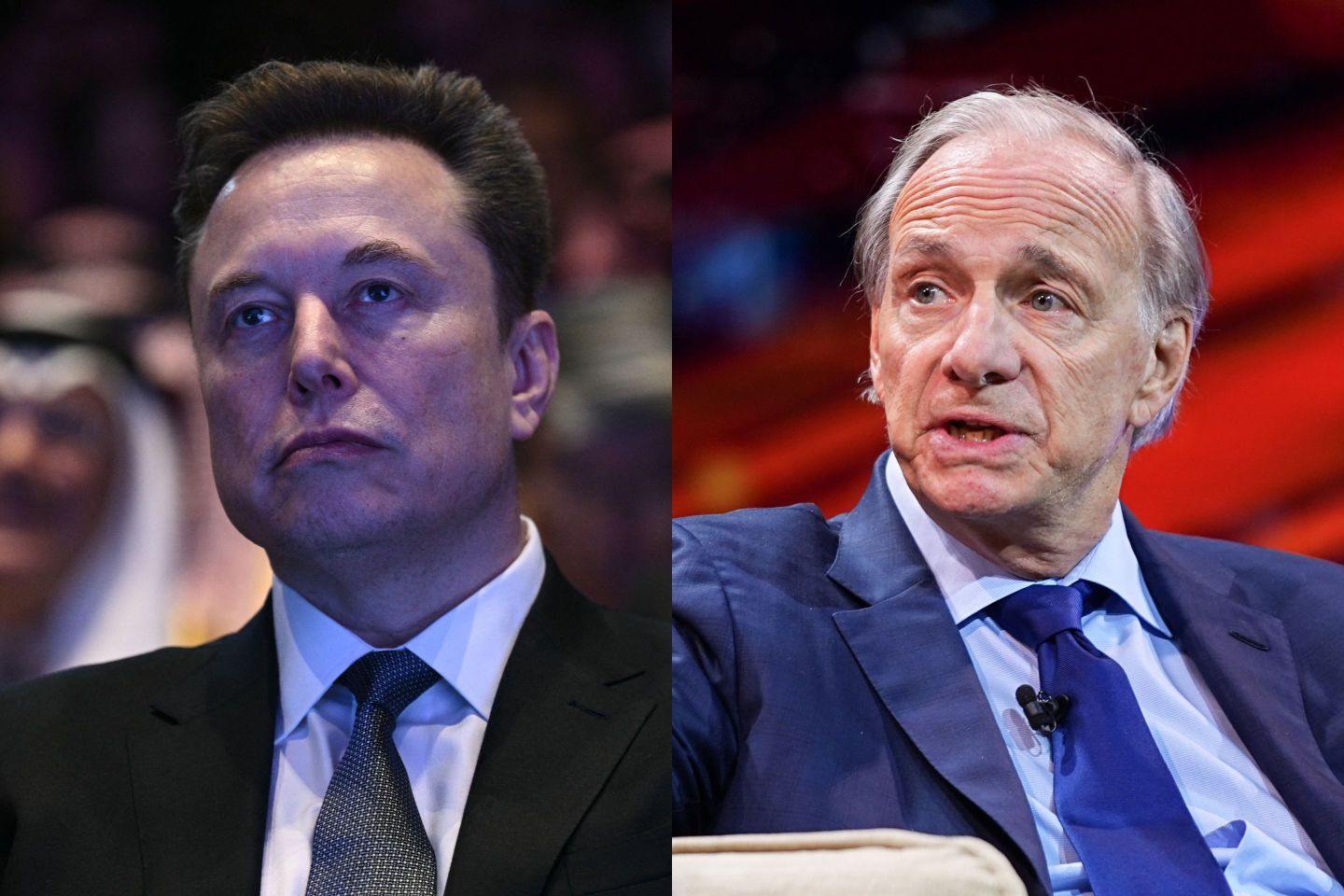
Bridgewater Associates founder Ray Dalio lauded President Trump’s savers accounts for young Americans, announcing he and his wife Barbara will be making a $250 contribution into the accounts of some 300,000 children.
Trump Accounts are a pilot program pitched in the “One Big, Beautiful Bill Act,” which gives children born between January 1, 2025, and December 31, 2028, a savings account in their name funded with a $1,000 government contribution. The initiative is open to households of any income; the children must be U.S. citizens.
The total of Dalio’s contribution is not confirmed, but some simple math puts the likely figure north of $70 million. The funds will initially be targeted at children living in the zip codes of Connecticut where the median income is less than $150,000, the pair said in a statement.
Dalio is following the lead of tech billionaire Michael Dell and his wife, Susan, after the couple pledged $6.25 billion toward Trump Accounts weeks ago. Dalio, 76, said that compounding savings accounts offer young people “early insights into financial literacy and a path towards financial independence.”
While Dalio said investments into human capital, as he described it, “the ability of humans to earn money and handle it well,” were his focus, not everyone agrees on the strategy.
Chief among the critics is Elon Musk, the richest man on the planet and the CEO of Tesla. Responding to a post from Dalio on social media platform X (which Musk owns), the man worth $632 billion argued his pledges were essentially useless.
He wrote: “It is certainly a nice gesture of the Dells, but there will be no poverty in the future and so no need to save money. There will be universal high income.”
One might argue that such optimism from the wealthiest person on the planet is a departure from the reality of millions. Still, Musk has previously outlined why he believes this will be achievable. It is (perhaps unsurprisingly) based on the promise of AI and robotics.
In August, Musk discussed a future in which intelligent robots in humanoid form will outnumber the human population, with each person allotted a personal mechanical assistant as well as any help needed to provide goods and services. Posting on X, he said: “There will be universal high income (not merely basic income). Everyone will have the best medical care, food, home, transport and everything else. Sustainable abundance.”
It is certainly a nice gesture of the Dells, but there will be no poverty in the future and so no need to save money.
— Elon Musk (@elonmusk) December 17, 2025
There will be universal high income.
It stands to reason that if everyone has a high income, then no one does—and this is precisely Musk’s argument. As well as a belief that humans will one day live on Mars, the SpaceX founder said money will one day become “non-existent” as a concept, and that no one will need to work. On an episode of the People by WTF podcast a few weeks ago, the entrepreneur added: “In a future where anyone can have anything, you no longer need money as a database for labor allocation. If AI and robotics are big enough to satisfy all human needs, then money is no longer necessary. Its relevance declines dramatically.”
Plan B
On the off-chance that Musk’s theory on the collapse of money doesn’t pay off, billionaires like Dalio are keen to step up.
While the accounts carry the name of the current president, the concept of early-savings support for young Americans is a notion that has garnered bipartisan support for many years. This is something Dalio was keen to highlight, saying if the American people can invest in human capital in “a bipartisan way, we will have a strong country.”
Dalio, worth some $15.4 billion per Forbes, holds the belief that the answer to many of America’s issues lies in political partnership—and its downfall in division. On finding a more sustainable path for the nation’s $38 trillion national debt burden, for example, he said earlier this month: “You need a strong [political] middle because both sides will fight each other and probably get to the point where there are irreconcilable differences, and they can’t resolve that—and difficult things will happen.”
However, if a strong consensus can be created, this will allow for “difficult” decisions to be made to “achieve a better situation.”
Likewise, the hedge fund titan warned that if consensus cannot be reached, then the U.S. is headed for civil war due to irreconcilable differences. Speaking to Bloomberg, he shared hopes society would “rise above it and realize that our common good is going to necessitate us dealing with it so that what works for most people is going to work,” he noted. Unfortunately, this belief may prove “a little bit idealistic.”
In backing the Trump Accounts, perhaps Dalio has seen some evidence of the cross-party cooperation he believes is so vital.