
Quantum computing is generating about $1 billion in revenues today and has a potential “total addressable market” of up to $198 billion by 2040, according to analyst Kevin Garrigan and his colleagues at Jefferies.
Garrigan and his team began coverage of the quantum industry by rating three companies: D-Wave Quantum (buy), IonQ (buy), and Rigetti Computing (hold). Coincidentally, Wedbush also today initiated coverage of those companies along with a fourth, Quantum Computing Inc. It rated all of them as “outperform” except for QCI, which it graded as neutral.
All three companies covered by Jefferies emerged from U.S. academic research labs more than 10 years ago, but financially they still look like well-funded startups. D-Wave and IonQ are both growing but unprofitable. The former reported Q3 revenue was up 100% to $3.7 million but with a net loss of $140 million; the latter disclosed Q3 revenue of $39.9 million, up 222% on a net loss of $1.1 billion. Rigetti reported a decline in Q3 revenue of 18% to $1.9 million and a loss of $201 million, but also disclosed new incoming contract agreements worth $11.5 million. QCI is profitable, and it reported growing Q3 revenues, but the size of its business is currently tiny: It booked only $384,000 in sales for the period.
In “classical” computing, computer chips and software solve problems using “bits” that represent information as 1 or 0, like a light switch that can only be on or off. Quantum computers, by contrast, use the principles of quantum uncertainty in subatomic physics to represent information as “qubits” that can be 1, 0, or both at the same time. This ability to present information in “superposition” (roughly, in simultaneous parallel) makes quantum computers potentially very powerful.
“A classical computer is like reading every book in the library one by one to find an answer. A quantum computer is like being able to read all the books at once,” the team at Jefferies wrote in a note to clients seen by Fortune. A fully functioning quantum computer can, in theory, tackle complex problems in five minutes that classical computers would need 10 septillion years of processing to solve.
The downside is that the physics and engineering needed to make quantum computers work have only just moved out of the theoretical realm and into reality.
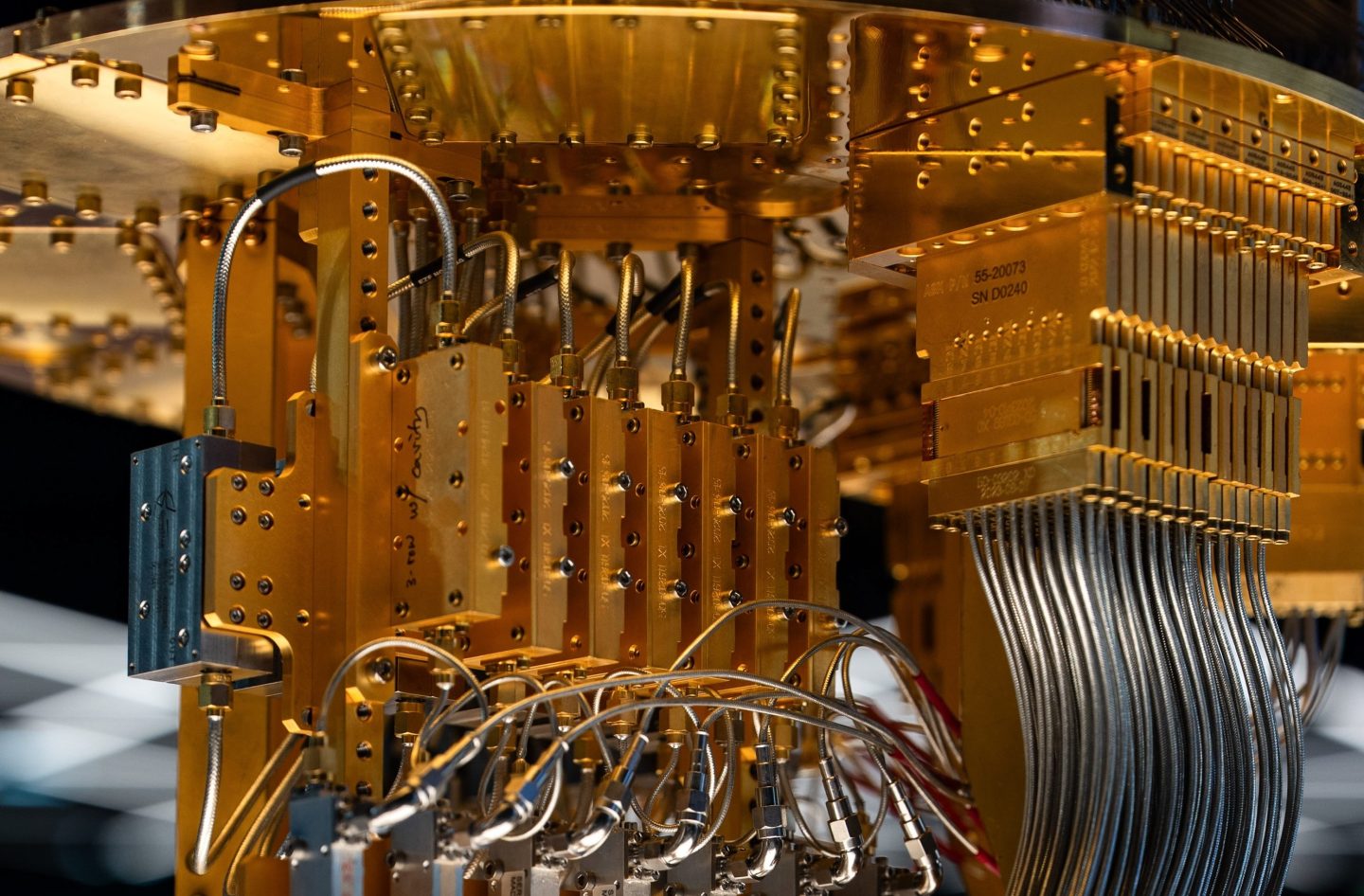
Nonetheless, “as quantum moves from lab to applied pilots, a specialized industry is emerging for components, such as cryogenics (dilution refrigerators), lasers/optics, and control electronics, that increasingly supplies multiple hardware stacks,” the Jefferies analysts said. That industry is being funded by governments and large tech companies like Google and IBM.
Wedbush analysts Antoine Legault and Matt Bryson have almost the exact same theory: “We expect that by the end of the decade quantum computing companies will represent a larger share of the total spend on compute from what is a very small base today. Specifically, we project quantum computing spend on the four covered companies could reach just under 2% of total compute expenditures by 2030, from virtually nothing today, as the technology moves from research to commercial applications,” they said in a note to clients.
Jefferies gathered three wildly differing estimates of the potential size of the quantum market:
- McKinsey projected revenues to grow from $4 billion in 2024 to a potential $198 billion by 2040.
- Boston Consulting Group estimated the “direct hardware/software/services market” at up to $170 billion by 2040.
- Yole Group said the market would grow from $954 million in 2024 to $17.4 billion by 2035.
The wide range of the estimates reflects the promise and doubt that surround the industry. If they succeed these companies could generate fantastic advances in finance or molecular biology that are currently beyond the power of normal computer chips. But as the heavy losses on the balance sheets of D-Wave, IonQ, and Rigetti indicate, that promise remains largely undelivered commercially.