
Good morning. CFOs are ending 2025 more confident, even as they confront a mixed growth outlook and mounting pressure to deliver efficiency gains from AI.
Deloitte’s Q4 2025 CFO Signals report, released this morning, finds the CFO Confidence Score at 6.6, higher than the Q3 reading of 5.7, and the highest score since late 2021. The score, the highest 10, measures CFO confidence in economic conditions and sentiment about the capital markets.
CFOs raised their assessment of the North American economy this quarter, with 36% rating the current environment as very good or good, and 56% saying they expect it to be much better or better in 12 months. Meanwhile, 86% of finance chiefs surveyed are more optimistic about their company’s prospects than they were just three months ago.
Nearly six in 10 now say it is a good time to take more risk, reversing the more cautious sentiment seen over the prior two quarters. The findings are based on a Q4 survey of 200 CFOs at companies across the U.S., Canada, and Mexico, each with at least $1 billion in annual revenue.
However, at the same time, CFOs modestly dialed back expectations for six metrics—revenues, earnings, dividends, capital allocation, domestic hiring, and domestic wages and salaries—suggesting they are preparing to move ahead in a world where demand may be softer than hoped. This underscores the “mixed bag” reality finance leaders are navigating.
On one side, risk-taking confidence, capital markets sentiment, and views on the attractiveness of the external environment have all improved, buoyed by a somewhat clearer picture of interest rates and trade policy, Steve Gallucci, global and U.S. leader of Deloitte’s CFO Program, told me. A recent rate cut and more visibility into the path of rates over the next six months have reduced some of the uncertainty that weighed on CFOs a year ago, Gallucci said. On the other hand, concerns about the consumer are building, with multiple indicators pointing to waning consumer confidence and persistent inflation—factors that are already prompting CFOs to temper revenue and earnings forecasts relative to last quarter, he explained.
From ‘talent crunch’ to productivity and AI execution
The economy (56%) and inflation (53%) top the CFO respondents’ list of the most worrying external risks this quarter. For internal concerns, 53% pointed to cost management, with efficiency and productivity a close second at 52%—ranking higher than talent as an internal risk (47%), a notable shift from Q3.
That change could reflect the conversation in boardrooms moving from “Can we hire and retain the skills we need?” to “Are we getting enough out of the technology and people we already have?” For CFOs, that discussion is increasingly inseparable from AI.
Gallucci links this internal risk shift to AI-enabled transformation, noting the overall discussion that CFOs are having with their boards, the broader C-suite, and other stakeholders. “There isn’t a CFO out there who hasn’t had to sit down with their board, answer questions, or present an AI strategy for the enterprise—and certainly what the impact would be on finance,” he said.
Deloitte’s recent trends research shows that at least two-thirds of CFOs have already deployed AI in some form. Yet many finance teams still have room to increase the impact of these investments: Only 21% of active users say AI has delivered clear, measurable value, and just 14% have fully integrated AI agents into the finance function. Finance leaders now need to demonstrate that AI and broader technology investments can translate into tangible performance gains over the next several years.
Looking back on 2025, I asked Gallucci how he’d grade CFOs broadly overall. He gives finance chiefs “very high marks” for navigating another year of overlapping shocks. Finance leaders have had to juggle geopolitics, talent and skills issues, shifting economic policy, and rapid technological change—on top of years of pandemic-era disruption. After five to seven years of near-constant volatility, this level of complexity has become the “new normal” for the role.
Does Gallucci have any predictions for 2026? “I try not to be in the prediction business,” he told me. “But I think, if anything, there’s going to continue to be a fair amount of uncertainty on all fronts, and it’ll be interesting to see how CFOs continue to navigate that.”
Sheryl Estrada
sheryl.estrada@fortune.com
Leaderboard
Fortune 500 Power Moves
Matthew Calderone, EVP and CFO of Booz Allen Hamilton Holding Corporation (No. 398), will resign from the company effective Feb. 1, 2026, according to an SEC filing. Calderone, a longtime executive at Booz Allen, became CFO in October 2022. He previously served in several leadership roles, including chief strategy officer. The company has initiated a search for a new CFO. Upon Calderone’s departure, Kristine Martin Anderson, EVP and chief operating officer, will assume his duties and responsibilities on an interim basis.
Calderone is the newly appointed CFO of the Mobility business of S&P Global (No. 305), effective March 1, 2026. He will serve as the CFO of the standalone public company through its planned separation from S&P Global. Calderone will report to Bill Eager, president of S&P Global Mobility and CEO-designate of the future standalone company.
Every Friday morning, the weekly Fortune 500 Power Moves column tracks Fortune 500 company C-suite shifts—see the most recent edition.
More notable moves:
Amy Butte, CFO of Navan, Inc. (NASDAQ: NAVN), a corporate travel management platform, will step down from the role on Jan. 9, 2026. Navan made the announcement on Dec. 15 in its third-quarter earnings release—its first since its initial public offering. Butte will continue to serve as a strategic advisor to Navan while the board conducts its search for the company’s next CFO. Anne Giviskos, the current SVP of strategic finance and chief accounting officer, has been appointed interim CFO. “I am pleased to have achieved my goals at Navan, including helping to complete Navan’s IPO, and wish the company and its leadership team continued success,” Butte said in a statement.
Lance Ludman is the new CFO of SurveyMonkey, a platform for surveys and forms. Ludman is a seasoned finance executive. He most recently served as CFO at Benevity, a provider of corporate purpose software. Before that, he was CFO for DreamBox Learning. Ludman also held leadership roles at Blackbaud (NASDAQ: BLKB) and Lockheed Martin (NYSE: LMT). "I am drawn to the market opportunity and the company’s recent successes executing against a compelling value creation plan," Ludman said in a statement about his move to SurveyMonkey.
Big Deal
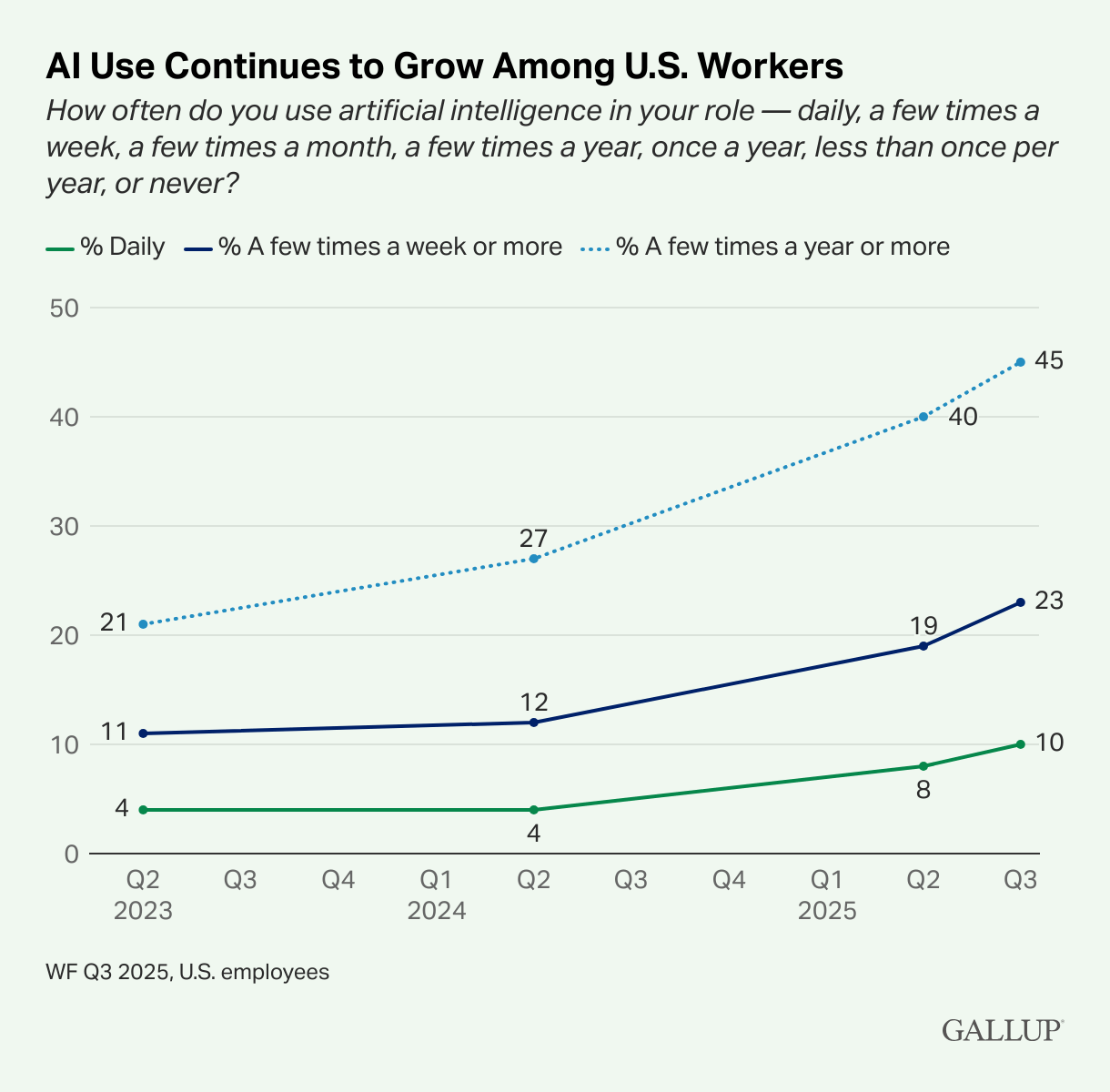
According to a new Gallup report, the share of U.S. employees who use AI at work at least a few times a year rose from 40% to 45% between the second and third quarters of 2025. Frequent use (a few times a week or more) climbed from 19% to 23%, while daily use inched up from 8% to 10% over the same period. The findings come from a nationally representative survey of 23,068 U.S. adults employed full- or part-time.
Going deeper
"Inside OpenAI’s fragile lead in the AI race, and the 8-week ‘code red’ to fend off a resurgent Google" is a new Fortune article by Jeremy Kahn, Alexei Oreskovic and Lee Clifford.
From the article: "At this time last December, OpenAI was dazzling the world with its ‘12 days of Shipmas,’ a cleverly marketed daily drumbeat of new product releases that included its paradigm-setting 01 reasoning model. OpenAI had just raised $6.6 billion in fresh funding, and its ChatGPT user base was growing so fast that the company complained it was struggling to find enough computing power to keep up with demand.
"Fast-forward just one year to this December, when employees got a decidedly different holiday present: a five-alarm ‘code red’ laid out in a memo from CEO Sam Altman, bracing the team for ‘rough vibes’ and economic headwinds in the wake of increased competition, and trying to light a fire under them to refocus over the coming weeks." Read more here.
Overheard
"Looking ahead, the factories that lead will not be those with the flashiest dashboards or the biggest models. They will be the ones that embed intelligence where it counts, in the workflow, in the decisions, and in the relationships between people and machines."
—Norbert Jung, CEO of Bosch Connected Industry, writes in a Fortune opinion piece. Jung leads the development of advanced software solutions for discrete manufacturing and Bosch plants.