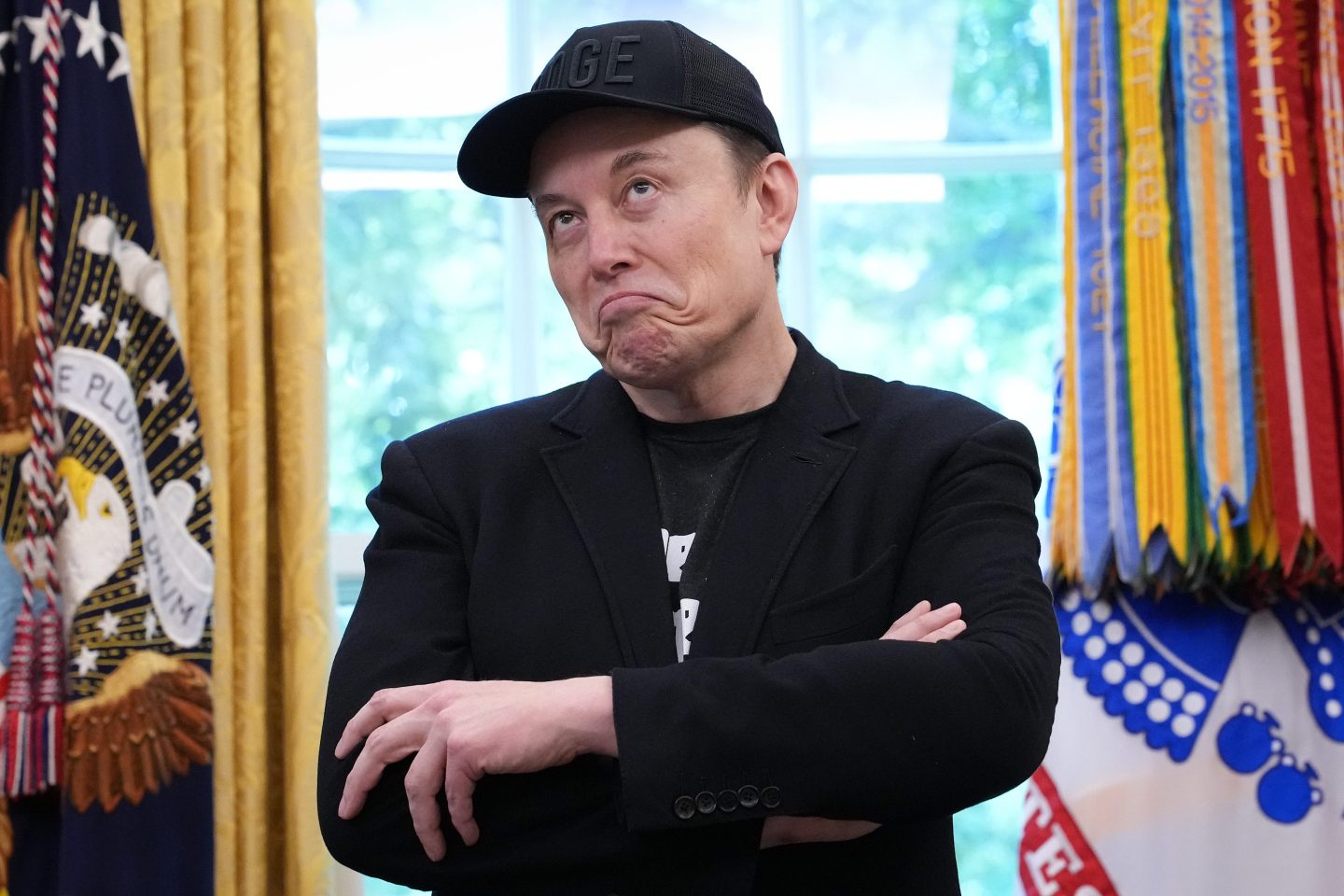
So you’ve worked your way up the ladder to a comfortable six-figure salary. Or perhaps you’ve squirreled away hundreds of thousands in cash in the bank—or invested in stocks and retirement accounts. According to Elon Musk, none of that may matter for very long.
The world’s richest person believes money itself is on borrowed time. In a future workforce dominated by artificial intelligence and robotics, Musk says salaries will become nonexistent, and therefore, cash will fade into irrelevance.
“I think money disappears as a concept, honestly,” the SpaceX and Tesla founder said on an episode of the People by WTF podcast.
“It’s kind of strange, but in a future where anyone can have anything, you no longer need money as a database for labor allocation. If AI and robotics are big enough to satisfy all human needs, then money is no longer necessary. Its relevance declines dramatically.”
Work—and money—could be ‘optional’ in less than 20 years
Essentially, if robots can build houses, grow food, manufacture goods, and even provide services like health care and education at a near-zero cost then wages stop being the mechanism that determines who gets what.
Musk pointed to The Culture series by Iain M. Banks as his best “imagining” of this world. The science fiction novels depict a utopian future where citizens can have virtually anything they want thanks to AI—making money obsolete and leaving citizens free to spend their time doing whatever they love.
It’s a future Musk has returned to repeatedly. Even two years ago, when ChatGPT was relatively new, he was telling former U.K. Prime Minister Rishi Sunak that “AI will be able to do everything” and that work will effectively become “like a hobby.”
But Musk’s vision leaves unanswered questions that go beyond science fiction. If money disappears, what decides who gets access to scarce resources—for example, the larger home in the better location?
The billionaire also didn’t put a time frame on exactly when society will no longer need cash to buy food, real estate, and other basic necessities. But his bold claims about when work will end suggest that such a shift could arrive in the coming decade.
“In less than 20 years—but maybe even as little as 10 or 15 years—the advancements in AI and robotics will bring us to the point where working is optional,” Musk said.
The key to unlocking Musk’s utopian vision sits in the hands of the government
Technologies such as ChatGPT and Google Gemini have already alleviated the burden of some time-consuming work, such as data cleaning, summarization, and other administrative tasks. By 2029, one survey last year found that AI will save workers up to 12 hours per week. Still, workers have heard such promises before.
In 1930, John Maynard Keynes predicted that technological progress would allow people to work just 15 hours a week by 2030. Productivity did soar. Leisure time did not. Instead, workers were often expected to do more, not less, with the time saved.
What makes this moment different is the rate of change that’s happening right now. AI isn’t a distant theory or a piece of science fiction—it’s here, and it’s moving at a pace that worries even Bill Gates and the man behind ChatGPT, Sam Altman.
Anthropic’s chief of staff, Avital Balwit, has previously warned that she expects most jobs—including her own—to become obsolete within just a few years.
In fact, Balwit predicts that a million two-legged robots could have already taken over jobs in less than 10 years.
But with the “right policies” in place, she said workers could enjoy life like the upper echelons of society: materially secure, largely unemployed, and free to fill their days with pursuits beyond paid labor. Hobbies, relationships, and leisure would replace commutes and meetings.
“If we do manage to obtain a world where people have their material needs met but also have no need to work, aristocrats could be a relevant comparison,” Balwit concluded.
In a lengthy blog post, Vinod Khosla, the billionaire cofounder of Sun Microsystems and an early investor in companies like Amazon, Google, and OpenAI, echoed that the key to unlocking Musk’s utopian future sits in the hands of governments.
He wrote that AI will outperform humans at most jobs, faster and cheaper, reducing the need for human labor altogether. But without intervention, Khosla warned, the result could be “economic dystopia,” with wealth concentrating at the top while both intellectual and physical labor are devalued.
“As AI reduces labor costs and increases productivity, the role of government regulation will be crucial in managing the distribution of wealth and maintaining social welfare,” he added.
Khosla’s proposed solution is a universal basic income to ensure people can live well even as jobs disappear. Done right, he argued, it could free people from the daily grind of work and redefine what it means to live a meaningful life.